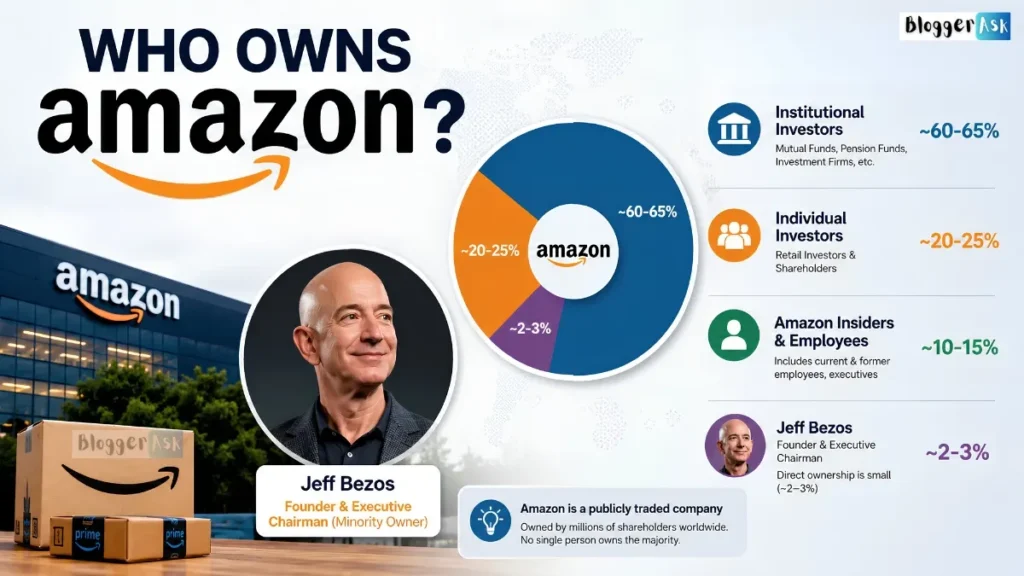
⚡ Quick Answer: Who Owns Amazon?
No single person does. Amazon is a publicly traded company, owned by millions of shareholders. The largest individual owner is founder Jeff Bezos, who holds roughly 8–9%. The largest collective owners are index-fund giants — Vanguard, BlackRock, and State Street — which together hold most of the company for everyday investors.
Here’s the twist most people miss. The man most associated with Amazon, Jeff Bezos, owns less than 9% of it. The man who runs it, CEO Andy Jassy, owns almost none of it. And the biggest block of all sits quietly inside retirement accounts and index funds — maybe even yours.
As of late July 2026, Amazon’s market value is about $2.5 trillion, and it climbed roughly 8% after a strong July 30 earnings report. The company trades on the Nasdaq as AMZN, with about 10.76 billion shares outstanding.
Amazon Ownership Snapshot (2026)
| Shareholder | Approx. Shares | Approx. % | Type | Data As Of |
|---|---|---|---|---|
| Jeff Bezos | ~950M (proxy) / ~880M (est.) | ~8.8% / ~8.2% | Individual — Founder, Executive Chairman | Feb 2026 proxy / mid-2026 est. |
| BlackRock | ~735M | ~6.8% | Institutional | Feb 2026 proxy |
| Vanguard Group | ~630M | ~5.9%* | Institutional | Feb 2026 proxy |
| State Street | ~390M | ~3.6% | Institutional | Feb 2026 proxy |
| MacKenzie Scott | ~81.1M | ~0.75% | Individual — Bezos’s ex-wife | Sept 2025 filing |
| Andy Jassy (CEO) | ~2.3M | <0.1% | Individual — Executive | Feb 2026 proxy |
*Some trackers list Vanguard as high as ~6.8%, because its stake is spread across many separate funds. More on why sources disagree below.
In short: Amazon has three different “owners” depending on what you mean — the biggest single stake (Bezos), the biggest collective stake (index funds), and the person in operational control (Jassy). Let’s separate them cleanly.
Founder vs. CEO vs. Owner: Why People Get This Confused
Owning Amazon, running Amazon, and profiting from Amazon are three different things — and at Amazon, they belong to three different parties. Nobody “owns” it the way you’d own a corner shop. It’s a public company with millions of shareholders, and running it is a separate job from holding its stock.
Jeff Bezos — Founder and Executive Chairman
Jeff Bezos founded Amazon in 1994 and took it public in 1997. Today he’s Executive Chairman of the board — a governance role, not a management one. He’s still the largest single shareholder. But “largest shareholder” and “the person who runs the company” are no longer the same person.
Andy Jassy — the CEO Who Actually Runs It
Andy Jassy has been Amazon’s CEO since July 2021, when Bezos stepped back. He built and led Amazon Web Services (AWS) for nearly two decades first. His personal stake is about 2.3 million shares — worth roughly $600 million in mid-2026. Compare that to Bezos’s stake, worth over $200 billion.
That gap is the clearest lesson in this whole topic: the person controlling Amazon’s operations is not the person who owns the most of it.
Jeff Bezos’s Stake: How Much, and Why It Keeps Shrinking
How much of Amazon does Jeff Bezos own? About 8.8% per Amazon’s February 2026 proxy statement (roughly 950 million shares). A more recent mid-2026 third-party estimate puts it slightly lower, near 8.2%, after further share sales. Both are correct — they just measure different dates.
Expect this number to keep drifting down. It has fallen every year since Amazon’s IPO.
How Bezos’s Ownership Fell From ~43% to ~8%
At Amazon’s IPO on May 15, 1997, Bezos owned more than 43% of the company. Here’s the long slide since:
| Date | Bezos’s Stake | Basis |
|---|---|---|
| May 1997 (IPO) | ~43% | SEC filings |
| 2021 (CEO handoff to Jassy) | 14.1% | SEC filings |
| Late 2024 | ~10.1% | SEC Form 4 |
| Early 2025 | fell below 10% for the first time (~9.6%) | Amazon proxy |
| Late 2025 | ~9% | SEC Form 4 |
| Feb 2026 | 8.80% | Amazon 2026 proxy |
| Mid-2026 | ~8.2% | Market-data estimate |
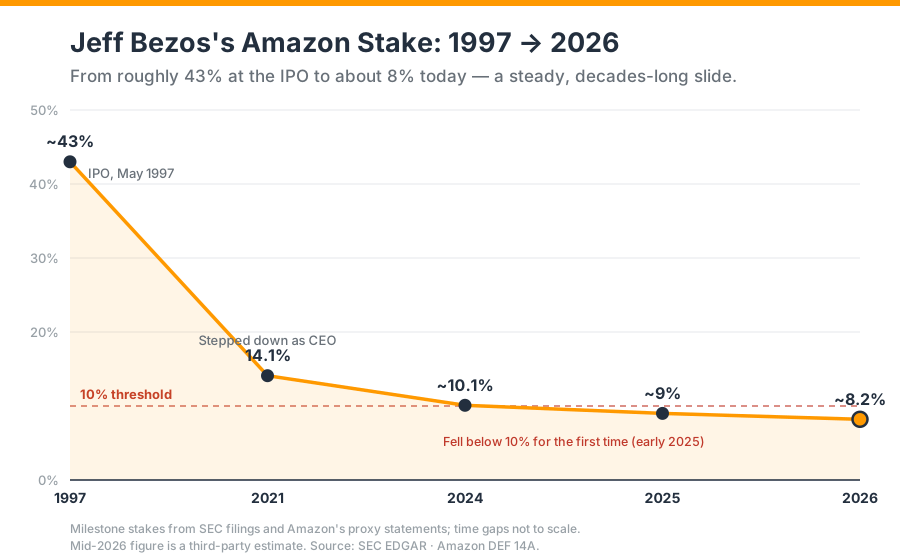
That’s a drop from roughly 43% to roughly 8% in about three decades. Bezos now holds proportionally about one-fifth the stake he did at IPO — even after a 20-for-1 stock split in June 2022, which multiplied his share count without changing his percentage.
Why Does Bezos Keep Selling Amazon Shares?
The sales fund his other ambitions. Some proceeds go to Blue Origin, his space company. Others go to philanthropy and plain diversification. Across 2024 and 2025, he sold roughly 95 million shares for about $18 billion.
Most of these sales run on prearranged trading plans (SEC Rule 10b5-1). These let insiders schedule sales months in advance — precisely so nobody can claim they traded on inside information. In plain terms: this looks like routine, planned diversification, not a loss of faith in the company.
MacKenzie Scott’s Stake: Wealth Without the Votes
MacKenzie Scott, Bezos’s ex-wife, is a real and often-overlooked part of Amazon’s ownership. She received a 4% stake in Amazon in their 2019 divorce — worth about $36 billion at the time.
Her position has shrunk a lot since, through both share sales and enormous charitable giving. A regulatory filing dated September 30, 2025 showed her holding 81.1 million shares — down about 42% from a year earlier.
Here’s the detail that makes her case fascinating. Under the divorce terms, Bezos still controls the votes on her shares. She received the economic value; he kept the voting power. It’s one of the cleanest real-world examples of ownership and control being legally split apart — she got the wealth, not the say.
And despite giving away more than $26 billion since 2019, Scott is still worth over $40 billion. Why? Amazon’s stock more than doubled after her divorce, growing what she kept even as she gave money away. At today’s prices, her remaining shares are worth roughly $18–19 billion (a rough estimate from share count and current price, not a directly reported figure).
Other Insiders and Executives
Beyond Bezos, Amazon’s executives and directors hold very little of the company. Together — excluding Bezos — the roughly 16 other officers and directors own about 3.4 million shares, worth around $920 million in mid-2026. Andy Jassy holds the largest slice of that group.
No executive or director besides Bezos holds even 1% of Amazon. Ownership at the top is remarkably thin.
Institutional Shareholders: Vanguard, BlackRock, and State Street
Institutional investors own the biggest collective share of Amazon — roughly 60–65%. These are mutual funds, pension funds, and asset managers like Vanguard, BlackRock, and State Street.
But this isn’t a big bet on Amazon specifically. Amazon is one of the largest companies on Earth, so it sits inside nearly every S&P 500 index fund and total-market ETF by default. If you own a typical index fund or a 401(k), you already own a tiny piece of Amazon — without ever choosing it.
That’s the quiet truth of modern ownership: the “biggest owner” of Amazon isn’t a person or a rival. It’s passive investing itself, holding shares for millions of ordinary savers.
Why Sources Disagree on the Exact Numbers
You’ll see different ownership percentages depending on where you look — and that’s normal, not an error. Here’s why, so you can judge any figure you find:
- Different cutoff dates. A proxy statement freezes numbers on one record date; a market tracker updates weekly. Bezos can be “8.8%” and “8.2%” in the same year.
- Different definitions. Providers split “insider,” “institutional,” and “retail” differently.
- Split fund families. Vanguard’s stake is spread across dozens of funds, so one source may show ~5.9% and another ~6.8%, depending on how it groups them.
Best practice: treat any single percentage as a close estimate unless it’s dated and tied to a specific filing. The gold standard is Amazon’s own SEC proxy statement.
Why No One Can Simply Take Over Amazon: The Single-Share-Class Factor
Here’s a structural fact almost every competing article skips: Amazon has only one class of stock, and every share carries exactly one vote. There are no special “founder shares” with extra votes.
This matters enormously. It’s the reason Bezos’s control genuinely fades as his stake shrinks. At many founder-led companies, that isn’t true — founders keep control long after selling most of their shares, using dual-class stock. Amazon works differently.
Amazon vs. Founder-Controlled Companies
| Company | Share Structure | Founder/Family Control |
|---|---|---|
| Amazon | One class — one share, one vote | None locked in; Bezos’s power tracks his ~8% stake |
| Meta | Dual class — Class B has 10× votes | Mark Zuckerberg keeps majority voting control |
| Alphabet (Google) | Dual class — Class B has 10× votes | Page & Brin hold ~52.7% of votes with ~3% each in economic terms |
| Ford | Dual class — Class B held by the Ford family | The family controls ~40% of votes with a small economic stake |
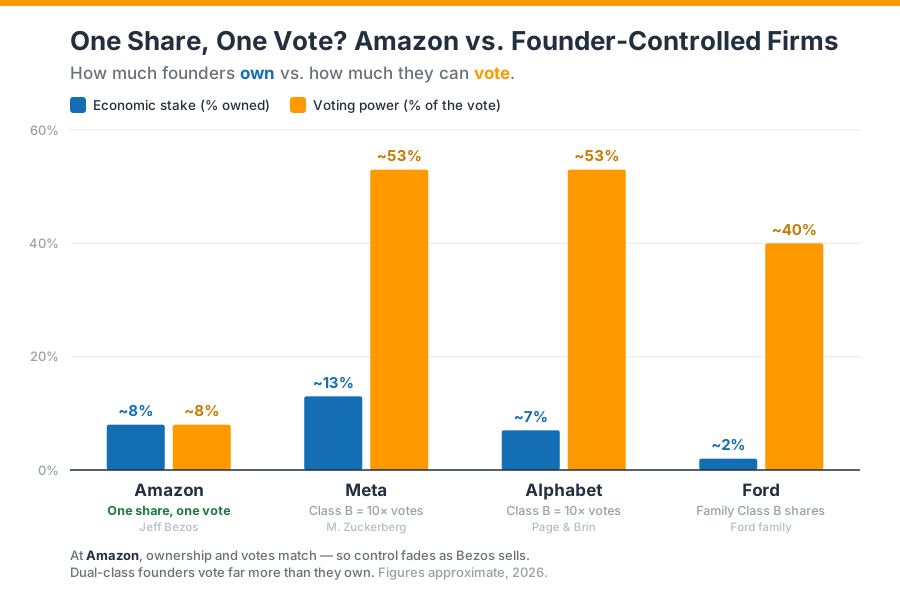
This is why “who owns Amazon” and “who controls Amazon” have the same answer — a broad, diffuse crowd of shareholders. At Meta, Google, or Ford, those two questions have very different answers. Bezos, by contrast, has no super-voting lifeline. If he keeps selling, his influence keeps fading.
Ownership vs. Control: Who Actually Runs Amazon?
It helps to split “ownership” into three separate layers, because Amazon keeps them clearly apart:
- Economic ownership — who profits when the stock rises. That’s Bezos, the index funds, and everyone down to a one-share investor.
- Voting power — who gets a say in board elections. Since every Amazon share has one vote, voting weight simply follows share count — which is why big institutions carry real governance weight, even when they stay quiet.
- Operational control — who makes the daily calls. That’s Andy Jassy and Amazon’s management, no matter how few shares they personally hold.
Does Bezos Still Control Amazon With Only ~8%?
Not on paper — but more than the number suggests. He doesn’t have majority control. Yet an 8–9% stake, combined with his role as Executive Chairman, still gives him outsized influence.
The reason is the rest of the shareholder base. Passive funds like Vanguard and BlackRock rarely intervene in day-to-day governance. They vote on board matters but don’t run companies. That passivity is a big part of why Bezos’s shrinking stake hasn’t meant a matching loss of influence — for now.
What Does Amazon Own? Subsidiaries and Major Investments
Separate from who owns Amazon’s stock is what Amazon itself owns — and it’s far more than a store. Amazon fully owns AWS (its cloud business and biggest profit engine), Whole Foods, MGM Studios, Twitch, Ring, Zoox (self-driving), Kuiper (satellite internet), and Amazon Pharmacy, among others.
Here’s how the three most-searched acquisitions happened:
| Company | Acquired | Price | Previously Owned By |
|---|---|---|---|
| Whole Foods Market | 2017 | $13.7 billion | Independent public company |
| MGM Studios | 2022 | $8.5 billion | Investment group led by Anchorage Capital |
| Twitch | 2014 | ~$970 million | Independent startup (spun out of Justin.tv) |
When people ask “who owned Whole Foods before Amazon” or “who owned MGM before Amazon,” they’re really asking acquisition history. All three now run as wholly owned subsidiaries — they have no separate shareholders anymore.
One big 2026 investment worth knowing: Amazon also holds a roughly 21% stake in Anthropic, the AI company behind Claude. It’s a minority investment, not a subsidiary, but it’s large — Amazon valued the stake at about $74 billion in early 2026, and far higher by mid-year as Anthropic’s valuation soared. This sits alongside Amazon’s massive AI push: the company committed about $200 billion in capital spending for 2026 and raised $25 billion in bonds in July to fund AI data centers.
What Jeff Bezos Owns Personally (That Amazon Doesn’t)
Don’t confuse what Bezos owns with what Amazon owns. Bezos personally owns Blue Origin (his rocket company) and The Washington Post, which he bought in 2013 for $250 million. Neither is part of Amazon. They’re his private holdings, funded largely by selling Amazon stock — which is exactly why his stake keeps shrinking.
Common Misconceptions About Amazon’s Ownership
Is Amazon Owned by a Foreign Country or Government?
No. Amazon is an American company — headquartered in Seattle, incorporated in Delaware, and listed on the Nasdaq. Government entities hold only a negligible fraction of shares, roughly 0.1%, through routine index investing. That’s the same way a public pension fund holds a sliver of almost any big company. It isn’t government ownership or control in any real sense.
Is Amazon Owned by Its Employees or Customers?
No, not in any special structural way. Employees can own Amazon stock like anyone else — through stock-based pay or their own brokerage — but that doesn’t create a separate “employee-owned” category. The same goes for customers. There’s no cooperative or customer-ownership model here, unlike a credit union.
How to Check Amazon’s Ownership Yourself
Want to verify any of this instead of trusting an article? You can — it’s all free and public through the SEC. Here’s the exact process:
- Go to SEC EDGAR (the SEC’s public filing database). Search “Amazon.com” or the ticker AMZN.
- For Bezos and insiders, open the Form 4 filings. These show every time an executive or director buys, sells, or is granted shares — usually within two business days.
- For institutions, open the Form 13F filings. Any manager overseeing more than $100 million files these quarterly, listing exact holdings.
- For the full ownership table and board, read Amazon’s DEF 14A proxy statement, filed once a year before the shareholder meeting. This is the single most authoritative source — it’s where the 8.8% Bezos figure comes from.
Expert tip: compare the same fund’s 13F across two quarters to see whether it’s buying or trimming Amazon. That’s how you catch real ownership shifts before headlines do.
Key Takeaways
- Amazon is publicly traded — no person, family, or single entity owns or controls it.
- Jeff Bezos is the largest individual shareholder (~8–9%) but hasn’t been CEO since 2021.
- Andy Jassy runs Amazon day to day yet owns under 0.1% of it.
- MacKenzie Scott holds a real, shrinking stake (~0.75%) — but Bezos still votes her shares.
- Index funds (Vanguard, BlackRock, State Street) hold the largest collective block, mostly for everyday investors.
- Amazon’s single share class — one share, one vote — is why Bezos’s control fades with his stake, unlike founders at Meta, Google, or Ford.
- Whole Foods, MGM, and Twitch are Amazon subsidiaries; Blue Origin and The Washington Post are Bezos’s personal holdings, not Amazon’s.
Conclusion
Who owns Amazon has no single dramatic answer — and that’s the whole point. Amazon is owned by a wide, constantly shifting mix of index funds, everyday investors, and a handful of insiders, with no founder, family, or lone billionaire holding real control.
The clean way to remember it: Bezos holds the biggest stake, index funds hold the biggest block, and Jassy holds the controls. MacKenzie Scott’s shares even split wealth from votes inside one holding. And because Amazon uses a single share class, Bezos’s grip loosens a little with every sale — no super-voting shares to save it.
If you see a different percentage anywhere, it’s probably not wrong — just check the date. These numbers move with every filing. For the definitive figure, Amazon’s own SEC proxy statement is always the place to look.
Frequently Asked Questions
Does Jeff Bezos still own Amazon?
Yes — he’s still the largest individual shareholder, at roughly 8–9% as of mid-2026. But he’s no longer CEO, and 8–9% is far from majority control. So “owns” here means “largest single shareholder,” not “controls outright.”
Who owns the most shares of Amazon besides Jeff Bezos?
Institutional investors hold the next-largest blocks — BlackRock (~6.8%), Vanguard (~5.9–6.8%), and State Street (~3.6%). Among individuals, MacKenzie Scott holds the next-largest personal stake after Bezos.
Who runs Amazon now?
Andy Jassy has been CEO since July 2021. Jeff Bezos moved to Executive Chairman, a board role, and no longer runs daily operations.
Is Amazon owned by a foreign country?
No. Amazon is a U.S. company listed on the Nasdaq. Government entities hold, at most, a negligible fraction of shares through routine index investing — nowhere near ownership or control.
Why does Bezos’s ownership percentage keep changing?
He sells shares regularly, mostly through prearranged 10b5-1 trading plans, to fund ventures like Blue Origin and his philanthropy. Each sale slightly lowers his share of the company.
Who owns Whole Foods now?
Amazon.com, Inc. Whole Foods has been a wholly owned Amazon subsidiary since the 2017 acquisition and no longer has independent shareholders.
What is Jeff Bezos’s net worth?
It moves daily with Amazon’s stock, since most of his wealth sits in Amazon shares. He’s consistently among the world’s two or three richest people (around $230 billion in mid-2026). For a live figure, the Forbes or Bloomberg real-time billionaire indexes are more reliable than any fixed number.
📖 Continue Reading:
Sources & References
- Amazon.com, Inc. — 2026 Proxy Statement (DEF 14A), filed with the SEC (record date Feb 24, 2026). Searchable via SEC EDGAR
- Amazon Investor Relations — Officers & Directors
- Yahoo Finance — “Who owns Amazon? Top executives and institutional investors”
- The Motley Fool — “Who Owns Amazon? Largest Shareholders”
- Reuters (via Yahoo Finance) — “MacKenzie Scott cuts Amazon stake by 42%”
- Fortune — MacKenzie Scott donations and net worth
- The Motley Fool — Amazon’s $200 billion 2026 capex and $25 billion bond sale (July 2026)
- U.S. Securities and Exchange Commission — EDGAR Full-Text Search (Form 4, Form 13F, DEF 14A)
Note: Ownership figures are drawn from Amazon’s 2026 proxy statement and third-party trackers as dated above. Because share counts change with every filing, treat market-data estimates as close approximations and verify current figures via SEC EDGAR.
Disclaimer
This article is for general informational purposes only and is not financial or investment advice. Ownership percentages and share counts change frequently as new SEC filings are released; figures here are dated as noted and may not reflect the most current filings when you read this. Verify current figures directly through SEC EDGAR or Amazon’s investor relations page before making any financial decision.

Olivia Isabel is a Business & Technology Writer specializing in corporate ownership, company leadership, shareholders, acquisitions, and the business strategies behind major global companies. Her work covers technology, artificial intelligence, social media, finance, e-commerce, automotive, and consumer technology, with a particular focus on explaining who owns, controls, and leads well-known companies.
With a background in Economics and Journalism, Olivia approaches each topic as a research-driven business story. She examines company filings, investor-relations materials, regulatory records, official corporate announcements, and reputable financial sources to distinguish between legal ownership, economic ownership, voting control, and day-to-day management.
Her articles explore the founders behind major companies, current CEOs, significant shareholders, parent companies, subsidiaries, acquisitions, and changes in corporate structure. She has written about companies including Google, Alphabet, Apple, Microsoft, Amazon, Meta, OpenAI, Tesla, SpaceX, YouTube, Instagram, TikTok, WhatsApp, Reddit, Spotify, and other major technology and consumer brands.
Olivia’s goal is to make complicated corporate and financial information clear, accurate, and useful for everyday readers. She is particularly interested in corporate strategy, technology business models, entrepreneurship, emerging AI companies, public markets, and the evolution of globally recognized brands.