⚡ Quick Answer: Who Owns Genesis?
Genesis is owned by Hyundai Motor Company, the core automaker inside South Korea’s Hyundai Motor Group. Hyundai announced Genesis as an independent luxury brand on November 4, 2015. Genesis has no shares of its own; it’s a brand within Hyundai Motor Company, with no separate corporate listing of its own. Under Hyundai’s interim financial statements for the first half of 2026, its U.S., European and Chinese Genesis sales companies are all listed as 100%-owned subsidiaries.
The short version:
- Owner: Hyundai Motor Company
- Sister brands: Hyundai and Kia. Hyundai Motor Company holds a 35.17% stake in Kia — short of outright ownership
- Built by: Hyundai-owned plants in Ulsan, South Korea, and Montgomery, Alabama
- Not owned by: Kia, or any of the unrelated companies that happen to share the Genesis name
What Is Genesis, Exactly?
A Luxury Car Brand
Genesis is a luxury car brand. The name started out as a single Hyundai sedan, which explains most of the confusion below.
Today the lineup splits cleanly: sedans carry a G plus a number (G80, G90), SUVs carry GV plus a number (GV70, GV80). Battery versions of the gas models add the word Electrified in front, as in Electrified GV70.
How Genesis Fits Inside Hyundai Motor Group
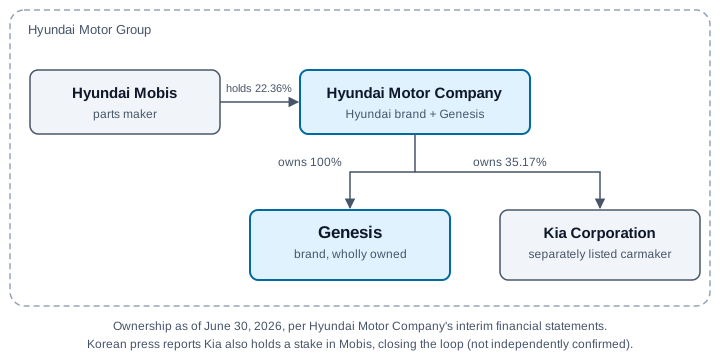
Hyundai Motor Company is Genesis’s parent and owns it outright. Hyundai Motor Group is the larger family around it: the carmakers Hyundai and Kia, plus the parts maker Hyundai Mobis.
Hyundai’s own financial statements lay out the connections. Hyundai Mobis is Hyundai Motor Company’s largest shareholder, at 22.36%. Hyundai Motor Company holds 35.17% of Kia. Genesis Motor America LLC, Genesis Motor Europe GmbH, and Genesis Motor Sales (Shanghai) are all listed as wholly owned subsidiaries in the filing for the six months ended June 30, 2026.
Not the Genesis You’re Thinking Of? (Quick Disambiguation)
Several unrelated companies use the same name. Genesis Healthcare is a health care provider, Genesis Energy is an energy company, and Genesis Global Trading is a crypto trading firm. Gyms and schools use it too. None of them connects to Hyundai’s car brand — everything below is about Genesis the automaker, specifically.
The History: How Genesis Became Its Own Brand
2008–2015: The Hyundai Genesis Sedan
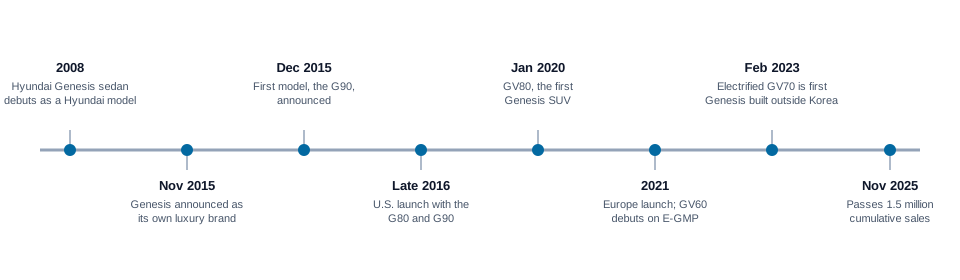
Genesis started as a car, not a company. Hyundai showed a rear-wheel-drive concept called Concept Genesis in 2003, then put the production version on sale in 2008 wearing a plain Hyundai badge. The idea of a separate brand was already being floated internally. It took seven more years to happen.
By 2015 the internal case had solidified. Hyundai’s then-U.S. spokesman, Chris Hosford, gave three reasons: the Genesis sedan had spent seven years in the luxury segment, it consistently ranked among the top three sellers in its class, and customer research showed strong interest in a stand-alone division.
November 2015: The Spin-Off Announcement
Hyundai made it official on November 4, 2015: Genesis would become a separate brand. Euisun Chung, who now leads Hyundai Motor Group, ran the project from planning through hiring and reorganization. Hyundai’s own retrospective calls Genesis Korea’s first luxury automotive brand.
Take “spin-off” loosely here. Hyundai didn’t sell or divest anything — it built a new brand identity and kept full ownership the entire time.
2016–2017: The First Genesis Models Reach the U.S.
Hyundai announced the brand’s first model, the G90, on December 9, 2015 (sold as the EQ900 in South Korea). U.S. showrooms got their first Genesis-badged cars in late 2016, when the G80 and G90 went on sale. The G80 was the existing Hyundai Genesis sedan wearing a new name.
You’ll see 2015, 2016 and 2017 all cited as “the” launch year. All three are defensible: 2015 is the brand announcement, 2016 is the first U.S. on-sale date, 2017 shows up in some records as the G90’s formal release year. The smaller G70 sedan came after, debuting at the New York Auto Show on March 28, 2018.
Global Expansion Since Launch
Genesis’s first SUV, the GV80, debuted in January 2020. European sales, including the UK, began the following year. The GV60 arrived that same year — the brand’s first model on Hyundai Motor Group’s E-GMP electric platform, the same underpinnings later shared with the Hyundai Ioniq 5 and Ioniq 6 and the Kia EV6.
By October 2025, Genesis was selling in roughly 20 major markets. Cumulative global sales passed 1.5 million units that November, with about 221,000 cars sold across 2025 alone.
Who Owns Genesis vs. Who Makes Genesis
Ownership, manufacturing and design are three different questions, and the answers aren’t identical. The first two point to Hyundai. The third is more mixed.
| Question | Answer for Genesis |
|---|---|
| Who owns it? | Hyundai Motor Company |
| Who builds it? | Hyundai-owned plants in Ulsan, South Korea, and Montgomery, Alabama |
| Who designs and engineers it? | Genesis studios in Germany, South Korea and California, with engineering shared across Hyundai Motor Group |
Ownership: Hyundai Motor Company
Hyundai Motor Company owns the brand outright, along with its regional sales arms. Genesis Motor America LLC, Genesis Motor Europe GmbH (and its UK, Swiss and German units), and Genesis Motor Sales (Shanghai) all show up as 100%-owned subsidiaries in the company’s latest filing.
Hyundai Motor Company has traded on the Korea Exchange since June 1974. Genesis has never had shares of its own, so there’s no way to buy into it separately from Hyundai.
Manufacturing: Where Genesis Vehicles Are Built
Hyundai builds every current Genesis, the same way it owns the brand. Hyundai’s assembly records place the GV60, GV70, GV80, G70, G80 and G90 at its Ulsan plant in South Korea. The GV70 and Electrified GV70 are also built at Hyundai Motor Manufacturing Alabama (HMMA) in Montgomery, a plant listed as 100% Hyundai-owned in the June 2026 filing.
Worth flagging specifically: the Electrified GV70 began production in Montgomery in February 2023, making it the first Genesis model ever assembled outside South Korea. The standard gas GV70 later joined it on the same line. A U.S. buyer can end up with a GV70 built in either country — the window sticker’s final-assembly line settles which one.
Engines follow the same pattern. Genesis has no separate engine program; the G70 shares its engine range with the Kia Stinger, a Hyundai Motor Group sibling. Development happens at the group level, not inside a Genesis-only operation.
Design & Engineering: How Independent Is Genesis?
Design is where the brand is most its own. Genesis runs dedicated studios in Rüsselsheim, Germany; Namyang, South Korea; and Irvine, California. Namyang also doubles as Hyundai’s main R&D center — the same site that developed the G70 — so the overlap with Hyundai runs deeper than just shared parts.
Leadership and retail identity sit apart from Hyundai. Sean (Sihyeok) Lee became global head of Genesis on December 8, 2025, succeeding Mike Song. The brand’s first dedicated showroom, in Seoul’s Gangnam district, was designed by architect Rem Koolhaas — a deliberate move to give Genesis its own physical presence instead of a corner of a Hyundai dealership.
Genesis has the most visible independence in design, branding and retail. Ownership and manufacturing remain with Hyundai.
Is Genesis Just a Rebadged Hyundai?
Genesis shares substantial engineering with Hyundai, more than brand marketing usually lets on. The overlap is specific:
- Factories — Genesis cars come off Hyundai-owned assembly lines, in Korea and Alabama.
- Platforms — a platform is the underlying structure and mechanical layout a car is built on, and Genesis doesn’t always get its own. The G70 rides on the same rear-wheel-drive platform as the Kia Stinger; the GV60 rides on E-GMP, shared with the Hyundai Ioniq 5 and 6 and the Kia EV6.
- Engines — the G70’s engine range is shared with the Stinger.
- R&D — the G70 came out of Hyundai’s Namyang center, not a Genesis-only facility.
Platform sharing isn’t corner-cutting. It’s how automakers spread development cost across multiple models.
What Genesis Does Differently
The G70 and Stinger share mechanical DNA, but they aren’t the same car. The G70 has a shorter wheelbase and a conventional sedan body; the Stinger is a liftback aimed at a different buyer. Genesis also has its own design studios, naming system, showrooms and leadership.
The clearest evidence for skeptics is historical. The G80 did start life as the Hyundai Genesis sedan, renamed when the brand launched. For that one car, “a Hyundai with a different badge” was true, for a while.
Why This Confusion Exists in the First Place
- Genesis was already the name of a Hyundai model before it became a brand of its own.
- Some Genesis retail still sits inside existing Hyundai dealerships rather than standalone stores.
- Several Genesis models share platforms and engines with Hyundai and Kia siblings.
- The brand is young — about a decade old, against nearly four decades for Acura (1986) and Lexus (1989).
To size up a specific Genesis instead of the whole brand:
- Find its closest Hyundai or Kia relative — the Stinger for the G70, the Ioniq 5 for the GV60.
- Check what’s shared (platform, engine family) against what isn’t (body, interior, features, price).
- Judge the car on driving experience, reliability data and ownership cost.
Genesis, Hyundai, and Kia: How the Three Brands Relate
Same Parent, Separate Companies
Hyundai, Kia and Genesis are the group’s three car brands, but they sit at different levels. Hyundai Motor Company owns Genesis outright and holds 35.17% of Kia — real influence, not ownership. Kia remains a separately listed company with its own shareholders.
Genesis vs. Kia
Kia holds no stake in Genesis, which settles the ownership question. There’s a narrower link elsewhere: the G70 and Kia Stinger share a platform and engine range — a connection between two specific models, not the companies that make them.
How Genesis Compares to Other Captive Luxury Brands
A captive luxury brand is a luxury brand built and owned by a mainstream automaker, rather than operating as an independent company. Genesis, Acura, Lexus and Infiniti all fit that description.
| Luxury brand | Parent | First cars | Detail |
|---|---|---|---|
| Genesis | Hyundai Motor Company | G90 announced Dec. 2015; U.S. sales from late 2016 | G80 was the renamed Hyundai Genesis |
| Acura | Honda | Launched in the U.S. in 1986 | First model was an export version of the Honda Legend |
| Lexus | Toyota | LS launched in 1989 | Didn’t exist as a brand in Japan until 2005 |
| Infiniti | Nissan | Q45 launched in 1990; plans unveiled 1987 | Q45 was a revised Nissan President |
Genesis isn’t unusual in being a luxury marque built by a mass-market automaker — Acura, Lexus and Infiniti all followed versions of the same playbook, each starting with a reworked version of a car already sold under the parent’s main badge.
The real gap between Genesis and its older peers is time: Acura and Lexus have close to four decades of track record; Genesis has about one.
Ownership structure can’t settle whether Lexus or Genesis is “better” — both run on the same model. What settles it is the specific cars: independent reliability data, crash-test ratings and real ownership costs for whatever’s being cross-shopped.
A Closer Look: Hyundai Motor Group’s Ownership Structure
This section goes deeper than most buyers need. Skip to “Does Any of This Matter” if the short answer already covered it for you.
The Circular Shareholding System
A circular shareholding is companies in a group owning shares of one another in a loop, rather than a clean top-down chain. Hyundai’s group runs one: Hyundai Mobis holds 22.36% of Hyundai Motor Company, and Hyundai Motor Company holds 35.17% of Kia. Korean financial press has reported that Kia also holds a stake in Hyundai Mobis, which would close the loop — we couldn’t confirm a current exact percentage for that specific holding from a primary source, so treat it as reported rather than verified.
Structures like this are common among Korea’s large family-controlled conglomerates, known as chaebol. They let a controlling family retain influence without owning a majority of every company in the group. The percentages drift — older sources cite figures closer to 33.9% for the Kia stake — so treat any number here as a snapshot and check current filings for anything time-sensitive.
The Chung Family’s Role
Hyundai Motor Group has been led by the Chung family since its founding. Chung Mong-koo, the group’s honorary chairman, is the only other individual named as a major Hyundai Motor Company shareholder in the June 2026 filing, at 5.57%. His son, Euisun Chung, now leads the group and oversaw the creation of the Genesis brand.
Does Any of This Matter If You’re Buying a Genesis?
Mostly indirectly. Ownership tells you who stands behind the brand, not how good any individual car is.
- Who’s backing it: Genesis Motor America LLC, the U.S. sales arm, is a wholly owned part of Hyundai Motor Company’s reporting structure, not a separate company that could fold independently of its parent.
- Ownership isn’t a quality score. Check independent reliability and safety data for the exact model and year.
- Sibling cars are a research shortcut. When a Genesis model shares a platform or engine with a Hyundai or Kia — the G70/Stinger pairing is the clearest case — that sibling’s reliability record and recall history can flag questions worth asking before you buy.
- Check where your specific car was built. The window sticker lists the final-assembly location, South Korea or Alabama depending on the model.
The UK shows what “ownership” means in practice. In early 2024, Genesis became a standalone business unit inside Hyundai Motor UK rather than operating as a fully separate company there. A Genesis brand lead now reports to a single UK chief executive who also runs Hyundai, aimed at efficiency and synergy between the two brands’ back-office operations. Customers still buy and service Genesis cars as Genesis cars. The restructuring happened behind the scenes, in exactly the place a casual shopper wouldn’t think to look.
Key Facts at a Glance
| Item | Detail |
|---|---|
| Owner | Hyundai Motor Company |
| Parent group | Hyundai Motor Group |
| Brand announced | November 4, 2015 |
| First model announced | G90 (EQ900 in South Korea), December 9, 2015 |
| U.S. launch | Late 2016 (G80 and G90) |
| Sister car brands | Hyundai; Kia (35.17% held by Hyundai Motor Company) |
| Where built | Ulsan, South Korea; and Montgomery, Alabama since Feb. 2023 (first Genesis built outside Korea) |
| Design studios | Rüsselsheim, Namyang, Irvine |
| Global head | Sean (Sihyeok) Lee, since December 8, 2025 |
| Cumulative sales | More than 1.5 million (as of November 2025) |
| Ownership data as of | June 30, 2026 |
So, Who Owns Genesis?
Hyundai Motor Company has owned Genesis since 2015. Ownership, manufacturing and design each tell a different part of the story — Hyundai owns and builds every current Genesis outright, while design splits between Genesis’s own studios and Hyundai’s shared R&D center.
The rebadged-Hyundai worry holds up in two places: the G80 started as a Hyundai, and models like the G70 share engineering with the Kia Stinger. It doesn’t hold up as a description of the whole brand — Lexus, Acura and Infiniti were built the same way, and nobody still calls those cars rebadged Toyotas or Hondas.
Ownership explains the brand’s history and structure. It isn’t a substitute for checking the individual car: find its closest platform relative, confirm where it was assembled, and pull independent reliability data before you buy.
FAQs
Who owns Genesis cars?
Hyundai Motor Company. Genesis is part of Hyundai Motor Group, and Hyundai holds it outright, including its U.S., European and Chinese sales companies.
Is Genesis owned by Hyundai or Kia?
Hyundai. Kia doesn’t own any part of Genesis — Hyundai Motor Company holds 35.17% of Kia, a separately listed company with its own shareholders.
Is Genesis a Hyundai?
It’s a separate brand Hyundai owns, with its own badge, naming system and design studios. The G80 started out as the Hyundai Genesis sedan before being renamed in 2016.
Is Genesis just a fancy Hyundai?
Not a simple rename. Genesis shares factories, some platforms and some engines with Hyundai Motor Group cars, and keeps its own design studios, lineup and leadership.
Is Genesis a high-end Kia?
No — Kia doesn’t own Genesis. The comparison comes from one model pairing: the G70 shares a platform and engine range with the Kia Stinger.
Who builds Genesis engines?
Genesis has no separate engine business. Engines come from Hyundai Motor Group; the G70 shares its engine range with the Kia Stinger specifically.
Where are Genesis cars assembled?
Mostly Hyundai’s Ulsan plant in South Korea. The GV70 and Electrified GV70 are also built at Hyundai Motor Manufacturing Alabama — the Electrified GV70 became the first Genesis built outside South Korea when that line started in February 2023.
Is Lexus or Genesis better?
Both are captive luxury brands under mainstream automakers, so ownership doesn’t settle it. Compare the specific models on independent reliability, safety and cost data.
Is Genesis owned by Chrysler?
No. Hyundai Motor Company owns it.
Can I buy Genesis stock?
Not directly — Genesis has no shares of its own. Hyundai Motor Company trades on the Korea Exchange.
📖 Continue Reading:
Sources & References
- Hyundai Motor Company, Interim Consolidated Financial Statements, six months ended June 30, 2026
- Hyundai Motor Group, “Ten Years of Genesis: A Journey Built Together”
- Genesis Motor Europe, “Genesis Launches Next Stage of Brand Evolution” (February 22, 2024)
- Hyundai Newsroom, “Hyundai Motor Manufacturing Alabama Celebrates 20 Year Production Anniversary”
- Wikipedia, Genesis Motor
- Wikipedia, Genesis G70
- Wikipedia, Lexus
Disclaimer
This article is for general information only and isn’t financial, investment or car-buying advice. Ownership percentages come from Hyundai Motor Company’s interim financial statements for the period ending June 30, 2026, and they change over time. Check current filings and the official Genesis website before relying on any figure for a decision.

Alex Miller is an automotive writer and industry researcher specializing in the companies, brands, and corporate groups that shape the global automotive market. His coverage focuses on automotive ownership, parent companies, mergers and acquisitions, brand histories, executive leadership, and the business decisions behind major vehicle manufacturers.
Alex’s work spans mainstream, luxury, performance, and emerging automotive brands. He researches how automakers are structured, which companies control individual brands, how ownership has changed over time, and what those relationships mean for consumers and the wider industry. His coverage includes brands such as Jaguar, Ferrari, BMW, Volvo, Mazda, Lamborghini, Lexus, Acura, Audi, Genesis, Infiniti, Porsche, and Volkswagen.
For ownership and corporate-structure stories, Alex prioritizes primary and authoritative sources, including company filings, investor-relations publications, official corporate announcements, regulatory records, and established automotive and financial publications. This approach helps separate a brand’s public identity from its actual corporate ownership and control.
Alex combines detailed industry research with straightforward explanations designed for both automotive enthusiasts and general readers. Beyond ownership stories, his interests include automotive history, luxury and performance vehicles, electric-vehicle development, mobility companies, motorsports, and the evolving relationship between global automakers and their parent groups.