⚡ Quick Answer: Who Owns Audi in 2026?
Audi AG is a wholly owned subsidiary of Volkswagen AG. Volkswagen has controlled Audi since the mid-1960s, but full ownership only became final once a shareholder squeeze-out was completed and entered into Germany’s commercial register on November 16, 2020. Since that date, Volkswagen has held 100% of Audi, with no independent public shareholders left in the company.
The ownership picture goes one level higher, too, to a holding company most car buyers have never heard of.
Key takeaways:
- Volkswagen AG owns 100% of Audi AG, confirmed since November 16, 2020.
- Volkswagen AG itself is controlled by Porsche SE, a separate holding company tied to the Porsche-Piëch family — not the Porsche sports car brand.
- Audi owns Lamborghini outright and a majority stake in Ducati.
- BMW has zero ownership connection to Volkswagen, Porsche SE, or Audi. It’s a fully independent company.
The Ownership Chain — From Audi to Volkswagen to Porsche SE
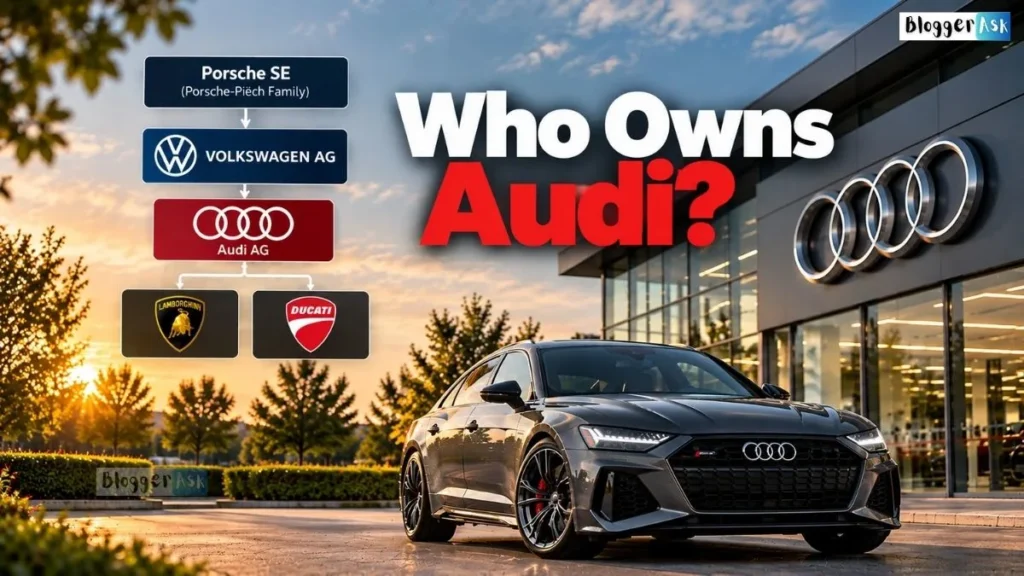
Audi answers to Volkswagen AG. Volkswagen AG answers to Porsche SE.
How Volkswagen Took Full Control of Audi
By early 2020, Volkswagen already held 99.64% of Audi’s registered share capital. On February 28, 2020, Volkswagen AG formally requested a transfer of the remaining minority shares under Section 327a of Germany’s Stock Corporation Act — the legal mechanism known as a squeeze-out. Volkswagen set cash compensation for departing minority shareholders at €1,551.53 per share, roughly a 48% premium over Audi’s trading price. The AGM approved the transfer on July 31, 2020; the register entry that November is what made it final.
Who Controls Volkswagen Itself
Volkswagen AG is publicly traded, but control there isn’t spread evenly. As of the end of 2025, Porsche Automobil Holding SE held 53.3% of the voting rights in Volkswagen AG. The State of Lower Saxony held 20.0%, Qatar Holding LLC held 17.0%, and the remaining 9.7% sat in free float.
Porsche SE isn’t the sports car company — that’s Porsche AG, a separate entity that Volkswagen itself majority-owns. Porsche SE is the holding company above it, majority owned by the Porsche-Piëch family, descendants of Ferdinand Porsche. The full chain, top to bottom:
- Porsche-Piëch family → majority owners of
- Porsche SE → holds 53.3% of voting rights in
- Volkswagen AG → owns 100% of
- Audi AG → owns Lamborghini outright and holds a majority stake in Ducati
A Brief History of How VW Acquired Audi
Audi’s path to Volkswagen didn’t start with Volkswagen. The company traces back to August Horch, who founded the original Horch automobile business and later Audiwerke in the early 1900s. Audi merged with DKW and Wanderer to form Auto Union in 1932 — the four rings in Audi’s logo represent those four founding companies.
Auto Union struggled through the postwar years. In 1958, Daimler-Benz — Mercedes-Benz’s parent — took an 88% stake, and Auto Union became a wholly owned Daimler-Benz subsidiary the following year. That didn’t last: continued reliance on outdated two-stroke engines drove sales down, and Daimler-Benz cut its losses.
Volkswagenwerk AG acquired a 50.3% stake in Auto Union on January 1, 1965, and took full ownership the following year. Auto Union merged with NSU Motorenwerke in 1969, forming the company that became the present-day Audi, which adopted the Audi AG name outright in the 1980s.
Volkswagen’s relationship with Audi is genuinely 60 years old. Full legal ownership just took until 2020 to finish.
What Else Does Volkswagen Group Own?
Audi isn’t a one-off acquisition. It’s one piece of a larger portfolio. As of 2026, Volkswagen AG’s brand lineup includes Audi, Bentley, Cupra, Lamborghini, Porsche, Scout, SEAT, and Volkswagen as a standalone brand.
| Brand | Ownership Note |
|---|---|
| Audi | 100% direct subsidiary of Volkswagen AG (since Nov 2020) |
| Porsche | Majority owned by Volkswagen AG; listed separately since its 2022 IPO |
| Lamborghini | Owned outright by Audi AG, not Volkswagen AG directly |
| Bentley | Owned directly by Volkswagen AG |
| Škoda, SEAT/Cupra | Owned directly by Volkswagen AG |
| Ducati | Majority stake held through Lamborghini |
| Scout | Revived U.S.-focused brand, part of Volkswagen Group’s current lineup |
| Bugatti | Not directly owned by Volkswagen Group. Since 2021, Bugatti has operated as Bugatti Rimac, a joint venture between Rimac Group and Porsche AG. Volkswagen’s interest is now indirect, through Porsche AG’s stake in the venture. |
Since September 2023, Audi’s CEO, Gernot Döllner, has also led Volkswagen Group’s internal “Progressive” brand group, which groups Audi with Bentley, Lamborghini, and Ducati for strategy and product planning. Bentley remains owned directly by Volkswagen AG, not Audi.
Is Audi Basically a Volkswagen?
Audi and Volkswagen share some hardware. They don’t share a design team or a target buyer. The price bracket is different too.
The MQB platform underpins both the VW Golf and the Audi A3. The MEB electric platform underpins both the VW ID.4 and the Audi Q4 e-tron. Sharing a platform means sharing suspension geometry, crash structure, and some drivetrain components — it’s not badge-engineering. Audi keeps its own design studio and its own engineering leadership. Its market position sits above the core Volkswagen brand. As part of the 2020 reorganization that came with full ownership, then-Volkswagen chairman Herbert Diess said directly that Audi would take the lead on research and development across the group — a sign of how the two brands actually divide labor, closer to how Lexus relates to Toyota, or Genesis to Hyundai.
Is BMW Owned by the Same Company as Audi?
No. BMW AG has no ownership connection to Volkswagen AG, Porsche SE, or Audi AG. It’s a fully separate, publicly traded German company controlled by a different family entirely.
BMW’s controlling shareholders are siblings Stefan Quandt and Susanne Klatten, who together held a combined stake of just over 47% as of year-end 2025 shareholder disclosures. That control dates back to the 1950s, when their father, Herbert Quandt, invested in BMW during a period when the company was nearly acquired by Daimler-Benz. Volkswagen plays no role in that history at any point.
Audi and BMW compete directly, and always have.
Does Volkswagen’s Ownership Affect Audi’s Reliability or Resale Value?
Being part of Volkswagen Group hasn’t insulated Audi from reliability swings. Audi’s position in Consumer Reports’ most recent annual brand report card dropped noticeably compared to the prior year, landing well outside the top 10, with complaints concentrated in newer, tech-heavy models. That’s a brand-specific trend tied to feature complexity. BMW, for comparison, has generally ranked closer to the top of the luxury tier in the same reports — rankings that shift year to year and shouldn’t be read as permanent verdicts on either brand.
Platform-sharing cuts a few different ways:
- Parts and repair costs: shared components across VW Group brands can lower the cost of certain repairs, since parts are built at greater scale. Audi’s luxury trims and added electronics tend to eat into that savings.
- Resale value: driven mainly by segment competition against BMW, Mercedes, and Lexus, plus model-specific reputation — not by Volkswagen ownership itself.
- Reliability: varies by year and model. Who owns the company isn’t a factor either way.
The platform matters more than the ownership chart if you’re choosing between an Audi and something else. So does trim complexity, and that specific model’s repair history.
Bottom line: Audi is fully Volkswagen-owned, has been since November 2020, and sits under a chain of control that traces back to the Porsche-Piëch family through Porsche SE.
FAQs
Does Volkswagen own 100% of Audi?
Yes. Volkswagen AG has held all of Audi’s shares since the squeeze-out transfer was legally registered on November 16, 2020.
Is Lamborghini owned by Volkswagen too?
Yes, but indirectly. Lamborghini is owned by Audi AG, which is itself wholly owned by Volkswagen AG.
Does Volkswagen still own Bugatti?
No, not directly. Since 2021, Bugatti has operated as Bugatti Rimac, a joint venture between Rimac Group and Porsche AG. Volkswagen has only an indirect link through Porsche AG’s stake.
What do the four rings in Audi’s logo represent?
The four founding companies of Auto Union — Audi, DKW, Horch, and Wanderer — which merged in 1932.
Who is Audi’s current CEO?
Gernot Döllner, who became CEO on September 1, 2023, and was confirmed for another five-year term in autumn 2025.
📖 Continue Reading:
Sources & References
- Audi — Capital-Market-Law Publications and Ad Hoc Announcements
- Audi Media Center — Annual General Meeting Votes on Squeeze-Out
- EQS News / Audi AG — Cash Settlement Announcement, €1,551.53 per Share
- Volkswagen Group 2025 Annual Report — Shareholder Structure
- Consumer Reports — Who Owns Which Car Brands
- Wikipedia — Bugatti Rimac
- Audi — Company History
Disclaimer: Ownership stakes, voting rights, and corporate structures for publicly traded companies can change. The figures above reflect the most recent publicly disclosed filings and company statements, verified via live sources as of this review, and should be re-checked against current company disclosures for any use beyond general reading.

Alex Miller is an automotive writer and industry researcher specializing in the companies, brands, and corporate groups that shape the global automotive market. His coverage focuses on automotive ownership, parent companies, mergers and acquisitions, brand histories, executive leadership, and the business decisions behind major vehicle manufacturers.
Alex’s work spans mainstream, luxury, performance, and emerging automotive brands. He researches how automakers are structured, which companies control individual brands, how ownership has changed over time, and what those relationships mean for consumers and the wider industry. His coverage includes brands such as Jaguar, Ferrari, BMW, Volvo, Mazda, Lamborghini, Lexus, Acura, Audi, Genesis, Infiniti, Porsche, and Volkswagen.
For ownership and corporate-structure stories, Alex prioritizes primary and authoritative sources, including company filings, investor-relations publications, official corporate announcements, regulatory records, and established automotive and financial publications. This approach helps separate a brand’s public identity from its actual corporate ownership and control.
Alex combines detailed industry research with straightforward explanations designed for both automotive enthusiasts and general readers. Beyond ownership stories, his interests include automotive history, luxury and performance vehicles, electric-vehicle development, mobility companies, motorsports, and the evolving relationship between global automakers and their parent groups.