⚡ Quick Answer: Who Owns Acura?
Acura is owned by Honda. More precisely, it’s a division of American Honda Motor Co., Inc., the U.S. subsidiary of Japan’s Honda Motor Co., Ltd. Acura isn’t a separately incorporated automaker — it’s a brand that Honda built from scratch in 1986 to sell luxury and performance vehicles without stretching the Honda name into territory it wasn’t built for.
Key facts at a glance:
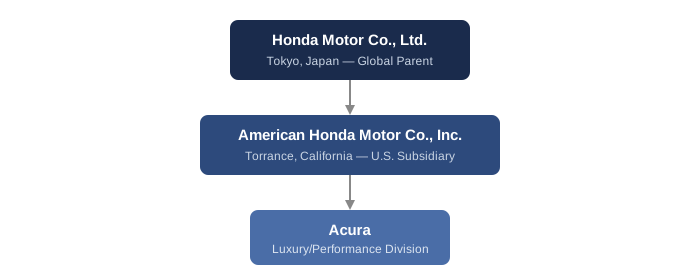
- Honda Motor Co., Ltd. (Tokyo) is the ultimate global parent
- American Honda Motor Co., Inc. (Torrance, California) is the U.S. subsidiary that actually operates Acura
- Acura launched March 27, 1986, as the first Japanese luxury brand sold in the U.S.
- Acura has no separate stock, board, or CEO — it’s a division, not an independent company
The rest of this article explains why that distinction matters, how much Acura still shares with Honda mechanically, and why the “just a rebadged Honda” reputation is a lot less accurate now than it was twenty years ago.
The Real Ownership Structure: Honda Motor Co. vs. American Honda
Most explanations of who owns Acura stop at one sentence: Honda does. That’s not wrong, but it skips the part that actually answers the question people are asking — which Honda, and in what capacity.
There are two separate Honda entities involved, and they do different jobs.
Honda Motor Co., Ltd. — The Global Parent
Honda Motor Co., Ltd. is the Tokyo-headquartered parent company that owns Honda’s entire global operation — cars, motorcycles, power equipment, jet aircraft, and every regional subsidiary underneath it. It’s a publicly traded Japanese multinational, and Acura sits several layers down inside that structure, not as a sibling company but as a brand controlled through Honda’s American operations.
American Honda Motor Co., Inc. — The U.S. Operating Company
American Honda Motor Co., Inc. is the entity that actually runs things in the United States. Founded in 1959 and headquartered in Torrance, California, it’s a wholly owned subsidiary of Honda Motor Co., Ltd., and it handles sales, marketing, and distribution for both the Honda and Acura brands in North America (Wikipedia — American Honda Motor Company). When you buy an Acura from a U.S. dealership, American Honda is the company standing behind that transaction, not the Tokyo parent directly.
Where Acura Fits In (Division, Not a Separate Company)
Acura has no separate stock, no independent board, and no CEO of its own the way Honda or Toyota do. It’s a brand — a division — operated by American Honda. Honda’s own regulatory filings describe it plainly: the company created Acura in 1986 to enter the North American luxury market as a second sales channel alongside Honda, not as a spin-off business, and it later used the same subsidiary structure to introduce Acura in China in 2006 through a dedicated Honda-owned import entity (Honda Motor Co., Ltd. — SEC Form 6-K).
Here’s the structure laid out simply:
| Entity | Role | Location |
|---|---|---|
| Honda Motor Co., Ltd. | Global parent company | Tokyo, Japan |
| American Honda Motor Co., Inc. | U.S. subsidiary that operates Honda and Acura | Torrance, California |
| Acura | Luxury/performance brand operated by American Honda | Sold across North America, and — starting in 2026 — Japan |
If you want a visual version of that chain, here’s a simple diagram:
Is Acura Just a Rebadged Honda?
This question shows up almost as often as the ownership question itself, and the honest answer is: it depends on which model — and which model year — you’re asking about.
What Acura and Honda Still Share
Some overlap is real and ongoing. Acura and Honda vehicles are engineered by overlapping teams, assembled in some of the same U.S. plants, and use related safety technology — AcuraWatch and Honda Sensing are built on shared underlying systems, just tuned and packaged differently. The clearest current example is the Integra: Acura’s entry-level model is openly built on the same platform as the 11th-generation Honda Civic, using the same 1.5-liter turbocharged engine and much of the same interior architecture as the Civic Si, and it rolls off the line at Honda’s Marysville, Ohio plant (Wikipedia — Acura Integra (2023)). Acura doesn’t hide this. It markets the Integra as a more refined execution of that shared foundation, not a disguised one.
Where Acura Has Become More Independent
Above the entry level, the relationship has loosened. Acura told Autoblog directly that its MDX, TLX, and RDX generations from the early 2020s were each engineered on platforms not shared with any other Honda or Acura model — the TLX rode on a bespoke platform of its own, and the RDX moved to what Acura called an Acura-exclusive architecture back in 2019 (Autoblog). The 2022 MDX went a step further: its “Global Light Truck Platform” debuted on the MDX first, with Honda’s own trucks expected to adopt versions of it later — reversing the direction platform-sharing has traditionally flowed in.
So the fair answer is a split one, not a flat yes or no. Acura’s cheapest model is closely related to a Honda. Its pricier models have been engineered to stand apart — though, as the next section covers, Acura’s current lineup is in more flux than usual right now.
Acura Models vs. Their Honda Counterparts
| Acura Model | Closest Honda Relative | How Closely Related | Current Status (2026) |
|---|---|---|---|
| Integra | Civic (11th gen) | Shares platform, engine, and much of the interior | In production |
| RDX | None — Acura-exclusive platform since 2019 | Earlier generations (2007–2018) shared underpinnings with the Civic and CR-V | Production of the current, third generation ended in spring 2026 amid parts-supplier shortages; a hybrid fourth-generation replacement isn’t expected before 2028 (The Drive) |
| TLX | None | Bespoke platform not shared with any current Honda or Acura | Discontinued in 2025, with no successor confirmed as of this writing |
| MDX | None yet | New platform debuted on the MDX first, ahead of Honda’s own trucks | In production |
Worth noting: this lineup churn — RDX paused, TLX gone — isn’t about Acura’s relationship with Honda changing. It’s a separate, more immediate story about parts availability and product planning, and it’s a good reminder that specific model-lineup facts age faster than the ownership structure itself.
Why Honda Created Acura in the First Place
Founding Date, Clarified (1986, Not 1984)
You’ll see both 1984 and 1986 cited as Acura’s founding year across different sites, and neither is technically wrong — they’re just describing different moments. According to Honda’s own corporate timeline, American Honda announced plans for a new luxury division in February 1984, under the internal working name “Channel II.” The name Acura was officially chosen that September. The brand didn’t actually open for business until March 27, 1986, when 60 dealers across 18 states opened their doors, making Acura the first Japanese luxury brand sold in the U.S. (Honda News — official Acura timeline).
So: 1984 is when the project began. 1986 is when the brand actually launched. Most competitor content picks one year without explaining why the other one also shows up — which is exactly the kind of small inconsistency worth clearing up here.
Why It Launched as “Channel II”
Honda’s problem in the early 1980s was reputation, not engineering. American buyers associated the Honda name with reliable, affordable, practical cars, which was the opposite image a luxury buyer wanted. Rather than risk that hard-won reputation by selling a premium sedan under the Honda badge, Honda built an entirely separate dealer network and brand identity around it instead. The name “Acura” itself came from a naming consultancy and was derived from the Latin root “acu,” meaning precise or done with precision.
The Same Playbook: Lexus/Toyota and Infiniti/Nissan
Acura wasn’t just first, it set the template. Toyota launched Lexus in 1989 and Nissan launched Infiniti the same year, both following the same logic Honda had already proven: keep the mainstream brand’s identity intact, and build a standalone luxury division to compete with BMW and Mercedes-Benz without diluting either image. If you understand the Acura/Honda relationship, you already understand how Lexus relates to Toyota and how Infiniti relates to Nissan. It’s the same corporate pattern, repeated by three different Japanese automakers within a few years of each other.
Is Acura American or Japanese?
Where Acura Vehicles Are Actually Built
Acura is a Japanese-owned brand, but most of its lineup is manufactured in the United States. The Integra comes out of Honda’s Marysville, Ohio plant; the RDX and MDX have been built at Honda’s Ohio operations as well. It’s a Japanese company’s brand, built substantially by American workers, for a market that — until very recently — existed almost entirely in North America.
Why Acura Wasn’t Sold in Japan — Until 2026
For nearly 40 years, Acura was never sold in its own parent company’s home country. Acura was created specifically to solve an American perception problem: luxury buyers in the U.S. wanted something that didn’t feel like a Honda. That problem didn’t exist in Japan, where Honda addressed its domestic luxury market instead through separate dealership channels rather than exporting Acura back home. (Acura did briefly sell vehicles in China starting in 2006 through a dedicated Honda import subsidiary, though it’s no longer part of the brand’s current international lineup.)
That changed in 2026. Following a U.S.–Japan trade agreement, Honda confirmed it will export the U.S.-built Acura Integra Type S to Japan for the first time, alongside the U.S.-built Honda Passport, beginning in the second half of 2026 — marking the first time an Acura-badged vehicle will be sold in Japan since the brand’s founding (Car and Driver, via AOL). Both vehicles are being reverse-imported in their U.S. specification, left-hand drive included, so this is a limited, symbolic entry rather than a full Japanese launch of the Acura brand — but it does close a genuinely 40-year gap.
So, Who Really Owns Acura?
Strip away the marketing copy and the answer is straightforward: Honda owns Acura, operating it in the U.S. through American Honda Motor Co., Inc., which itself answers to Honda Motor Co., Ltd. in Japan. What’s changed since 1986 isn’t the ownership, it’s how much engineering independence Acura has been given inside that structure. Lately, that independence has been growing on Acura’s higher-end models, even as the brand’s day-to-day lineup goes through one of its more turbulent stretches in years.
Frequently Asked Questions
Does Honda own Acura?
Yes. Acura is a brand operated by American Honda Motor Co., Inc., which is a wholly owned U.S. subsidiary of Honda Motor Co., Ltd. in Japan.
Is Honda and Acura the same company?
Not exactly. They’re the same corporate family, but Honda and Acura are separate brands sold through separate dealer networks. Neither is independently incorporated — both are operated by American Honda.
Do Acuras have Toyota engines?
No. This is a persistent myth with no factual basis. Acura vehicles use Honda-designed and Honda-manufactured engines, the same engineering lineage used across Honda’s lineup, not Toyota’s.
What does “Acura” stand for?
It isn’t an acronym. The name comes from the Latin root “acu,” meaning precise or done with precision, chosen to reflect a brand image built around engineering accuracy and performance.
Where is Acura’s headquarters?
Acura operates out of American Honda Motor Co.’s headquarters in Torrance, California, the same U.S. base that oversees Honda’s American operations.
Is Acura still sold only in North America?
Mostly, but not exclusively anymore. As of 2026, Honda has begun reverse-importing a small number of U.S.-built Acura vehicles into Japan for the first time — a limited, trade-policy-driven move rather than a full international expansion.
Disclaimer
Corporate structures, model lineups, and production plans at Acura and American Honda can change without much public notice. The ownership chain described here (Honda Motor Co., Ltd. → American Honda Motor Co., Inc. → Acura) is a stable, long-standing structure and unlikely to change. The lineup-specific details (RDX production status, TLX discontinuation, the 2026 Japan export) reflect reporting current as of September 2026 and should be reconfirmed against current Acura or American Honda sources before being used for a purchase decision.
📖 Continue Reading:
Sources & References
- American Honda Motor Company — Wikipedia
- Honda Motor Co., Ltd. — SEC Form 6-K
- Official Acura Timeline — Honda News
- 2022 Acura MDX Platform Strategy — Autoblog
- Acura Integra (2023) — Wikipedia
- The Acura RDX Is Pausing Production With a Next-Gen Hybrid Years Away — The Drive
- Honda Will Sell an Acura in Japan for the First Time — Car and Driver, via AOL

Alex Miller is an automotive writer and industry researcher specializing in the companies, brands, and corporate groups that shape the global automotive market. His coverage focuses on automotive ownership, parent companies, mergers and acquisitions, brand histories, executive leadership, and the business decisions behind major vehicle manufacturers.
Alex’s work spans mainstream, luxury, performance, and emerging automotive brands. He researches how automakers are structured, which companies control individual brands, how ownership has changed over time, and what those relationships mean for consumers and the wider industry. His coverage includes brands such as Jaguar, Ferrari, BMW, Volvo, Mazda, Lamborghini, Lexus, Acura, Audi, Genesis, Infiniti, Porsche, and Volkswagen.
For ownership and corporate-structure stories, Alex prioritizes primary and authoritative sources, including company filings, investor-relations publications, official corporate announcements, regulatory records, and established automotive and financial publications. This approach helps separate a brand’s public identity from its actual corporate ownership and control.
Alex combines detailed industry research with straightforward explanations designed for both automotive enthusiasts and general readers. Beyond ownership stories, his interests include automotive history, luxury and performance vehicles, electric-vehicle development, mobility companies, motorsports, and the evolving relationship between global automakers and their parent groups.