⚡ Quick Answer: Who Owns BMW in 2026?
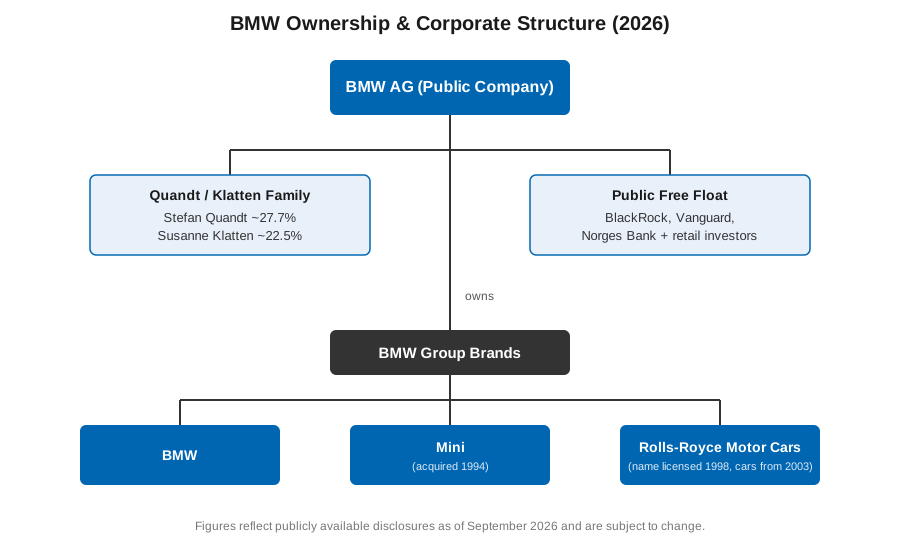
BMW is a publicly traded German company — no single person, company, or country owns it. As of 2026, siblings Stefan Quandt (about 27.7%) and Susanne Klatten (about 22.5%) together hold roughly half of BMW AG‘s shares — depending on the exact date and source, estimates put their combined stake anywhere from about 47% to just over 50%. That makes the Quandt family BMW’s largest and most influential shareholder group, though they hold their stakes as two separate individuals rather than through one single controlling entity.
The remaining shares trade freely on the Frankfurt Stock Exchange, held by institutional investors and thousands of individual shareholders worldwide. BMW is not owned by Volkswagen, not state-owned, and not foreign-acquired — it remains an independent, Munich-headquartered company.
BMW’s Current Shareholder Structure
If you’ve searched who owns BMW, you’ve probably landed on a handful of different percentages. That’s not a mistake on anyone’s part necessarily — the numbers genuinely shift depending on when they were reported. Here’s the clearest, most current breakdown available.
The Quandt Family’s Combined Stake
The Quandt family — specifically siblings Stefan Quandt and Susanne Klatten — is the dominant force behind BMW’s ownership. Current figures put Stefan Quandt’s stake at approximately 27.7% and Susanne Klatten’s at approximately 22.5%. Added together, that’s roughly half of BMW — though it’s worth being precise here: some sources place the combined figure closer to 47%, others closer to 50–51%, because the two siblings hold their shares individually rather than as a single legal bloc, and disclosure dates differ.
Either way, that combined figure is the largest concentrated ownership position in the company by a wide margin, built up over decades through inheritance and share purchases rather than a single transaction.
Institutional and Public Shareholders
The rest of BMW’s shares make up what’s called the “free float”: shares available for anyone to buy on the open market. This includes:
- Institutional investors such as BlackRock, Vanguard Group, and Norges Bank (Norway’s sovereign wealth fund), each typically holding low-single-digit percentages
- Individual retail investors around the world who own BMW stock directly or through index funds
- Employee shareholders, since BMW has historically offered company shares to staff
No single institutional holder comes anywhere close to matching the Quandt family’s combined position.
Why the Exact Percentages Vary by Source
You’ll see slightly different numbers for Stefan Quandt and Susanne Klatten depending on where you look — some sources say 25.8%/20.9%, others say 29%/21%, others say 27.7%/22.5%. Here’s why:
- Disclosure timing: shareholder percentages are reported as of a specific date and shift slightly over time through buybacks, dividends, and minor trades.
- Rounding conventions: different financial data providers round differently.
- Direct vs. indirect holdings: some figures count only direct personal ownership; others include shares held through family investment vehicles, such as Stefan Quandt’s holding company, AQTON SE.
None of this changes the core fact: the Quandt family has held the largest, most influential stake in BMW for decades, and that hasn’t changed — only the exact decimal point moves.
How the Quandt Family Controls BMW Without Owning It Outright
This is the part most articles skip entirely — and part of it genuinely changed in 2026.
Ownership vs. Control vs. Management — What’s the Difference
These three ideas get blended together constantly, but they’re distinct:
| Concept | What It Means | Who It Applies To at BMW |
|---|---|---|
| Ownership | Who holds equity/shares in the company | Quandt/Klatten family + thousands of public shareholders |
| Control | Who has enough voting influence to shape major company decisions | Quandt/Klatten family, via their combined shareholding |
| Management | Who runs day-to-day operations | The Board of Management, currently chaired by Milan Nedeljković |
A family can hold roughly half a company between two people, not run it day-to-day, and still shape its long-term direction — that’s effectively BMW’s situation.
BMW’s 2026 Share Structure Change: One Share, One Vote
Until mid-2026, BMW’s structure had an extra layer most people never heard about: the company issued two classes of stock — ordinary shares (Stammaktien), which carried voting rights, and preferred shares (Vorzugsaktien), which didn’t vote but paid a slightly higher dividend. Preferred shares had existed since 1989, mainly as part of BMW’s employee share programs.
That changed in 2026. At BMW’s Annual General Meeting on May 13, 2026, shareholders approved converting all non-voting preferred shares into ordinary voting shares, at a 1:1 ratio. The conversion became legally effective on July 1, 2026, when nearly 55 million preferred shares were reclassified as voting ordinary shares. Today, BMW’s entire share capital — about €615.8 million, made up of roughly 615.8 million shares — consists solely of ordinary voting shares.
Practically, this means:
- BMW now follows a strict “one share, one vote” principle, with no separate non-voting share class at all.
- The move increased BMW’s voting free float by about 19%, since the former non-voting preferred shares now carry votes.
- The Quandt/Klatten family’s share of total capital is essentially unchanged, but their share of the voting pool specifically is now identical to their capital stake, rather than calculated separately.
So how does a stake hovering around half of BMW amount to meaningful control? Three practical reasons:
- No other shareholder comes close. The rest of BMW’s shares are spread across thousands of institutional and individual holders — even BlackRock, typically the largest single institutional holder, owns only a low-single-digit percentage.
- Concentrated holdings vote more reliably than dispersed ones. At annual meetings, dispersed retail and institutional shareholders rarely all show up to vote, while a family with a long-term, coordinated interest typically does — giving their position outsized practical weight relative to the raw percentage alone.
- A stake this size functions as an effective blocking position. Certain major decisions — like changes to BMW’s Articles of Incorporation — require supermajority approval, meaning a stake of this size can block changes the family opposes, regardless of whether it technically clears 50%.
BMW’s Corporate Structure — BMW AG, BMW Group, and Its Brands
What BMW Group Actually Means
“BMW” and “BMW Group” are often used interchangeably, but they’re describing the same legal entity from two angles:
- BMW AG (Bayerische Motoren Werke Aktiengesellschaft) is the legal, publicly traded company — the “AG” designation signals it’s a shareholder-owned corporation under German law.
- BMW Group is the umbrella brand name that same company uses to describe its full portfolio across multiple car and motorcycle brands.
There isn’t a separate parent company sitting above BMW AG — BMW Group is BMW AG, referred to by its group-level branding.
Brands Owned by BMW Group
BMW Group’s portfolio includes:
- BMW — the core luxury vehicle brand.
- Mini — acquired as part of BMW’s 1994 purchase of the Rover Group; the rest of Rover was sold off in 2000 (Land Rover went to Ford), but BMW kept Mini.
- Rolls-Royce Motor Cars — and this one has a genuinely interesting backstory worth getting right, because it’s also the answer to a common myth (more below).
- BMW Motorrad — BMW’s motorcycle division.
How BMW actually ended up with Rolls-Royce: In 1998, the British engineering group Vickers put Rolls-Royce Motors up for sale. Volkswagen won the bidding war, paying roughly £430 million for the car business — including the historic Crewe factory. But there was a catch: Volkswagen’s purchase didn’t include the rights to the “Rolls-Royce” name and logo, which belonged to a completely separate, unrelated company — Rolls-Royce plc, an aerospace and jet-engine manufacturer that had spun off its car division decades earlier.
BMW then struck its own deal directly with Rolls-Royce plc to license the name for a much smaller sum. Under a transitional arrangement that ran until 2003, Volkswagen kept the Crewe factory and used it to build Bentleys going forward, while BMW built an entirely new factory in Goodwood, England, and began producing cars under the Rolls-Royce name starting in 2003. So: BMW owns the Rolls-Royce car brand; Volkswagen owns Bentley; and Rolls-Royce plc, the jet-engine company, has never been owned by either of them.
So the ownership direction is clear: BMW owns Mini and Rolls-Royce Motor Cars — not the other way around.
Who Runs BMW Today (Leadership vs. Ownership)
BMW’s Current CEO/Chairman
As of May 14, 2026, BMW’s Chairman of the Board of Management — the company’s top executive role, roughly equivalent to a CEO in English-language usage — is Milan Nedeljković. He succeeded Oliver Zipse, who stepped down after 35 years at BMW, including nearly seven years as chairman, following BMW’s Annual General Meeting on May 13, 2026, in Munich.
Nedeljković joined BMW as a trainee in 1993 and rose through senior production leadership roles, including managing BMW’s Leipzig and Munich plants, before overseeing the company’s global production strategy. His contract runs through 2031.
Why Leadership and Ownership Are Different Things
Here’s a distinction worth stating plainly: Milan Nedeljković does not hold a controlling ownership stake in BMW. He’s a professional executive appointed by BMW’s Supervisory Board to run the company — a role entirely separate from the Quandt/Klatten family’s ownership position.
This is a normal structure for large public companies: the people who own the most shares aren’t necessarily the people making daily operational decisions. The Quandt family shapes long-term strategic direction through its shareholding and board influence; Nedeljković and BMW’s management board run the business day-to-day.
How BMW Ended Up in the Quandt Family’s Hands — A Brief History
The 1959 Daimler-Benz Takeover Threat
BMW wasn’t always financially stable. By the late 1950s, the company was in serious trouble — its main profitable product, the tiny Isetta microcar, couldn’t generate enough cash to fund real growth, and BMW’s own management floated the idea of selling the entire company to rival Daimler-Benz.
Industrialist Herbert Quandt, who already held around 30% of BMW through his family’s holdings, stepped in instead. Rather than let BMW get absorbed by a competitor, he increased his personal stake to roughly 50%, taking on significant financial risk to keep BMW independent and stave off the Daimler-Benz bid.
How the Stake Passed Through the Family Over Time
The ownership path from Herbert Quandt to today’s shareholders runs through several generations:
- Herbert Quandt (until his death in 1982) held the controlling stake he’d built during the 1959 rescue.
- Johanna Quandt, his widow, inherited a substantial portion and sat on BMW’s Supervisory Board from 1982 until her retirement in 1997, holding roughly 16.7% of BMW at the time of her death in 2015.
- Stefan Quandt and Susanne Klatten, her children, inherited her shares upon her death, adding to stakes they already held individually — Stefan’s holdings grew large enough that, by 2018, his direct ownership reached a so-called “blocking stake” of roughly 25.83%, worth an estimated $16.6 billion at the time.
This is why the Quandt family’s BMW stake isn’t the result of one clean transaction — it’s the product of a 1959 rescue, followed by more than 60 years of inheritance and gradual consolidation.
The Family’s Fuller Historical Record
A complete, honest account of the Quandt family’s history includes a chapter that most BMW-ownership content skips entirely. The family’s wealth traces back to Günther Quandt, Herbert’s father, whose businesses used forced labor in Nazi Germany during World War II. A documentary titled “The Silence of the Quandts” examined this history, and a study the family itself commissioned concluded that “the Quandts were linked inseparably with the crimes of the Nazis.”
This is a documented part of the family’s history, separate from BMW’s current operations, and it’s worth stating plainly rather than omitting.
Common Myths About Who Owns BMW
“BMW Is Owned by Volkswagen” — False
BMW AG and Volkswagen Group are completely separate, independently owned companies. The confusion likely comes from two things: Volkswagen’s ownership of other prominent brands (Audi, Porsche, Bentley), and the fact that Volkswagen genuinely did try to buy Rolls-Royce in 1998 — and did end up with the historic Crewe factory and the Bentley brand. But as explained above, BMW secured the Rolls-Royce name itself in a separate deal, which is the actual, more precise reason Rolls-Royce sits under BMW Group today rather than Volkswagen.
“BMW Is a State-Owned Company” — False
No government — German or otherwise — holds any ownership stake in BMW. It’s a privately and publicly held company, owned by the Quandt/Klatten family and a globally dispersed group of free-float shareholders. This distinguishes BMW from companies with direct state ownership.
“BMW Is No Longer German-Owned” — False, With Nuance
BMW’s headquarters, founding family, and largest shareholders are German. That said, a meaningful share of BMW’s stock is held by a global free float that includes non-German institutional investors — American firms like BlackRock and Vanguard, and Norway’s sovereign wealth fund, among others. That’s normal for any large public company and isn’t the same as a foreign takeover; the largest, most influential ownership position remains German.
How BMW’s Ownership Compares to Other Automakers
BMW’s structure — a large family stake plus public trading — isn’t unique in the auto industry, but it isn’t universal either.
| Automaker | Ownership Structure | Who Actually Controls It |
|---|---|---|
| BMW | Publicly traded; single class of voting shares (since July 2026) | Quandt/Klatten family (combined stake near the halfway mark) |
| Volkswagen Group | Majority controlled through Porsche SE, a separate holding company | Porsche and Piëch families |
| Ford Motor Company | Dual-class stock; the Ford family holds special Class B shares | Ford family (voting power exceeds their economic stake) |
| General Motors | Fully dispersed public ownership | No single controlling family — spread across institutional investors |
BMW sits closer to the Volkswagen/Ford model — a founding family retaining outsized influence over a publicly traded company — than to General Motors’ fully dispersed structure.
Quick Recap — Key Facts About Who Owns BMW
- BMW is not owned by one person, one country, or another car company — it’s a publicly traded company.
- The Quandt family (siblings Stefan Quandt and Susanne Klatten) holds the largest ownership position, with a combined stake commonly reported between roughly 47% and just over 50%, depending on the source and date.
- As of July 1, 2026, BMW has a single class of voting shares — the old non-voting preferred share structure was eliminated.
- Milan Nedeljković became BMW’s Chairman/CEO on May 14, 2026, succeeding Oliver Zipse.
- BMW Group owns Mini and Rolls-Royce Motor Cars — not the other way around, and Rolls-Royce’s aerospace namesake company has never been part of either BMW or Volkswagen.
- The family’s influence traces back to Herbert Quandt’s 1959 rescue of BMW from a Daimler-Benz takeover bid.
Conclusion
So, who owns BMW? The honest, complete answer is that BMW belongs to two groups at once: the Quandt family, whose combined stake — hovering right around half the company — gives them lasting influence over its direction, and a global free float of institutional and individual shareholders who own the rest. Nobody outright owns a majority as a single unified entity, no government holds a stake, and no rival automaker has swallowed it up — BMW remains an independent, German-headquartered public company, run day-to-day by professional management under Chairman Milan Nedeljković, while the Quandt/Klatten family continues to shape its long-term strategy from a position built over more than six decades, starting with Herbert Quandt’s decision to save the company in 1959.
FAQs
Who is the CEO of BMW right now?
Milan Nedeljković has been BMW’s Chairman of the Board of Management (the company’s top executive role) since May 14, 2026, succeeding Oliver Zipse.
Is Rolls-Royce owned by BMW?
Yes. BMW Group secured the rights to the Rolls-Royce name in 1998 and began producing cars under that brand in 2003. This is separate from Rolls-Royce’s aerospace and jet-engine business, which has always been a different, unrelated company.
Can I buy BMW stock and become a partial owner?
Yes. BMW AG trades publicly on the Frankfurt Stock Exchange under the ticker BMW. Buying shares makes you one of thousands of free-float shareholders, though your stake would be far smaller than the Quandt family’s position.
Does the Quandt family run BMW’s day-to-day operations?
No. Day-to-day management is handled by BMW’s Board of Management, currently led by Milan Nedeljković. The Quandt family’s influence comes through their shareholding and board representation, not hands-on daily operations.
Why do different websites list different ownership percentages for the Quandt family?
Because shareholder disclosures are dated, and small changes happen over time through trades, dividends, and rounding differences between financial data providers. The core fact — that the family holds the largest, most influential stake — hasn’t changed even as the exact percentage shifts slightly.
📖 Continue Reading:
Sources & References
- Wikipedia — BMW
- Wikipedia — Herbert Quandt
- Wikipedia — Johanna Quandt
- Wikipedia — Stefan Quandt
- BMW Group — Official AGM Management Report on Share Conversion (PDF)
- MarketScreener — “One Share, One Vote”: BMW AG Converts Preferred Shares Into Ordinary Shares
- BMW Blog — Milan Nedeljković Succeeds Oliver Zipse as BMW CEO
Disclaimer
Shareholder percentages and corporate leadership are current as of the publication date and are based on the most recent publicly available disclosures. Ownership stakes in publicly traded companies can change through trades, buybacks, and inheritance. For the exact, real-time shareholder structure, consult BMW Group’s official investor relations page. This article is for informational purposes only and does not constitute financial or investment advice.

Alex Miller is an automotive writer and industry researcher specializing in the companies, brands, and corporate groups that shape the global automotive market. His coverage focuses on automotive ownership, parent companies, mergers and acquisitions, brand histories, executive leadership, and the business decisions behind major vehicle manufacturers.
Alex’s work spans mainstream, luxury, performance, and emerging automotive brands. He researches how automakers are structured, which companies control individual brands, how ownership has changed over time, and what those relationships mean for consumers and the wider industry. His coverage includes brands such as Jaguar, Ferrari, BMW, Volvo, Mazda, Lamborghini, Lexus, Acura, Audi, Genesis, Infiniti, Porsche, and Volkswagen.
For ownership and corporate-structure stories, Alex prioritizes primary and authoritative sources, including company filings, investor-relations publications, official corporate announcements, regulatory records, and established automotive and financial publications. This approach helps separate a brand’s public identity from its actual corporate ownership and control.
Alex combines detailed industry research with straightforward explanations designed for both automotive enthusiasts and general readers. Beyond ownership stories, his interests include automotive history, luxury and performance vehicles, electric-vehicle development, mobility companies, motorsports, and the evolving relationship between global automakers and their parent groups.