⚡ Quick Answer: Who Owns WhatsApp?
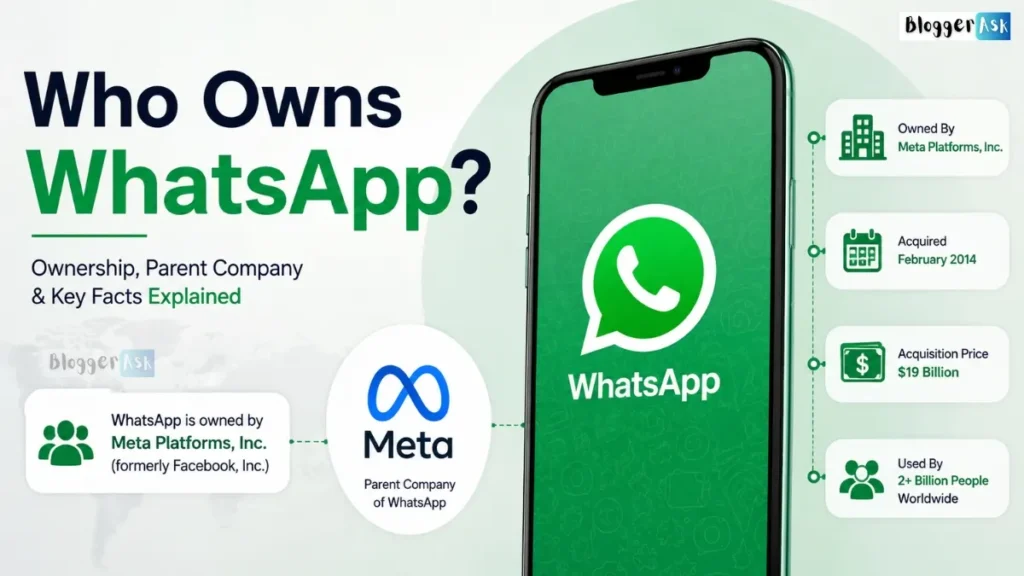
WhatsApp is owned by Meta Platforms, Inc. — the same company that owns Facebook and Instagram. Meta bought WhatsApp in February 2014 for about $19 billion. Since then, WhatsApp has run as a wholly owned Meta subsidiary, keeping its own name and app while Meta controls the business behind it.
So who owns WhatsApp and Instagram? The same company: Meta. It bought Instagram in 2012 and WhatsApp in 2014, and both still run as separate apps under one parent.
Does Mark Zuckerberg own WhatsApp? Not directly. He controls Meta — and Meta owns WhatsApp.
Here’s the short version:
- Owner: Meta Platforms, Inc.
- Acquired: February 2014
- Deal value: ~$19 billion announced (it rose to about $22 billion by the time it closed)
- Founders: Jan Koum and Brian Acton — both have since left
- Runs it today: Kunal Shah, Head of WhatsApp since June 2026
- Users: Over 3 billion worldwide, with 500 million-plus in India, its biggest market
- Still its own app: Yes — WhatsApp was never merged into Facebook or Messenger
The rest of this guide covers what that ownership actually means, how it happened, who runs it now, and the two big legal fights testing what Meta can do with WhatsApp in 2026.
What “Owning WhatsApp” Actually Means
Ownership sounds like a one-word answer. But it really splits into three layers: who legally owns WhatsApp, who owns it economically, and who actually controls it. For WhatsApp, all three trace back to Meta — and, through Meta, to Zuckerberg.
Legal Ownership — WhatsApp as a Meta Subsidiary
WhatsApp is a wholly owned subsidiary of Meta. That means Meta holds 100% of WhatsApp’s shares. There’s no outside partner, no separate stock listing, and no independent board. Legally, WhatsApp is simply part of Meta.
What makes WhatsApp unusual is that Meta kept it running under its own name and app, instead of folding it into Facebook or Messenger.
Want to confirm it yourself? Open WhatsApp’s listing in the Apple App Store or Google Play. The developer is listed as Meta Platforms, Inc. That’s the fastest way to verify who owns it — about ten seconds, no article needed.
Economic Ownership — Meta’s Shareholders
Because WhatsApp has no public shares of its own, asking who owns it “economically” really means asking who owns Meta. And like most big public companies, Meta is mostly held by institutional investors — index funds, pension funds, and asset managers — on behalf of millions of ordinary savers. Zuckerberg holds a large personal stake, but institutions own the bulk. (For the full breakdown of Meta’s shareholders, see our guide to who owns Facebook.)
Operational Control — Zuckerberg’s Voting Power
This is the part most articles skip — and it’s the real answer to “does Zuckerberg own WhatsApp?”
Meta uses a dual-class share structure. Class A shares get one vote each. Class B shares — held mostly by Zuckerberg — get ten votes each. That’s how Zuckerberg controls roughly 61.2% of Meta’s voting power while owning only about 13% of the company by economic value.
So no, Zuckerberg doesn’t own WhatsApp in his own name. He controls Meta, and Meta owns WhatsApp. It’s indirect — but very real.
How Meta Came to Own WhatsApp (The 2014 Acquisition)
Facebook — renamed Meta in 2021 — acquired WhatsApp in February 2014. It was announced at around $16 billion in cash and stock, plus about $3 billion in restricted stock for WhatsApp’s team, for a headline figure near $19 billion. By the time the deal closed that October, Facebook’s stock had climbed, pushing the final value to roughly $22 billion — which is why you’ll sometimes see that number instead.
At the time, it was the largest acquisition of a venture-backed startup in history.
Who Founded WhatsApp
Jan Koum and Brian Acton, both former Yahoo engineers, founded WhatsApp in 2009. The idea started small. Koum wanted an app that showed a status next to your contacts’ names. Messaging got added almost as an afterthought — then took over.
It grew fast. By the time Facebook came calling, WhatsApp had about 450 million monthly users and a famously lean team — reportedly around 50 employees serving hundreds of millions of people. That efficiency was a big part of its appeal.
So who owned WhatsApp before Facebook? Its two founders and its investors — most notably Sequoia Capital, WhatsApp’s only venture backer. Sequoia invested about $60 million over a few rounds. That stake was worth roughly $3 billion when the deal closed — one of the best returns in venture capital history.
Why Facebook Wanted It
Growth was the simple answer. WhatsApp was adding more than a million users a day, with especially strong traction outside the US — in markets where SMS was expensive and WhatsApp’s low-data messaging filled a real gap.
Facebook had already bought Instagram in 2012 and had tried, and failed, to buy Snapchat. WhatsApp fit the pattern: a fast-growing app that could become a serious rival if it kept growing alone.
The Real Deal Terms — Announced vs. What Closed
A lot of articles round this to “$19 billion” without explaining it. Here’s the actual breakdown, from Facebook’s 2014 announcement:
| Component | Amount |
|---|---|
| Cash | ~$4 billion |
| Facebook stock (Class A shares) | ~$12 billion |
| Restricted stock for WhatsApp founders/employees | ~$3 billion (vesting over 4 years) |
| Total announced | ~$19 billion |
| Value at closing (Oct 2014) | ~$22 billion (Facebook stock rose) |
That $3 billion in restricted stock wasn’t paid for the company itself — it was compensation to keep WhatsApp’s team around after the sale. Most summaries blur that line, which hides a real distinction: what was paid for the company versus what was paid to retain its people.
What Happened to the Founders After the Sale
Both WhatsApp co-founders eventually left Meta — and neither exit was quiet.
Brian Acton left first, in 2017, walking away from unvested stock reportedly worth hundreds of millions. Jan Koum followed in 2018. Both spoke publicly about friction with Meta over how it wanted to monetize WhatsApp and use data for ads — a clash with the privacy-first philosophy WhatsApp was built on.
Acton didn’t just leave. In February 2018, he put $50 million of his own money into launching the Signal Foundation, the nonprofit behind Signal — a rival encrypted messaging app. It’s hard to read that as anything but a pointed statement about the platform he’d helped build. Signal has since become one of the most-recommended alternatives for people who specifically want out of Meta’s ecosystem.
Who Runs WhatsApp Today?
As of mid-2026, WhatsApp is led by Kunal Shah, who became Head of WhatsApp in June 2026. Note the title: WhatsApp doesn’t have a standalone “CEO” — it has a Head who reports up into Meta. So if you’re searching for WhatsApp’s CEO, this is the role you mean.
Shah took over from Will Cathcart, who had led WhatsApp since 2019. Shah is best known as the founder of Cred, a major Indian fintech built around credit-card bill payments. His appointment came alongside a separate $900 million Meta-led investment in Cred, making Meta a minority investor. Shah has said that arrangement gives Meta no access to Cred’s user data.
Why this hire, and why now? It’s a bet on WhatsApp’s next chapter: payments, business messaging, and commerce — especially in India, WhatsApp’s largest market with over 500 million users. Shah’s fintech background points straight at that goal.
Cathcart isn’t leaving Meta. He’s moving to a new role building products from scratch, including AI work. Under him, WhatsApp grew past three billion users and expanded end-to-end encryption to group chats and linked devices.
One thing worth stating plainly: running WhatsApp is not the same as owning it. Shah sets day-to-day strategy. Ownership and ultimate control still sit with Meta — and, through Meta, with Zuckerberg.
Is WhatsApp Part of Meta’s Other Apps? (Instagram, Facebook, Messenger)
Yes. WhatsApp, Instagram, Facebook, Messenger, and Threads are all owned by Meta — a group Meta calls its “Family of Apps.” Each keeps its own brand and interface, but they all report up through one corporate structure and, in places, share infrastructure like safety and account tools.
| App | Origin | Year | Separately branded? |
|---|---|---|---|
| Built in-house | 2004 | Yes | |
| Acquired (~$1 billion) | 2012 | Yes | |
| Acquired (~$19 billion) | 2014 | Yes | |
| Messenger | Split from the Facebook app | 2011–2014 | Yes |
| Threads | Launched in-house | 2023 | Yes |
None of these apps have been merged into one product. That’s deliberate — each serves a different audience, and forcing them together would likely lose users, not gain them. For the deeper stories, see our guides to who owns Instagram and who owns Facebook.
How Much Is WhatsApp Worth?
Here’s a question competitors love to answer with a confident number — so let’s be honest instead. Meta does not report WhatsApp’s value or revenue separately. WhatsApp’s results are folded into Meta’s broader “Family of Apps” segment, alongside Facebook and Instagram.
That means any exact dollar figure you see is a third-party estimate, not an official one. With that caveat:
- Users: Over 3 billion monthly users worldwide — one of the most-used apps on Earth.
- Standalone value: Older third-party estimates have pegged WhatsApp’s worth in the tens of billions, but these are analyst guesses, not Meta disclosures.
- Revenue: Independent trackers have estimated WhatsApp Business revenue in the low billions of dollars a year — a small slice of Meta’s total, but a fast-growing one.
The honest takeaway: WhatsApp is clearly worth a great deal to Meta as a growth engine — especially in payments and business messaging — but treat any precise valuation as an estimate, not a fact.
Does Meta Owning WhatsApp Mean It Can Read Your Messages?
No — not under normal circumstances. WhatsApp uses end-to-end encryption on personal and group chats. That means your messages are scrambled so that, by design, only you and the person you’re messaging can read them. Meta says repeatedly that it cannot read encrypted messages.
But that claim is now being challenged in court — and it’s worth understanding both sides.
In May 2026, Texas Attorney General Ken Paxton sued Meta and WhatsApp, alleging the company misrepresented how private its messages really are. The suit leans on whistleblower accounts and a Commerce Department inquiry, both claiming some employees and contractors — including staff at the consulting firm Accenture — had broader access to message-related data than WhatsApp’s marketing suggests.
A separate federal class action, filed in California in January 2026, made similar claims. On July 9, 2026, a federal judge ordered that case into individual arbitration, so it won’t proceed as a public class action for now. A related US-user case was dismissed with leave to amend on July 24, 2026 — meaning those plaintiffs can refile with stronger evidence. The Texas lawsuit is separate and continues in state court.
| The allegation | Meta’s response | |
|---|---|---|
| Texas AG lawsuit (May 2026) | WhatsApp’s “your messages are private” marketing misrepresents what the company can actually access, based on insider accounts | WhatsApp says it cannot access people’s encrypted messages and calls any suggestion otherwise false |
Here’s the nuance that usually gets lost. Even when message content is encrypted, ownership still gives Meta access to metadata — the information around your messages. That includes:
- Who you message, and when
- Your phone number and profile details
- Your device and how often you use the app
- How WhatsApp links to your other Meta accounts
Encryption protects what you say. Ownership can still shape what’s known about who you say it to. That gap is the real source of much of the unease about Meta owning WhatsApp.
A practical privacy tip: if privacy matters to you, turn off chat backups to iCloud or Google Drive — or enable WhatsApp’s encrypted backups. Standard cloud backups are stored outside WhatsApp’s end-to-end encryption by default, which is an easy detail to miss.
This is an active legal dispute, not a settled fact in either direction. Expect it to keep developing.
WhatsApp’s Legal and Regulatory Status (Mid-2026)
No court has ordered Meta to sell or separate WhatsApp. But two major legal fights are alive, and both could eventually affect how WhatsApp is owned or run.
The FTC Antitrust Case — Could WhatsApp Be Broken Up?
It’s possible, but far from decided. The US Federal Trade Commission sued Meta in December 2020, arguing that buying Instagram and WhatsApp was a strategy to illegally protect a monopoly in “personal social networking” — snapping up rising rivals before they could challenge Facebook.
After a long trial, Judge James Boasberg ruled in Meta’s favor in November 2025, finding Meta doesn’t hold monopoly power given competition from TikTok and YouTube.
The FTC didn’t quit. It filed a notice of appeal on January 20, 2026, and in late May 2026 asked the D.C. Circuit Court of Appeals to reverse the ruling — arguing the lower court asked the wrong question by focusing on whether Meta is a monopoly today, rather than whether it became one through the 2012 and 2014 acquisitions.
The appeal drew real weight fast. Attorneys general from 28 states and the District of Columbia, plus the American Antitrust Institute, filed briefs backing the FTC in late May 2026. Meta’s response was due in August 2026.
Current status: pending at the D.C. Circuit Court of Appeals. No divestiture has been ordered, and none is imminent — but the case is genuinely unresolved, not dead. Appeals like this commonly take a year or more.
The EU’s €225 Million Privacy Fine — Still Being Fought
Separately, Ireland’s Data Protection Commission fined WhatsApp €225 million in September 2021 for failing to properly disclose how it shares data with other Meta companies — a breach of the EU’s GDPR transparency rules. A further €5.5 million fine followed in 2023.
WhatsApp has contested the penalty for years. In February 2026, the European Court of Justice ruled that WhatsApp does have the right to challenge the fine, sending the matter back to a lower tribunal.
Current status: the fine stands, but it’s not finally settled — it’s back in the legal process as of mid-2026.
How Ownership Shapes the Way WhatsApp Makes Money
Being owned by Meta doesn’t mean WhatsApp runs ads in your chat inbox the way Facebook and Instagram do in your feed. Instead, Meta mainly monetizes WhatsApp Business.
Here’s what that looks like in practice:
- A local business uses a WhatsApp Business account to confirm bookings automatically.
- A large retailer runs its entire support line through WhatsApp instead of email or phone.
- A brand runs “Click-to-WhatsApp” ads that open a chat window instead of a landing page.
So who owns WhatsApp Business? The same company — Meta. It’s not a separate company; it’s a product line, owned and run exactly like the main app.
Pricing changed in mid-2025. As of July 1, 2025, Meta bills per delivered message rather than per 24-hour conversation, according to Meta’s own developer docs. Rates depend on the message type — marketing, utility, or authentication — and the country. Because rates shift often, check Meta’s current Business Platform pricing page directly if you’re costing this out for a company.
Meta doesn’t break out WhatsApp’s standalone revenue, so treat any specific dollar figure quoted elsewhere as an estimate, not an official number.
Key Takeaways
- Meta Platforms, Inc. owns WhatsApp outright, as a wholly owned subsidiary — not “Facebook,” which renamed itself Meta in 2021.
- Ownership has three layers: legal (Meta owns 100%), economic (Meta’s shareholders, mostly institutions), and control (Zuckerberg, via ~61.2% voting power from dual-class shares).
- Meta bought WhatsApp in February 2014 for about $19 billion (roughly $22 billion at closing) — then the biggest venture-backed acquisition ever.
- Both founders left — Acton in 2017, Koum in 2018 — and Acton went on to fund Signal, a privacy-focused rival.
- Kunal Shah became Head of WhatsApp in June 2026, but leadership isn’t ownership — Meta still owns and controls the app.
- WhatsApp’s legal status is unresolved on two fronts: an active FTC antitrust appeal and an EU privacy fine still in the courts, plus separate US lawsuits over its encryption claims.
Conclusion
So, who owns WhatsApp? Meta Platforms — plainly and legally. But the useful answer sits underneath that one. Ownership here comes in layers, and right now two separate legal fights are actively testing what that ownership lets Meta do.
If you came here worried about privacy, the honest answer is this: encryption protects your message content, but ownership still gives Meta visibility into things encryption doesn’t cover — and that exact gap is being argued in court. Treat this as a topic to revisit, not a settled fact. The FTC appeal, the Texas and California cases, and the EU fine are all still moving.
FAQs
Does Mark Zuckerberg own WhatsApp?
Not directly. Zuckerberg controls Meta through dual-class shares that give him about 61.2% of the vote, and Meta owns WhatsApp. So he controls WhatsApp indirectly, through its parent — he holds no personal stake in WhatsApp itself.
Is WhatsApp still owned by Facebook, or is it Meta now?
It’s Meta. Facebook renamed itself Meta Platforms in 2021. It’s the same company that bought WhatsApp in 2014 — just under a new name.
Who owns WhatsApp and Instagram?
Both are owned by Meta. Meta acquired Instagram in 2012 and WhatsApp in 2014, and runs them as separate apps under one parent company.
Why are people moving away from WhatsApp?
The most common reasons are concerns about Meta’s data practices, the ongoing legal fights over its encryption claims, and a preference among some users for apps not owned by a major ad company — which is part of why alternatives like Signal have grown.
What is the downside of using WhatsApp?
The main concerns are Meta’s ownership and data-sharing, the metadata WhatsApp collects even with encrypted content, and open legal questions about how private it really is. It also requires a phone number to sign up, which some privacy-focused users dislike.
Who owns WhatsApp Business?
Meta. WhatsApp Business isn’t a separate company — it’s a product line owned and run by Meta, just like the standard app.
Could Meta be forced to sell WhatsApp?
It’s possible but far from decided. The FTC is appealing a ruling that went in Meta’s favor, and such appeals commonly take a year or more. No divestiture has been ordered as of mid-2026.
Is Amazon owned by a foreign country?
No — and neither is WhatsApp. Meta is an American company listed on the Nasdaq. No government holds an ownership or controlling stake in WhatsApp or Meta.
📖 Continue Reading:
Sources & References
- Meta Investor Relations — Facebook to Acquire WhatsApp (Feb. 19, 2014)
- Meta Newsroom — Facebook to Acquire WhatsApp
- U.S. Securities and Exchange Commission — Facebook, Inc. Form 10-Q, FY2014
- TechCrunch — Sequoia’s Big Win in Facebook’s WhatsApp Acquisition (2014)
- TechCrunch — Signal Foundation Launches with $50M from Brian Acton (2018)
- CNBC — Meta’s WhatsApp Head to Step Down, Replaced by Kunal Shah (June 22, 2026)
- TechCrunch — WhatsApp Gets New Chief as Meta Taps Kunal Shah (June 22, 2026)
- Bloomberg — Meta Names Cred Founder Kunal Shah as New Global Head of WhatsApp (June 2026)
- Federal Trade Commission — FTC Appeals Ruling in Meta Monopolization Case (Jan. 20, 2026)
- Ireland’s Data Protection Commission — Decision on WhatsApp GDPR inquiry (Sept. 2, 2021)
- The Irish Times — WhatsApp’s Fight Against €225M Fine Sent Back to Lower Tribunal (Feb. 2026)
- Texas Office of the Attorney General — AG Paxton Files Lawsuit Against Meta and WhatsApp (May 21, 2026)
- ClassAction.org — Meta, WhatsApp Compel Arbitration in Message Privacy Class Action (updated July 2026)
- Meta for Developers — Pricing on the WhatsApp Business Platform
Disclaimer
This article covers ongoing litigation and regulatory proceedings that had not reached a final resolution as of publication. Legal statuses described here — including the FTC antitrust appeal, the Texas lawsuit, the California cases, and the EU privacy fine — are subject to change and may have moved on by the time you read this. Nothing here is legal advice; for a specific legal question, consult a qualified attorney. Facts were last verified on 01 August, 2026.

Olivia Isabel is a Business & Technology Writer specializing in corporate ownership, company leadership, shareholders, acquisitions, and the business strategies behind major global companies. Her work covers technology, artificial intelligence, social media, finance, e-commerce, automotive, and consumer technology, with a particular focus on explaining who owns, controls, and leads well-known companies.
With a background in Economics and Journalism, Olivia approaches each topic as a research-driven business story. She examines company filings, investor-relations materials, regulatory records, official corporate announcements, and reputable financial sources to distinguish between legal ownership, economic ownership, voting control, and day-to-day management.
Her articles explore the founders behind major companies, current CEOs, significant shareholders, parent companies, subsidiaries, acquisitions, and changes in corporate structure. She has written about companies including Google, Alphabet, Apple, Microsoft, Amazon, Meta, OpenAI, Tesla, SpaceX, YouTube, Instagram, TikTok, WhatsApp, Reddit, Spotify, and other major technology and consumer brands.
Olivia’s goal is to make complicated corporate and financial information clear, accurate, and useful for everyday readers. She is particularly interested in corporate strategy, technology business models, entrepreneurship, emerging AI companies, public markets, and the evolution of globally recognized brands.