⚡ Quick Answer: Who Owns Tesla?
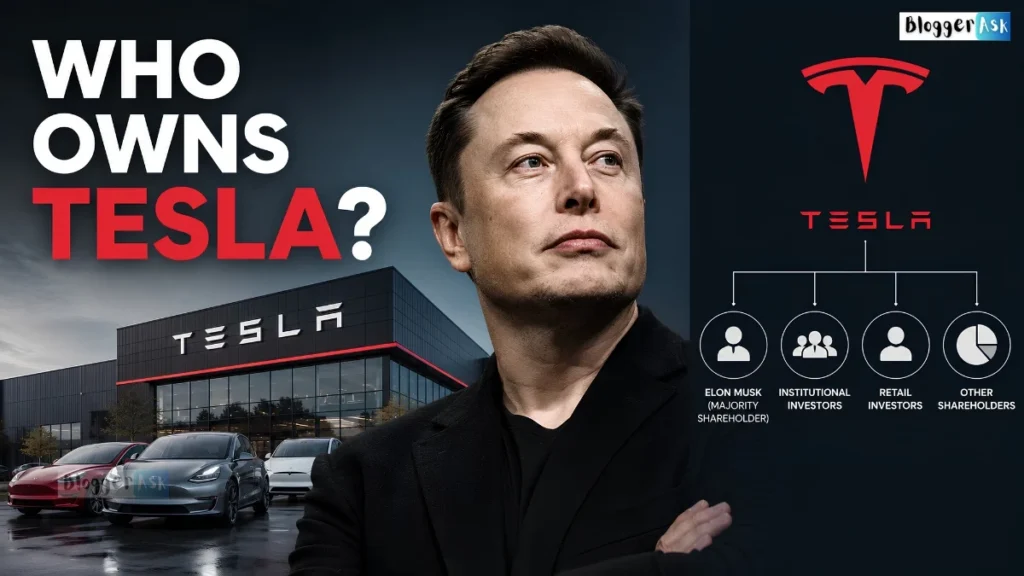
No single person or entity owns Tesla. It’s a publicly traded company (Nasdaq: TSLA), and anyone with a brokerage account can buy a piece of it.
Elon Musk is the largest individual shareholder. His beneficial ownership sits at approximately 19.9% — about 699.6 million shares — according to his mid-2026 SEC filing. That’s a sharp rise from roughly 13–15% a year earlier, because he won a two-year court fight over his 2018 pay package and exercised the restored stock options on June 16, 2026.
Institutional investors collectively own more than Musk does. Vanguard, BlackRock, State Street, and thousands of other funds together hold more of Tesla than any individual, Musk included.
Nobody holds majority control — not Musk, not any institution. Tesla uses a single class of stock where every share gets one vote, so there’s no legal mechanism for outsized control the way there is at companies like Meta or Alphabet.
So the honest, two-part answer: Musk doesn’t own Tesla outright, but between his stake, his role as CEO, and a board that has consistently backed him, he has more practical influence over the company than anyone else alive.
Introduction
“Who owns Tesla?” sounds like it should have a one-word answer. It doesn’t.
Tesla is a $1.4-trillion public company with a shareholder base that includes index funds, pension managers, day traders, and one famously outspoken CEO — and depending on which headline you read, that CEO’s stake gets reported anywhere from 12% to 28%. Neither number is necessarily wrong. They’re just measuring different things, on different dates, using different rules.
This guide breaks Tesla’s ownership down the way a securities filing would: precisely, with dates attached, and with the difference between owning a company, voting on it, and running it kept clearly separate. We’ll also cover the two questions that come up almost as often as ownership itself — whether Musk actually founded Tesla (he didn’t), and what else he owns now that SpaceX has gone public and swallowed his AI company whole.
Every figure below is traced to a primary source — Tesla’s own SEC filings, court records, or its official investor materials — and dated so you can judge for yourself how current it still is when you’re reading this.
Key Takeaways
- Tesla is publicly traded (Nasdaq: TSLA). No single person or institution owns it outright.
- Elon Musk is the largest individual shareholder — about 19.9% on a beneficial-ownership basis (mid-2026), up from roughly 13–15% a year earlier.
- The 2026 jump came from a court win, not open-market buying. The Delaware Supreme Court restored Musk’s 2018 pay package in December 2025; he exercised the options in June 2026.
- Institutions — Vanguard, BlackRock, State Street, and thousands more — collectively hold more of Tesla than Musk does.
- No one, including Musk, holds majority ownership or majority voting control. Every TSLA share carries one vote; there’s no dual-class structure.
- Musk did not found Tesla. Martin Eberhard and Marc Tarpenning did, in 2003. Musk joined in 2004 as an investor and chairman, then became CEO in 2008.
- A separate 2025 pay package, worth up to roughly $1 trillion over a decade if Tesla hits steep milestones, could push Musk’s stake toward ~25% — but he doesn’t count those shares as owned yet.
- Robyn Denholm, not Musk, has chaired Tesla’s board since 2018, a structural result of Musk’s SEC settlement that year.
- Tesla reincorporated in Texas in 2024, so Texas law now governs its corporate disputes.
- Musk’s other major company, SpaceX, went public in June 2026 and had already absorbed his AI company, xAI, months earlier — a structural change that changes the accurate answer to “what else does Musk own.”
Tesla At a Glance
| Fact | Detail |
|---|---|
| Company | Tesla, Inc. |
| Stock symbol | TSLA |
| Exchange | Nasdaq |
| Company type | Public |
| State of incorporation | Texas (reincorporated from Delaware in 2024) |
| CEO | Elon Musk |
| Board Chair | Robyn Denholm |
| CFO | Vaibhav Taneja |
| Founded | 2003 |
| Original founders | Martin Eberhard, Marc Tarpenning |
| Legally recognized co-founders (5) | Eberhard, Tarpenning, Elon Musk, JB Straubel, Ian Wright |
| Largest individual shareholder | Elon Musk (~19.9%, mid-2026 SEC filing) |
| Majority owner | None |
| Market capitalization | ~$1.4 trillion (late August 2026) |
| Share price | ~$355 (late August 2026) |
| FY2025 revenue | ~$94.8 billion |
| FY2025 vehicle deliveries | ~1.64 million (down from ~1.79 million in 2024) |
Market cap and share price move constantly — check a live source like Nasdaq’s TSLA listing for the current number.
Who Founded Tesla? (It Wasn’t Elon Musk)
This is the single most common misconception about Tesla, and it’s worth clearing up before anything else, because it colors how people read every ownership figure that follows.
Tesla was founded in July 2003 by Martin Eberhard and Marc Tarpenning — not by Elon Musk. Eberhard and Tarpenning had previously built one of the first e-readers together before turning to electric vehicles.
Musk joined Tesla in February 2004, leading the company’s Series A funding round with about $6.5 million of the roughly $7.5 million raised. He came in as chairman and lead investor — not as a founder in the original sense.
Eberhard was ousted as CEO in 2008 amid disputes over cost control and strategy; Musk took over the role that same year and has held it ever since.
Why the confusion persists: Musk has referred to himself as a Tesla “founder” for years, and a 2009 legal settlement with Eberhard formally recognized him as one of five legally designated co-founders: Eberhard, Tarpenning, Musk, JB Straubel, and Ian Wright. That settlement makes “co-founder” technically accurate for Musk — but it’s a legal designation reached through litigation, not a description of who started the company. Straubel, Tesla’s former CTO, still sits on Tesla’s board today.
Bottom line: Eberhard and Tarpenning started Tesla. Musk invested early, took control, and built it into the company it is today. Both things are true.
What Changed in 2026 (Start Here)
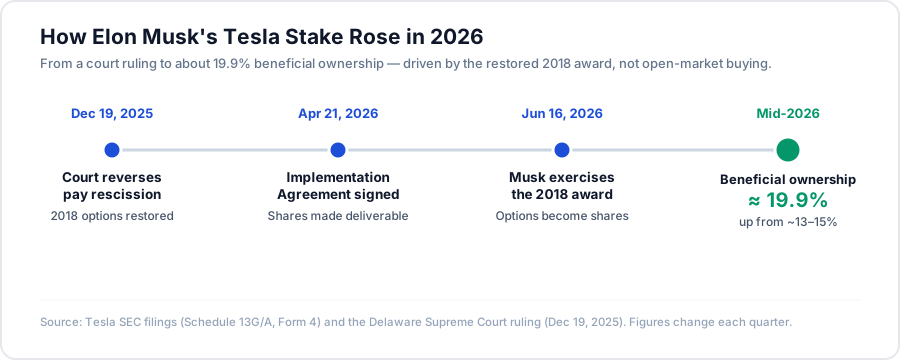
If you’ve seen a “who owns Tesla” piece published before mid-2026, its numbers are stale. Musk’s stake moved more in the first half of 2026 than in the previous three years combined. Here’s the timeline.
| Date | What Happened | Why It Matters |
|---|---|---|
| Nov 6, 2025 | Shareholders approved a new, separate performance pay package worth up to ~$1 trillion over 10 years. | This is a different, forward-looking award — not the one that raised Musk’s stake in June 2026. |
| Dec 19, 2025 | The Delaware Supreme Court reversed the lower-court ruling that had voided Musk’s 2018 pay package. | His disputed 303.9 million options were restored. |
| Feb 2, 2026 | SpaceX acquired xAI in an all-stock deal, valuing the combined company at roughly $1.25 trillion. | A separate Musk company merger — unrelated to Tesla, but frequently confused with it. |
| Apr 21, 2026 | Tesla’s board signed an Implementation Agreement to deliver the restored 2018 shares. | The court win became real, deliverable stock. |
| Jun 12, 2026 | SpaceX went public on the Nasdaq under ticker SPCX, pricing at $135/share and closing its first day up 19%. | A different Musk company, publicly traded for the first time — see our guide to Who Owns SpaceX. |
| Jun 16, 2026 | Musk exercised the restored 2018 options: 303,960,630 shares at a $23.34 strike price. | The options converted into shares he now beneficially owns. |
| Jul 6, 2026 | xAI was formally dissolved as a standalone entity and folded into SpaceX, rebranded internally as “SpaceXAI.” | Grok and X (formerly Twitter) are now part of SpaceX, not a separate xAI company. |
| Result | Musk’s SEC beneficial ownership of Tesla rose to about 19.9%. | Up from roughly 13–15% in mid-2025. |
Note: These numbers shift every quarter, and litigation can resurface. Treat any single percentage — including the ones in this article — as a dated snapshot, not a permanent fact.
Tesla’s Ownership Breakdown
Answering who owns Tesla in any real detail means starting with how its shares split into three broad buckets:
- Institutional investors — asset managers, pension funds, mutual funds, and ETFs. The largest bucket by share count, but spread across thousands of firms.
- Insiders — Musk plus other executives and directors, mostly holding stock granted as compensation.
- Retail investors — everyday people buying shares through a brokerage account.
Trackers typically put the split somewhere near 40–45% institutional, 25–30% insider, and 25–30% retail — though as you’ll see in the “Why Percentages Vary” section below, different data providers report meaningfully different splits depending on how they classify shares and which filing date they use. This moves every quarter as institutions rebalance and equity awards vest.
Full Shareholder Table
| Holder | Type | Approx. % of Tesla | As of |
|---|---|---|---|
| Elon Musk | Insider (CEO) | ~12% common stock; ~19.9% beneficial (incl. restored 2018 award) | Mid-2026 SEC filing |
| Vanguard Group (combined) | Institutional | ~5.6–7.7% (varies by Vanguard filer) | 2026 filings |
| BlackRock | Institutional | ~5.5–6% | 2026 filings |
| State Street Global Advisors | Institutional | ~3–3.4% | 2026 filings |
| Geode Capital Management | Institutional | ~1.5–2% | 2026 filings |
| Larry Ellison | Individual (former director) | Estimates vary widely by source and date — see note below | 2025–2026 filings |
| Kimbal Musk | Insider (director) | <0.1% | 2026 filings |
| Vaibhav Taneja (CFO) | Insider | <0.1% | 2026 filings |
| All other institutions (thousands) | Institutional | ~25–30% combined | 2026 filings |
| Retail investors | Public float | ~25–30% combined | 2026 estimate |
A live example of why sources disagree: One financial data platform lists Larry Ellison — Oracle’s founder, a former Tesla director from 2018–2022, and a longtime Musk ally — at roughly 0.08% of Tesla as of a recent snapshot. A separate source from late 2025 puts him closer to 1.4%. Forbes reports he held about 45 million split-adjusted shares when he left Tesla’s board in 2022. All three could be accurate; they’re just capturing different holding entities or different dates. This is exactly the kind of discrepancy explained in the “Why Percentages Vary” section further down.
Musk’s figures come from Tesla’s SEC filings — Form 4, the 10-Q, the proxy, and his mid-2026 Schedule 13G/A.
How Much of Tesla Does Elon Musk Own?
Short answer: about 19.9% on the standard SEC beneficial-ownership basis (mid-2026 filing).
But “how much” has three honest answers, and they differ substantially. Most headlines don’t say which one they’re using — so let’s be precise.
1. Common stock: ~413 million shares (~12%)
Musk directly holds 413,152,109 shares of ordinary common stock, through the Elon Musk Revocable Trust — about 12% of Tesla’s roughly 3.5 billion shares outstanding. These are shares he can vote, sell, or pledge freely. It’s the cleanest “what has he owned all along” figure.
2. SEC beneficial ownership: ~699.6 million shares (~19.9%)
This is the number Tesla reports to regulators, and the one most sites headline.
On top of his common stock, Musk’s beneficial ownership now includes the 2018 award he won back in court. Under the April 2026 Implementation Agreement, that award was delivered as about 286 million restricted shares (with a service-based vesting condition).
413,152,109 (common) + ~286,428,773 (restored 2018 award) = 699,580,882 shares ≈ 19.9%
That figure comes from Musk’s mid-2026 Schedule 13G/A.
Why it jumped in 2026: Until December 2025, those ~304 million options sat in legal limbo — a Delaware court had voided them in the 2024 Tornetta v. Musk ruling. The Delaware Supreme Court reversed that decision, Tesla delivered the shares, and Musk exercised them on June 16, 2026 at a $23.34 strike price. So “~18–20%” is no longer a bet on a pending case. It’s settled, and it’s on the record in a specific, dated transaction.
3. Fully diluted (conditional): up to ~25%+
Musk’s stake could climb toward 25% — the level he’s said he wants for strategic control — if his separate, giant 2025 pay award vests over the next decade.
The catch: Musk currently disclaims those shares. They’re locked under a voting agreement and irrevocable proxy, so he doesn’t count them as owned yet. It’s a ceiling, not a current holding.
The three measures, side by side
| Measure | Shares | % of Tesla | What it counts |
|---|---|---|---|
| Common stock | 413,152,109 | ~12% | Long-held shares in the Musk Revocable Trust |
| SEC beneficial ownership | 699,580,882 | ~19.9% | Common stock + restored 2018 award (mid-2026) |
| Fully diluted (conditional) | up to +423.7M more | ~25%+ target | If the 2025 award vests over ~10 years (disclaimed today) |
Expert tip: None of these three numbers is “wrong” — they answer different questions. Want what Musk owns outright? ~12%. Want the standard disclosed figure regulators and most press use? ~19.9%. Want his long-run ambition if everything vests? ~25%+, clearly labeled as conditional.
What is 19.9% actually worth? At Tesla’s roughly $1.4 trillion market cap in late August 2026, Musk’s ~699.6 million beneficially owned shares are worth somewhere in the neighborhood of $245–255 billion. For scale, that’s larger than Larry Ellison’s roughly $139 billion Oracle stake — though it’s smaller than Musk’s own ~42% SpaceX position, which is worth substantially more on paper following SpaceX’s June 2026 IPO. That figure moves with the stock price daily, so treat it as a rough order of magnitude rather than a precise net-worth number.
For context: in mid-2025, before the court win, Musk’s stake was often cited at 13–15%. Part of that lower figure traces back to 2022, when he sold approximately $23 billion in Tesla shares — largely to help fund his $44 billion acquisition of Twitter (now folded into X). The rise since the December 2025 ruling comes almost entirely from the restored equity award, not open-market buying. He did buy about 2.57 million shares for roughly $1 billion on September 12, 2025 — his first open-market purchase since February 2020 — but at that size, it barely moved his percentage.
The 2025 Pay Package (and the ~25% Question)
TL;DR: In November 2025, shareholders approved a 10-year, up-to-$1-trillion performance award — 423.7 million shares in 12 tranches. It only vests if Tesla hits extremely steep milestones, and Musk disclaims most of it for now. This is the mechanism behind his ~25% goal.
On November 6, 2025, Tesla shareholders approved a new performance-based pay package — potentially the largest in corporate history. It passed with more than 75% of votes in favor.
Note the distinction: the board proposed it, but the shareholders approved it — a detail that matters for the governance debate below.
The milestones, and where Tesla actually stands
| Milestone | Target | Status as of August 2026 |
|---|---|---|
| Market capitalization | $8.5 trillion | ~$1.4 trillion — roughly 16% of the way there |
| Cumulative vehicle deliveries | 20 million | Tesla delivered ~1.64 million vehicles in FY2025 alone; cumulative lifetime deliveries remain well under half the target |
| Optimus humanoid robots delivered | 1 million | Production has not yet reached commercial scale |
| Robotaxis in commercial operation | 1 million | Limited commercial robotaxi service has launched in select markets; nowhere near 1 million vehicles |
| Active Full Self-Driving subscriptions | 10 million | Below target; exact current subscriber counts aren’t broken out separately in public filings |
| Plus | Escalating profit goals | Ongoing |
Musk must also stay CEO for at least 7.5 years to vest any of it. Miss the targets, and the shares simply don’t vest — there’s no partial credit built in for effort.
This is the mechanism that could eventually push Musk toward ~25%. But it’s relative dilution — everyone else’s slice shrinks proportionally as his grows — not a stock purchase. And it only converts into real ownership if Tesla keeps hitting these targets over the next decade.
The disagreement: the package was controversial. Proxy advisory firms ISS and Glass Lewis — independent firms that advise institutional investors on how to vote — urged shareholders to vote no, and Norway’s sovereign wealth fund publicly opposed it. On the other side, ARK Invest’s Cathie Wood defended the package, and Board Chair Robyn Denholm pushed back hard on the proxy advisors, arguing their standardized model didn’t fit a company like Tesla. Shareholders ultimately sided with the board.
One clarification: because Musk won the 2018 case, a fallback award Tesla had prepared in case he lost became moot. He kept the original 2018 package instead of needing the backup.
Tesla’s Largest Institutional Shareholders
The three biggest institutional holders are consistently the same names:
- Vanguard Group — ~5.6–7.7% (depending on which specific Vanguard entity you count)
- BlackRock — ~5.5–6%
- State Street Global Advisors — ~3–3.4%
Together, these three hold well over 14% of Tesla — more than Musk’s common stock alone (~12%) and comparable to his full beneficial stake.
What institutional ownership actually means. It’s tempting to read “BlackRock owns 6%” as a bold strategic bet on Tesla. Mostly, it isn’t. Vanguard, BlackRock, and State Street hold Tesla primarily through index funds and ETFs that track benchmarks like the S&P 500 and Nasdaq-100. Tesla sits in those indexes, so these funds hold it automatically — not out of conviction, but because the funds are built to mirror the market.
“Passive” doesn’t mean powerless, though. These firms still vote on shareholder proposals — including executive pay — and at their scale, those votes matter. Tesla’s board lobbied large institutional investors directly ahead of the November 2025 pay vote. Think of institutional ownership as automatic market exposure, not a deliberate wager on Musk personally.
Who Owns Tesla Stock? (Retail, Institutional, and Index Funds Explained)
This question gets asked slightly differently than “who owns Tesla” — people asking specifically about Tesla stock are usually trying to understand the mechanics of how shares get distributed, not just who the biggest names are. Here’s the direct breakdown.
Anyone can own Tesla stock. It trades on the Nasdaq under TSLA, and any brokerage account — Fidelity, Schwab, Robinhood, or dozens of others — can buy shares with no special access required.
Tesla’s roughly 3.5 billion outstanding shares (its “free float,” since there’s no separate controlling class) break down into three groups:
- Institutional shareholders (~40–45%) — mutual funds, pension funds, and ETFs, led by Vanguard, BlackRock, and State Street. Most of this is passive, index-tracking ownership.
- Insiders (~25–30%) — primarily Musk, plus other executives and directors holding equity granted as compensation.
- Retail investors (~25–30%) — individual people. Tesla has one of the largest retail shareholder bases of any public company, driven partly by brand loyalty and Musk’s outsized social-media following.
Why the exact split varies by source: Some financial data platforms classify shares differently — a few report retail ownership as high as 70% by excluding certain insider or index-fund categories from their “institutional” bucket. If you see wildly different retail/institutional splits across two sites, check whether they’re using the same definition of each category before assuming one is wrong.
A structural fact that matters here: Tesla has never paid a dividend. Every category of shareholder — institutional, insider, or retail — makes money only if the share price rises, not through payouts. That’s relevant context for understanding why proxy votes on pay and governance get so much attention from every ownership tier: with no dividend, share-price performance and governance quality are the only levers shareholders have.
Ownership vs. Voting Control vs. Operational Control
This framework resolves almost all the confusion around Tesla’s ownership — and most articles on this topic skip it entirely.
“Ownership,” “voting power,” and “control” are three separate things at Tesla. No single person or group holds all three at a majority level simultaneously.

| Type of Control | What It Means | Who Has the Most |
|---|---|---|
| Economic ownership | Your share of profits, dividends, and liquidation value | Institutions, collectively (~40%+) |
| Voting control | Your share of votes on board seats, pay, and major proposals | No majority; Musk holds the largest single bloc, but institutions combined outweigh him if they vote together |
| Operational control | Day-to-day authority over direction | Elon Musk, as CEO |
The crucial detail: Tesla has a single class of common stock — every share carries one vote. That’s unlike Meta or Alphabet, where founders hold special high-vote shares that let them control the company with a fraction of the economic ownership.
So Musk’s outsized influence doesn’t come from special voting rights. It comes from three things stacked together:
- Being the largest individual shareholder — more votes than any other single person.
- Holding the CEO role, which gives operational authority regardless of vote share.
- A board that has consistently backed him, including through legal fights over his pay.
Nobody — Musk included — holds a majority stake or majority voting control. If institutions voted as a unified bloc against him, they could theoretically outvote him. In practice, that’s rare and hard to coordinate across thousands of firms with different mandates. But it does happen at the margins: the November 2025 pay vote drew real, organized opposition, including from Norway’s sovereign wealth fund and both major proxy advisory firms.
How Tesla’s Ownership Structure Compares to Other Automakers
Part of what makes “who owns Tesla” a more interesting question than it first appears is how unusual Tesla’s “no controlling shareholder, single class of stock” setup is among car companies. Seeing it next to peers makes the structure easier to judge.
| Company | Largest shareholder | Approx. stake | Share structure |
|---|---|---|---|
| Tesla | Elon Musk (individual, CEO) | ~19.9% (beneficial) | Single class — one share, one vote |
| Lucid Motors | Saudi Arabia’s Public Investment Fund | ~57% | Effectively controlled by one sovereign investor |
| Polestar | Li Shufu (via Geely, Volvo Cars, and personal holdings) | ~60.5% | Effectively controlled by one individual/group |
| Ford Motor Company | The Ford family | ~2% economic stake, but ~40% of voting power | Dual-class stock (Class B shares carry outsized votes) |
| General Motors | No single controlling shareholder | Widely held | Single class |
What this comparison shows: Tesla is closer to General Motors’ “no controlling shareholder” model than it is to Lucid or Polestar, where one investor or family effectively calls the shots through majority or supermajority ownership. It’s also structurally different from Ford, where the founding family keeps outsized control through a special high-vote share class despite owning a small economic slice of the company.
Musk’s influence at Tesla is real, but — unlike at Ford, Lucid, or Polestar — it isn’t backed by any special legal mechanism. It rests entirely on the size of his ordinary stake, his CEO role, and the board’s support, all of which could theoretically shift.
Tesla’s Board of Directors and Governance
Who’s on the board
Per Tesla’s most recent proxy filings, the board includes:
- Elon Musk — CEO (director since 2004)
- Robyn Denholm — Board Chair (director since 2014)
- Ira Ehrenpreis — Founder and managing partner of DBL Partners (director since 2007)
- Joe Gebbia — Co-founder of Airbnb (director since 2022)
- James Murdoch — Former CEO of Twenty-First Century Fox (director since 2017)
- Kimbal Musk — Elon’s brother (director since 2004)
- JB Straubel — Tesla’s former CTO and co-founder (director since 2005, rejoined 2023)
- Kathleen Wilson-Thompson — Former Chief HR Officer of Walgreens Boots Alliance (director since 2018)
- Jack Hartung — Senior advisor at Chipotle (director)
Board composition changes through annual shareholder votes, so check Tesla’s latest proxy statement for the current roster before citing it elsewhere.
For balance: some shareholder groups and public pension funds have opposed re-electing certain directors, citing the board-independence concerns documented in the 2024 Tornetta ruling. Tesla’s board defends its independence and has continued recommending these directors for re-election. It’s a genuine, ongoing governance debate — not a settled question — and it bears directly on how much real check the board provides on Musk’s influence.
Why Robyn Denholm is Chair, not Musk
Most ownership breakdowns skip this, but it explains a real structural fact: Musk is not Tesla’s board chair.
In 2018, the SEC charged Musk with securities fraud over a tweet claiming he had “funding secured” to take Tesla private — a deal that never happened. In the settlement, Musk agreed to step down as chairman while remaining CEO, and Tesla added independent directors along with tighter oversight of his public statements. Robyn Denholm, on the board since 2014, became Chair in November 2018.
So the chair role exists partly as an independent check on Musk — by regulatory requirement, not by informal custom.
The Texas reincorporation
One structural change that’s easy to miss: Tesla is no longer a Delaware company. After the Delaware Chancery Court voided Musk’s 2018 pay package in January 2024, Tesla reincorporated in Texas later that year. That’s why Tornetta v. Musk was fought in Delaware in the first place — the dispute began while Tesla was still incorporated there. Going forward, Texas law and Texas courts govern Tesla’s corporate disputes.
The staggered board
Tesla’s board splits into three classes with staggered three-year terms, so only about a third of directors face election in any given year. This is a common corporate structure that makes it harder for any single shareholder — or coalition of shareholders — to replace the board quickly. Unseating a majority of directors takes more than one election cycle.
What Other Companies Does Elon Musk Own?
“Who owns Tesla” and “what companies does Musk own” are closely related questions, and the answer to the second one changed meaningfully in 2026. Here’s the current, accurate picture.
| Company | Musk’s role | Ownership status | Public/Private |
|---|---|---|---|
| Tesla | CEO | ~19.9% beneficial ownership | Public (Nasdaq: TSLA) |
| SpaceX | Founder & CEO | ~42% ownership; controls over 80% of voting power through super-voting shares | Public (Nasdaq: SPCX, since June 12, 2026) |
| xAI / Grok / X (formerly Twitter) | Founder (xAI); owner (X) | Now a division of SpaceX, not a separate company | Owned by SpaceX (see below) |
| Neuralink | Founder & CEO | Majority stakeholder | Private |
| The Boring Company | Founder & CEO | Majority stakeholder | Private |
| Musk Foundation | Co-founder (with Kimbal Musk) | Nonprofit; funded largely with donated Tesla stock | Private/nonprofit |
What changed and needs correcting from older coverage: For most of 2025, X (formerly Twitter) operated as a subsidiary of xAI, Musk’s AI company, after xAI acquired X in an all-stock deal in March 2025. That structure no longer exists. SpaceX acquired xAI outright in an all-stock deal that closed February 2, 2026, valuing the combined entity at roughly $1.25 trillion ($1 trillion for SpaceX, $250 billion for xAI). Then, on July 6, 2026, xAI was formally dissolved as a standalone company and folded into SpaceX as an internal division informally referred to as “SpaceXAI” — meaning Grok and X are now part of SpaceX’s corporate structure, not a separate xAI entity.
In plain terms: if you’re asking “what does Musk own,” the accurate 2026 structure is Tesla (separate, public) and SpaceX (public, and now encompassing the former xAI and X businesses) — not three or four disconnected companies.
A quick contrast worth noting: unlike Tesla’s single-class, one-share-one-vote structure, SpaceX uses a dual-class share arrangement that gives Musk voting control (over 80%) far exceeding his roughly 42% economic stake. This is exactly the kind of “super-voting” mechanism Tesla does not have — a useful real-world example of the ownership-vs-voting distinction described earlier in this article, playing out differently at Musk’s other company.
Why Tesla–SpaceX merger speculation exists: Since SpaceX’s June 2026 IPO, some market commentary has floated the idea of a future Tesla-SpaceX tie-up, partly because both are now public companies led by the same person. As of late August 2026, nothing official has been announced by either company. Treat any merger talk as speculation, not settled fact, and verify against each company’s own investor-relations announcements before relying on it.
Why Tesla Ownership Percentages Vary Across Sources
Searched this topic before? You’ve probably seen Musk’s stake listed anywhere from ~12% to ~28%, sometimes within the same month. Here’s why — with real, current examples.
- Different definitions. “Ownership” can mean common stock (~12%), beneficial ownership including the restored 2018 award (~19.9%), or a conditional fully diluted figure including the disclaimed 2025 award (~25%+). All three can be accurate simultaneously — they measure different things. Most articles never specify which one they’re using.
- Whether the 2025 award is counted. Some trackers add all 423.7 million award shares from the 2025 pay package and report figures approaching 28–29%. But Musk disclaims those shares — they’re unvested and locked under a voting agreement. Counting them today overstates his actual current stake. One financial data platform, for instance, currently lists Musk at 28.44% (roughly 1.12 billion shares) — a figure that appears to include award shares beyond the standard 19.9% beneficial-ownership basis most primary reporting uses.
- Filing dates and lag. Data comes from periodic filings — 10-Ks, proxies, Form 4, and 13F/13G reports, the last of which are filed quarterly and sometimes weeks late. A snapshot from Q1 and a snapshot from Q3 can look meaningfully different even if nothing dramatic happened between them.
- Different filers within one institution. Vanguard’s stake is cited anywhere from ~5.6% to ~7.7% depending on which specific affiliated entity is counted. Neither figure is wrong — you just need to know which filing you’re reading.
- The share-count denominator. Tesla’s 10-Q cover page reports the true period-end share count; some aggregators instead use a lower weighted-average diluted figure (an accounting number used for EPS calculations). Using the wrong denominator shifts every single percentage derived from it.
Takeaway: treat any “Musk owns X%” claim skeptically unless it states both a date and a definition. Without those two things attached, a figure isn’t necessarily wrong — it’s just incomplete.
Key Terms, Defined
A short glossary for terms used throughout this article, since several of them get used loosely elsewhere.
- Beneficial ownership — The SEC’s standard measure of how many shares a person effectively controls, including shares held directly plus certain options, warrants, or other rights to acquire shares. This is usually the headline figure in news coverage.
- Fully diluted ownership — A hypothetical measure assuming every outstanding option, award, and convertible security has vested and converted into shares. Useful for understanding a ceiling, not a current reality.
- Schedule 13D vs. 13G — Both are SEC filings disclosing large ownership stakes (generally 5%+). A 13D signals an “activist” intent to influence the company; a 13G is for passive investors (like most index funds) or, in some cases, insiders like Musk who aren’t seeking to change control through the filing itself.
- Say-on-pay vote — A shareholder vote on executive compensation. It’s typically advisory (non-binding) at most companies, but Tesla’s 2025 pay package vote was structured as a binding approval of the award itself.
- Free float — The portion of a company’s shares available for public trading, excluding closely held or restricted stock.
How to Verify Tesla’s Ownership Yourself
These numbers shift quarterly, so the reliable move is checking them directly — instead of trusting any single article, including this one. Tesla still files everything with the SEC, even as a Texas company.
Step 1: Go to SEC EDGAR (sec.gov/edgar) and search “Tesla,” or look up the company directly using its CIK number, 0001318605.
Step 2: Open the filing that matches what you need:
| You want to know… | Open this filing | Note |
|---|---|---|
| Musk’s exact current stake | His latest Schedule 13G/A | Mid-2026 filing shows 699,580,882 shares (~19.9%) |
| Insider ownership + explanatory footnotes | The latest DEF 14A (proxy statement) | Footnotes explain exactly which shares and options are counted |
| Musk’s buys/sells/option exercises | Form 4 filings | Filed within two business days of the transaction; shows the exact June 16, 2026 exercise |
| Institutional holdings | 13F/13G filings from Vanguard, BlackRock, State Street | Can lag up to 45 days; institutions only |
| Total shares outstanding | The 10-Q cover page | Use this as your percentage denominator |
Verification checklist:
- Confirm the filing date is recent (within the last quarter, ideally)
- Check whether the figure is “common stock,” “beneficial ownership,” or “fully diluted” — they’re not interchangeable
- Read the footnotes on any beneficial-ownership figure — they list exactly which options and awards are included
- Cross-check the share-count denominator against the most recent 10-Q, not an older filing
- Note the source and date whenever you cite a percentage elsewhere
Timing heads-up: Tesla’s full annual proxy can sometimes lag. In spring 2026, Tesla updated its director-and-insider ownership disclosures through a 10-K/A amendment rather than issuing a fresh proxy — so if the latest DEF 14A on file looks outdated, check EDGAR for a more recent 10-K/A as well.
Expert tip: The single most useful document is a proxy statement footnote — it spells out exactly which options and awards are baked into a beneficial-ownership number. Checking a primary filing takes a few minutes and gives you a figure with a real date and a defined method attached, rather than a number copied from another article.
Does Elon Musk Control Tesla?
Short answer: not through ownership alone. Nobody owns enough of Tesla to control it that way — Musk included.
What makes his position unusual isn’t his percentage; it’s that three separate sources of influence happen to point the same direction at once: the largest individual voting bloc, the CEO’s day-to-day authority, and a board with a consistent track record of backing him through legal fights over his own pay. Take away any one of those three, and his position looks much closer to an ordinary large shareholder’s.
In 2026, that combined grip tightened somewhat — winning the 2018 case and exercising the shares lifted his voting position to ~19.9%, and his disclaimed 2025 award sits under a voting agreement that ties up an additional large block of votes even though he doesn’t yet own those shares outright.
The limits remain real, though. Institutions collectively hold more of the company than he does, and Tesla’s staggered board structure means no single actor — Musk included — could push through a governance overhaul in a single election cycle even if they wanted to.
The honest bottom line: Musk doesn’t own Tesla, and he doesn’t control it in the strict, legal, majority sense. But between his shares, his CEO role, and the board’s track record, he holds more practical sway over the company’s direction than any other single person or institution. That gap — between “large minority stake” and “outsized real-world influence” — is what most people are actually asking about when they ask who owns Tesla.
What Would Happen If Elon Musk Sold All His Tesla Shares?
This is a common hypothetical, and it’s worth answering directly since it’s rarely addressed elsewhere.
Mechanically, he could. His common stock (~12%) is his to sell freely; his beneficial-ownership shares from the restored 2018 award carry no restriction preventing a sale once vested and delivered. There’s no legal or contractual lock preventing Musk from selling his entire Tesla position, aside from standard insider-trading windows and disclosure rules that apply to any executive.
What it would likely mean for governance: Musk would immediately cease to be Tesla’s largest shareholder, and his outsized voting bloc would disappear. However, his role as CEO is not tied to his share ownership — Tesla’s bylaws don’t require the CEO to hold any particular stake. He could, in theory, sell every share and remain CEO, provided the board continued to support him. In practice, a full sale would almost certainly trigger a serious governance crisis and likely accelerate calls for his removal, given how much of his influence rests on being the largest shareholder as well as CEO.
What it would likely mean for the stock: A sale of that size — nearly 700 million shares — would be enormous relative to Tesla’s daily trading volume (roughly 20–40 million shares per day in recent periods) and would almost certainly be executed gradually, through a structured sale plan, rather than all at once, to limit market impact. Even so, a disclosed intent to exit entirely would likely trigger significant share-price volatility, given how closely Tesla’s stock has historically tracked Musk’s personal involvement and public statements.
Historical precedent: Musk has sold large blocks of Tesla stock before — roughly $23 billion worth in 2022, mostly to help fund his Twitter acquisition — without leaving the company or losing the CEO role. That episode suggests a full exit isn’t structurally impossible, but a sale of his entire stake would be an order of magnitude larger than anything he’s done previously, in a market environment that has grown even more sensitive to his personal actions.
Bottom line: it’s legally possible, would end his status as largest shareholder, but wouldn’t automatically end his role as CEO — though it would likely make that role considerably harder to hold onto in practice.
Common Misconceptions About Tesla Ownership
A quick-reference list of the mistakes this topic generates most often:
- “Elon Musk founded Tesla.” He didn’t — Eberhard and Tarpenning did, in 2003. Musk joined as an investor in 2004.
- “Musk owns a majority of Tesla.” He doesn’t. His beneficial ownership (~19.9%) is well short of the 50% threshold for majority control.
- “Institutional ownership means big investors are betting heavily on Musk.” Mostly not — the largest institutional holders own Tesla primarily through passive index funds that automatically hold any S&P 500 or Nasdaq-100 company.
- “Musk’s high vote share gives him special control, like at Meta or Alphabet.” Tesla has no dual-class structure. Every share carries exactly one vote; Musk’s influence comes from the size of his ordinary stake plus his CEO role, not from special voting rights.
- “Tesla is owned by China because it has a factory there.” No — Tesla operates a large plant (Gigafactory Shanghai) in China and sells heavily there, but manufacturing presence isn’t ownership. Tesla’s shares are held by U.S. and global public investors.
- “SpaceX and Tesla are the same company, or about to merge.” They’re entirely separate public companies. As of late August 2026, no merger has been announced by either.
Conclusion
Tesla is a publicly traded company owned by a mix of institutional investors, insiders, and retail shareholders — not by one person, and not by Elon Musk specifically.
Musk is the largest individual shareholder: about 12% in common stock, and roughly 19.9% on the standard SEC beneficial-ownership basis. That figure rose sharply in 2026 after he won back his 2018 pay package in a Delaware Supreme Court ruling and exercised the shares that June. It could climb toward ~25% if his separate 2025 performance award vests over the next decade — but that’s conditional on Tesla hitting extraordinarily steep milestones, and he disclaims most of those shares today. Meanwhile, institutions led by Vanguard, BlackRock, and State Street collectively hold more of Tesla than Musk does.
His real influence comes less from his ownership percentage and more from three things layered together: his role as CEO, his position as the single largest voting bloc, and a board that has consistently backed him — including through an independent chair role that exists specifically because of a 2018 SEC settlement.
If you see a different percentage cited elsewhere, it isn’t necessarily wrong. Check what it counts — common stock, beneficial ownership, or a fully diluted estimate — and check the date attached to it. That combination explains almost every discrepancy you’ll find on this topic.
Frequently Asked Questions
Who owns the most Tesla stock?
Elon Musk is the largest individual shareholder, at about 19.9% (mid-2026 SEC filing). Collectively, though, institutional investors — Vanguard, BlackRock, State Street, and thousands of others — own more of Tesla than Musk does.
Does Elon Musk own the majority of Tesla?
No. Musk doesn’t own a majority and doesn’t have majority voting control. His stake is roughly 19.9% on a beneficial-ownership basis — well short of the 50% threshold.
Did Elon Musk buy Tesla?
No — Musk didn’t buy Tesla in the sense of acquiring an existing company. He invested in Tesla’s Series A funding round in 2004, about a year after Martin Eberhard and Marc Tarpenning founded it, becoming chairman and lead investor. He later became CEO in 2008. His current ~19.9% stake reflects two decades of equity compensation and the restored 2018 pay award, not a single purchase.
Who is the real founder of Tesla?
Martin Eberhard and Marc Tarpenning founded Tesla in 2003. Elon Musk joined in 2004 as lead investor and chairman, then became CEO in 2008. A 2009 legal settlement formally recognized five co-founders: Eberhard, Tarpenning, Musk, JB Straubel, and Ian Wright.
Did Elon Musk win his Tesla pay case?
Yes. On December 19, 2025, the Delaware Supreme Court reversed the lower-court decision that had voided his 2018 pay package. Tesla then delivered the shares, and Musk exercised the award on June 16, 2026. That’s the main reason his stake rose in 2026.
Has Musk reached his 25% ownership goal?
Not yet. He’s at about 19.9% today. The path to ~25% runs through his separate 2025 performance award, which only vests if Tesla hits a decade of aggressive milestones — including an $8.5 trillion market cap, roughly six times its current value. For now, Musk disclaims most of those shares.
What would happen if Elon Musk sold all his Tesla shares?
He legally could — there’s no lock preventing it once shares are vested. He would cease to be Tesla’s largest shareholder and lose his outsized voting bloc, but his CEO role isn’t contractually tied to his share ownership. In practice, a full exit would likely trigger significant governance and market disruption, given how closely tied Musk’s involvement is to investor confidence in the stock.
Is Tesla owned by China?
No. Tesla is a U.S.-based, publicly traded company on the Nasdaq. It operates a large plant (Gigafactory Shanghai) in China and sells heavily there, but manufacturing in a country isn’t the same as being owned by it. Tesla’s shares are held by U.S. and global public investors.
Is SpaceX public now? Does Musk own it too?
Yes to both. SpaceX went public on the Nasdaq (ticker: SPCX) on June 12, 2026, with Musk as its largest shareholder (~42% ownership, over 80% of voting power via super-voting shares). It’s a separate company from Tesla. Musk’s AI venture, xAI — along with X, formerly Twitter — is now part of SpaceX’s corporate structure, following a February 2026 acquisition and a July 2026 restructuring. Owning Tesla stock gives you a stake in Tesla only, not in Musk’s other companies.
Are Tesla and SpaceX merging?
There’s been public speculation about a tie-up since SpaceX’s June 2026 IPO, partly because both are now public companies led by the same person. As of late August 2026, nothing official has been announced by either company. Treat merger talk as speculation, not fact, until confirmed by an official filing or announcement.
Can Tesla shareholders fire Elon Musk?
In theory, yes — the board can remove a CEO, and shareholders elect the board. In practice, it would be very difficult. Tesla’s staggered board slows any rapid change, Musk holds the largest single voting bloc, and the board has consistently supported him. It’s structurally possible but practically unlikely without broad, coordinated institutional action.
Does Tesla pay dividends?
No. Tesla has never paid a dividend on its common stock; it reinvests earnings into growth instead. Every shareholder — institutional, insider, or retail — makes money only if the share price rises.
What is Tesla’s market capitalization?
Tesla’s market cap moves constantly with its share price. As of late August 2026, it sits around $1.4 trillion. For a live figure, check a market-data source such as Tesla’s Nasdaq listing rather than relying on a static article.
📖 Continue Reading:
Sources & Verification
Primary sources (Tesla’s own SEC filings, via SEC EDGAR, CIK 0001318605):
- Form 10-Q — shares outstanding.
- DEF 14A proxy statement — director and insider beneficial ownership, including explanatory footnotes. See Tesla’s 2025 definitive proxy statement.
- Form 4 — Musk’s insider transactions, including the June 2026 option exercise.
- Schedule 13G/A — Musk’s mid-2026 beneficial-ownership amendment reporting 699,580,882 shares (~19.9%). See the Schedule 13G/A filing summary.
- Form 10-K/A — Tesla’s spring 2026 amendment updating Part III ownership details. See the Form 10-K/A.
Institutional holdings: Schedule 13F/13G filings from Vanguard, BlackRock, and State Street.
2025 pay package: Tesla 2025 proxy materials and the November 6, 2025 annual-meeting vote results.
2018 pay-package litigation:
- Delaware Court of Chancery, Tornetta v. Musk (2024); reversed by the Delaware Supreme Court on December 19, 2025. Opinion available at the Delaware Courts website.
- News coverage of the ruling: CNBC, “Musk’s 2018 Tesla pay package must be restored, Delaware court rules”.
- Analysis: Harvard Law School Forum on Corporate Governance.
SpaceX IPO: CNBC’s SpaceX IPO coverage (June 12, 2026).
Disclaimer
This article is for informational purposes only and is not investment, legal, or financial advice. Ownership figures change with each new filing, and litigation or new equity awards can shift them further. Verify current numbers directly on SEC EDGAR before relying on them for any financial decision. Every ownership figure in this article is traced to a primary SEC filing or an official corporate announcement and dated to its source; the article is reviewed and updated on a quarterly cadence, or sooner if a material event (such as a court ruling or a new SEC filing) changes the underlying figures.

Olivia Isabel is a Business & Technology Writer specializing in corporate ownership, company leadership, shareholders, acquisitions, and the business strategies behind major global companies. Her work covers technology, artificial intelligence, social media, finance, e-commerce, automotive, and consumer technology, with a particular focus on explaining who owns, controls, and leads well-known companies.
With a background in Economics and Journalism, Olivia approaches each topic as a research-driven business story. She examines company filings, investor-relations materials, regulatory records, official corporate announcements, and reputable financial sources to distinguish between legal ownership, economic ownership, voting control, and day-to-day management.
Her articles explore the founders behind major companies, current CEOs, significant shareholders, parent companies, subsidiaries, acquisitions, and changes in corporate structure. She has written about companies including Google, Alphabet, Apple, Microsoft, Amazon, Meta, OpenAI, Tesla, SpaceX, YouTube, Instagram, TikTok, WhatsApp, Reddit, Spotify, and other major technology and consumer brands.
Olivia’s goal is to make complicated corporate and financial information clear, accurate, and useful for everyday readers. She is particularly interested in corporate strategy, technology business models, entrepreneurship, emerging AI companies, public markets, and the evolution of globally recognized brands.