⚡ Quick Answer: Who Owns SpaceX?
Featured Snippet Summary
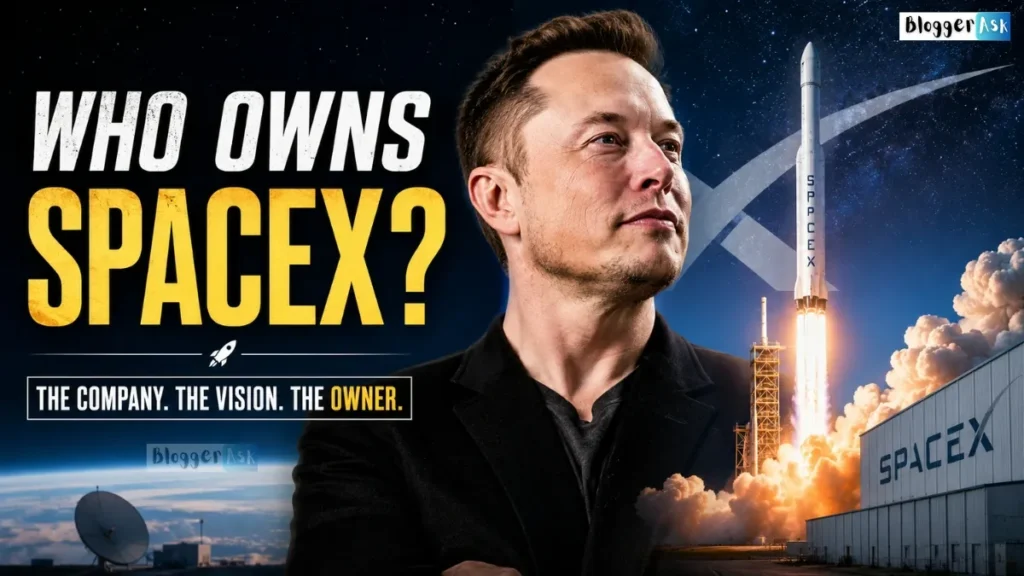
- Founder and CEO: Elon Musk, who started SpaceX in 2002
- Musk’s equity stake: approximately 42–43%
- Musk’s voting control: 83.8% (per SpaceX’s April 2026 confidential S-1 filing, confirmed by Bloomberg, CNBC, and Reuters)
- Other major shareholders: Alphabet (Google) ~7%, Fidelity, Founders Fund, Sequoia Capital, EchoStar, sovereign wealth funds
- Company type: privately held — not listed on any stock exchange
- Current valuation: approximately $1.25 trillion (post-xAI merger, February 2026)
- IPO status: widely reported for mid-2026 at a potential $1.5 trillion valuation
Introduction
SpaceX is the most valuable private company on Earth as of 2026. It builds rockets, operates the Starlink satellite internet network, and recently merged with Elon Musk’s artificial intelligence company xAI. But despite its size and global reach, SpaceX does not trade on any public stock exchange. So who actually owns it?
The short answer: Elon Musk is the founder, CEO, and largest shareholder. He holds roughly 42% of SpaceX’s equity and controls 83.8% of its voting rights through a dual-class share structure (per SpaceX’s April 2026 confidential S-1 filing, confirmed by Bloomberg, CNBC, and Reuters). That level of control makes him the undisputed decision-maker, even as hundreds of institutional investors, sovereign wealth funds, and employees also hold stakes in the company.
This article covers the full SpaceX ownership picture as of May 2026 — who owns what, how the structure works, what the company is worth, and what the upcoming IPO could mean for ordinary investors.
Who Founded SpaceX and When?
Space Exploration Technologies Corp — known as SpaceX — was founded on March 14, 2002, by Elon Musk. At the time, Musk had recently sold his stake in PayPal to eBay for roughly $1.5 billion. He invested approximately $100 million of his own money into SpaceX at founding, taking nearly 100% of the equity in exchange.
His stated goal was to reduce the cost of space travel and eventually make humanity a multi-planetary species by establishing a self-sustaining colony on Mars. Few investors took that vision seriously in 2002. Musk’s willingness to fund it personally meant he did not need outside investors early on — which is a key reason he still holds such a dominant stake more than two decades later.
The company is headquartered at Starbase, Texas — a facility SpaceX built from the ground up near Boca Chica, on the Gulf Coast. It now employs over 14,000 people and conducts more orbital launches per year than any other company or national space program in the world.
Elon Musk’s Stake: How Much of SpaceX Does He Own?
As of May 2026, Elon Musk holds an estimated 42–43% equity stake in SpaceX. At the company’s current $1.25 trillion valuation (post-xAI merger), that stake is worth approximately $520–540 billion on paper — making SpaceX the single largest component of Musk’s total net worth, which Forbes estimates above $852 billion.
Equity vs. voting control: Musk’s 42% equity is already dominant for a company that has raised tens of billions from external investors. But the more important number is his voting power. Through a dual-class share structure — where his shares carry significantly more votes per share than standard shares — According to SpaceX’s April 2026 confidential S-1 filing, confirmed independently by Bloomberg, CNBC, and Reuters, Musk controls 83.8% of all SpaceX voting rights. That means he can single-handedly approve or block any major corporate decision, including a future IPO, mergers, or board appointments.
For context: Meta’s Mark Zuckerberg controlled roughly 58% of Facebook’s voting power at the time of its 2012 IPO. Musk’s 83.8% is significantly higher than that — a structure that gives him near-absolute authority even as the shareholder base has expanded dramatically.
SpaceX Ownership Structure Explained
SpaceX uses a dual-class share structure — a common mechanism in founder-led technology companies. Here is how it works in plain terms:
- Class A shares: standard shares held by external investors and employees. Each share carries a limited number of votes.
- Founder/supervoting shares: held by Musk. Each share carries a much larger number of votes per share.
- Result: Musk controls 83.8% of votes while holding 42.5% of the economic ownership (source: SpaceX April 2026 confidential S-1, per Bloomberg/Reuters).
This structure means that even if every other investor voted together against Musk on a resolution, they could not outvote him. He retains full operational and strategic control regardless of how the external shareholder base grows.
Equity vs. Voting Rights: Side-by-Side
| Stakeholder | Equity % | Voting Control % |
| Elon Musk (founder) | 42.5% (SEC filing) | 83.8% (SEC filing) |
| Alphabet (Google) | ~7% | ~2–3% |
| Fidelity Investments | ~2% | <1% |
| Founders Fund | <2% | <1% |
| Sequoia Capital | <2% | <1% |
| EchoStar | Significant (post-2025 deal) | <2% |
| Employees (RSUs/options) | Meaningful, undisclosed | Minimal |
| Other institutional investors | Remaining | Minimal |
Note: All figures are estimates based on public reporting. SpaceX has never filed public financial statements.
Who Are the Other Major Shareholders of SpaceX?
SpaceX has raised capital across multiple funding rounds since its early years. Each round brought in new investors, gradually diluting Musk’s equity stake from near 100% in 2002 to roughly 42% today — while his voting control has remained dominant throughout.
Alphabet (Google) — ~7%
Alphabet, the parent company of Google, holds one of the largest external stakes in SpaceX — estimated at around 7%. This investment dates to 2015, when Google and Fidelity jointly led a $1 billion Series F round. At current valuations, Alphabet’s position is worth over $80 billion — far exceeding the original investment.
Fidelity Investments — ~2%
Fidelity entered alongside Google in the 2015 round and remains a major institutional holder. Its Contrafund alone held approximately $2.7 billion in SpaceX shares as of early 2025. Fidelity is notable as one of the few traditional asset managers with meaningful access to pre-IPO SpaceX equity.
Founders Fund — <2%
Peter Thiel’s Founders Fund was an early backer, entering in 2008 when SpaceX was still recovering from three failed Falcon 1 launches. That early-stage bet has since grown into one of the fund’s best-performing investments.
Sequoia Capital and Andreessen Horowitz
Sequoia participated in SpaceX’s 2021 Series J round. Andreessen Horowitz (a16z) led a $750 million raise in January 2023 that valued SpaceX at $137 billion. Both firms hold stakes below 2% each.
EchoStar — New major shareholder (2025)
In September 2025, SpaceX agreed to acquire EchoStar’s spectrum for $17 billion in a cash and stock transaction. As part of this deal, EchoStar received up to $8.5 billion in SpaceX Class A shares at $212 per share, making it one of the largest new shareholders in the company. EchoStar subsequently created an entirely new division — EchoStar Capital — specifically to manage this position.
Sovereign Wealth Funds
Several Middle Eastern sovereign wealth funds joined SpaceX’s 2023 financing rounds, including Saudi Arabia’s Public Investment Fund and the Abu Dhabi Investment Authority. Following the February 2026 xAI merger, new investors including Nvidia, Cisco, Qatar Investment Authority, and Abu Dhabi’s MGX also became SpaceX shareholders through the all-stock transaction.
Employees
SpaceX grants equity to employees through stock options and restricted stock units (RSUs). The company conducts regular tender offers — organized secondary market sales — that allow employees and early investors to sell shares without waiting for an IPO. These tender offers serve two purposes: they provide liquidity, and they establish new price marks that update the company’s implied valuation.
What Is SpaceX’s Current Valuation?
SpaceX’s valuation has risen faster than almost any private company in history. Here is the trajectory:
| Year / Event | Implied Valuation |
| January 2023 (a16z-led round) | $137 billion |
| Late 2023 (tender offer) | $150–210 billion |
| December 2024 (tender offer) | $350 billion |
| February 2026 (xAI merger announcement) | $1.0 trillion (SpaceX alone) |
| February 2026 (combined entity) | $1.25 trillion |
| Reported IPO target (mid-2026) | $1.5 trillion |
The February 2026 xAI merger (confirmed by CNBC, Bloomberg, and TechCrunch) — structured as an all-stock triangular merger — was the highest-valued private company acquisition in history. It valued SpaceX at $1 trillion and xAI at $250 billion, producing a combined entity worth $1.25 trillion.
SpaceX’s valuation is driven by two primary assets. First, Starlink — its satellite internet constellation of over 6,000 active satellites serving more than 4 million subscribers across 100+ countries as of early 2026. Starlink is the company’s largest and fastest-growing revenue source. Second, the Starship program — SpaceX’s fully reusable super-heavy lift rocket system, which is seen as the eventual backbone of both commercial space transport and NASA’s Artemis lunar program.
Revenue estimates for 2025 range from $13 billion to $16 billion. SpaceX has never published audited financial statements, so all figures are analyst estimates derived from public filings in jurisdictions where SpaceX has registered subsidiaries.
Is SpaceX a Private Company? Can You Buy SpaceX Stock?
Yes, SpaceX is a private company. Its shares do not trade on the NYSE, Nasdaq, or any other public stock exchange. Ordinary retail investors currently cannot buy SpaceX stock through a standard brokerage account.
However, there are limited ways that certain investors can gain exposure:
- Secondary markets: Platforms such as Forge Global, EquityZen (a Morgan Stanley subsidiary), and Nasdaq Private Market allow accredited investors to buy SpaceX shares from existing holders. These platforms are not open to retail investors — they require proof of accredited investor status.
- Tender offers: SpaceX periodically organizes internal tender offers where employees and early investors can sell shares to approved buyers. The December 2024 tender priced shares at $185 each, implying a $350 billion valuation.
- Indirect exposure: Alphabet (Google) holds roughly 7% of SpaceX. Investors who hold Alphabet shares have some indirect exposure to SpaceX’s performance, though it represents a small portion of Alphabet’s overall business.
If the reported IPO proceeds in mid-2026, it would be the first time retail investors can buy SpaceX shares directly. Multiple financial news sources including the Financial Times and Reuters, have cited June 2026 as the likely listing window, potentially at a $1.5 trillion valuation and raising up to $50 billion. However, SpaceX has not confirmed any IPO timeline, and Musk has a history of discussing IPO plans without committing to firm dates.
SpaceX IPO: Will SpaceX Go Public?
SpaceX going public has been discussed for years. In December 2025, SpaceX CFO Bret Johnsen issued a shareholder memo confirming the company was actively preparing for a possible public offering in 2026, while cautioning that timing remained uncertain.
The February 2026 xAI merger added complexity and urgency to the IPO question. The combined company — which now includes Starlink broadband, Grok AI products, SpaceX rockets, and an indirect stake in the social media platform X — is what would go public if the IPO proceeds as reported. Analysts note that consolidating these high-growth assets on a single balance sheet simplifies investor disclosures for a public filing.
The reported IPO valuation of $1.5 trillion would make it the largest IPO in history, surpassing Saudi Aramco’s 2019 listing at $1.7 trillion — though at a far higher price-to-revenue multiple. At $1.5 trillion on estimated 2025 revenues of $13–16 billion, SpaceX would trade at roughly 90–115x revenue, an aggressive multiple even by high-growth technology standards.
Key risks that prospective IPO investors should be aware of: regulatory scrutiny of xAI (investigations in Europe, India, and California related to its Grok image generator), capital intensity of proposed orbital AI data centers, and the concentration of control with a single founder whose attention is spread across multiple companies.
Frequently Asked Questions
Does Elon Musk fully own SpaceX?
No. Elon Musk does not fully own SpaceX. He holds an estimated 42–43% of the company’s equity. However, per SpaceX’s April 2026 confidential S-1 filing (confirmed by Bloomberg, CNBC, and Reuters), he controls 83.8% of the voting rights through supervoting shares, which means he has near-absolute decision-making authority over the company. Full ownership and voting control are different things — Musk has the latter without the former.
Does Tesla own SpaceX?
No. Tesla and SpaceX are completely separate companies with separate cap tables and separate corporate structures. The connection is that Elon Musk is the CEO of both. In April 2026, Tesla agreed to invest $2 billion in xAI — which is now a SpaceX subsidiary — so Tesla has an indirect financial interest in the combined SpaceX-xAI entity, but Tesla does not own SpaceX shares directly.
What percentage of SpaceX does Elon Musk own?
Elon Musk owns approximately 42–43% of SpaceX’s equity, based on credible estimates from Bloomberg, Forbes, and secondary market data. Because SpaceX is a private company, it is not required to disclose its cap table publicly. This percentage has been gradually diluted down from close to 100% in 2002 as the company has raised capital across multiple funding rounds.
Who owns SpaceX Starship?
SpaceX owns the Starship program. As a wholly owned division of SpaceX, Starship is not separately incorporated. All intellectual property, hardware, and launch facilities associated with Starship belong to SpaceX, which means the ownership flows up to SpaceX’s shareholders in proportion to their stakes — with Elon Musk as the dominant owner.
How can I invest in SpaceX before the IPO?
Retail investors currently cannot invest in SpaceX directly. Options for accredited investors include secondary market platforms such as Forge Global and EquityZen, which facilitate share purchases from existing employees and early investors. These platforms have minimum investment thresholds and require proof of accredited investor status. Ordinary investors can gain indirect exposure by purchasing shares in Alphabet, which holds roughly 7% of SpaceX. If the IPO proceeds as reported in mid-2026, retail investors will be able to buy shares directly through standard brokerages for the first time.
Is SpaceX more valuable than NASA?
NASA is a U.S. government agency with an annual budget of approximately $25 billion — it does not have a market valuation in the corporate sense. SpaceX, as a private company, has an implied valuation of $1.25 trillion as of May 2026. These two numbers are not directly comparable because NASA’s ‘value’ includes decades of public-funded assets, intellectual property, and infrastructure that does not appear on any balance sheet. What is comparable is scale: SpaceX now conducts more orbital launches per year than NASA and any other launch provider globally.
Who owned SpaceX before Elon Musk?
Elon Musk founded SpaceX in 2002 and has been its only controlling owner since inception. There was no previous owner. He started the company with approximately $100 million of personal capital from his PayPal exit. Unlike companies that are acquired or spun off from larger corporations, SpaceX was built from scratch by Musk — making this question inapplicable. However, over time, investors such as Founders Fund (2008), Google and Fidelity (2015), and others have purchased minority stakes.
Conclusion: Who Controls SpaceX?
SpaceX is primarily owned and completely controlled by Elon Musk. With 42.5% of the equity and 83.8% of the voting rights (per SpaceX’s SEC filing), he shapes every major decision the company makes — from launch schedules to the February 2026 merger with xAI that turned SpaceX into a $1.25 trillion combined entity.
The remaining equity is held by a mix of institutional investors (Alphabet, Fidelity, Sequoia), newer stakeholders (EchoStar, Middle Eastern sovereign wealth funds, Nvidia), and employees who hold RSUs and stock options. None of them, individually or collectively, can outvote Musk.
As of May 2026, SpaceX remains private. If the widely reported mid-2026 IPO proceeds at the estimated $1.5 trillion valuation, it will be the largest public offering in history — and the first time ordinary investors can participate directly in a company that has fundamentally reshaped how the world reaches orbit.
📖 Continue Reading:
Editorial note: Ownership percentages reflect SpaceX’s April 1, 2026 confidential S-1 filing (confirmed by Bloomberg, CNBC, Reuters, and The Wall Street Journal) (Musk: 42.5% equity, 83.8% voting control). Valuation figures are based on reporting by CNBC, Bloomberg, Reuters, and the Financial Times. SpaceX’s 2025 revenue of $18.67 billion and the $4.94 billion consolidated loss are per the S-1 prospectus. All figures are subject to change.

Olivia Isabel is a Business & Technology Writer specializing in corporate ownership, company leadership, shareholders, acquisitions, and the business strategies behind major global companies. Her work covers technology, artificial intelligence, social media, finance, e-commerce, automotive, and consumer technology, with a particular focus on explaining who owns, controls, and leads well-known companies.
With a background in Economics and Journalism, Olivia approaches each topic as a research-driven business story. She examines company filings, investor-relations materials, regulatory records, official corporate announcements, and reputable financial sources to distinguish between legal ownership, economic ownership, voting control, and day-to-day management.
Her articles explore the founders behind major companies, current CEOs, significant shareholders, parent companies, subsidiaries, acquisitions, and changes in corporate structure. She has written about companies including Google, Alphabet, Apple, Microsoft, Amazon, Meta, OpenAI, Tesla, SpaceX, YouTube, Instagram, TikTok, WhatsApp, Reddit, Spotify, and other major technology and consumer brands.
Olivia’s goal is to make complicated corporate and financial information clear, accurate, and useful for everyday readers. She is particularly interested in corporate strategy, technology business models, entrepreneurship, emerging AI companies, public markets, and the evolution of globally recognized brands.