
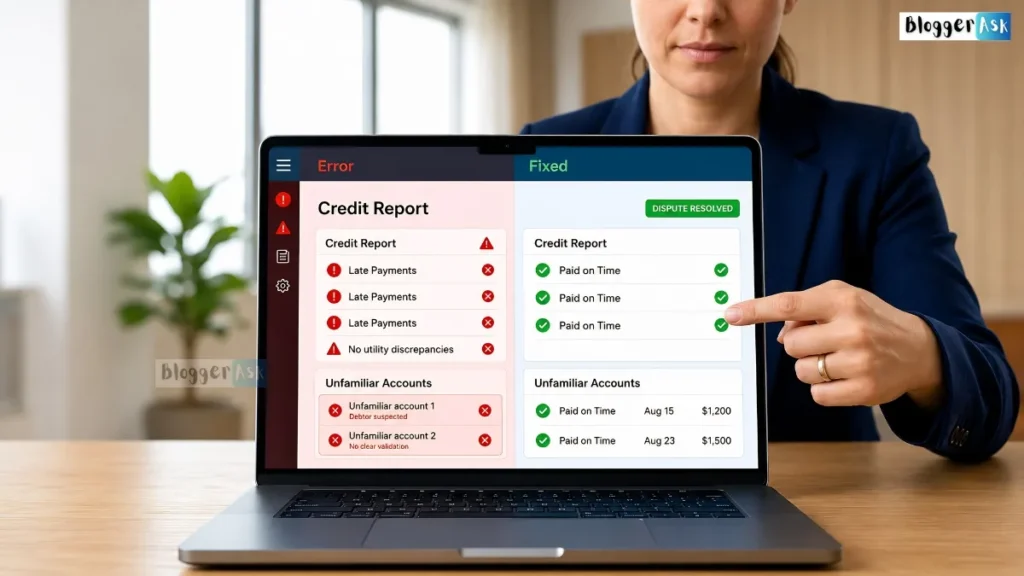
⚡ Quick Answer: How do you dispute errors on your credit report?
Pull your free reports at AnnualCreditReport.com, identify the error, gather supporting documents, and file a dispute directly with the bureau showing the mistake — online, by mail, or by phone.
- Disputing is always free — you never need to pay a credit repair company
- Bureaus must respond within 30 days under federal law
- If the bureau rejects your dispute — dispute with the data furnisher directly (most people skip this step)
- Filing a dispute does not hurt your credit score
👇 Full step-by-step process below — including ready-to-use dispute letter templates.
The Problem Is Bigger Than Most People Realize
One incorrect entry on your credit report is not a minor inconvenience. It can cost you a loan approval, a rental application, or thousands of dollars in higher interest rates — for an error you did not create.
Learning how to dispute errors on your credit report is now more important than ever. CFPB credit reporting complaints soared from approximately 1.3 million in 2023 to nearly 5 million in 2025. And the process of getting those errors fixed has become harder.
Experian resolved nearly 20% of complaints in consumers’ favor in 2024. In 2025, that figure fell to less than 1%. TransUnion’s relief rate dropped roughly 50% by October 2025.
This guide gives you the complete picture — how to file a dispute, what to do when bureaus reject it, and what your legal rights actually are.
What Counts as a Disputable Credit Report Error?
A disputable error is any inaccurate, incomplete, or unverifiable information on your credit report. You cannot dispute accurate negative information — only factual mistakes qualify.
Errors you can dispute:
- Payments marked late that you paid on time
- Accounts you never opened (possible identity theft)
- Wrong account balances or credit limits
- Closed accounts still listed as open
- Duplicate entries for the same debt
- Negative items older than 7 years still showing (10 years for bankruptcy)
- Personal information errors — wrong name, address, Social Security number
What you cannot dispute:
- Accurate late payments — even if you have since paid
- Valid collection accounts — if the debt is real
- Legitimate hard inquiries from applications you made
- Charge-offs that are correctly reported
⚠️ Important: Many credit repair companies charge fees to dispute accurate negative information. This is a waste of money — bureaus will reject those disputes, and the information stays on your report.
Step 1 — Pull Your Credit Reports from All Three Bureaus
Your first step is getting your actual credit reports — not just your credit score.
Go to AnnualCreditReport.com — the only federally authorized source for free credit reports. You can pull all three reports (Experian, TransUnion, Equifax) once per week at no cost.
What to review in each report:
| Section | What to Check |
| Personal Information | Name, address, SSN, date of birth — all must be accurate |
| Account Information | Balance, credit limit, payment status, open/closed status |
| Payment History | Every “late” marker — verify each one against your records |
| Negative Items | Dates — items older than 7 years should be removed |
| Inquiries | Hard inquiries only from applications you actually made |
| Public Records | Bankruptcies, judgments — verify accuracy and dates |
💡 Check all three bureaus separately. An error often appears on one report but not the others. If a lender pulls the bureau with the error, you lose — even if your other two reports are clean.
Step 2 — Gather Your Supporting Documents
Before filing, collect evidence that proves the error. Bureaus investigate faster and resolve more disputes when clear documentation is submitted upfront.
Documents by error type:
| Error Type | Documents Needed |
| Late payment you did not miss | Bank statement, payment confirmation, cleared check |
| Account you did not open | Identity theft report (IdentityTheft.gov), government ID |
| Wrong balance or limit | Recent statement from lender showing correct amount |
| Closed account showing open | Account closure letter from lender |
| Debt older than 7 years | Original delinquency date documentation |
| Duplicate account | Both account numbers documented, explanation letter |
Key rule: Send copies only — never originals. Documents will not be returned after dispute submission.
Step 3 — File Your Dispute (Online, Mail, or Phone)
You can dispute credit report errors three ways. Each has tradeoffs.
Option A: Online (Fastest)
Filing online is the quickest method and recommended for most disputes.
| Bureau | Dispute Portal |
| Equifax | equifax.com/personal/credit-report-services/credit-dispute/ |
| Experian | experian.com/disputes/main.html |
| TransUnion | transunion.com/credit-disputes/dispute-your-credit |
Steps for online filing:
- Create an account with the bureau
- Navigate to the dispute section
- Select the specific account or item with the error
- Choose your dispute reason from the menu
- Upload copies of your supporting documents
- Submit and save your confirmation number
Option B: Certified Mail (Strongest Paper Trail)
Mail disputes create a legal record — critical if you later need to escalate.
What to include in your envelope:
- Your dispute letter (template below)
- Copy of your credit report with the error circled or highlighted
- Copies of all supporting documents
- Copy of your government-issued ID
Send to:
| Bureau | Dispute Mailing Address |
| Equifax | Equifax Information Services, P.O. Box 740256, Atlanta, GA 30374 |
| Experian | Experian, P.O. Box 4500, Allen, TX 75013 |
| TransUnion | TransUnion Consumer Solutions, P.O. Box 2000, Chester, PA 19016 |
💡 Always send by certified mail with return receipt requested. This gives you proof the bureau received your dispute — which matters if you need to escalate later.
Option C: Phone
Phone disputes are accepted but not recommended as your primary method. You cannot upload documents over the phone, and there is no written record of what was said. Use this only to follow up on an existing dispute.
| Bureau | Dispute Phone Number |
| Equifax | (866) 349-5191 |
| Experian | (888) 397-3742 |
| TransUnion | (800) 916-8800 |
Ready-to-Use Credit Report Dispute Letter Templates
Template 1 — General Error Dispute Letter
[Your Full Name]
[Your Address]
[City, State, ZIP]
[Date]
[Bureau Name] — Dispute Department
[Bureau Address]
Re: Credit Report Dispute — Account Number [XXXX]
To Whom It May Concern,
I am writing to formally dispute the following inaccurate information
on my credit report. My identifying information is as follows:
Full Name: [Your Name]
Date of Birth: [MM/DD/YYYY]
Social Security Number (last 4 digits): XXXX
Current Address: [Your Address]
THE ERROR:
Account Name: [Creditor Name]
Account Number: [Account Number]
Error Description: [Describe exactly what is wrong —
e.g., “This account is listed as 30 days late in March 2024.
I made this payment on time. My bank statement dated March 15,
2024 confirms the payment was processed.”]
REQUESTED ACTION:
Please investigate this matter and [correct / remove] the inaccurate
information from my credit report.
I have enclosed the following documents to support my dispute:
– Copy of my credit report with the error highlighted
– [List each document you are including]
Under the Fair Credit Reporting Act, you are required to investigate
this dispute within 30 days of receipt. Please notify me in writing
of the results.
Sincerely,
[Your Signature]
[Your Printed Name]
Enclosures: [List all documents]
Template 2 — Account You Did Not Open (Identity Theft)
[Your Full Name]
[Your Address]
[City, State, ZIP]
[Date]
[Bureau Name] — Dispute Department
[Bureau Address]
Re: Fraudulent Account Dispute — Account Number [XXXX]
To Whom It May Concern,
I am writing to dispute a fraudulent account appearing on my credit
report that I did not open and do not recognize.
Account Name: [Creditor Name]
Account Number: [Account Number]
Issue: This account does not belong to me. I did not open this
account and have not authorized anyone to open it on my behalf.
I believe this is the result of identity theft.
I have enclosed the following:
– A copy of my FTC Identity Theft Report (IdentityTheft.gov)
– A copy of my government-issued ID
– My credit report with the fraudulent account highlighted
I am requesting that this account be removed from my credit report
immediately. Please block this information under Section 605B of the
Fair Credit Reporting Act.
Please provide written confirmation of the results of your
investigation within 30 days as required by law.
Sincerely,
[Your Signature]
[Your Printed Name]
Step 4 — Track Your Dispute Status
After filing, do not wait passively. Track your dispute through each bureau’s online account portal.
What dispute status updates mean:
| Status | What It Means |
| In Progress | Bureau is investigating |
| Updated / Corrected | Error confirmed — information corrected |
| Deleted | Item removed from your report |
| Verified / Remains | Bureau says information is accurate — dispute unsuccessful |
| Processed | Item was updated or deleted |
Timeline to expect:
| Timeframe | What Should Happen |
| Day 1–5 | Dispute received; confirmation sent |
| Day 5–30 | Bureau investigates; contacts data furnisher |
| Day 30 | Bureau must notify you of results |
| Day 30–45 | If you submitted additional info during investigation |
| Day 45–75 | Credit score updates to reflect any changes |
What If Your Dispute Is Rejected? (The Step Most People Skip)
This is the section that separates useful credit dispute guides from generic ones.
Since January 2025, more than 2.7 million credit reporting complaints submitted to the CFPB have gone without relief. Bureau rejections are at historic highs for Experian and TransUnion. If your dispute is rejected, you are not out of options.
Option 1: Dispute Directly with the Data Furnisher
The data furnisher is the company that reported the information to the bureau — your bank, lender, credit card issuer, or collection agency.
Why this works better than most people realize:
Under the Fair Credit Reporting Act, furnishers are independently required to investigate disputes and correct inaccurate information they reported. A furnisher that confirms an error must notify all three bureaus to update your report — regardless of what the bureau initially decided.
How to dispute with a furnisher:
- Find the furnisher’s dispute address on your credit report or their website
- Send a certified letter (same format as the bureau letter above)
- Include all supporting documents
- Request written confirmation of their investigation results
- If they confirm the error — they must update all three bureaus
Option 2: File a CFPB Complaint
Go to consumerfinance.gov and file a formal complaint. Even though CFPB enforcement has weakened since early 2025, filing a complaint creates an official public record — which strengthens any future legal action.
Option 3: Contact Your State Attorney General
State AGs have independent authority to enforce consumer protection laws regardless of federal CFPB policy. Many states have strong credit reporting laws that mirror or exceed the FCRA.
Option 4: Consult a Consumer Protection Attorney
Under the FCRA, if a bureau willfully ignores a legitimate dispute, you have the right to sue in federal court. Many consumer protection attorneys take these cases on contingency — meaning no upfront cost to you.
💡 Add a dispute statement to your file. Even if a bureau refuses to correct an error, you can request that a 100-word statement explaining your dispute be added to your credit report. Anyone who pulls your report in the next 6 months will see it.
Your Legal Rights Under the FCRA
The Fair Credit Reporting Act gives you specific, enforceable rights in the credit dispute process. These exist regardless of what any bureau’s internal policy says.
| Your Right | What It Means |
| Free reports | One free report from each bureau per week at AnnualCreditReport.com |
| Free disputes | No cost to file a dispute — ever |
| 30-day investigation | Bureaus must investigate within 30 days of receiving your dispute |
| Written results | Bureau must notify you of dispute outcome in writing |
| Free updated report | If dispute succeeds, you receive a free corrected credit report |
| Dispute statement | You can add a 100-word statement to your file if dispute is rejected |
| Sue for violations | You can sue for actual damages, statutory damages up to $1,000, and attorney fees for willful FCRA violations |
The CFPB’s official dispute guide outlines the full process and your rights under federal law.
The 3-Source Dispute Method™
A unique framework for maximum dispute effectiveness — especially when bureau rejections are high.
Most people dispute only with the bureau. That is one source. When that fails, they stop.
The 3-Source Dispute Method targets all three simultaneously:
SOURCE 1: Credit Bureau
File dispute with each bureau showing the error
↓ (If rejected or no response in 30 days)
SOURCE 2: Data Furnisher
Dispute directly with the lender or creditor
↓ (If still unresolved)
SOURCE 3: Regulatory + Legal
CFPB complaint + State AG + Consumer attorney consultation
Working all three sources in parallel — not sequentially — gives you the strongest possible outcome and creates a documented paper trail for any legal action.
Common Credit Report Mistakes to Watch For
Based on CFPB complaint data and consumer reports:
| Error Type | How Common | Impact on Score |
| Incorrect payment status | Very common | High |
| Wrong account balance | Common | Medium–High |
| Account not yours | Less common, but serious | Very High |
| Outdated negative items past 7 years | Common | Medium |
| Duplicate entries | Uncommon | Medium |
| Wrong personal information | Very common | Low direct impact |
| Closed account showing open | Common | Medium |
Does Filing a Credit Dispute Hurt Your Score?
No. Filing a dispute does not hurt your credit score.
However, there are two things to understand:
- While a dispute is active, some scoring models may temporarily exclude the disputed account from score calculations. This can cause a small temporary fluctuation.
- If the dispute succeeds and a negative item is removed or corrected, your score will likely improve — sometimes significantly.
- If the dispute fails and the item remains unchanged, your score stays exactly where it was before you filed.
Frequently Asked Questions
What errors can be disputed on a credit report?
Any inaccurate, incomplete, or unverifiable information qualifies for dispute. This includes incorrect payment history, accounts you did not open, wrong balances, outdated negative items, and duplicate entries. Accurate negative information — even if frustrating — cannot be removed through the dispute process.
How do I write a credit dispute letter?
Include your full name, address, account number, a description of the error, why it is wrong, and what correction you want. Attach document copies as evidence. Send by certified mail with return receipt. Use the templates above as your starting point — they are ready to customize and send.
How long does a credit dispute take?
30 days is the legal maximum for bureau investigations. This can extend to 45 days if you submit additional documents during the investigation. Score updates may take an additional 30–45 days to reflect after the dispute is resolved.
What happens after I file a credit dispute?
The bureau investigates, contacts the data furnisher, and notifies you of the outcome in writing. If the error is confirmed, it must be corrected or removed. You will also receive a free updated copy of your credit report reflecting any changes.
What if my credit dispute is rejected?
Dispute directly with the data furnisher — the lender or creditor who reported the information. This is the most underused step in the dispute process. You can also file a CFPB complaint, contact your state attorney general, or consult a consumer protection attorney. Your FCRA rights remain enforceable regardless of bureau decisions.
Does disputing a credit report hurt your score?
No. Filing a dispute has no negative impact on your credit score. A successful dispute that removes a negative item will typically improve your score.
Can I dispute a credit report error for free?
Yes — always. Federal law guarantees you the right to dispute credit report errors at no cost. You can dispute directly with Experian, TransUnion, and Equifax online, by phone, or by mail. You never need to pay a third party to do this for you.
Bottom Line
How to dispute errors on your credit report — the complete process:
- Step 1: Pull all three bureau reports at AnnualCreditReport.com
- Step 2: Identify disputable errors and gather supporting documents
- Step 3: File disputes with each bureau showing the error — online or certified mail
- Step 4: Track dispute status and respond to any bureau requests for more information
- Step 5: If rejected — dispute with the data furnisher directly using the 3-Source Dispute Method™
- Step 6: Escalate to CFPB, state AG, or consumer attorney if needed
Disputing is free. Your rights are protected by federal law. The process takes 30–45 days per round. Start with the bureau — but do not stop there if they reject it.
📖 Continue Reading:
- Build Credit Score From Zero: Easy and Smart Beginner Guide
- What Is a Good Debt-to-Income Ratio for a Loan?
- How do you raise credit score from good to excellent?
Disclaimer: This article is for informational purposes only and does not constitute legal or financial advice. Credit reporting laws and bureau policies may change. Consult a consumer protection attorney for guidance specific to your situation.

Vikas Chauhan has over 8+ years of experience researching personal finance, credit, and money management. She breaks down complex financial topics — credit scores, debt, budgeting — into simple, data-backed strategies anyone can act on.