⚡ Quick Answer: Who Owns Google?
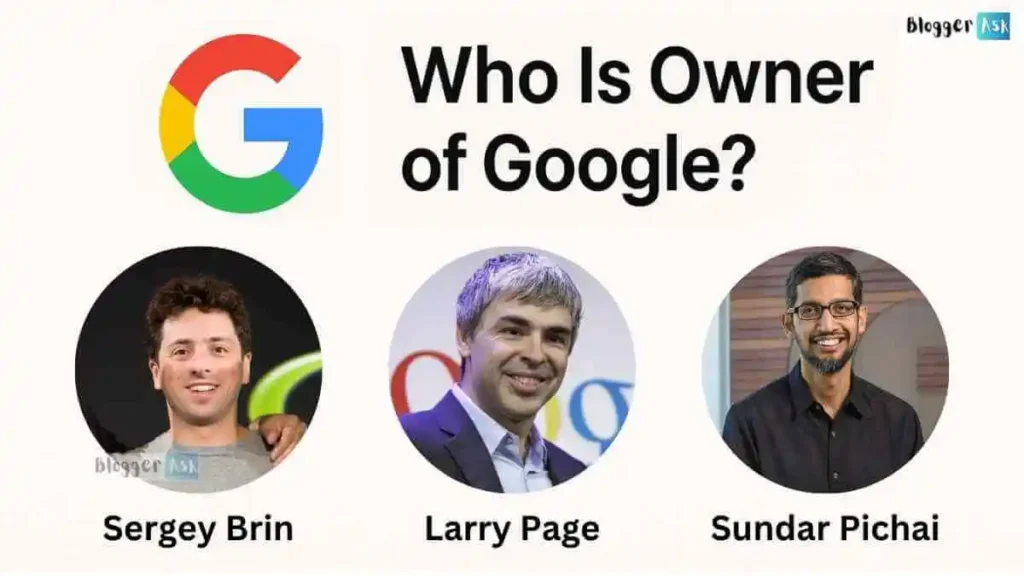
Google is owned by Alphabet Inc., its publicly traded parent company. But ownership and control are two different things here.
Co-founders Larry Page and Sergey Brin hold Class B super-voting shares that give them 52.7% of all voting power combined (27.4% and 25.3% respectively) — confirmed directly from Alphabet’s 2026 DEF 14A proxy statement filed with the SEC, based on the April 6, 2026 record date.
That means two people can outvote every other shareholder on Earth, combined, on any matter that comes to a vote.
Sundar Pichai, Google’s CEO, holds 227,560 Class A shares and less than 1% of voting power. He runs the company. He does not own it.
| Role | Who | What They Actually Control |
|---|---|---|
| Legal owner | Alphabet Inc. | Owns Google LLC outright as a subsidiary |
| Controlling owners | Larry Page (27.4%) + Sergey Brin (25.3%) | 52.7% combined voting power — can approve or block anything |
| CEO, not owner | Sundar Pichai | Daily operations; under 1% voting power |
| Largest economic stake | Vanguard Group | ~7% of all shares, ~3.5% of votes |
| Everyone else | Public shareholders | Majority of shares by value, minority of votes |
Source: Alphabet Inc. DEF 14A Proxy Statement, filed April 2026 (record date April 6, 2026), SEC EDGAR.
Key Facts
- Alphabet market cap: ~$4.3 trillion (mid-2026; changes daily with the stock price). In late June 2026, Alphabet was added to the Dow Jones Industrial Average and became the world’s second-most valuable public company — though it still trades on Nasdaq, not the Dow.
- Combined founder voting power: 52.7% (Page 27.4% + Brin 25.3%)
- Founders’ economic stake: only about 6% each by dollar value — far smaller than their voting share
- Global search market share: estimated near 90% (analyst trackers, not an SEC-filed figure)
- Dividend: Alphabet announced its first-ever quarterly dividend in April 2024 and paid it in June 2024. The payout has since risen to 22¢ per share (as of June 2026).
- Next scheduled disclosure that could shift these numbers: Alphabet’s Q2 2026 earnings report, expected in late July 2026 (around July 28).
Introduction
If you’ve ever bought a share of GOOGL, you technically own a tiny piece of Google. But you don’t control any of it — and neither do most people who think they do.
Most explanations of who owns Google stop at one fact: Alphabet Inc. is the legal parent. That’s true. But it’s the least useful part of the answer.
The real story is the gap between who owns Google on paper and who actually decides what Google does. And that gap was engineered on purpose — before the company even went public.
This guide walks through all three layers: legal ownership, economic ownership, and voting control. It’s built from Alphabet’s actual SEC filings, not paraphrases of paraphrases. So the numbers here trace back to a primary source. We’ll also flag the handful of places where you’ll see different figures online, and explain why.
A note on scope: this guide focuses on Google specifically — the products people use, and how ownership of those products traces back through the corporate structure. Want a deeper dive on Alphabet’s legal structure, institutional shareholders, and the 2015 restructuring? See our companion guide, Who Owns Alphabet Inc.?
Key Takeaways
- Alphabet Inc. is Google’s legal parent company. Google LLC is a private subsidiary. You cannot buy shares in Google itself — only in Alphabet.
- Larry Page and Sergey Brin control 52.7% of Alphabet’s voting power through Class B shares, even though they own only about 6% of the company each by dollar value.
- Sundar Pichai runs Google day to day as CEO but holds under 1% of the vote. The board Page and Brin control could replace him.
- Vanguard (~3.5% of votes) and BlackRock (~2.5% of votes) are the largest economic stakeholders. Neither has meaningful say — their shares carry far less voting weight than the founders’ Class B stock.
- No individual or company can buy Google outright. Alphabet’s market cap is roughly $4.3 trillion, and even unlimited money can’t buy Class B shares — they aren’t for sale.
- Jeff Bezos was one of Google’s earliest investors, putting in $250,000 in 1998. It’s unclear whether he still holds those shares today.
- If Page or Brin sell their Class B shares, those shares automatically and permanently convert to ordinary Class A shares — the one mechanism that could erode their control.
People Also Ask
Who owns Google today? Alphabet Inc. owns Google LLC outright, as a wholly-owned subsidiary. But real control sits with co-founders Larry Page and Sergey Brin, who hold 52.7% of Alphabet’s voting power combined through Class B super-voting shares. Sundar Pichai runs daily operations as CEO but holds under 1% of the vote.
Who owns Alphabet? Millions of public shareholders own Alphabet’s stock — Vanguard and BlackRock hold the largest institutional stakes, each under 4% of total votes. But voting control belongs to Page and Brin. For the full breakdown of Alphabet’s corporate structure and institutional ownership, see our companion guide, Who Owns Alphabet Inc.?
Can Larry Page be removed as Google’s controlling owner? Not by the board, shareholders, or a court. Page’s control comes from owning Class B shares directly, not from a role he can be voted out of. His control could only end if he sells or transfers those shares (which convert to standard Class A shares on sale), or dies without pre-approved heirs to inherit Class B status.
Does Google belong to the US government? No. Alphabet Inc. is a private, publicly traded US corporation incorporated in Delaware. No government — US or otherwise — holds any ownership or voting stake in Alphabet or Google LLC, despite the company’s size and its ongoing antitrust litigation with the US Department of Justice.
Does Sundar Pichai own Google? No. Pichai holds 227,560 Class A shares — under 1% of total voting power — and zero Class B shares. He’s the CEO who runs operations, but ownership and control belong to Page and Brin, who could replace him through the board they control.
Who Owns Google? The Three-Layer Answer
Ownership of Google breaks into three distinct answers. All three are correct at the same time.
- Legal ownership: Alphabet Inc. owns Google LLC outright, as a wholly-owned subsidiary.
- Economic ownership: Millions of shareholders worldwide — from index funds to individual retail investors — own the financial upside of Alphabet’s stock.
- Voting control: Larry Page and Sergey Brin, through Class B shares, hold the actual power to approve or block anything Alphabet’s board does.
How the ownership chain actually flows:
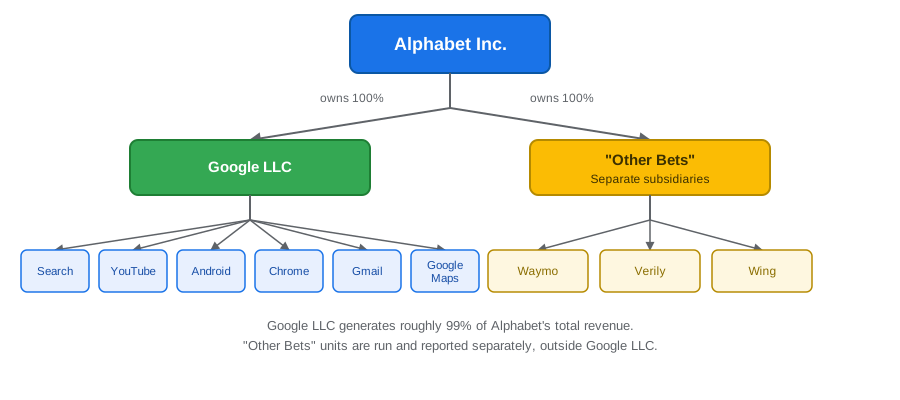
Figure 1: How ownership flows from public shareholders through Alphabet Inc. down to Google LLC — with voting control held separately by the two founders.
Most explainers feel incomplete because they pick one layer and treat it as the whole answer. It isn’t. A Vanguard index fund can own more Alphabet stock by dollar value than Larry Page does — and still have a fraction of his say in how the company is run.
Definition — What is a DEF 14A? A DEF 14A is the formal “definitive proxy statement” a public company files with the SEC before its annual shareholder meeting. It discloses who owns how much stock, how much voting power that represents, executive pay, and what shareholders will vote on. For a company like Alphabet, it’s the single most reliable public source for “who really controls it.”
Alphabet’s Three Share Classes — Why Voting Power Isn’t Tied to Share Count
Most public companies use one rule: one share, one vote. Alphabet uses three separate classes, and only one gave the public real voting power.
| Share Class | Ticker | Votes Per Share | Who Holds It |
|---|---|---|---|
| Class A | GOOGL | 1 vote | Public investors |
| Class B | Not publicly traded | 10 votes | Larry Page, Sergey Brin, a small group of early insiders (including former CEO Eric Schmidt) |
| Class C | GOOG | 0 votes | Public investors, employees (RSU compensation) |
Definition — What are super-voting shares? Super-voting shares are a special stock class that carries more votes per share than ordinary stock — often 10x or more. Companies use them so founders can raise public capital without losing control. Alphabet, Meta, and Snap all use versions of this structure.
Class B shares aren’t listed on any exchange. You cannot buy them from Fidelity, Robinhood, or anywhere else, at any price. The only way to hold them is to have been one of the small group who held them before the 2004 IPO — or to receive them directly from a current holder in an approved transfer.
Here’s why this matters. As of April 6, 2026, Alphabet had roughly 5.82 billion Class A shares and 835.8 million Class B shares outstanding. Class B is a small slice of total shares. But because each one carries 10 votes, it dominates the vote count.
The Real Owners: Larry Page and Sergey Brin
According to Alphabet’s 2026 DEF 14A proxy statement, filed with the SEC and based on an April 6, 2026 record date:
| Shareholder | Class B Shares Held | % of Class B | Total Voting Power |
|---|---|---|---|
| Larry Page | 389,051,160 | 46.5% | 27.4% |
| Sergey Brin | 358,939,978 | 42.9% | 25.3% |
| Combined | 747,991,138 | 89.4% | 52.7% |
That last number, 52.7%, is the one that matters. It’s an outright majority. No board decision, acquisition, executive appointment, or strategic pivot can happen against Page and Brin’s wishes.
And here’s the twist most articles miss: each founder owns only about 6% of Alphabet by economic value (roughly 6.1% for Page, 5.7% for Brin). So they own a small slice of the company by dollars — yet control a majority of the vote.
A simple way to picture it: imagine 100 total votes decide everything at the annual meeting. Vanguard shows up with about 3.5. BlackRock with about 2.5. Tens of thousands of other investors split most of the rest. Then Larry Page walks in with 27 votes and Sergey Brin with 25. Combined: 52. They win, every time.
Expert insight — why you might see different percentages elsewhere: Ownership sites often cite the founders’ combined voting power as “56%,” “51.4%,” or other close-but-different figures. This usually isn’t an error. It reflects different snapshot dates (voting power shifts slightly as share counts change through buybacks, RSU vesting, and options), or a source citing an older proxy filing. The 52.7% figure here is the number Alphabet itself reported as current, based on its most recent SEC filing.
Who Sits on Alphabet’s Board?
The board is where Page and Brin’s voting power actually gets exercised. Per Alphabet’s 2026 proxy statement, the board consists of:
| Director | Role |
|---|---|
| John L. Hennessy | Independent Chair of the Board; former Stanford University president |
| Larry Page | Director; co-founder, controlling shareholder |
| Sergey Brin | Director; co-founder, controlling shareholder |
| Sundar Pichai | Director and CEO |
| Frances H. Arnold | Independent Director |
| R. Martin “Marty” Chávez | Independent Director |
| L. John Doerr | Independent Director; early Google investor (holds a small Class B stake himself) |
| Roger W. Ferguson Jr. | Independent Director |
| K. Ram Shriram | Independent Director; early Google investor |
| Robin L. Washington | Independent Director |
Entity note: K. Ram Shriram isn’t just a board member. He’s the same early Google insider who introduced Jeff Bezos to Page and Brin in 1998 — which is how Bezos ended up making the investment described later in this article. In Alphabet’s case, board membership and early ownership history are more connected than most people realize.
Collectively, Alphabet’s executive officers and directors as a group hold roughly 92% of all Class B shares, representing about 54% of total voting power — slightly higher than Page and Brin’s individual 52.7%, since a few other directors (like Doerr) hold small Class B positions of their own.
Owner vs. CEO: Why Sundar Pichai Doesn’t Own Google
This is the single most common point of confusion on this topic.
| Dimension | Owner | CEO |
|---|---|---|
| Holds | Voting shares | An operating role |
| Controls | Board appointments, mergers, long-term direction | Daily operations, product strategy, hiring |
| At Google (2026) | Larry Page, Sergey Brin | Sundar Pichai |
Sundar Pichai became CEO of Google LLC in 2015 and of Alphabet Inc. in 2019. Per Alphabet’s 2026 proxy statement, he holds 227,560 Class A shares — under 1% of total voting power — and zero Class B shares. He also holds about 1.6 million non-voting Class C shares directly, plus more through family annuity trusts.
His financial stake, largely through RSU compensation, is worth hundreds of millions of dollars at current share prices. His base salary sits at $2 million. That’s real wealth. It is not control. If Page and Brin strongly disagreed with his direction, they could replace him through the board they control — without a single other shareholder’s vote.
Common mistake: assuming Google’s CEO is automatically one of its wealthiest people, on the scale of the founders. He isn’t. Larry Page’s net worth is estimated around $285 billion in mid-2026 (placing him among the world’s two or three richest people, per Forbes), and Sergey Brin’s is close behind at roughly $260 billion. Both figures move daily with Alphabet’s share price. Pichai’s wealth, while substantial, sits in a different tier entirely — it comes from compensation, not founder-level equity.
Who Owns the Most Google Stock? (Vanguard, BlackRock, and What “Ownership” Really Means)
This is where most explainers get sloppy. “Vanguard owns 7% of Google” is technically imprecise in a way that matters.
| Institution | Stake | What It Actually Means |
|---|---|---|
| Vanguard Group | ~7% of all Alphabet shares (~3.5% of total votes) | Held on behalf of millions of index-fund and ETF investors — not a controlling stake Vanguard directs itself |
| BlackRock | ~6.2% of all Alphabet shares (~2.5% of total votes) | Same structure — passive fund holdings, not active control |
Institutional stakes are drawn from the most recent 13F filings (Q1 2026) and shift each quarter.
Definition — What does “passive ownership” mean? When Vanguard or BlackRock “owns” shares of Alphabet, they’re almost always holding them inside index funds and ETFs on behalf of retail investors — not making an active bet as a company. If you have a 401(k) in a target-date fund or a broad market index fund, there’s a real chance you already own a small sliver of Google’s economic performance — without ever buying GOOGL directly.
This is also why Vanguard and BlackRock never push for boardroom change at Alphabet the way an activist investor would elsewhere. Their voting power is structurally too small to matter, no matter how much stock they hold.
Google’s Ownership Timeline: How the Structure Was Built
| Year | Event | Ownership Impact |
|---|---|---|
| 1998 | Google Inc. incorporated; $100,000 seed check from Andy Bechtolsheim | Page and Brin sole owners |
| 1998 | Jeff Bezos invests $250,000 in a follow-on round, at roughly 4 cents/share | Early outside investor — see below |
| 1999 | Sequoia Capital and Kleiner Perkins invest ~$25 million | First major dilution; founders retain control |
| 2004 | IPO at $85/share; dual-class structure written into the prospectus from day one | Public gets economic upside; founders keep voting control |
| 2014 | Class C shares (zero votes) introduced via stock split | Further capital raised without diluting founder votes |
| 2015 | Alphabet Inc. created as holding company; Google LLC becomes its subsidiary | Corporate structure changed; voting control unchanged |
| 2019 | Page and Brin step down from executive titles; Pichai becomes CEO of both companies | Operations handed off; voting control stays with the founders |
| 2026 | Market cap ~$4.3 trillion; Alphabet added to the Dow Jones Industrial Average and becomes the world’s #2 most valuable company; Page and Brin still hold 52.7% combined voting power | Structurally identical to the 2004 IPO design |
The Jeff Bezos Connection
Here’s a detail most ownership explainers skip: Amazon founder Jeff Bezos was one of Google’s earliest outside investors.
In 1998, Bezos personally invested $250,000 in a $1 million follow-on funding round, at a price later calculated at roughly 4 cents per share. By Google’s 2004 IPO, that stake had grown to approximately 3.3 million shares, worth over $280 million on IPO day alone.
It’s not publicly known whether Bezos still holds any of that stock today. He may have sold some or all of it over the past two decades, and no disclosure requirement forces him to say either way.
This doesn’t make Bezos an owner of Google today in any meaningful sense. But it’s a real, verifiable, and often-asked-about piece of the company’s ownership history.
Is Google a Public or Private Company?
Short answer: Google LLC is private; Alphabet Inc. is public. The honest answer depends on which entity you mean.
| Entity | Public or Private | Details |
|---|---|---|
| Google LLC | Private | Wholly owned by Alphabet; not separately listed or investable |
| Alphabet Inc. | Public | Trades on Nasdaq as GOOGL (Class A) and GOOG (Class C); market cap ~$4.3 trillion |
When someone says “I bought Google stock,” they mean they bought Alphabet stock. Since Google LLC generates the overwhelming majority of Alphabet’s revenue, buying GOOGL is effectively an economic bet on Google’s performance. But it is legally Alphabet equity — and it comes with none of the direct say a Google LLC “owner” would have, because that entity isn’t for sale.
Can Anyone Buy Google Completely?
No — for two separate reasons, either one of which would be enough on its own.
1. Cost. Alphabet’s market capitalization is roughly $4.3 trillion as of mid-2026 — a figure that moves daily with the stock price. No individual on Earth has the personal wealth to buy a controlling economic stake at that valuation, even accounting for normal market swings.
2. Structure. Even with unlimited money, a buyer could only acquire Class A shares (1 vote) or Class C shares (0 votes) on the open market. Class B shares — the ones that carry control — aren’t listed for sale at any price. Page and Brin’s 52.7% combined voting power cannot be outbid.
This wasn’t an accident. The dual-class structure was written into the 2004 IPO prospectus specifically to prevent a hostile takeover, an activist campaign, or a rival from ever buying control of Google against the founders’ wishes.
What Could Actually Change This Structure?
The dual-class setup isn’t permanent by law. It’s tied to two individuals’ choices and lifespans.
If Page or Brin sell Class B shares: under Alphabet’s charter, Class B shares automatically and irreversibly convert to ordinary Class A shares (1 vote each) upon sale or transfer to anyone not pre-approved to hold Class B status. This is the most realistic long-term path by which their control could shrink. Every share sold on the open market permanently loses 9 of its 10 votes.
If a founder dies or becomes incapacitated: Class B shares would likely convert to Class A upon transfer to heirs, unless those heirs are pre-approved to retain Class B status. If both founders’ shares converted, voting control would revert to the broader shareholder base for the first time since the 2004 IPO. Neither founder has publicly disclosed a succession plan for this scenario.
One counter-intuitive point: absent a sale, the founders’ grip tends to tighten, not loosen. Alphabet buys back Class A and Class C shares every quarter, shrinking the public float. Class B is fixed. So each buyback nudges the founders’ voting percentage slightly higher over time.
Expert insight: for long-term Alphabet investors, this is a real structural variable — not a hypothetical. A large, sudden Class B sale by either founder would be a material governance event. It’s the kind of thing worth watching in SEC filings (Form 4 insider-transaction reports), rather than assuming the current structure is fixed forever.
The DOJ Antitrust Case: Does It Affect Who Owns Google?
Short answer: no. It could eventually affect what Google is allowed to do — which is a different question from who controls it.
| Date | Event |
|---|---|
| August 5, 2024 | Judge Amit Mehta (D.D.C.) ruled Google illegally maintained a monopoly in general search and search-text advertising, violating Section 2 of the Sherman Act |
| September 2025 | Mehta issued his remedies decision: no Chrome or Android divestiture, but Google barred from exclusive search-distribution contracts and required to share certain search-index and interaction data with qualified competitors for five years |
| February 3, 2026 | The DOJ and a coalition of state attorneys general cross-appealed, seeking stronger remedies including the Chrome divestiture Mehta rejected |
| April 2026 | The court entered its final written order implementing the September 2025 decision; Google filed its notice of appeal and separately sought an emergency stay of the data-sharing requirements pending appeal |
| May 22, 2026 | Google filed its opening appellate brief with the D.C. Circuit Court of Appeals |
| Late 2026 – early 2027 (expected) | Oral arguments before the D.C. Circuit |
In its appeal, Google also raised a novel argument aimed at AI: generative-AI rivals such as OpenAI and Perplexity should be excluded from receiving its mandated search data, since those products didn’t exist when the DOJ filed the case. A final ruling — which could reach the Supreme Court — may not arrive until 2028.
A separate case, before Judge Leonie Brinkema (Eastern District of Virginia), ended in an April 2025 ruling that Google illegally monopolized parts of the online advertising-technology market. Closing arguments in the remedies phase wrapped in November 2025, and a remedies ruling is expected in 2026.
Why none of this changes ownership: even a worst-case outcome — a forced Chrome divestiture, say — would be implemented by Alphabet’s board, which answers to Page and Brin’s majority vote. A federal court can order a company to change its conduct or restructure its business. It cannot reassign who holds the underlying voting shares.
Why Doesn’t Google Use One Share, One Vote?
Most public companies follow a simple rule: one share equals one vote. Alphabet deliberately doesn’t — and the reasoning was public before the company ever sold a share.
How the voting power concentrates:
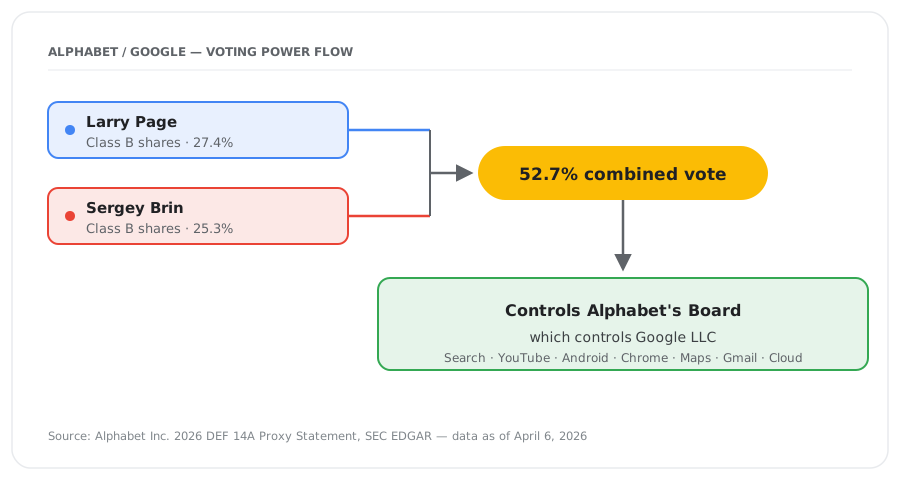
Figure 2: Why a small block of Class B shares outweighs billions of public Class A and Class C shares.
The founders’ stated reason: before the 2004 IPO, Page and Brin published an open letter to prospective investors explaining the dual-class structure directly. Their argument: public markets pressure companies into short-term decisions to protect quarterly stock prices, and they wanted the freedom to make long-term bets — including expensive, unprofitable ones — without needing shareholder approval each time.
That argument looks especially relevant in 2026. Alphabet plans capital expenditures of up to roughly $190 billion this year, pouring money into AI infrastructure that may take years to pay off. Founder control lets management greenlight bets that size without shareholder pushback.
Hostile-takeover protection: the structure also plays defense. Class B shares aren’t for sale on any exchange, so no company, activist, or accumulation of public shares can assemble a controlling stake without the founders’ cooperation. This was written into the 2004 prospectus specifically to make an unwanted takeover structurally impossible — not just unlikely.
How this compares to other companies:
| Company | Founder Control | Super-Vote Ratio | Can Founders Be Outvoted? |
|---|---|---|---|
| Alphabet (Google) | Page + Brin, 52.7% of votes | 10:1 (Class B) | No |
| Meta | Zuckerberg, majority control | 10:1 (Class B) | No |
| Snap | Spiegel + Murphy | 10:1 (Class A) | No — public gets 0 votes |
| Amazon | Jassy (CEO, not a founder) | Standard 1:1 | Yes |
| Apple | No founder control remains | Standard 1:1 | Yes |
Balanced view: Proxy advisory firms including ISS and Glass Lewis have flagged Alphabet’s dual-class structure as a governance risk, since shareholders have no realistic path to hold leadership accountable through voting. Supporters counter that founder-controlled companies can make long-term decisions without being forced into short-term stock-price management by quarterly earnings pressure. Both positions have genuine support among corporate-governance researchers. There isn’t a settled consensus on which tradeoff serves shareholders better.
Quick Checklist: What You Get (and Don’t Get) as a Google/Alphabet Shareholder
✅ You get:
- A share of Alphabet’s profits and stock-price growth
- Dividend eligibility (Alphabet began paying a quarterly dividend in 2024; 22¢ per share as of June 2026)
- The right to vote your shares at the annual meeting
❌ You don’t get:
- Any realistic chance your vote changes a contested decision
- Access to Class B shares at any price
- Direct ownership of “Google” — you legally own Alphabet, a holding company
Frequently Asked Questions
Who owns Google in 2026?
Alphabet Inc. is Google’s legal parent company. Co-founders Larry Page and Sergey Brin control 52.7% of Alphabet’s voting power combined (27.4% and 25.3% respectively), per Alphabet’s 2026 DEF 14A proxy statement filed with the SEC. Sundar Pichai is CEO but holds under 1% of the vote.
Is Google a publicly traded company?
Google LLC itself is private and wholly owned by Alphabet Inc. Alphabet is publicly traded on Nasdaq under GOOGL (Class A) and GOOG (Class C). Buying “Google stock” means buying Alphabet stock.
Does Sundar Pichai own Google?
No. He holds 227,560 Class A shares — under 1% of total voting power — plus non-voting Class C shares, and zero Class B shares. He runs daily operations as CEO but does not have a controlling ownership stake.
Does Jeff Bezos own part of Google?
Not currently, as far as public records show. But he was one of Google’s earliest investors, putting in $250,000 in 1998 that grew to roughly 3.3 million shares by the 2004 IPO. Whether he still holds any of that stock has never been publicly disclosed.
Who owns the most Google stock?
By economic value, Vanguard Group holds the largest single institutional stake (roughly 7% of all Alphabet shares). By voting power, Larry Page controls more votes (27.4%) than any institutional investor — because his shares are Class B super-voting stock.
Is Google’s CEO a billionaire?
Sundar Pichai’s wealth, driven mainly by RSU compensation, is estimated in the low billions — substantial, but far below the tier of Page and Brin, who are each estimated around $260–290 billion in 2026, among the wealthiest people in the world.
Which country owns Google?
None. Alphabet Inc. is a private, publicly traded U.S. corporation incorporated in Delaware and headquartered in Mountain View, California. No government holds an ownership or voting stake in Alphabet or Google LLC.
Can someone buy Google completely?
No. Alphabet’s market cap is roughly $4.3 trillion — beyond any individual’s financial capacity — and Class B super-voting shares, which control the company, aren’t available for purchase at any price.
What happens if Page or Brin sell their shares?
Under Alphabet’s charter, Class B shares automatically and permanently convert to Class A shares (1 vote each) upon sale to anyone not pre-approved to hold Class B status. This is the most likely long-term mechanism by which the founders’ control could shrink.
Who is on Alphabet’s board of directors?
As of the 2026 annual meeting, the board includes Chair John L. Hennessy, co-founders Larry Page and Sergey Brin, CEO Sundar Pichai, and independent directors Frances H. Arnold, R. Martin Chávez, L. John Doerr, Roger W. Ferguson Jr., K. Ram Shriram, and Robin L. Washington.
Does the DOJ antitrust case affect who owns Google?
No. Court-ordered remedies could change how Google is allowed to operate — for example, restrictions on exclusive contracts or, in a worst case, a forced divestiture — but any such change would be implemented by Alphabet’s board, which is itself controlled by Page and Brin’s majority vote. Courts can regulate conduct; they can’t reassign share ownership.
Why doesn’t Alphabet just use one share, one vote like most companies?
Page and Brin built the dual-class structure into Google’s 2004 IPO specifically to keep long-term control after going public — protecting the company from short-term stock-price pressure and making a hostile takeover structurally impossible. Meta and Snap use similar structures; Amazon and Apple don’t, and both can theoretically outvote their leadership.
Conclusion
The complete answer to “who owns Google” isn’t one fact. It’s three, layered on top of each other.
Alphabet Inc. legally owns Google. Millions of shareholders — from Vanguard’s index funds to individual retail investors — own its economic performance. And Larry Page and Sergey Brin, through Class B shares built into the company’s structure since before its 2004 IPO, hold 52.7% of the vote that actually decides what happens next.
Sundar Pichai runs the company brilliantly, every day. But running Google and owning Google have never been the same thing — and per Alphabet’s own current SEC filings, they aren’t likely to be for as long as Page and Brin choose to hold their shares.
📖 Continue Reading:
Sources & References
- Alphabet Inc., 2026 Definitive Proxy Statement (DEF 14A), filed with the U.S. Securities and Exchange Commission, record date April 6, 2026 — SEC EDGAR
- Alphabet Inc., Form 10-K, Fiscal Year 2025 — SEC EDGAR
- Alphabet Inc., Form 8-K, 2026 Annual Meeting of Stockholders results — SEC EDGAR
- United States v. Google LLC, Case No. 1:20-cv-03010-APM, U.S. District Court for the District of Columbia
- U.S. Department of Justice, Office of Public Affairs — case statements on United States v. Google LLC
- Alphabet Inc. Investor Relations — abc.xyz

Olivia Isabel is a business and technology researcher and writer with 9 years of experience analysing market trends, corporate strategy, and the impact of emerging technologies on business and marketing practice. She holds an MBA in Strategy and Innovation from London Business School and a Bachelor’s degree in Economics from University College London (UCL) — credentials that ground her research and writing in rigorous analytical frameworks used at the highest levels of global business.
She specialises in corporate ownership, company structure, and how major tech firms are governed and funded — breaking down complex questions like who controls a company versus who profits from it into clear, accurate explainers for readers trying to understand the businesses behind the world’s biggest brands.
Her work on BloggerAsk includes in-depth ownership breakdowns of OpenAI, Tesla, SpaceX, Alphabet, Google, Meta, and more, along with guides to company leadership and the corporate structures of major technology and social media platforms. Each article is built from primary sources — company filings, official statements, and reputable financial press such as Bloomberg, CNBC, Reuters, and the Financial Times — and is updated as ownership and governance details change.
Olivia focuses on accuracy and freshness over hot takes: every ownership figure is dated to when it was confirmed, estimates are clearly labelled, and fast-moving stories (like IPO filings and funding rounds) are revisited as they develop. Her goal is simple — give readers a version of the facts they can actually rely on, and cite where each claim comes from.