⚡ Quick Answer: Who Owns OpenAI?
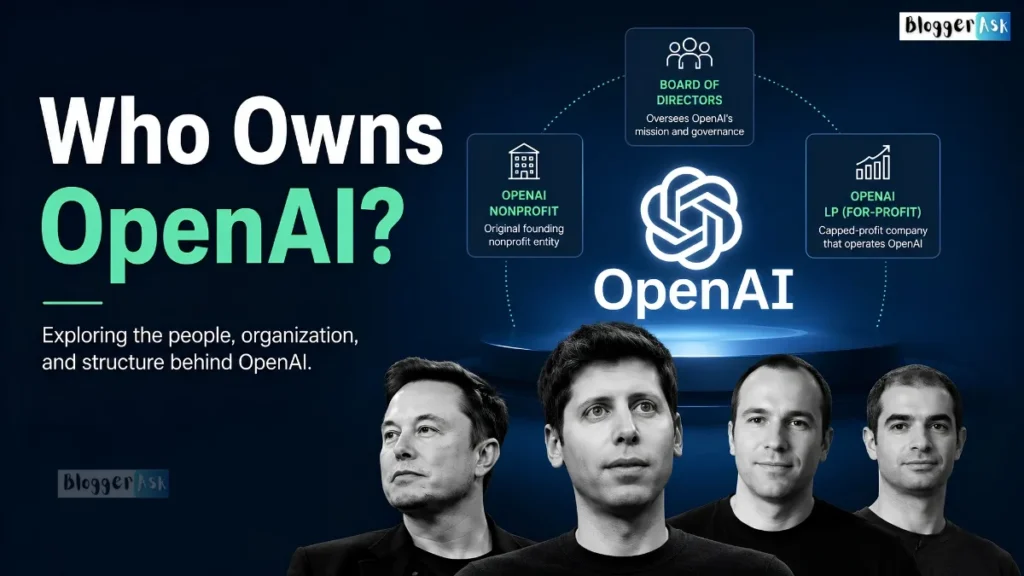
OpenAI is controlled by the OpenAI Foundation, a nonprofit, and owned economically by the Foundation, Microsoft, and other investors through OpenAI Group PBC, a for-profit public benefit corporation.
The Foundation controls the board and decision-making. OpenAI Group PBC (also called OpenAI’s for-profit arm — this article uses “OpenAI Group PBC” throughout) holds the business, raises money from investors, and pays out profits.
As of the last full official disclosure (October 2025):
- The OpenAI Foundation holds about 26% of OpenAI Group PBC
- Microsoft holds about 27%
- The remaining ~47% is split between current and former employees and outside investors (SoftBank, Amazon, Nvidia, Thrive Capital, and others)
Ownership and control are not the same thing here. Microsoft owns more equity than the Foundation, but the Foundation appoints every member of the board. Microsoft has no board seat.
Since that disclosure, OpenAI raised $122 billion in a round that closed on March 31, 2026, pushing its valuation to $852 billion — the largest private technology fundraise on record. That round diluted every existing shareholder’s percentage, but OpenAI has not published an updated ownership table since. Treat the October 2025 percentages above as the last officially confirmed numbers, not today’s exact figures.
Two developments have moved the story further since then, both covered in detail below: OpenAI confidentially filed for an IPO on June 8, 2026, and in July 2026 it was reported to be in early talks about handing the U.S. government a 5% stake.
Ownership vs. Control: The Distinction That Actually Matters
Ownership means an economic stake in OpenAI’s value. Control means the power to decide OpenAI’s direction. At OpenAI, these belong to different parties.
Most confusion about OpenAI comes from treating “who owns the most equity” and “who’s in charge” as the same question. At OpenAI, they aren’t.
What “Ownership” Means at OpenAI (Economic Stake)
Ownership here means an economic stake — a claim on OpenAI’s financial value. If OpenAI’s valuation goes up, an owner’s stake is worth more. If OpenAI pays dividends or gets sold, an owner gets a cut proportional to their stake.
Microsoft, employees, and outside investors like SoftBank and Nvidia hold this kind of stake. It’s money in, money out. It comes with no automatic say over strategy or leadership.
What “Control” Means at OpenAI (Board & Governance)
Control means the power to make decisions — who runs the company, what direction it takes, and how disputes get resolved.
At OpenAI, control sits with the OpenAI Foundation’s board. The Foundation:
- Appoints every director on the OpenAI Group PBC board
- Can remove any director at any time
- Holds special voting rights beyond what its 26% equity stake would normally give it
This means a shareholder with more equity than the Foundation — Microsoft — has zero formal say in who runs the company.
Why OpenAI Split These Two Things Apart
OpenAI needed outside capital to compete in the AI race, which meant taking in huge sums from investors. But its founding mission was built around AI safety, not shareholder returns. Splitting ownership from control let OpenAI raise money from Microsoft, SoftBank, Amazon, and Nvidia without handing any of them a seat at the table.
This also reduces antitrust exposure. If Microsoft had a board seat at one of the most powerful AI companies in the world, regulators would take a much harder look at the relationship. No board seat keeps that risk lower, while Microsoft still gets outsized commercial benefits through its cloud and licensing deals.
OpenAI’s Current Ownership Structure (2026)
The OpenAI Foundation (Nonprofit Layer)
The OpenAI Foundation is what OpenAI’s original nonprofit became after a corporate restructuring completed on October 28, 2025. It holds:
- A 26% equity stake in OpenAI Group PBC, worth roughly $130 billion at the October 2025 valuation
- Full board appointment and removal power
- Reportedly, a long-dated warrant tied to OpenAI’s share price, structured so the Foundation’s upside grows if OpenAI’s value rises well beyond current expectations (reported at the time of the restructuring; treat the specific terms as reported rather than officially detailed)
The Foundation has committed an initial $25 billion toward philanthropic work — funded by this equity stake — aimed at accelerating health breakthroughs and technical AI-resilience (safety) work.
OpenAI Group PBC (For-Profit Layer)
OpenAI Group PBC is the operating business — the entity that builds ChatGPT, sells API access, and takes on investment. It became a Delaware Public Benefit Corporation (PBC) in October 2025, after the California and Delaware Attorneys General cleared the recapitalization (California issued a non-opposition, and Delaware issued a “statement of no objection”).
What Is a Public Benefit Corporation?
A PBC is a for-profit company structure that’s legally required to consider its stated public mission alongside shareholder returns — not shareholder returns alone. In practice, a PBC still behaves like an ordinary company most of the time. The “public benefit” requirement adds a legal mandate more than an externally enforced behavioral constraint; there’s no independent regulator checking whether OpenAI’s day-to-day decisions actually serve its stated mission.
This structure isn’t unique to OpenAI. Anthropic uses a comparable hybrid model (see the comparison section below), making the mission-plus-investor-capital approach a real pattern among frontier AI labs, not just one company’s unusual arrangement.
Ownership Breakdown Table — Confirmed vs. Estimated Figures
How to Read This Table
The numbers below come from two different points in time. The October 2025 figures are officially confirmed. The 2026 figures reflect a $122 billion funding round (closed March 31, 2026) that diluted every existing stakeholder — but OpenAI has not released an updated official percentage table since. Where a number is estimated rather than confirmed, it’s marked.
| Entity | Stake (Oct 2025, Confirmed) | Value (Oct 2025) | Status After March 2026 Round |
|---|---|---|---|
| OpenAI Foundation | ~26% | ~$130 billion | Diluted; new % not officially published |
| Microsoft | ~27% (as-converted, fully diluted) | ~$135 billion | Diluted; new % not officially published (see note below) |
| Employees & other investors | ~47% | Not separately disclosed | Diluted; now includes 2026 investors (Amazon, SoftBank, Nvidia, and others) |
Note on Microsoft’s current value: Applying the old 27% to the new $852B valuation implies a stake worth roughly $230 billion — but this is illustrative only. Microsoft did not participate in the March 2026 round at the same level it once did, so its actual percentage today is very likely below 27%, which would make the true dollar figure lower than a straight 27% × $852B calculation suggests. OpenAI has not confirmed an updated number.
Key point: dollar values rose for most stakeholders because OpenAI’s overall valuation climbed sharply (from $500 billion in October 2025 to $852 billion in March 2026), even though percentage ownership fell for everyone who didn’t participate proportionally in the new round.
Who Owns ChatGPT?
ChatGPT is a product owned and operated by OpenAI Group PBC — not by Microsoft, and not by any single investor.
Is ChatGPT Owned by Microsoft? (Direct Answer)
No. Microsoft does not own ChatGPT. Microsoft holds roughly 27% equity (as of October 2025) in OpenAI Group PBC, the company that owns ChatGPT, and has a commercial partnership that gives it certain cloud, licensing, and revenue-sharing rights. That’s a financial and commercial relationship, not ownership of the product itself.
The confusion is understandable — Microsoft has invested more in OpenAI than any other outside company (over $13 billion cumulatively), integrated OpenAI’s models into Copilot, and hosts much of OpenAI’s compute on Azure. None of that amounts to owning ChatGPT.
How Much of OpenAI Does Microsoft Own?
Microsoft holds approximately 27% of OpenAI Group PBC on an as-converted, fully diluted basis (meaning the calculation counts all shares as if every convertible security were already turned into stock), per the October 2025 disclosure. This was itself a reduction from an earlier 32.5% stake Microsoft held in OpenAI’s prior for-profit structure, before the 2025 recapitalization.
Microsoft did not participate at the same level in the March 2026 round, so its actual percentage today is very likely lower than 27% — OpenAI simply hasn’t confirmed the updated number. Any current dollar-value estimate based on the old percentage should be treated as illustrative only, not precise.
What Microsoft Gets Beyond Equity
Microsoft’s relationship with OpenAI goes well beyond its shareholding:
- Intellectual property rights to OpenAI’s models and products, extended through 2032, including models developed after any future AGI declaration (OpenAI’s consumer hardware is excluded)
- A revenue-sharing agreement, historically structured to give Microsoft a cut of OpenAI’s revenue (now capped — see the April 2026 changes below)
- Priority access to OpenAI’s technology for products like Copilot, as Microsoft’s frontier-model partner
What Microsoft Doesn’t Get (No Board Seat)
Despite being OpenAI’s largest outside shareholder, Microsoft has no seat on the OpenAI Group PBC board and no formal vote in company decisions. All board appointments run through the OpenAI Foundation. This arrangement is deliberate — it lets Microsoft benefit financially and commercially from OpenAI’s growth without triggering the antitrust scrutiny that board representation would likely invite.
The October 2025 & April 2026 Deal Changes, Explained
The October 2025 recapitalization already loosened the original 2019 terms: it removed OpenAI’s profit cap, gave Microsoft its 27% stake, ended Microsoft’s right of first refusal as OpenAI’s exclusive compute provider (alongside an incremental $250 billion Azure commitment from OpenAI), extended Microsoft’s IP rights to 2032, required any AGI claim to be verified by an independent expert panel, and let both companies pursue some work with third parties.
In April 2026 (announced April 27), Microsoft and OpenAI went further, ending the exclusive partnership and open-ended revenue-share arrangement:
- OpenAI can now cap its revenue-share payments to Microsoft at a fixed ceiling rather than an indefinite share (some reports put the ceiling in the tens of billions through 2030 — treat the exact figure as reported rather than officially confirmed)
- OpenAI can license its models and products to any third party on any cloud, including Microsoft competitors like Google and Amazon
- In exchange, Microsoft no longer has to share a cut of its own AI revenue with OpenAI
- Microsoft retains a first right to provide cloud services, but not an exclusive lock
- Microsoft can now pursue AGI research independently or with other partners
These changes loosened Microsoft’s grip on OpenAI’s infrastructure and revenue, while preserving its equity position and long-term IP rights.
Is OpenAI Publicly Traded? Can You Buy Stock?
The Current Status (Confidential IPO Filing)
No — OpenAI is not yet publicly traded, and you cannot buy its shares on any exchange today. But the picture has moved: on June 8, 2026, OpenAI confirmed it had confidentially filed draft IPO paperwork with the U.S. Securities and Exchange Commission, saying it announced the filing because it expected the news to leak, and that it had not decided on timing. That followed rival Anthropic’s own confidential filing a week earlier and came days before Elon Musk’s SpaceX began its IPO roadshow.
A confidential filing is a first formal step, not a listing. It lets the SEC review the draft before a public prospectus appears, and it does not lock OpenAI into any date. As of early July 2026, reporting indicates OpenAI’s advisers were weighing a possible delay into 2027, and the company has said only that it wants the option to go public. Alongside the filing, OpenAI reportedly planned an employee tender offer at the $852 billion valuation to give staff some liquidity without waiting for a public debut.
Why You Still Can’t Buy OpenAI Stock
There is no public stock ticker for OpenAI, and shares are not available on any public exchange. Private companies can raise money from investors — as OpenAI has from SoftBank, Amazon, and Nvidia — without listing shares publicly. Until an actual IPO prices and lists (if it does), there is no legitimate way to directly buy OpenAI shares.
What “OpenAI Stock” Searches Are Actually Confusing
People searching for “OpenAI stock” usually want financial exposure to OpenAI’s growth. Right now, the only indirect paths are:
- Buying shares of Microsoft, which holds a direct equity stake in OpenAI
- Buying shares of Nvidia or Amazon, both OpenAI investors and infrastructure partners — though OpenAI is a small part of their overall business
- Certain ETFs have begun adding exposure to OpenAI’s private stock (OpenAI said it would be included in several ARK Invest ETFs), offering limited indirect access
- Waiting for a potential future OpenAI IPO, which is now in confidential-filing stage but has no confirmed date
None of these gives you the same direct exposure that owning OpenAI stock itself would.
Does the U.S. Government Own Part of OpenAI?
Not currently — but as of July 2026 it’s being discussed. On July 2, 2026, the Financial Times reported that OpenAI had begun early, preliminary discussions about giving the U.S. government a 5% equity stake. The idea, reportedly pitched by CEO Sam Altman to President Trump, Commerce Secretary Howard Lutnick, and Treasury Secretary Scott Bessent, is part of a broader proposal under which Washington would hold 5% of each leading U.S. AI developer — potentially including Anthropic, Google, and Meta — feeding a public investment vehicle modeled on Alaska’s Permanent Fund.
The numbers and caveats that matter:
- At OpenAI’s $852 billion valuation, a 5% stake would be worth roughly $42.6 billion
- The talks are conceptual and early-stage, and any arrangement would likely require Congressional approval
- It’s unclear whether other AI companies would agree to a similar deal
- It would be the first time Washington held equity in a private AI company — though it follows recent precedent, including the government’s 9.9% stake in Intel taken in 2025
This sits inside a wider political push. Senator Bernie Sanders has floated a far more aggressive proposal that would require the largest AI companies to place a large share of equity into a public fund, and OpenAI faces scrutiny from a coalition of state attorneys general. Whatever emerges, a government stake agreed now would be locked in before the ownership dilution an IPO would bring — one reason the timing is being discussed at all.
Who Are OpenAI’s Other Major Investors?
The 2026 Funding Round (Amazon, Nvidia, SoftBank)
OpenAI’s funding round — first announced at $110 billion in February 2026 and extended to $122 billion at close on March 31, 2026, at an $852 billion valuation — is the largest private technology fundraise on record. The round was anchored by Amazon, Nvidia, and SoftBank, with SoftBank co-leading alongside Andreessen Horowitz (a16z), D. E. Shaw Ventures, MGX, TPG, and accounts advised by T. Rowe Price, plus continued participation from Microsoft. Notably, for the first time OpenAI opened participation to individual investors through bank channels, raising more than $3 billion from retail investors.
| Investor | Reported Commitment | Notes |
|---|---|---|
| Amazon | Up to $50 billion | ~$35B contingent on OpenAI’s IPO or reaching AGI |
| Nvidia | $30 billion | Largely GPU capacity / infrastructure commitments |
| SoftBank | $30 billion | Structured in tranches (April, July, October 2026) |
| Broader pool | ~$12 billion | a16z, D.E. Shaw, MGX, TPG, T. Rowe Price accounts, retail investors, and others |
Microsoft’s participation in this specific round was more limited than in prior rounds, and OpenAI did not disclose the size of Microsoft’s investment — contributing to the expected dilution of Microsoft’s overall percentage stake.
Earlier Backers (Thrive Capital, Khosla Ventures, Sequoia, and Others)
Before the 2026 mega-round, OpenAI’s investor base built up over several years:
- Thrive Capital and Khosla Ventures were early backers
- SoftBank led a $40 billion round in April 2025 at a $300 billion valuation, with participation from Coatue and Altimeter
- Later rounds also brought in Andreessen Horowitz, Fidelity Investments, Sequoia Capital, and Tiger Global Management, among a broad institutional roster (BlackRock, Blackstone, Temasek, Coatue, and others)
None of these investors hold board seats. Their stakes are purely economic — the same arrangement Microsoft has, just without the added commercial partnership terms. Across all rounds, OpenAI has now raised well over $180 billion in total funding.
How OpenAI’s Ownership Got Here: A Timeline
- 2015 — OpenAI founded as a nonprofit research lab in Delaware
- 2019 — OpenAI creates a “capped-profit” for-profit subsidiary to raise outside capital; Microsoft invests $1 billion
- 2023 — Microsoft commits an additional $10 billion (bringing its total to roughly $13 billion); OpenAI’s nonprofit board fires CEO Sam Altman in November, then reinstates him days later after employee and investor pressure
- February 2025 — An Elon Musk–led investor group offers $97.4 billion to buy the OpenAI nonprofit; OpenAI rejects the bid, saying it is not for sale
- April 2025 — OpenAI raises $40 billion at a $300 billion valuation, led by SoftBank
- October 28, 2025 — OpenAI completes its restructuring: the nonprofit becomes the OpenAI Foundation (26% stake), the for-profit becomes OpenAI Group PBC (valued at $500 billion), Microsoft’s stake is confirmed at 27%, and the AGI-verification panel and 2032 IP terms are set
- February 2026 — SpaceX acquires xAI, folding Musk’s AI company into the rocket maker as a subsidiary
- February–March 2026 — OpenAI raises $110 billion, extended to $122 billion at close on March 31, at an $852 billion valuation, anchored by Amazon, Nvidia, and SoftBank
- April 27, 2026 — Microsoft and OpenAI revise their partnership: revenue-share capped at a fixed ceiling, cloud exclusivity dropped, both free to pursue AGI independently
- May 18, 2026 — A federal jury dismisses Elon Musk’s lawsuit against OpenAI on statute-of-limitations grounds; the judge adopts the verdict
- June 1, 2026 — Anthropic confidentially files a draft S-1 with the SEC
- June 8, 2026 — OpenAI confirms it has confidentially filed IPO paperwork with the SEC; timing left open
- July 2, 2026 — The Financial Times reports OpenAI is in early talks about giving the U.S. government a 5% stake
The Elon Musk Lawsuit and OpenAI’s Governance History
Why Elon Musk Sued OpenAI
Elon Musk co-founded OpenAI in 2015 (contributing roughly $38 million in its early years) but left its board in 2018. As OpenAI moved further from its original nonprofit-only structure toward a conventional for-profit model, Musk sued in 2024, arguing the shift betrayed the organization’s founding mission and his original contributions to it. He sought to unwind the restructuring, remove Altman and president Greg Brockman, and disgorge profits to the nonprofit — reportedly seeking as much as $150 billion. Microsoft was named as a co-defendant.
How the Lawsuit Was Resolved (May 2026)
On May 18, 2026, after a roughly three-week trial in Oakland, California, a nine-member advisory jury deliberated for under two hours and concluded Musk had waited too long to bring his claim — beyond the applicable three-year statute of limitations. U.S. District Judge Yvonne Gonzalez Rogers adopted the verdict and dismissed all claims, including those against Microsoft. Musk called the outcome a “calendar technicality” and said he would appeal. The ruling closed one of the most closely watched legal disputes in the AI industry, though it didn’t resolve the broader public debate about whether OpenAI’s restructuring honored its original mission.
The November 2023 Board Crisis (Altman’s Firing and Return)
In November 2023, OpenAI’s nonprofit board — at the time including safety-focused members like Ilya Sutskever — fired CEO Sam Altman, citing a loss of confidence in his leadership. The decision triggered immediate backlash from employees, investors, and Microsoft. Altman was reinstated within days, and the board was substantially reshuffled afterward.
This episode is a useful data point for understanding today’s structure: it showed the original nonprofit board’s power was real, but also that exercising it against strong investor and employee opposition was costly and short-lived. The October 2025 restructuring didn’t eliminate the Foundation’s board control — but it happened in a very different environment, with far more capital and commercial dependency built into the relationship.
How OpenAI’s Structure Compares to Anthropic and xAI
This comparison shows that “mission-protected AI lab” isn’t one single model — it’s several different approaches with real tradeoffs in how much independent power the mission-focused body actually holds.
| Company | Governance Model | Independent Oversight Mechanism |
|---|---|---|
| OpenAI | Nonprofit Foundation controls the PBC board | Foundation appoints the board directly; no separate body audits whether decisions serve the mission |
| Anthropic | Public Benefit Corporation + Long-Term Benefit Trust | Trust holds a special share class, has no financial stake, and — as of April 2026 — appoints a majority of the board |
| xAI | Subsidiary/division of SpaceX | None — control runs directly through Elon Musk’s position at SpaceX |
Anthropic’s Structure
Anthropic runs on a Public Benefit Corporation structure layered with a Long-Term Benefit Trust (LTBT). The Trust holds a special class of shares called Class T Common Stock, which carries no financial stake — trustees don’t profit from Anthropic’s growth. What it does carry is the power to appoint a growing share of Anthropic’s board over time. The Trust began appointing a minority of directors and, with the April 14, 2026 appointment of Novartis CEO Vas Narasimhan, Trust-appointed directors now make up a majority of Anthropic’s board — a governance threshold written into the founding documents but only crossed then.
Unlike OpenAI, Anthropic has never published a full ownership percentage breakdown. What’s publicly known comes from funding announcements and court filings — for instance, Google’s roughly 14% stake surfaced through a 2025 antitrust filing (it’s contractually capped near 15%, with no voting rights or board seats), not a company disclosure. Anthropic confidentially filed a draft S-1 with the SEC on June 1, 2026, putting it a week ahead of OpenAI in the race toward a public listing, shortly after a funding round that valued it near $965 billion.
The practical difference from OpenAI: Anthropic’s Trust has no equity of its own to protect, and its board-control power actively grew until it reached a majority — rather than being fixed at the outset. OpenAI’s Foundation controls the board today, but there’s no separate mechanism checking whether OpenAI Group PBC’s decisions actually serve its stated mission over time.
xAI’s Structure
xAI is no longer a useful comparison for OpenAI’s governance model. SpaceX acquired xAI in February 2026, folding it in as a wholly owned subsidiary; by May 2026 Musk announced xAI would cease to exist as a separate company, with Grok and X operating as SpaceX’s AI division. There is no nonprofit layer, no equivalent of a Long-Term Benefit Trust, and no split between economic ownership and mission-based control. xAI’s direction is set directly through Elon Musk’s controlling position at SpaceX — the opposite approach from OpenAI’s and Anthropic’s split-governance model.
What This Pattern Tells You About AI Company Governance
OpenAI and Anthropic both split economic ownership from mission control because they need enormous outside capital but were founded on safety-focused premises that a standard shareholder-first structure would undermine. This explains why OpenAI’s own structure looks the way it does — it isn’t a one-off arrangement, it’s a shared industry response to the same problem. xAI shows the alternative path is still very much in use: concentrated founder control, with no independent governance layer at all. Whether either approach actually constrains company behavior in practice, or mainly functions as a governance narrative, remains an open question across the industry.
What’s Next: IPO Timeline and the Future of Foundation Control
IPO Timeline
As of July 2026, OpenAI has confidentially filed for an IPO (June 8, 2026) but set no date, and advisers have reportedly discussed a possible delay into 2027. Confidential filings can be amended, delayed, or withdrawn. Reported target valuations for an eventual public listing have reached $1 trillion or more, though this is speculative until a priced offering. OpenAI is filing into a crowded AI IPO window that also includes Anthropic (confidential filing June 1) and SpaceX (already on its roadshow).
Will the Foundation Keep Control If OpenAI Goes Public?
This is the most important unresolved question in OpenAI’s ownership story. Right now, the OpenAI Foundation controls the board despite holding less equity than Microsoft — a structure outside investors accepted because it predates their involvement and was built into the terms they invested under.
An IPO changes the picture. Public shareholders investing fresh capital may not be as willing to accept a structure where board control sits entirely outside their voting power, especially if their combined holdings dwarf the Foundation’s ~26% stake. How OpenAI handles this — through special share classes, revised bylaws, or some other mechanism — will determine whether the Foundation’s control is a durable feature of the company or a temporary condition that erodes once public markets are involved.
There’s also the separate matter of the reported U.S. government stake proposal, which adds a layer of political complexity that didn’t exist in OpenAI’s earlier funding rounds.
FAQs
Who owns 51% of OpenAI?
No single entity owns 51% of OpenAI. The largest disclosed stakes are Microsoft at approximately 27% and the OpenAI Foundation at approximately 26%, based on the October 2025 disclosure. No majority owner exists.
Does Elon Musk still own OpenAI?
No. Elon Musk co-founded OpenAI in 2015 but left its board in 2018 and holds no disclosed ownership stake. He sued OpenAI over its restructuring; a jury dismissed the case on statute-of-limitations grounds in May 2026, and Musk said he would appeal.
Who is the largest shareholder in OpenAI?
Microsoft is the largest disclosed outside shareholder, holding approximately 27% of OpenAI Group PBC as of October 2025 (likely somewhat lower now after the March 2026 round). The OpenAI Foundation holds approximately 26% but exercises full board control despite the smaller stake.
Is OpenAI owned by Microsoft?
No. Microsoft owns roughly 27% equity in OpenAI Group PBC and has significant commercial agreements with the company, but it does not own OpenAI outright and has no board seat.
Is OpenAI public? Did OpenAI file for an IPO?
OpenAI is not yet publicly traded, but on June 8, 2026 it confirmed it had confidentially filed IPO paperwork with the SEC. No listing date has been set, and reports suggest it could slip into 2027. You cannot buy OpenAI shares on a public exchange today.
Does the U.S. government own part of OpenAI?
Not currently. In July 2026, the Financial Times reported OpenAI was in early talks about giving the U.S. government a 5% stake (worth about $42.6 billion at the $852 billion valuation), potentially as part of a broader arrangement across major AI companies. The talks are preliminary and would likely require Congressional approval.
How much is Microsoft’s OpenAI stake worth?
At the October 2025 restructuring, Microsoft’s ~27% stake was valued around $135 billion. At the March 2026 valuation of $852 billion, 27% would imply roughly $230 billion — but that’s illustrative only, since Microsoft’s actual percentage is likely lower than 27% after the latest round, and OpenAI hasn’t confirmed an updated figure.
Is OpenAI worth more than Anthropic?
By headline valuation, they’re close. OpenAI was valued at $852 billion in its March 2026 round; Anthropic was valued near $965 billion in a round shortly before its June 2026 IPO filing. Both figures are private-market valuations and move quickly.
What company owns OpenAI?
No single company owns OpenAI. It’s controlled by the OpenAI Foundation (a nonprofit) and owned economically by the Foundation, Microsoft, employees, and outside investors including SoftBank, Amazon, and Nvidia.
Who owns ChatGPT?
ChatGPT is owned and operated by OpenAI Group PBC, the for-profit arm of OpenAI. Microsoft does not own ChatGPT.
Conclusion
OpenAI’s ownership doesn’t fit the usual “founder owns X%, biggest investor calls the shots” model most people expect from a tech company. It’s split deliberately: the OpenAI Foundation controls governance, Microsoft and other investors hold economic stakes without board power, and the company remains privately held despite an $852 billion valuation and a confidential IPO filing.
The numbers you’ll see cited — ~26% Foundation, ~27% Microsoft, ~47% everyone else — are accurate as of October 2025, but they predate a $122 billion round that diluted every stakeholder without a public update to the percentages. Treat any post-March-2026 percentage you see as an estimate unless it’s sourced directly to OpenAI.
The open questions that matter most going forward aren’t who owns what today — they’re whether the Foundation’s board control survives contact with public markets, and whether the U.S. government ends up holding a piece of OpenAI before it lists.
📖 Continue Reading:
Sources & References
Primary sources
- OpenAI, “Our Structure” — openai.com/our-structure
- OpenAI, restructuring announcement (October 28, 2025) — OpenAI newsroom
- OpenAI, “OpenAI raises $122 billion to accelerate the next phase of AI” (March 31, 2026) — openai.com
- OpenAI & Microsoft partnership statements (October 2025; April 2026) — OpenAI/Microsoft
- Anthropic, “The Long-Term Benefit Trust” — anthropic.com
- Anthropic, “Anthropic’s Long-Term Benefit Trust appoints Vas Narasimhan to Board of Directors” (April 14, 2026) — anthropic.com
- Anthropic, “Anthropic confidentially submits draft S-1 to the SEC” (June 1, 2026) — anthropic.com
News & wire reporting
- Bloomberg, “Microsoft to Get 27% of OpenAI, Access to AI Models Until 2032” (October 28, 2025) — bloomberg.com
- CNBC, “OpenAI completes restructure, solidifying Microsoft as a major shareholder” (October 28, 2025) — cnbc.com
- Fortune, “OpenAI completes for-profit restructuring and grants Microsoft a 27% stake” (October 28, 2025) — fortune.com
- Coverage of OpenAI’s $122B round at an $852B valuation (March 31, 2026) — Bloomberg, CNBC, TechCrunch
- Forbes, “OpenAI and Microsoft End Exclusive Partnership and Revenue Sharing” (April 27, 2026) — forbes.com
- Coverage of the Musk v. OpenAI verdict (May 18, 2026) — NPR, CNN, CBS News, Fox Business
- CNBC, SpaceX–xAI merger coverage (February 2026) — cnbc.com
- OpenAI confidential IPO filing (June 8, 2026) — CNBC, Fortune
- Financial Times reporting on OpenAI–U.S. government 5% stake talks (July 2, 2026), via Bloomberg, CoinDesk, Decrypt
This article is for general information and is not investment or legal advice. Ownership figures for a fast-moving private company change frequently; verify the latest against OpenAI’s own disclosures and reputable financial press before relying on any figure.

Olivia Isabel is a Business & Technology Writer specializing in corporate ownership, company leadership, shareholders, acquisitions, and the business strategies behind major global companies. Her work covers technology, artificial intelligence, social media, finance, e-commerce, automotive, and consumer technology, with a particular focus on explaining who owns, controls, and leads well-known companies.
With a background in Economics and Journalism, Olivia approaches each topic as a research-driven business story. She examines company filings, investor-relations materials, regulatory records, official corporate announcements, and reputable financial sources to distinguish between legal ownership, economic ownership, voting control, and day-to-day management.
Her articles explore the founders behind major companies, current CEOs, significant shareholders, parent companies, subsidiaries, acquisitions, and changes in corporate structure. She has written about companies including Google, Alphabet, Apple, Microsoft, Amazon, Meta, OpenAI, Tesla, SpaceX, YouTube, Instagram, TikTok, WhatsApp, Reddit, Spotify, and other major technology and consumer brands.
Olivia’s goal is to make complicated corporate and financial information clear, accurate, and useful for everyday readers. She is particularly interested in corporate strategy, technology business models, entrepreneurship, emerging AI companies, public markets, and the evolution of globally recognized brands.