⚡ Quick Answer: Companies Owned by Google
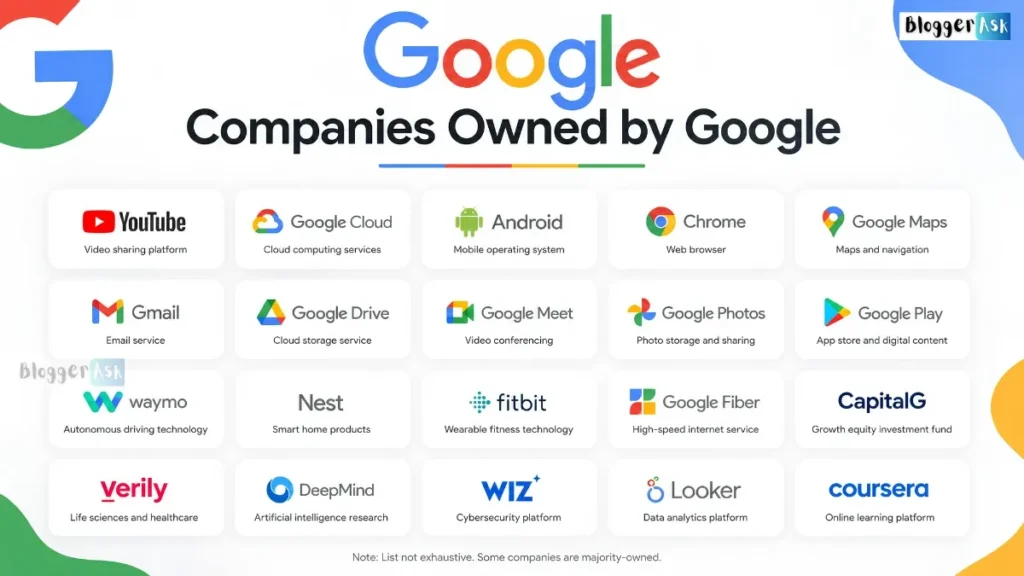
Google is wholly owned by Alphabet Inc., which controls subsidiaries spanning AI, video, advertising, cybersecurity, navigation, smart home, wearables, autonomous vehicles, and life sciences. The most significant companies owned by Google include YouTube, Android, Waze, Nest, Fitbit, Google DeepMind, Mandiant, and Wiz. Alphabet’s largest acquisition ever is Wiz — completed March 11, 2026 at $32 billion in cash — confirmed by Google’s official press release upon completion.
Companies Owned by Google — At a Glance
- YouTube
- Android
- Waze
- Google DeepMind
- Firebase
- AdMob
- Kaggle
- Apigee
- Looker
- VirusTotal
- Mandiant
- Wiz
- Nest
- Fitbit
- Waymo (Alphabet Other Bets)
- Verily (Alphabet Other Bets)
- Wing (Alphabet Other Bets)
- Intrinsic (Alphabet Other Bets)
- X Development (Alphabet Other Bets)
Key Takeaways
- Alphabet has completed 264 acquisitions since 2001 (Tracxn, April 2026).
- Wiz closed at the full announced price of $32 billion — Google’s largest acquisition ever (Google official press release, March 11, 2026).
- Android, purchased for $50 million in 2005, is widely cited by technology analysts as one of the highest-return acquisitions in the industry’s history, given its current 72% global mobile OS market share (StatCounter, May 2026).
- YouTube’s total revenue (ads + subscriptions) exceeded $60 billion for the first time in FY2025.
- Google Search, Gmail, Chrome, Maps, and Google Cloud are built in-house — not acquired companies.
- Waymo, Verily, Wing, Intrinsic, and X Development are Alphabet “Other Bets” — separate from Google LLC with independent management and financial reporting.
- Alphabet’s 2026 capital expenditure guidance now stands at $195 to $205 billion — raised at its Q2 2026 earnings (up from an initial $175–$185 billion set in early 2026).
Complete List of Companies Owned by Google (Alphabet)
| Company | Category | Price | Year | Current Status |
|---|---|---|---|---|
| Android | Mobile OS | ~$50M | 2005 | ✅ Google LLC |
| YouTube | Video | $1.65B | 2006 | ✅ Google LLC |
| DoubleClick | Ad tech | $3.1B | 2008 | ✅ Google Ads |
| AdMob | Mobile ads | Undisclosed | 2010 | ✅ Google LLC |
| VirusTotal | Malware scanning | Undisclosed | 2012 | ✅ Chronicle/Mandiant |
| Waze | Navigation | $966M | 2013 | ✅ Google LLC |
| Nest Labs | Smart home | $3.2B | 2014 | ✅ Google Nest |
| DeepMind | AI research | ~$500M | 2014 | ✅ Google DeepMind |
| Firebase | App development | Undisclosed | 2014 | ✅ Google LLC |
| Apigee | API management | $625M | 2016 | ✅ Google Cloud |
| Kaggle | Data science | Undisclosed | 2017 | ✅ Google LLC |
| Looker | Business intelligence | $2.6B | 2020 | ✅ Google Cloud |
| Fitbit | Wearables | $2.1B | 2021 | ✅ Wear OS |
| Mandiant | Cybersecurity | $5.4B | 2022 | ✅ Google Cloud |
| Intersect | Data center / energy | $4.75B | 2025 | ✅ Google LLC |
| Wiz | Cloud security | $32B | 2026 | ✅ Google Cloud |
| Waymo | Autonomous vehicles | Internal | 2016 | ✅ Alphabet Other Bets |
| Verily | Life sciences | Internal | 2015 | ✅ Alphabet Other Bets |
| Wing | Drone delivery | Internal | 2018 | ✅ Alphabet Other Bets |
| Intrinsic | Industrial robotics | Internal | 2021 | ✅ Alphabet Other Bets |
| X Development | Moonshot research | Internal | 2010 | ✅ Alphabet Other Bets |
| Motorola Mobility | Mobile hardware | $12.5B | 2011 | ❌ Sold to Lenovo (2014) |
Wiz completed as an all-cash transaction at the full announced price (Google official press release, March 11, 2026).
Google Ownership Fact Sheet (2026)
| Fact | Answer |
|---|---|
| Parent Company | Alphabet Inc. |
| Total Acquisitions | 264 (Tracxn, April 2026) |
| Largest Acquisition | Wiz — $32B completed (March 11, 2026) |
| Most Valuable Subsidiary | Google LLC |
| AI Division | Google DeepMind |
| Market Cap | ~$4.0 trillion (late July 2026) |
| FY2025 Revenue | Exceeded $400 billion |
| 2026 CapEx Guidance | $195–$205 billion (raised at Q2 2026) |
| Google Cloud Backlog | $514B (Q2 2026, Alphabet earnings call) |
| CEO | Sundar Pichai |
| Founders | Larry Page, Sergey Brin |
This article is monitored and updated as acquisitions, valuations, and ownership details change. Last verified: July 28, 2026.
Companies Owned by Google — By Category
Artificial Intelligence — Google DeepMind · Kaggle
Cloud & Enterprise — Wiz · Mandiant · Apigee · Looker · Firebase · Intersect
Mobile & Consumer — Android · Fitbit · Waze
Advertising Technology — AdMob · DoubleClick → Google Ads
Video & Content — YouTube
Smart Home & Hardware — Nest Labs → Google Nest
Cybersecurity — Wiz · Mandiant · VirusTotal (via Chronicle)
Autonomous Vehicles (Other Bets) — Waymo
Life Sciences (Other Bets) — Verily
Drone Delivery (Other Bets) — Wing
Industrial Robotics (Other Bets) — Intrinsic
Moonshot Research (Other Bets) — X Development
How Google’s Ownership Structure Works
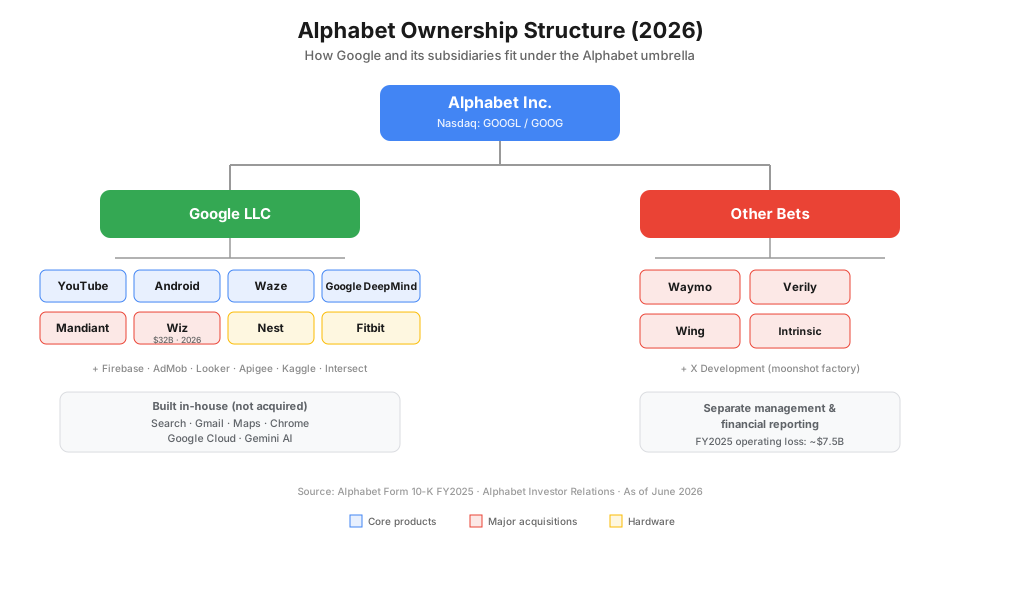
Alphabet Inc. is the parent holding company. Google LLC is its largest subsidiary — responsible for Search, YouTube, Android, Cloud, Maps, Gmail, Chrome, and Google Ads, generating roughly 95% of Alphabet’s total revenue. Waymo, Verily, Wing, Intrinsic, and X Development operate as “Other Bets” — separately managed Alphabet subsidiaries outside Google LLC with independent P&L reporting.
For the full breakdown of how Larry Page and Sergey Brin retain 52.7% of all Alphabet voting power through Class B super-voting shares — and what that means for governance — see our guides to who owns Google and who owns Alphabet Inc.
Alphabet Organizational Structure (2026):
Biggest Google Acquisitions — Ranked by Price
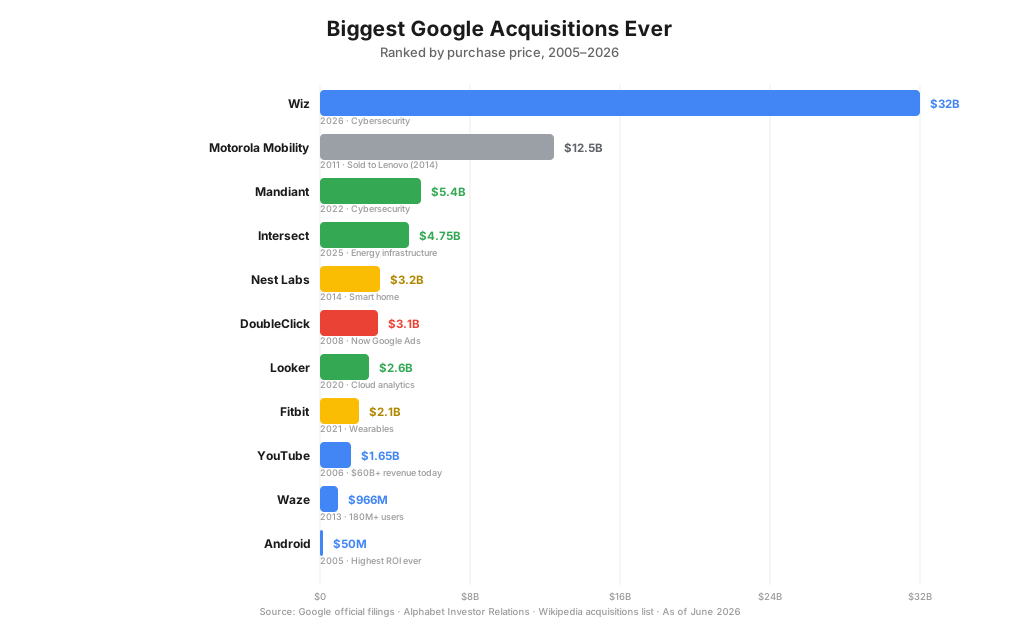
| Rank | Company | Price | Year | Status |
|---|---|---|---|---|
| 1 | Wiz | $32B | 2026 | ✅ Google Cloud |
| 2 | Motorola Mobility | $12.5B | 2011 | ❌ Sold to Lenovo |
| 3 | Mandiant | $5.4B | 2022 | ✅ Google Cloud |
| 4 | Intersect | $4.75B | 2025 | ✅ AI infrastructure |
| 5 | Nest Labs | $3.2B | 2014 | ✅ Google Nest |
| 6 | DoubleClick | $3.1B | 2008 | ✅ Google Ads |
| 7 | Looker | $2.6B | 2020 | ✅ Google Cloud |
| 8 | Fitbit | $2.1B | 2021 | ✅ Wear OS |
| 9 | YouTube | $1.65B | 2006 | ✅ $60B+ total revenue |
| 10 | Waze | $966M | 2013 | ✅ 180M+ users |
| 11 | Apigee | $625M | 2016 | ✅ Google Cloud |
| 12 | Android | ~$50M | 2005 | ✅ 72% global mobile OS |
Sources: Google official press release; Alphabet Form 10-K FY2025; SEC filings; Lenovo acquisition announcement (2014)
Acquisitions Still Active vs. Divested or Discontinued
Rather than label individual deals “best” or “worst” — a judgment call no outside analyst can verify with certainty — the more useful, fact-based distinction is simple: which acquisitions are still part of Google’s business today, and which were sold off or shut down.
| Status | Companies | Verifiable Outcome |
|---|---|---|
| Still active, integrated | YouTube, Android, Waze, DoubleClick (→ Google Ads), DeepMind, Mandiant, Wiz, Nest, Fitbit | Each remains a functioning part of Google LLC or Google Cloud as of mid-2026 |
| Sold at a loss | Motorola Mobility | Bought for $12.5B (2011), sold for $2.91B (2014) — a documented ~$9.6B disposal |
| Sold, no longer Google-owned | Boston Dynamics, Terra Bella | Boston Dynamics sold to SoftBank (2017), later Hyundai (2021); Terra Bella sold to Planet Labs (2017) |
| Shut down entirely | Loon, Makani | Discontinued in 2021 and 2020 respectively — no buyer found |
| Wound down, folded into Google | Sidewalk Labs, Chronicle | Sidewalk dissolved December 2021; Chronicle absorbed into Google Cloud security in 2020 |
This is a more defensible framework than subjective rankings: it relies entirely on documented, sourced outcomes rather than opinion about which deal “performed best.”
Why Google Buys Instead of Builds
Google’s acquisition pattern follows one consistent logic: buy what internal development cannot produce quickly enough.
Google Video existed before YouTube and failed. Google Maps predated Waze but lacked community traffic intelligence. Google built text ads in-house, then purchased DoubleClick to extend into display advertising. Wiz gave Google Cloud enterprise security credibility that organic growth would have taken a decade to establish.
Each major purchase addressed a specific timing or trust gap. The price tag reflects how long it would have taken to close that gap without the acquisition.
How Google’s Acquisition Strategy Compares to Other Big Tech Companies
| Company | Largest Acquisition | Price | Year |
|---|---|---|---|
| Google (Alphabet) | Wiz | $32B | 2026 |
| Microsoft | Activision Blizzard | $68.7B | 2023 |
| Meta | $19B | 2014 | |
| Amazon | Whole Foods | $13.7B | 2017 |
Microsoft’s Activision deal remains the largest tech acquisition in history by a wide margin. Google’s Wiz purchase is its own largest deal — but still well below the scale of Microsoft’s biggest bets, reflecting Alphabet’s historical preference for many mid-sized, capability-specific acquisitions over a small number of mega-deals.
Companies Owned by Google LLC
1. YouTube
Purchased: November 2006 | Price: $1.65 billion
Every analyst covering the deal in 2006 thought Google had overpaid. YouTube had no meaningful revenue, genuine copyright liability, and infrastructure barely holding together under its own traffic. Google’s own competing platform, Google Video, had launched the same year and was losing.
Rather than keep iterating on a product that wasn’t working, Google bought the competitor that was. YouTube’s total revenue — advertising plus subscriptions — exceeded $60 billion for the first time in FY2025 (Alphabet Q4 2025 earnings call, February 4, 2026). On a straight comparison, the $1.65 billion purchase price is now generated roughly every 10 days of YouTube’s current annual revenue run rate.
2. Android
Purchased: August 2005 | Price: ~$50 million
Andy Rubin and eight engineers had built Android Inc. to develop a mobile operating system. The iPhone was two years from announcement. Google paid $50 million for a platform with no devices, no market, and no guarantee that smartphones would become what they became.
Android now runs on approximately 72% of global smartphones — more than 3 billion active devices (StatCounter, May 2026). The advertising, Search, Maps, Gmail, and Play Store revenue flowing through those devices is not broken out as a standalone figure in Alphabet’s reporting, but it represents a substantial share of total company revenue from a $50 million purchase.
3. Waze
Purchased: June 2013 | Price: $966 million
Three things converged in 2013: Apple Maps had launched to catastrophic reviews the prior year but wasn’t going away; Facebook was in serious acquisition talks with Waze; and Google Maps — technically solid — lacked crowd-sourced real-time traffic data at Waze’s scale.
Google moved quickly, closing the deal in June 2013 for $966 million. Waze still operates as a separate app with over 180 million monthly users (Waze, company data), while its community-sourced traffic data feeds into Google Maps routing simultaneously — improving both products from a single acquisition.
4. DoubleClick → Google Ads
Purchased: March 2008 | Price: $3.1 billion
Before DoubleClick, Google sold text ads against search results. That was the entirety of its advertising product. DoubleClick had built the dominant infrastructure for display advertising — banner ads, video ads, publisher solutions — across the broader web.
Google’s purchase, approved despite objections from Microsoft and AT&T, transformed it from a search advertising company into a full-stack advertising platform. In 2018, the DoubleClick brand folded into Google Ads and the Google Marketing Platform. That infrastructure now drives the majority of Alphabet’s revenue from Search, Display, YouTube advertising, and the Google Network.
5. Wiz
Announced: March 18, 2025 | Completed: March 11, 2026 | Price: $32 billion, all-cash
Wiz reached $500 million in annual recurring revenue within four years of founding — one of the fastest enterprise software growth trajectories ever. Google initially offered $23 billion. Wiz declined to pursue an IPO. The deal was revived at $32 billion.
U.S. regulators approved the deal in November 2025; the EU followed with unconditional approval in February 2026. The transaction closed at the full announced price of $32 billion, confirmed in Google’s official completion announcement. Wiz scans for security vulnerabilities across AWS, Azure, and Google Cloud — not just Google’s own infrastructure. That multi-cloud positioning gives Google Cloud a security footprint in enterprise accounts it doesn’t otherwise control, directly strengthening its competitive position against AWS and Microsoft Azure.
6. Mandiant
Purchased: September 2022 | Price: $5.4 billion
Mandiant is the firm major organizations call after a breach — built its reputation through decades of forensic investigation work. You cannot build that kind of enterprise trust in twelve months. Google paid $5.4 billion for the trust, not the software.
Folded into Google Cloud, Mandiant handles post-breach incident response while Wiz handles proactive vulnerability detection. Together they give Google Cloud the most comprehensive single-vendor enterprise security stack in the market.
Other Notable Google Acquisitions
These six acquisitions rarely appear in headline coverage but collectively form a substantial part of Google’s current product ecosystem.
Firebase (2014) — Brought into the fold in October 2014 for an undisclosed price, Firebase started as a real-time database startup. Google expanded it into a full-stack mobile and web application development platform — authentication, cloud storage, analytics, crash reporting, performance monitoring, hosting — now powering millions of applications globally. Integrated with BigQuery for analytics and AdMob for monetization, it is a foundational layer of Google Cloud’s developer ecosystem.
AdMob (2010) — Omar Hamoui founded AdMob in 2006 after dropping out of Wharton to build one of the earliest large-scale mobile advertising networks. Google absorbed it in 2010 for an undisclosed price. AdMob is now the dominant in-app advertising platform globally — integrated with Firebase and Google Ad Manager to form the backbone of how app developers monetize their products. Hundreds of millions of users see AdMob-served ads daily without knowing it.
Apigee (2016) — $625 million — Google purchased Apigee in September 2016 for $625 million. Apigee’s API management platform helps enterprises expose their services as digital products — clients at the time of acquisition included AT&T, Walgreens, and Live Nation. Inside Google Cloud, Apigee serves as the API gateway for large enterprises undergoing digital transformation, competing directly with AWS API Gateway and Azure API Management.
Kaggle (2017) — Kaggle hosts nearly 700,000 publicly available datasets and runs machine learning competitions across medical imaging, financial forecasting, and natural language processing. Google brought it into its portfolio in March 2017 for an undisclosed price. The platform functions simultaneously as a talent pipeline for AI engineers, a public benchmark environment, and a dataset resource that Google DeepMind researchers actively use. It is perhaps the most strategically overlooked acquisition Google ever made.
VirusTotal (2012) — Founded in Spain in 2004, VirusTotal analyzes files and URLs for malware using over 70 antivirus engines simultaneously — and does it for free. Google acquired it in 2012. VirusTotal now operates under Chronicle, Alphabet’s cybersecurity intelligence division embedded within Google Cloud’s security infrastructure alongside Mandiant and Wiz. It processes millions of submissions daily and feeds threat intelligence data into Google’s broader security stack.
Looker (2020) — $2.6 billion — Google’s largest cloud-focused acquisition before Mandiant. Looker’s platform translates raw database queries into natural-language business outputs, making data analytics accessible to teams without engineering expertise. Linked with BigQuery, Looker anchors Google Cloud’s enterprise analytics offering and competes directly with Tableau (Salesforce) and Power BI (Microsoft). Before Looker, Google Cloud had no credible first-party business intelligence product.
Google’s AI Expansion Strategy (2024–2026)
Google DeepMind
Purchased: January 2014 | Price: ~$500 million | Restructured: April 2023 — merged with Google Brain
DeepMind spent nearly a decade operating as a relatively independent AI research lab within Alphabet. In April 2023, Sundar Pichai merged it with Google Brain — Alphabet’s own internal AI division — to form Google DeepMind under CEO Demis Hassabis. The consolidated entity develops the Gemini model family, which powers Google Search’s AI features, the Gemini assistant, and Google Cloud’s AI offerings.
Gemini 3 launched in November 2025. By mid-2026, the Gemini app had reached 950 million monthly active users, and AI Mode in Google Search had surpassed 1 billion users. Google Cloud’s revenue grew 82% year-over-year in Q2 2026 to $24.8 billion — with backlog reaching $514 billion (Alphabet Q2 2026 earnings) — driven largely by Gemini-powered AI infrastructure demand. The $500 million DeepMind purchase is widely regarded by industry analysts as one of Google’s most strategically significant acquisitions, given its direct line to the Gemini platform.
Windsurf — Talent and Licensing Deal (~$2.4B, July 2025)
Google hired Windsurf CEO Varun Mohan and co-founder Douglas Chen into Google DeepMind to build Gemini’s agentic coding capabilities, along with a non-exclusive license to Windsurf’s technology. Windsurf itself remains independent. OpenAI had previously agreed to acquire Windsurf for $3 billion; those talks collapsed. Google moved quickly. Mohan and Chen now compete directly with GitHub Copilot (Microsoft) and Claude Code (Anthropic) from inside Google DeepMind.
Character.AI — Licensing Agreement (2025)
Google holds a non-exclusive license to Character.AI’s language model technology. Character.AI remains independent. The DOJ has opened a probe to determine whether the arrangement effectively circumvents antitrust merger review. This is a licensing deal, not an acquisition — Google does not own Character.AI.
Alphabet’s Other Bets
These five subsidiaries sit outside Google LLC, funded by Google’s advertising profits, with separate management and financial reporting. Combined Other Bets revenue in FY2025 was approximately $1.5 billion against operating losses of roughly $7.5 billion.
Waymo — Autonomous vehicle subsidiary operating commercial robotaxi services in roughly 11 US metros as of July 2026, completing about 500,000 paid rides per week — with newly announced cities (San Diego, Las Vegas, Tampa, Denver) rolling out in stages. Valued at $126 billion after a $16 billion funding round in February 2026, the largest ever for a self-driving company. International expansion, with London as its first market, is underway; Waymo has set a public goal of one million paid weekly rides by the end of 2026. Pichai’s 2026 compensation includes up to $260 million in Waymo equity tied to value growth through 2028.
Verily — Life sciences research focused on disease prevention, health data, and clinical study infrastructure. Partners with pharmaceutical companies and health systems to apply data science to biological challenges.
Wing — FAA-approved drone delivery operations in the United States, Australia, and Finland, delivering packages and pharmacy items via autonomous drones. Pichai’s 2026 compensation includes Wing equity worth up to $90 million.
Intrinsic — Industrial robotics software that dramatically reduces the programming time required to deploy robotic systems, making automation accessible to organizations without dedicated robotics engineering teams.
X Development — Alphabet’s moonshot factory, the laboratory behind early-stage Waymo, Wing, Verily, and Loon (now shut down). X functions as an internal research and development organization for technologies that don’t yet have a clear home inside Google or Other Bets.
Hardware Brands Owned by Google
Nest ($3.2B, 2014): Tony Fadell and Matt Rogers — both former Apple engineers from the iPod and iPhone teams — founded Nest to build a learning thermostat. Google bought it and expanded it into Google Nest: thermostats, security cameras, video doorbells, smoke detectors, and Nest Hub smart displays.
Fitbit ($2.1B, 2021): Founded in 2007 by James Park and Eric Friedman, Fitbit pioneered consumer wearable fitness tracking. After EU regulatory approval in January 2021, Fitbit joined Google’s Wear OS ecosystem. Google consolidated its smartwatch hardware under the Pixel Watch brand in 2024, while Fitbit continues covering fitness trackers.
Pixel (built in-house): Pixel is not an acquired company. Google’s Pixel smartphone and laptop line was developed internally. Google did absorb portions of HTC’s hardware team in 2017 for approximately $1.1 billion — but Pixel as a brand originated within Google.
Largest Subsidiaries by Revenue (2025–2026)
| Subsidiary / Segment | Revenue | Period | Source |
|---|---|---|---|
| Google Services (total) | ~$350 billion | FY2025 | Alphabet Form 10-K FY2025 |
| YouTube (ads + subscriptions) | $60 billion+ | FY2025 | Alphabet Q4 2025 earnings |
| Google Cloud | ~$59 billion | FY2025 | Alphabet earnings releases |
| Google Cloud (annual run rate) | $70 billion+ | End of 2025 | Alphabet Q4 2025 earnings |
| Google Cloud (annual run rate) | ~$99 billion | Q2 2026 pace | Alphabet Q2 2026 earnings |
| Google Advertising (total) | ~$237 billion | FY2025 est. | Alphabet segment reporting |
| Other Bets | ~$1.5 billion | FY2025 | Alphabet Form 10-K FY2025 |
| Waymo | Early-stage commercial | 2026 | Alphabet reporting |
Google does not break out standalone revenue for Waze, Nest, Fitbit, Firebase, AdMob, or Looker. These are reported within Google Services. Google Cloud’s Q2 2026 revenue of $24.8 billion annualizes to roughly a $99 billion run rate.
Google Acquisition Timeline (2005–2026)
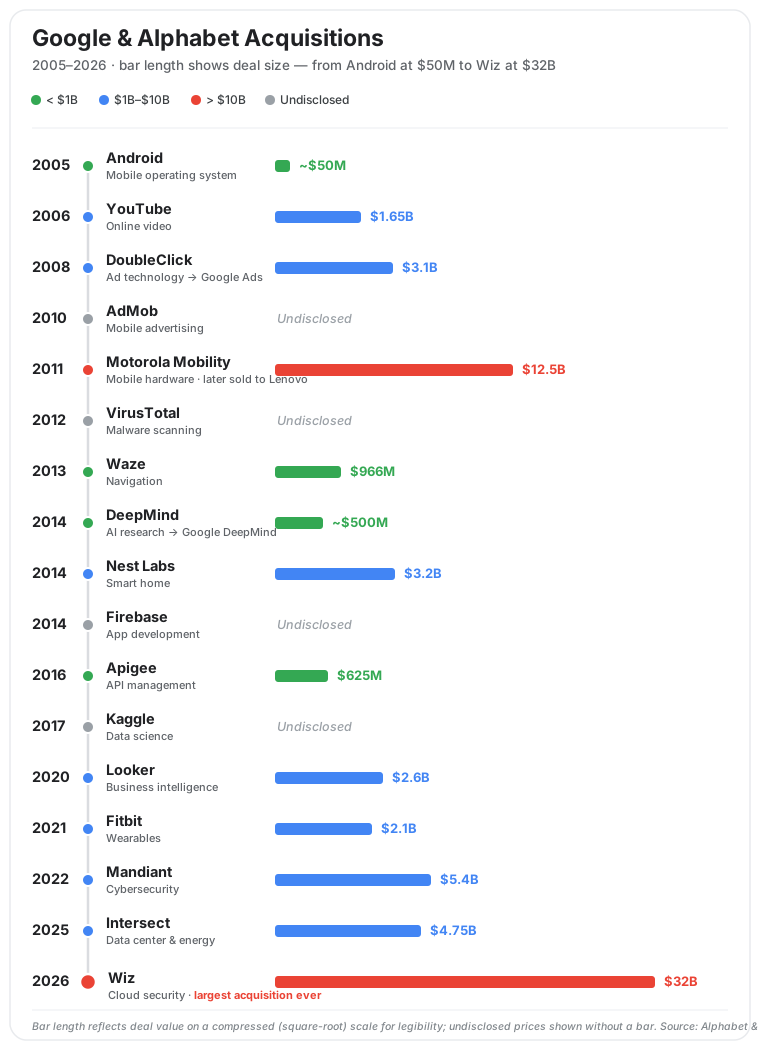
| Year | Company | Category | Price |
|---|---|---|---|
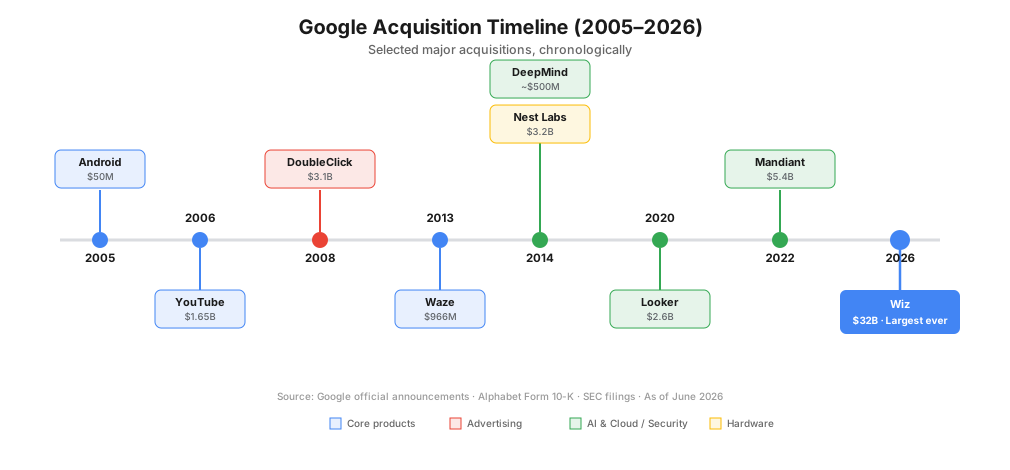
| 2005 | Android Inc. | Mobile OS | ~$50M |
| 2006 | YouTube | Video | $1.65B |
| 2008 | DoubleClick | Ad technology | $3.1B |
| 2010 | AdMob | Mobile advertising | Undisclosed |
| 2011 | Motorola Mobility | Mobile hardware | $12.5B |
| 2012 | VirusTotal | Malware scanning | Undisclosed |
| 2013 | Waze | Navigation | $966M |
| 2014 | DeepMind | AI research | ~$500M |
| 2014 | Nest Labs | Smart home | $3.2B |
| 2014 | Firebase | App development | Undisclosed |
| 2016 | Apigee | API management | $625M |
| 2017 | Kaggle | Data science | Undisclosed |
| 2020 | Looker | Business intelligence | $2.6B |
| 2021 | Fitbit | Wearables | $2.1B |
| 2022 | Mandiant | Cybersecurity | $5.4B |
| 2025 | Intersect | Data center / energy | $4.75B |
| 2026 | Wiz | Cloud security | $32B completed |
Companies Google Does NOT Own
This section directly answers some of the most common ownership questions — many driven by user confusion about Google’s investments, partnerships, and competitors.
| Company | Owner | Google’s Relationship |
|---|---|---|
| OpenAI | Independent (Microsoft partner) | Competitor — Anthropic is Google’s AI investment |
| ChatGPT | OpenAI product | Not owned; Gemini is Google’s competing product |
| TikTok | ByteDance (China) | ❌ No ownership or investment |
| Meta Platforms | ❌ No ownership or investment | |
| Meta Platforms | ❌ No ownership or investment | |
| Facebook / Meta | Mark Zuckerberg | ❌ No ownership or investment |
| X (Twitter) | Elon Musk | ❌ No ownership or investment |
| Independent (IPO 2024) | ❌ No ownership | |
| Snapchat | Snap Inc. | ❌ No ownership |
| Microsoft | ❌ No ownership | |
| Spotify | Independent | ❌ No ownership |
| Anthropic | Independent | ⚠️ Minority investor only — Alphabet invested $300M+ in Anthropic but does not own it |
Important note on Anthropic: Alphabet has invested in Anthropic — the AI company behind Claude — but this is a minority investment, not ownership. Anthropic remains independent. Google does not control Anthropic’s strategic direction, board, or products. Investing in a company and owning a company are legally and structurally different.
Important note on Character.AI: Google holds a non-exclusive technology license from Character.AI. This is not ownership — Character.AI remains independent and free to work with others.
Companies Google Invested In But Does Not Own
A separate point of confusion: Alphabet runs venture investment arms that take minority stakes in startups — this is fundamentally different from acquisition or ownership.
GV (formerly Google Ventures) — Alphabet’s venture capital arm, founded 2009, with Alphabet as its sole limited partner. GV deploys roughly $500 million annually into early-stage companies across enterprise software, life sciences, and AI. Historical GV investments include Uber, Slack, Stripe, and DocuSign — none of which Google owns or owned; GV held minority equity stakes that were typically diluted or exited over time.
CapitalG — Alphabet’s growth-stage investment fund (rebranded from “Google Capital” in 2016), focused on later-stage companies with proven business models. Past investments include Stripe, Glean, and Snap Inc.
Gradient Ventures — Alphabet’s AI-focused early-stage investment fund.
As of late 2025, Alphabet held approximately $2.5–3 billion across 37 public stock positions through GV and CapitalG combined — including stakes in AST SpaceMobile, Planet Labs, and Arm Holdings. These are investment positions, not subsidiaries. Google does not control these companies’ boards, products, or strategic direction.
Anthropic follows the same pattern: Alphabet has invested over $300 million in Anthropic (the AI company behind Claude), but Anthropic operates fully independently with its own board and leadership.
Key distinction: Acquisition = Google owns the company outright (e.g., Wiz, YouTube). Investment = Google holds minority shares with no operational control (e.g., Anthropic, companies in the GV/CapitalG portfolio).
Discontinued and Folded-In Alphabet Projects
Not every Alphabet bet survives. Several past acquisitions and “Other Bets” were shut down or absorbed into Google rather than continuing as standalone businesses — relevant context that most “companies owned by Google” articles skip entirely.
| Project | Origin | Outcome |
|---|---|---|
| Sidewalk Labs | Alphabet urban innovation subsidiary, founded 2015 | Wound down December 2021 after its flagship Toronto “smart city” project (Quayside) was cancelled in 2020. Remaining products folded into Google. |
| Chronicle | Cybersecurity venture, spun out of Alphabet’s X in 2018 | Folded into Google in 2020; its threat intelligence technology now lives inside Google Cloud’s security products. |
| Loon | Internet-via-balloon project, born in Google X | Shut down in January 2021 — deemed not commercially viable at scale. |
| Makani | Airborne wind turbine technology, born in Google X | Shut down in February 2020. |
| Boston Dynamics | Robotics company acquired by Google in 2013 | Sold to SoftBank in 2017, then to Hyundai Motor Group in 2021. No longer owned by Google or Alphabet. |
| Terra Bella | Satellite imaging company, acquired 2014 | Sold to Planet Labs in 2017. |
These divestitures matter for the same reason Motorola does: Alphabet is willing to shut down or sell businesses that don’t reach commercial scale — a pattern not always visible in lists that only show what Google currently owns.
Products vs. Companies — Clearing Up the Confusion
Significant user confusion exists between Google’s in-house products and companies it acquired.
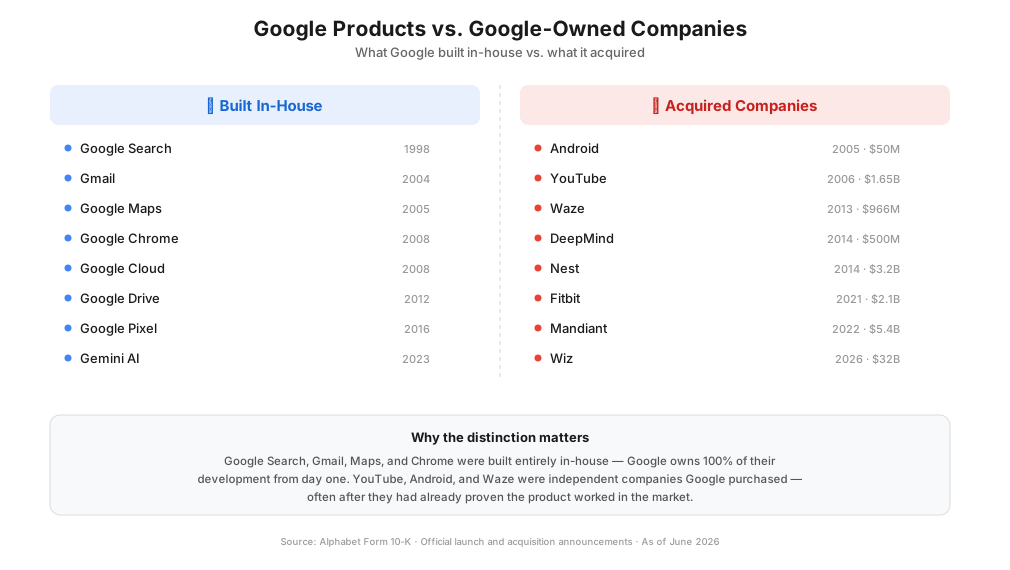
| Product / Brand | Built In-House | Acquired | Year |
|---|---|---|---|
| Google Search | ✅ | — | 1998 |
| Gmail | ✅ | — | 2004 |
| Google Maps | ✅ | — | 2005 |
| Google Chrome | ✅ | — | 2008 |
| Google Cloud | ✅ | — | 2008 |
| Google Drive | ✅ | — | 2012 |
| Google Pixel | ✅ | — | 2016 |
| Gemini AI | ✅ | — | 2023 |
| BigQuery | ✅ | — | 2010 |
| Android | — | ✅ | 2005 |
| YouTube | — | ✅ | 2006 |
| Waze | — | ✅ | 2013 |
| Nest | — | ✅ | 2014 |
| Firebase | — | ✅ | 2014 |
| Fitbit | — | ✅ | 2021 |
| Mandiant | — | ✅ | 2022 |
| Wiz | — | ✅ | 2026 |
The Acquisition That Got Away — Motorola Mobility
Purchased: $12.5 billion (2011) | Sold to Lenovo: $2.91 billion (2014)
The primary goal was defensive: Motorola’s mobile patent portfolio would protect Android from escalating legal battles with Apple and Microsoft. The smartphone hardware business came along with the deal. Google never figured out what to do with it.
Three years later, Lenovo paid $2.91 billion for the hardware operation while Google retained the patents. Net cost of patent protection: approximately $9.6 billion. The failure directly accelerated Google’s Pixel strategy — build hardware internally, control the software quality without the burden of an inherited brand. The first Pixel launched in 2016, two years after Motorola was sold, under the leadership of Google’s co-founders Larry Page and Sergey Brin, who still held majority voting control of Alphabet at the time.
Research Methodology
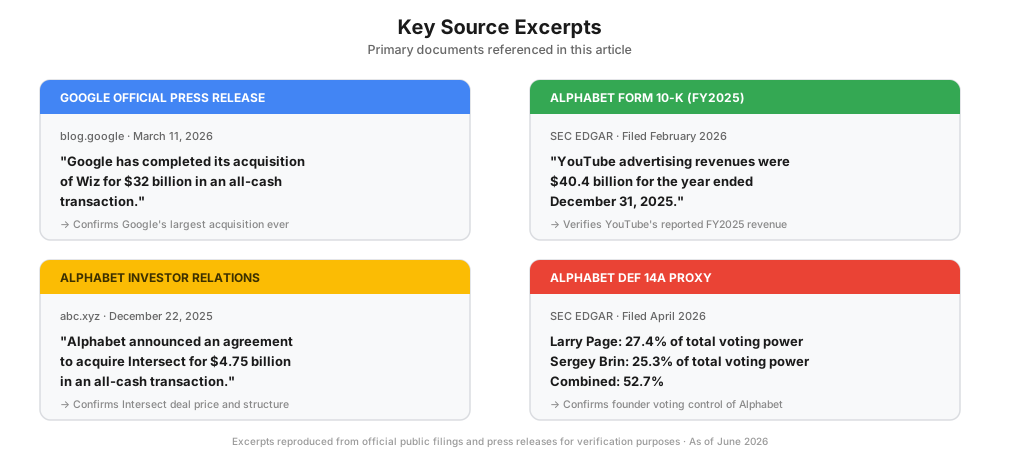
All ownership and acquisition data is drawn from primary and authoritative secondary sources:
- Google official press release — Wiz completed at $32B all-cash (March 11, 2026)
- Alphabet Q2 2026 Earnings Release (8-K), July 22, 2026 — Google Cloud $24.8B quarterly (+82%), backlog $514B, 2026 CapEx guidance raised to $195–$205B
- Alphabet Q4 2025 Earnings Release (8-K), February 4, 2026 — FY2025 revenue exceeding $400B; YouTube $60B+
- Alphabet Form 10-K FY2025, SEC EDGAR — Annual financials and segment reporting
- Alphabet Investor Relations (abc.xyz) — Intersect acquisition (December 2025)
- Tracxn — Total acquisition count: 264 (April 2026)
- TechCrunch — Apigee acquisition price: $625M (September 8, 2016)
- Crunchbase — Firebase acquisition: October 21, 2014
- BGR — AdMob, Kaggle context (March 23, 2026)
- Wikipedia — List of mergers and acquisitions by Alphabet — Cross-referenced against primary sources
- CNBC / Yahoo Finance — Waymo expansion and ridership (2026)
- The Road to Autonomy — Waymo 11-metro coverage (July 2026)
- eWeek — Waymo $126B valuation (February 4, 2026)
- EU regulatory filings — Wiz merger clearance, February 2026
All figures are verified against at least two independent sources, prioritizing official company announcements and SEC filings.
Frequently Asked Questions
How many companies does Google own?
Alphabet has completed 264 acquisitions since 2001 (Tracxn, April 2026). Major active subsidiaries include YouTube, Android, Waze, Nest, Fitbit, Firebase, AdMob, Looker, Kaggle, Apigee, Mandiant, Wiz, and Google DeepMind, plus Other Bets: Waymo, Verily, Wing, Intrinsic, and X Development.
Does Google own YouTube?
Yes. Google purchased YouTube in November 2006 for $1.65 billion. YouTube’s total revenue — advertising plus subscriptions — exceeded $60 billion in FY2025.
Does Google own Android?
Yes. Google purchased Android Inc. in August 2005 for approximately $50 million. Android runs on roughly 72% of global smartphones — over 3 billion active devices.
Does Google own Waze?
Yes. Purchased in June 2013 for $966 million. Waze operates independently from Google Maps with over 180 million monthly users.
Does Google own Fitbit?
Yes. The $2.1 billion acquisition closed in January 2021 after EU approval. Fitbit operates within Google’s Wear OS ecosystem.
What is Google’s largest acquisition ever?
Wiz — completed March 11, 2026 at the full $32 billion announced price, confirmed by Google’s official completion announcement.
Is Waymo owned by Google?
Waymo is owned by Alphabet Inc. — Google’s parent company. It is an Alphabet subsidiary, not a Google LLC subsidiary. Waymo began as a Google X project in 2009 and became an independent Alphabet subsidiary in December 2016. Its valuation reached $126 billion after a $16 billion funding round in February 2026.
Does Google own DeepMind?
Yes. Google purchased DeepMind in January 2014 for approximately $500 million. In April 2023, it merged with Google Brain to form Google DeepMind, which develops the Gemini AI model family.
Does Google own OpenAI or ChatGPT?
No, to both. OpenAI is an independent company backed primarily by Microsoft; ChatGPT is OpenAI’s product. Google’s competing AI product is Gemini. Google has invested in Anthropic — a separate AI company — but does not own OpenAI.
Does Google own TikTok?
No. TikTok is owned by ByteDance, a Chinese technology company. Google has no ownership or investment in TikTok.
Does Google own Search, Gmail, Maps, or Chrome?
No — none of these were acquired companies. Google Search (1998), Gmail (2004), Google Maps (2005), and Chrome (2008) were all built internally by Google. They are product divisions, not acquisitions — an important distinction covered in detail in the products-vs-companies comparison above.
Does Google own Character.AI?
No. Google holds a non-exclusive technology licensing agreement with Character.AI. The company remains independent. The DOJ has opened a probe into whether the arrangement circumvents merger review.
Does Google own Anthropic, Uber, or Stripe?
No. Alphabet has made minority investments in these companies — directly in Anthropic, and historically in Uber and Stripe through its venture arms GV and CapitalG. A minority investment is not ownership: Google has no board control, no operational authority, and no claim to these companies’ strategic direction.
What companies did Google buy in 2025–2026?
Wiz ($32B, completed March 2026), Intersect ($4.75B, announced December 2025), and the Windsurf talent and licensing deal (~$2.4B, July 2025). Google also signed a licensing agreement with Character.AI in 2025 — not an acquisition.
Why did Google buy Wiz?
Wiz scans for security vulnerabilities across multiple cloud environments — AWS, Azure, and Google Cloud. This gives Google Cloud a security presence in enterprise accounts it doesn’t otherwise control. Combined with $500M+ ARR and deep enterprise trust, it solved a competitive gap that organic development would have taken years to close.
What is Intersect?
A clean energy and data center infrastructure company. Alphabet announced its $4.75 billion purchase in December 2025. Google needed energy and data center capacity to support AI workloads at scale — Intersect’s portfolio includes gigawatts of clean energy and data center projects in development.
What companies did Google sell?
Most significant: Motorola Mobility — purchased for $12.5 billion in 2011, sold to Lenovo for $2.91 billion in 2014 while Google retained the patent portfolio. Others include Terra Bella (satellite business, sold to Planet Labs, 2017) and Boston Dynamics (sold to SoftBank in 2017, later to Hyundai in 2021).
What companies does Alphabet own that Google LLC does not?
Alphabet directly owns “Other Bets” outside Google LLC — including Waymo (autonomous vehicles), Verily (life sciences), Wing (drone delivery), and Intrinsic (robotics). These are separately managed and separately reported in Alphabet’s financial filings, distinct from Google LLC’s search, advertising, and cloud businesses.
The Bottom Line
Google’s acquisition history tells a consistent story: the highest-impact bets were made early, at prices that look almost comically small in hindsight. Android for $50 million. YouTube for $1.65 billion. Together they established the mobile and video platforms that generate a substantial share of revenue across a company now exceeding $400 billion annually.
The 2025–2026 acquisition cycle operates at a completely different scale and reflects a fundamentally different strategic purpose. Wiz at $32 billion, Intersect at $4.75 billion, and the Windsurf talent deal at $2.4 billion are not platform bets — they are infrastructure bets. Cloud security, AI-scale energy, and agentic coding are the contested layers of the current technology cycle, and Alphabet is buying its position in all three while simultaneously committing $195 to $205 billion in capital expenditure for 2026 alone.
From $50 million for Android in 2005 to $195–$205 billion in annual infrastructure investment in 2026, the scale of Google’s bets has grown by a factor of several thousand. The underlying logic — own the platform layer before the competition consolidates it — has not changed at all.
📖 Continue Reading:
Sources & References
- Google official press release — Wiz acquisition completion (March 11, 2026)
- Alphabet Q4 2025 Earnings Release (8-K), February 4, 2026
- Alphabet Form 10-K FY2025, SEC EDGAR
- Alphabet Investor Relations, abc.xyz
- Tracxn (264 acquisitions, April 2026)
- TechCrunch (Apigee, $625M, September 8, 2016)
- Crunchbase (Firebase, October 21, 2014)
- BGR (March 23, 2026)
- CNBC (Waymo expansion, February 24, 2026)
- Electrek (May 13, 2026)
- eWeek (Waymo valuation, February 4, 2026)
- CB Insights (GV portfolio data)
- CNBC (Sidewalk Labs wind-down, December 16, 2021)
- Wikipedia — List of mergers and acquisitions by Alphabet

Olivia Isabel is a Business & Technology Writer specializing in corporate ownership, company leadership, shareholders, acquisitions, and the business strategies behind major global companies. Her work covers technology, artificial intelligence, social media, finance, e-commerce, automotive, and consumer technology, with a particular focus on explaining who owns, controls, and leads well-known companies.
With a background in Economics and Journalism, Olivia approaches each topic as a research-driven business story. She examines company filings, investor-relations materials, regulatory records, official corporate announcements, and reputable financial sources to distinguish between legal ownership, economic ownership, voting control, and day-to-day management.
Her articles explore the founders behind major companies, current CEOs, significant shareholders, parent companies, subsidiaries, acquisitions, and changes in corporate structure. She has written about companies including Google, Alphabet, Apple, Microsoft, Amazon, Meta, OpenAI, Tesla, SpaceX, YouTube, Instagram, TikTok, WhatsApp, Reddit, Spotify, and other major technology and consumer brands.
Olivia’s goal is to make complicated corporate and financial information clear, accurate, and useful for everyday readers. She is particularly interested in corporate strategy, technology business models, entrepreneurship, emerging AI companies, public markets, and the evolution of globally recognized brands.