⚡ Quick Answer: Who Founded Google?
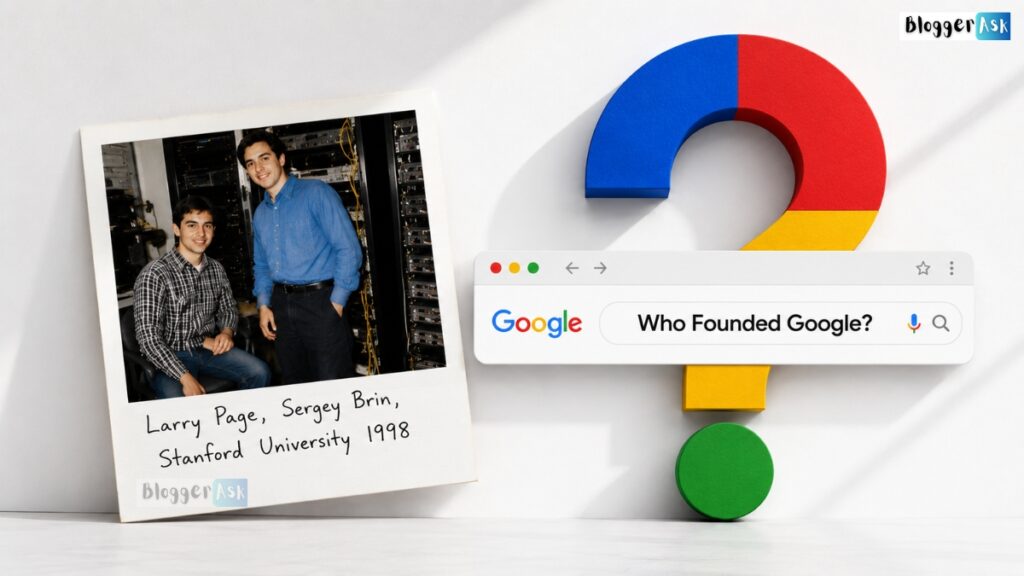
Google was founded by Larry Page and Sergey Brin on September 4, 1998. Both were PhD students at Stanford University when they built a search engine called BackRub — which eventually became Google. The company was incorporated in a Menlo Park garage and has since grown into one of the most valuable businesses in history.
How Google Was Founded — The Real Story
Two PhD students. One research project. And a question nobody had answered well yet: which web pages actually matter?
That question is where Google began. Larry Page and Sergey Brin — the co-founders of Google — didn’t set out to build a company. They set out to solve a problem. Understanding who founded Google means understanding how that problem was framed, who framed it, and why their approach worked when everything before it hadn’t.
Quick Facts
| Detail | Information |
|---|---|
| Founded | September 4, 1998 |
| Google founders | Larry Page, Sergey Brin |
| Location | Menlo Park, California |
| Original name | BackRub |
| Domain registered | September 15, 1997 |
| Original mission | “To organize the world’s information and make it universally accessible and useful.” |
| First investor | Andy Bechtolsheim — $100,000 |
| IPO date | August 19, 2004 — Nasdaq, $85/share |
| Parent company | Alphabet Inc. (since 2015) |
| Current CEO | Sundar Pichai |
Larry Page — Google Co-Founder and Creator of PageRank
Lawrence Edward Page was born on March 26, 1973, in East Lansing, Michigan. His father was a computer science professor and AI research pioneer — technology was simply part of daily life growing up. He earned his computer engineering degree from the University of Michigan in 1995, then enrolled in Stanford University’s PhD program that same year.
At Stanford, Page became fascinated by the mathematical structure of the web. His core question: which pages are actually important, and how can you prove it? His dissertation supervisor encouraged him to explore the idea — a decision Page later called the best advice he ever received.
That question became BackRub. BackRub became Google. And Google became the world’s default way of finding anything.
Per the Bloomberg Billionaires Index, Page ranked among the two or three wealthiest people on earth through 2026, with a net worth that peaked near $280 billion. Because the bulk of his fortune is Alphabet stock, the figure moves daily with the share price — which fell about 20% from its May 2026 high after the company’s Q2 earnings, bringing his net worth down from that peak. He stepped down as CEO of Alphabet in December 2019 but remains a board member and controlling shareholder, holding 27.4% of all Alphabet voting power.
Sergey Brin — Google Co-Founder and Data Mining Pioneer
Sergey Mikhailovich Brin was born in Moscow, Russia, in 1973. His family immigrated to the United States when he was six, settling in Maryland. His father was a mathematics professor — another household where academic thinking came naturally.
Brin completed his math and computer science degree at the University of Maryland in three years, graduating with highest honors. He then joined Stanford on a National Science Foundation fellowship, where he met Larry Page.
Where Page was drawn to link structure and web architecture, Brin’s strength was data mining — extracting patterns from large, messy datasets. That combination of skills turned out to be exactly right for building a search engine. Brin stepped down in December 2019 and holds approximately 25.3% of all voting power — making him, alongside Page, one of two people who still effectively control the company. Their combined 52.7% majority means their full ownership structure is worth understanding; we break it down in our guide to [who owns Google].
How Google’s Founders Met
In 1995, Larry Page visited Stanford to evaluate its PhD program. Sergey Brin, already enrolled, was assigned to show him around campus.
They disagreed about nearly everything during that first meeting. Page found Brin argumentative; Brin found Page opinionated. It did not look like the beginning of a historic partnership. But they kept talking — and over the following months, they discovered their disagreements were more productive than most people’s agreements.
By 1996, they were collaborating on a research project that would become Google. Page brought architectural thinking; Brin brought data expertise. Neither alone would have built what they built together.
BackRub — The Search Engine That Became Google
In 1996, Page launched a university research project called BackRub. The name came from its core function: analyzing backlinks — links pointing to a given page from other pages — to determine that page’s importance and relevance.
The logic borrowed from academic publishing. A paper cited by many others is generally more significant than one rarely referenced. Page applied the same reasoning to the web: a page linked to by many high-quality sites is probably more valuable than one few people point to. The weight of a link depended on the authority of the site giving it.
This became the PageRank algorithm — named partly after Larry Page himself. Brin joined and co-developed it, and together they authored a research paper that became one of the most influential documents in search engine history. BackRub eventually consumed so much of Stanford’s server bandwidth that university administrators took notice.
By 1997, Page and Brin had registered google.com — a variation on “googol,” the mathematical term for 1 followed by 100 zeros, chosen to reflect their ambition to organize a vast universe of information.
Google’s original mission statement, written at founding, put it plainly: “To organize the world’s information and make it universally accessible and useful.” That mission has never been officially changed.
September 4, 1998 — Google Is Officially Founded
On September 4, 1998, Page and Brin incorporated Google Inc. as a private company in California.
Before that happened, they had already secured their first major outside investment — and the story of how it came about has become one of Silicon Valley’s most retold legends.
Andy Bechtolsheim, co-founder of Sun Microsystems, watched a brief Google demo and was immediately convinced. He wrote a check for $100,000 made out to “Google Inc.” — and left for another meeting before the company had even been incorporated. For two weeks, Page and Brin held a check they couldn’t deposit. It was the kind of problem you only have when you’ve built something genuinely impressive.
That $100,000 check, written in a parking lot to a company that didn’t yet exist, was the financial seed of what became one of the most valuable enterprises ever built.
First Office — Susan Wojcicki’s Garage
Once incorporated, Google needed space. Page and Brin rented the garage of Susan Wojcicki’s house in Menlo Park, California, for $1,700 a month.
Wojcicki — who would later serve as CEO of YouTube from 2014 to 2023 — was among the company’s earliest employees. Her garage, modest by any measure, became one of the most famous addresses in technology history. Google later purchased the property. It is now a California historic landmark.
Why the Search Engine Google’s Founders Built Succeeded Where Others Didn’t
When Google launched, Yahoo, AltaVista, Lycos, and Ask Jeeves were all established competitors. Google didn’t just enter that market — it made most of them irrelevant within a few years. Several things set it apart:
- Better results. PageRank’s link-based ranking was far harder to game than keyword stuffing, which plagued competitors. Google’s results were cleaner and more relevant from day one.
- Simpler design. While Yahoo built a cluttered news portal, Google’s homepage had one search box. That simplicity communicated speed and focus in a way no rival matched.
- Faster performance. In an era of slow internet connections, returning results quickly wasn’t a minor feature — it was the feature.
- Smarter scalability. Google built its infrastructure on inexpensive commodity servers rather than costly specialized hardware. This let it index far more of the web and scale rapidly as usage grew.
The product spread almost entirely by word of mouth in its early years. Google ran almost no consumer advertising. It didn’t need to.
Google by the Numbers — 2026
| Metric | Figure |
|---|---|
| Global search market share | ~90% across all devices (StatCounter, Jan 2026) |
| Daily searches | Over 14 billion |
| Annual searches | Over 5 trillion |
| Most visited website | google.com — #1 globally |
| YouTube monthly users | Over 2.7 billion |
| Chrome global browser share | ~65% |
| Alphabet annual revenue | ~$402.8 billion (FY2025) |
Founding to IPO — Key Timeline
| Year | Milestone |
|---|---|
| 1995 | Page and Brin meet at Stanford |
| 1996 | BackRub research project begins |
| 1997 | google.com domain registered |
| Aug 1998 | Bechtolsheim writes $100,000 check |
| Sep 4, 1998 | Google Inc. officially incorporated |
| 1999 | $25M raised from Sequoia Capital and Kleiner Perkins |
| 2001 | Eric Schmidt joins as CEO |
| 2004 | Gmail launches; Google IPO raises $1.66 billion |
| 2006 | YouTube acquired for $1.65 billion |
| 2015 | Alphabet Inc. created; Google becomes subsidiary |
| 2019 | Page and Brin step down; Sundar Pichai becomes CEO of Alphabet |
Challenges Google Has Faced
Google’s dominance has not gone unchallenged.
In August 2024, a U.S. federal court ruled that Google had illegally maintained a monopoly in general search — finding that it paid device makers and browser developers billions annually to remain the default search engine, blocking competitors from gaining the scale needed to challenge it. Remedies followed in September 2025, banning exclusive distribution contracts and requiring data sharing with competitors. Both Google and the DOJ have appealed, with D.C. Circuit arguments expected in late 2026 or 2027.
A separate April 2025 ruling found Google had also unlawfully monopolized publisher ad server and ad exchange markets. In Europe, the pressure mounted further in 2026: the EU’s top court made a €4.1 billion Android fine final in July, and the Commission added an €890 million Digital Markets Act fine over search self-preferencing. Long-running privacy concerns around data collection and targeted advertising have drawn regulatory scrutiny across the US, UK, and EU for over a decade.
These challenges don’t erase what Page and Brin built. But they are part of the company’s story — a product this dominant inevitably attracts questions about how that dominance is maintained.
Where Are the Founders Now?
Google’s August 2004 IPO — priced at $85 per share — made Page and Brin instant billionaires. Both symbolically reduced their salaries to $1 per year, with their real wealth tied entirely to ownership.
Page returned as Google CEO in 2011. When Alphabet was created in 2015, he became its CEO and Brin became President. In December 2019, both stepped back from all executive roles, handing full operational authority to Sundar Pichai. What didn’t change: they kept every Class B share they ever held. Their combined 52.7% voting majority at Alphabet remains fully intact. For a full breakdown of how that control works today, see our guide to [who owns Alphabet Inc].
Frequently Asked Questions
Who founded Google and when?
Google was founded by Larry Page and Sergey Brin on September 4, 1998, after two years of research at Stanford University.
Who is the real founder of Google?
Both Page and Brin are co-founders with equal credit. Page conceived the BackRub project; Brin co-developed PageRank. Neither is considered more the founder than the other.
Where was Google founded?
In the garage of Susan Wojcicki’s home in Menlo Park, California. Google’s headquarters have been in Mountain View, California since the early 2000s.
How did Google get its name?
From “googol” — the mathematical term for 1 followed by 100 zeros — reflecting the founders’ mission to organize a vast amount of information.
Is Sergey Brin still involved with Google?
Brin stepped down from his executive role in December 2019 but remains an Alphabet board member and controlling shareholder with 25.3% of total voting power.
Who is Google’s CEO now?
Sundar Pichai has been CEO of Google since 2015 and CEO of Alphabet since 2019. See our full guide to [who is Google’s CEO] for his career and leadership story.
Why did Google beat other search engines?
PageRank produced more relevant results than keyword-based rivals, while a simpler interface, faster speed, and cleaner design created a product that spread almost entirely by word of mouth.
The Bottom Line
Google didn’t start as a business plan. It started with a question — which web pages actually matter, and how can you prove it? Larry Page asked that question. Sergey Brin helped answer it. And the answer, developed in a Stanford dorm room and refined in a rented Menlo Park garage, became the search engine that handles roughly 90% of the world’s searches today.
The Google founding story is ultimately about two people who were better together than either would have been alone. Their initial disagreement on that first campus tour turned into one of the most consequential partnerships in technology history — and nearly three decades later, through shares that have never changed hands, they still control the company they built from a $100,000 check written in a parking lot.
📖 Continue Reading:
Sources & References
- The Anatomy of a Large-Scale Hypertextual Web Search Engine — Sergey Brin & Lawrence Page (1998), Stanford University
- Google company history — about.google
- Alphabet Inc. Form 10-K, FY2025 — SEC EDGAR
- Alphabet (Google) IPO Prospectus, Form S-1 (2004) — SEC EDGAR
- Alphabet Inc. DEF 14A Proxy Statement (April 2026) — SEC EDGAR
- Bloomberg Billionaires Index
- StatCounter Global Stats
- United States v. Google LLC — U.S. Department of Justice
- Case C-738/22 P (Google/Android) — Court of Justice of the European Union, July 2, 2026
- Digital Markets Act decision — Google Search self-preferencing — European Commission, July 23, 2026
Research note: This article draws on Stanford University archives, Google’s official company history (about.google), Alphabet Inc. Form 10-K FY2025 (SEC EDGAR, total revenue $402.8B), Bloomberg Billionaires Index data (2026), StatCounter Global Stats (January 2026), and U.S. Department of Justice and European Commission filings in the Google antitrust cases.

Olivia Isabel is a Business & Technology Writer specializing in corporate ownership, company leadership, shareholders, acquisitions, and the business strategies behind major global companies. Her work covers technology, artificial intelligence, social media, finance, e-commerce, automotive, and consumer technology, with a particular focus on explaining who owns, controls, and leads well-known companies.
With a background in Economics and Journalism, Olivia approaches each topic as a research-driven business story. She examines company filings, investor-relations materials, regulatory records, official corporate announcements, and reputable financial sources to distinguish between legal ownership, economic ownership, voting control, and day-to-day management.
Her articles explore the founders behind major companies, current CEOs, significant shareholders, parent companies, subsidiaries, acquisitions, and changes in corporate structure. She has written about companies including Google, Alphabet, Apple, Microsoft, Amazon, Meta, OpenAI, Tesla, SpaceX, YouTube, Instagram, TikTok, WhatsApp, Reddit, Spotify, and other major technology and consumer brands.
Olivia’s goal is to make complicated corporate and financial information clear, accurate, and useful for everyday readers. She is particularly interested in corporate strategy, technology business models, entrepreneurship, emerging AI companies, public markets, and the evolution of globally recognized brands.