⚡ Quick Answer: Who Owns Apple?
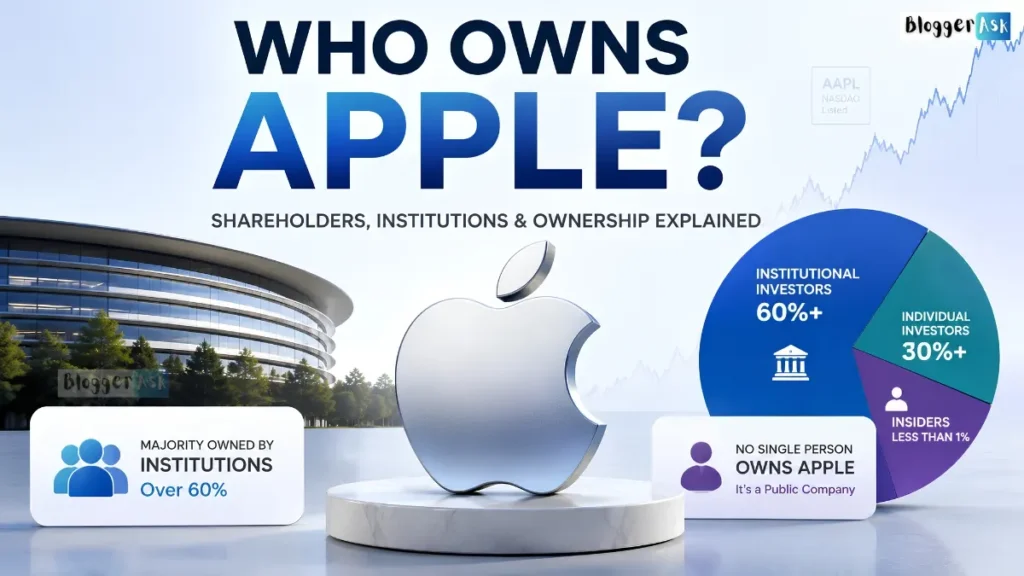
No single person does. Apple is a public company, so its stock is split among millions of owners. The biggest owners are large investment firms like The Vanguard Group and BlackRock. They hold Apple shares for regular people — through index funds, 401(k)s, and pensions.
A small slice is held by insiders, like CEO Tim Cook. The rest is held by everyday investors.
Two popular myths are worth clearing up fast. Bill Gates does not own a meaningful piece of Apple. And Steve Jobs’ family no longer holds a big Apple stake.
One thing is changing right now: leadership. As of late July 2026, Tim Cook is still Apple’s CEO. But on September 1, 2026, John Ternus takes over as CEO. Cook becomes executive chairman.
Apple’s Ownership at a Glance
Apple is ~64% owned by big institutions, ~36% by the public, and about 0.1% by insiders. Apple trades on the Nasdaq under the ticker AAPL. It has about 14.7 billion shares. As of late July 2026, its market value is near $5 trillion — it briefly crossed the $5 trillion line on July 28, 2026, only the second company ever to do so after Nvidia.
Ownership breaks into three simple groups.
| Group | Share of Apple | What it means |
|---|---|---|
| Big institutions | ~64% | Index funds, mutual funds, and pensions holding shares for clients |
| Insiders (execs + directors) | ~0.1% | Apple’s CEO, board, and top leaders — mostly from stock pay |
| Public + retail + others | ~36% | Everyday investors and small holders who don’t have to report |
These numbers are a snapshot from mid-2026. They move every quarter as funds buy and sell and refile with the U.S. Securities and Exchange Commission (SEC). Treat them as “about right,” not exact.
Important note: Apple reports its next earnings on July 30, 2026. Share price and market cap can move quickly around that date.
Big Institutions
Institutions are Apple’s largest owners by far. But here’s the key point most people miss. Firms like Vanguard and BlackRock are not rich people cashing in. They are asset managers. They run index funds and retirement accounts for millions of ordinary savers.
Do you have a 401(k) or an index fund? Then you probably own a tiny piece of Apple already — without even knowing it.
So who really “owns” Apple? In a way, the index does. These firms hold Apple mostly because Apple sits in the S&P 500 and other indexes — not because they made a special bet. Add them up, and the biggest force in Apple’s ownership isn’t a person or a company. It’s passive investing itself.
Insiders
Insiders are Apple’s CEO, top execs, and board members. Together they own well under 1% of the company. Their shares come mostly from stock pay, not personal buying. They must report any change through SEC Form 4 filings — usually within two business days.
Public and Retail Investors
The rest is spread across everyday investors, brokerages, and small funds. These holders fall below the size that triggers public reporting. No single one of them holds enough to steer Apple.
Who Owns the Most Apple Shares?
Who owns the most Apple shares? The Vanguard Group is Apple’s largest shareholder, at roughly 9.5%. BlackRock is next at about 7.7%. Both hold their stakes mainly through index and mutual funds — for their clients, not themselves.
Here are Apple’s top institutional owners, based on the latest filings available in mid-2026. Share counts and values use about 14.7 billion total shares and a ~$340 share price.
| Institution | Approx. stake | Approx. shares | Approx. value |
|---|---|---|---|
| The Vanguard Group | ~9.5% | ~1.40 billion | ~$475 billion |
| BlackRock, Inc. | ~7.7% | ~1.13 billion | ~$385 billion |
| State Street Corporation | ~3.9% | ~575 million | ~$195 billion |
| Fidelity (FMR LLC) | ~2.3% | ~340 million | ~$115 billion |
| Geode Capital Management | ~2.2% | ~325 million | ~$110 billion |
Together, the top five hold about a quarter of Apple. But none of them runs Apple. Their power is limited to voting on board seats and shareholder proposals once a year. They don’t touch products, prices, or strategy.
Berkshire Hathaway’s Apple Stake, Explained
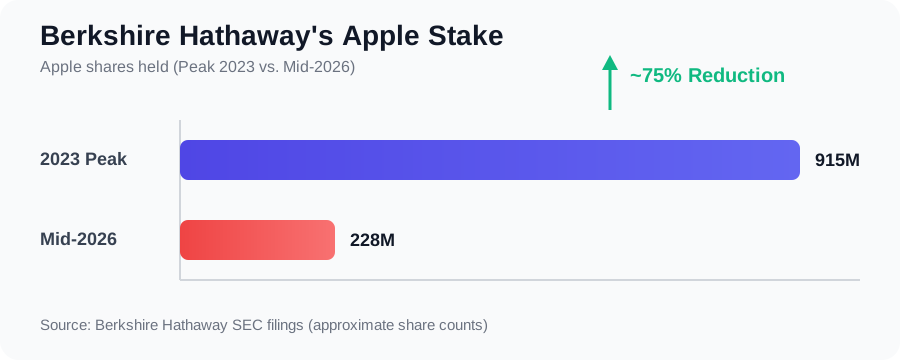
Berkshire Hathaway has the most dramatic Apple story of any big holder. Warren Buffett built the stake between 2016 and 2018. At its peak in 2023, Berkshire owned about 915 million Apple shares — roughly half of its entire stock portfolio. Buffett later said that felt too big.
Then the selling began. Across 2024 and 2025, Berkshire cut the position by about 75% from its peak. By the end of 2025, it held about 228 million shares, worth around $62 billion at the time.
Why did Buffett sell? He said Apple had simply grown into too large a share of the portfolio. He also pointed to locking in gains at today’s tax rates. Still, he called Apple a wonderful business he was happy to keep — just smaller.
There’s a leadership twist too. Buffett stepped down as Berkshire’s CEO at the end of 2025. Greg Abel now runs the firm. Under Abel, the selling stopped. Berkshire has held its Apple stake steady through 2026.
At today’s share price, those ~228 million shares are worth roughly $77 billion (based on the last filing and the current price). That’s about 1.5% of Apple. Even after all the cuts, Apple is still Berkshire’s single largest stock holding.
Here’s a detail most Apple articles miss. The firm most famous for owning Apple is now leaning into Google. Under Abel, Berkshire has built a large new position in Alphabet — Google’s parent — worth tens of billions of dollars, while keeping Apple flat. So the classic “Buffett owns Apple” story is quietly shifting.
Apple’s Biggest Insider Shareholders
Among Apple’s own leaders, the largest individual holders are its longest-serving execs and directors:
- Tim Cook (CEO through August 2026) holds about 3.3 million shares. That’s worth a little over $1 billion today. He built it over more than 20 years at Apple.
- Arthur D. Levinson, Apple’s chairman, holds around 4.2 million shares — worth roughly $1.4 billion.
- Other senior execs and directors hold smaller but still large stakes from stock pay.
Even so, Apple’s entire insider group owns just a sliver of one percent. It’s a good reminder of how spread out Apple’s ownership really is — even at the very top.
Is Bill Gates a Shareholder in Apple?
No — not in any real way. This is one of the most stubborn myths about Apple’s ownership.
It likely comes from a true event. In 1997, Microsoft invested $150 million in Apple. That deal helped keep Apple alive during a cash crisis. But the stake was small and non-voting. Microsoft sold out years ago.
Today, neither Bill Gates himself nor the Gates Foundation holds a meaningful, disclosed Apple stake. The myth is sticky. The facts are simple: no.
Who Owns Apple After Steve Jobs? What Happened to His Shares
Many people search for who owns Apple after Steve Jobs. The short answer surprises them: not his family, at least not in any big way. Here’s why.
Why Jobs Sold Most of His Shares in 1985
Steve Jobs co-founded Apple in 1976 with Steve Wozniak. He held a large stake early on. But in 1985, Apple’s own board pushed him out.
After that, Jobs sold nearly all his Apple shares. He kept just one symbolic share. He didn’t return until 1997. When he came back as CEO, his new shares came from stock option grants — not from buying back his old 1970s and ’80s stake.
Jobs’ Apple Shares When He Died
When Jobs died in October 2011, he held 5,546,451 shares — about 0.6% of Apple — through a family trust.
Apple has split its stock twice since then: 7-for-1 in 2014, and 4-for-1 in 2020. Adjusted for both splits, that same holding would equal roughly 154 million shares today — but only if none of it was ever sold.
Does the Jobs Family Still Own Apple Stock?
That “if none was ever sold” part matters a lot. Once a holder drops below 5%, they no longer have to report exact numbers. That’s what happened here. The Jobs family trust’s current Apple position isn’t public.
What we do know: Laurene Powell Jobs has spread the estate across many things since 2011, including selling large stakes in other companies.
Now here’s the twist most ownership articles skip. Steve Jobs’ biggest fortune at death wasn’t in Apple. It was in Disney.
When Disney bought Pixar in 2006, Jobs owned Pixar. So he received Disney shares — enough to make him Disney’s largest individual shareholder. At his death, that Disney stake was worth about $8 billion. His Apple stake was worth about $2 billion.
So if you’re researching the Jobs family’s wealth, Disney is where most of that legacy actually sat — not Apple.
Do Apple’s Other Co-Founders Still Own Apple?
Steve Wozniak Today
Steve Wozniak was Apple’s technical co-founder. He stepped back from an active role in the 1980s. Over the following years, he sold most of his shares.
He’s still a beloved figure in Apple’s story. But he holds no meaningful ownership or control today.
Ronald Wayne’s $800 Decision
Apple had a third co-founder: Ronald Wayne. He owned 10% of Apple. Just 12 days after signing the founding papers in April 1976, he sold that stake — for $800.
Left untouched, 10% of Apple would be worth hundreds of billions today. In reality, decades of new shares — from employees, investors, and Apple’s 1980 IPO — would have watered down any stake that big. Wayne has said he doesn’t regret it, given how risky Apple was back then.
Who Runs Apple? Ownership vs. Leadership
This is where most confusion about “who owns Apple” comes from. Owning shares and running the company are two different things.
A shareholder — even a giant one — doesn’t manage Apple. They don’t set prices or build products. That’s the job of Apple’s CEO and executive team. The board of directors hires and watches over them, on behalf of shareholders.
Who Is Apple’s CEO Right Now?
Some people even search who owns Apple CEO — which usually means “who is Apple’s CEO?” So let’s answer that clearly.
As of late July 2026, Tim Cook is Apple’s CEO. He’s held the job since 2011, when he took over from Steve Jobs. But that’s about to change.
The 2026 Leadership Change: Tim Cook to John Ternus
In April 2026, Apple announced a big handover. John Ternus — Apple’s longtime head of Hardware Engineering — becomes CEO on September 1, 2026. Tim Cook becomes executive chairman of the board.
Why Ternus? Apple called it the result of years of careful succession planning. Ternus is deeply respected inside Apple’s engineering teams and helped lead products like the iPhone and AirPods. The board approved the move unanimously.
Cook won’t vanish. He’ll stay involved, especially with governments and policy. But he steps back from daily leadership. Ternus also joins Apple’s board on the same day.
One key point: this change is about leadership, not ownership. Cook’s personal shares don’t move to Ternus. Leadership changes and ownership changes are separate things.
Apple’s Board of Directors
Apple’s board watches over the CEO and top leaders for shareholders. As of mid-2026, the board includes Chairman Arthur D. Levinson, CEO Tim Cook, and directors Wanda Austin, Alex Gorsky, Andrea Jung, Monica Lozano, Ronald Sugar, and Susan Wagner.
Levinson has been on Apple’s board since 2000 and its chairman since 2011. On September 1, 2026, he shifts to lead independent director as Ternus joins.
Here’s an interesting link. Board member Susan Wagner co-founded BlackRock — one of Apple’s biggest owners. Apple lists her as an independent director. Still, governance watchers keep an eye on ties like this, since a board is meant to stay independent from its largest shareholders.
Why Doesn’t Any Single Person Control Apple?
Apple Has One Share Class
The short answer: Apple has just one class of common stock. Every share gets exactly one vote.
There’s no special “founder share” or super-voting stock. No person or family can outvote everyone else. This was a choice, not an accident. And it’s the real reason no single person — not Cook, not a Jobs heir, not any investor — can control Apple alone.
Apple vs. Founder-Controlled Companies
Many famous companies work very differently. They use dual-class shares. This lets founders keep voting power even after selling most of their economic stake.
| Company | Share structure | Founder/family control |
|---|---|---|
| Apple | One class — one share, one vote | None — no person or family holds outsized power |
| Meta | Dual class — Class B has 10x votes | Mark Zuckerberg keeps majority voting control |
| Alphabet (Google) | Dual class — Class B has 10x votes | Page & Brin hold ~52.7% of votes with only ~3% each in economic terms |
| Ford | Dual class — Class B held by the Ford family | The family controls ~40% of votes with a small economic stake |
This is why “who owns Apple” and “who controls Apple” have the same answer — a broad, mixed crowd of shareholders. At Meta, Google, or Ford, those two questions have very different answers.
One Owner People Forget: Apple Itself
Here’s something the ownership tables don’t show. Apple is one of the biggest buyers of Apple stock in the world.
Every year, Apple spends tens of billions of dollars buying back its own shares. When a company buys back stock, it retires those shares. So Apple’s total share count keeps shrinking — from over 16 billion a few years ago to about 14.7 billion today.
Why does this matter for ownership? Fewer shares means each remaining share is a bigger slice of the pie. So even if Vanguard never buys another share, its ownership percentage can still creep up — just because Apple keeps shrinking the total. It’s a quiet force that reshapes Apple’s ownership every quarter.
What Companies and Brands Does Apple Own?
This is a different question from “who owns Apple’s stock.” It’s about what Apple, the company, owns.
Apple owns a wide set of products and services: the App Store, Apple Music, Apple TV+, Apple Pay, Apple Card, Apple Fitness+, Apple News+, and iCloud. It also owns Beats by Dre, plus smaller units like Braeburn Capital (its in-house money manager) and Apple Studios (its film and TV arm). It’s a common related search — so it’s worth a quick mention here.
How to Check Apple’s Ownership Yourself
Don’t want to take an article’s word for it? Good. You can check all of this yourself. It’s public, and it’s free — through the SEC.
- Go to SEC EDGAR (the SEC’s public filing site). Search “Apple Inc.” or the ticker AAPL.
- For institutions, open the Form 13F filings. Any investment manager with over $100 million must file these each quarter. They list exact holdings.
- For insiders, open the Form 4 filings. These show when an Apple exec or director buys, sells, or is granted shares — usually within two business days.
- For board and governance info, read Apple’s DEF 14A proxy statement. Apple files it once a year before its shareholder meeting.
Reading a Form 13F
Each 13F lists the fund’s name, the stock (Apple, AAPL), the number of shares, and the dollar value at quarter-end. Compare one quarter to the next to see if a fund is buying or selling.
Reading a Form 4
A Form 4 shows the person’s name, their role, the type of move (buy, sell, or grant), and how many shares they hold after.
Apple’s Proxy Statement (DEF 14A)
This is the single best document for governance. It shows who’s on the board, how much leaders are paid, and what shareholders vote on each year.
Key Takeaways
- Apple is a public company. No person, family, or single group owns or controls it.
- Big institutions like Vanguard and BlackRock hold the largest share — but for millions of everyday savers, not for themselves.
- Bill Gates does not hold a meaningful Apple stake. It’s a myth, not a fact.
- Steve Jobs sold nearly all his Apple stock after 1985. At his death, his bigger fortune was in Disney, not Apple.
- Berkshire Hathaway cut its Apple stake by about 75% from its peak. It now holds ~228 million shares (~1.5% of Apple) — still its largest stock holding.
- Tim Cook is CEO through August 2026. John Ternus becomes CEO on September 1, 2026, while Cook moves to executive chairman.
- Apple’s single share class — one share, one vote — is why no founder, exec, or family can control it the way they do at Meta, Google, or Ford.
Conclusion
“Who owns Apple” doesn’t have one dramatic answer. And that’s really the point.
Apple is owned by a huge, shifting mix of index funds, everyday investors, and a few insiders. No founder, family, or lone billionaire holds real control. Apple even shrinks its own share count each year through buybacks.
What is changing is who leads the company. Tim Cook’s handoff to John Ternus on September 1, 2026 is Apple’s biggest leadership shift since Cook took over from Steve Jobs in 2011.
Ownership and leadership are two different questions. Now you have clear, current answers to both.
FAQs
Who owns Apple?
Apple is a public company owned by a mix of big institutions, insiders, and everyday investors. No single person or group owns or controls it.
Does Bill Gates own Apple?
No. Microsoft made a one-time, non-voting $150 million investment in Apple in 1997. Bill Gates does not hold a meaningful, disclosed Apple stake today.
Did Steve Jobs still own Apple when he died?
Only a small stake. Jobs sold nearly all his shares after leaving in 1985. At his death in 2011, he held about 0.6% of Apple through a family trust. That position is no longer public.
Who owns the most Apple shares?
The Vanguard Group, at roughly 9.5%. BlackRock is close behind at about 7.7%. Both hold Apple mainly through index and mutual funds.
Does Warren Buffett still own Apple stock?
Yes, through Berkshire Hathaway — but far less than before. Berkshire cut the stake by about 75% from its peak and now holds ~228 million shares. It’s still Berkshire’s largest holding. Buffett stepped down as CEO at the end of 2025; Greg Abel now leads the firm.
Who is Apple’s CEO now?
Tim Cook, through August 2026. John Ternus becomes CEO on September 1, 2026, while Cook becomes executive chairman.
Who is John Ternus?
He’s Apple’s longtime head of Hardware Engineering and Apple’s next CEO. He helped lead products like the iPhone and AirPods, and he joins Apple’s board on September 1, 2026.
Is Apple owned by the government or another country?
No. Apple is an independent, public American company. No government — U.S. or foreign — holds an ownership or controlling stake.
📖 Continue Reading:
Sources & References
- Apple Newsroom — “Tim Cook to become Apple Executive Chairman, John Ternus to become Apple CEO” (apple.com/newsroom, April 2026)
- Apple Investor Relations — Leadership and Governance (investor.apple.com)
- U.S. Securities and Exchange Commission — EDGAR Full-Text Search, Form 13F, Form 4, and DEF 14A filings for Apple Inc., CIK 320193 (sec.gov/edgar/search)
- CNBC — Apple names John Ternus CEO; Apple touches $5 trillion market cap (cnbc.com, April and July 2026)
- CNBC — Berkshire Hathaway trims Apple stake in Buffett’s final moves as CEO (cnbc.com, 2026)
- The Motley Fool — Berkshire Hathaway’s Apple and Alphabet positions under Greg Abel (fool.com, July 2026)
- Companies Market Cap — AAPL market cap (July 2026) & StockAnalysis.com — shares outstanding (July 2026)
Disclaimer
This article is for general information only. It is not financial or investment advice. Ownership percentages, share counts, and market values change all the time. They are based on the most recent public filings available as of July 2026. For any investment, estate, or tax decision, talk to a licensed advisor and read Apple’s official SEC filings directly.

Olivia Isabel is a Business & Technology Writer specializing in corporate ownership, company leadership, shareholders, acquisitions, and the business strategies behind major global companies. Her work covers technology, artificial intelligence, social media, finance, e-commerce, automotive, and consumer technology, with a particular focus on explaining who owns, controls, and leads well-known companies.
With a background in Economics and Journalism, Olivia approaches each topic as a research-driven business story. She examines company filings, investor-relations materials, regulatory records, official corporate announcements, and reputable financial sources to distinguish between legal ownership, economic ownership, voting control, and day-to-day management.
Her articles explore the founders behind major companies, current CEOs, significant shareholders, parent companies, subsidiaries, acquisitions, and changes in corporate structure. She has written about companies including Google, Alphabet, Apple, Microsoft, Amazon, Meta, OpenAI, Tesla, SpaceX, YouTube, Instagram, TikTok, WhatsApp, Reddit, Spotify, and other major technology and consumer brands.
Olivia’s goal is to make complicated corporate and financial information clear, accurate, and useful for everyday readers. She is particularly interested in corporate strategy, technology business models, entrepreneurship, emerging AI companies, public markets, and the evolution of globally recognized brands.