⚡ Quick Answer: Who Owns YouTube?
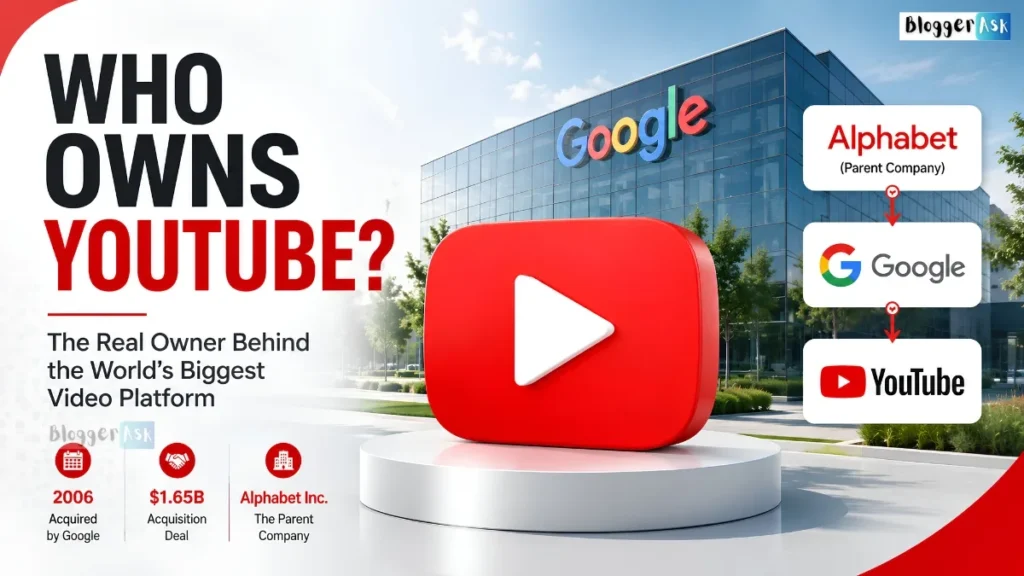
YouTube is owned by Google, which is a subsidiary of Alphabet Inc. Google bought YouTube in 2006 for $1.65 billion. Since Alphabet’s restructuring in 2015, Alphabet has sat above Google as the ultimate parent company. Day to day, YouTube is run by CEO Neal Mohan. Sundar Pichai leads both Google and Alphabet.
Key takeaways:
- Direct owner: Google (since 2006)
- Ultimate parent: Alphabet Inc. (since 2015)
- Current YouTube CEO: Neal Mohan (since February 2023)
- Current Google/Alphabet CEO: Sundar Pichai
- YouTube TV: same owner, different product
Who Owns YouTube? Google’s Role Explained
Most people stop at “Google owns YouTube.” That’s not wrong. But it skips a layer that matters if you want the full picture.
Does Google own YouTube? Yes, directly. Google has owned YouTube outright since 2006. What company owns YouTube? On paper, that’s Alphabet Inc. In daily practice, it’s Google.
Google vs. Alphabet: What’s the Difference
| Alphabet Inc. | ||
|---|---|---|
| What it is | A subsidiary — the company that operates Search, Ads, and YouTube | The holding company that owns Google and everything under it |
| Relationship to YouTube | Direct owner since 2006 | Ultimate parent owner since 2015 |
| Who leads it | Sundar Pichai (CEO) | Sundar Pichai (CEO), same person, different hat |
| Public stock ticker | Not separately traded | NASDAQ: GOOG, GOOGL |
Think of it like a parent company and its main division. Google is the business you actually interact with. Alphabet is the structure that sits above it, holding the shares.
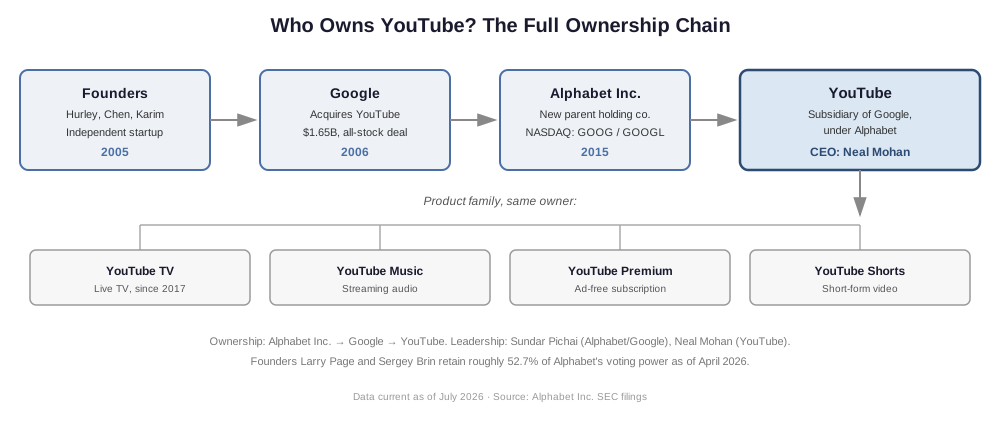
YouTube’s full ownership chain, from its three founders to today’s product family.
Why Google Created Alphabet in 2015
In August 2015, Google announced a major reorganization. It created a new holding company called Alphabet Inc. The change took effect later that year. The goal: separate Google’s core, profitable businesses — Search, Ads, YouTube — from longer-term bets like Waymo (self-driving cars) and Verily (life sciences).
This is why YouTube’s owner on paper is technically Alphabet, even though most people still think of it as a Google product. Both descriptions are accurate. They just describe different levels of the same ownership chain.
The Full Ownership Timeline: From Three Founders to Alphabet
Here’s the short version: three founders built YouTube, Google bought it in 2006, and Alphabet became the parent company holding it all today.
Before Google: Who Owned YouTube at the Start
Who owned YouTube before Google? Its three founders did. YouTube was founded on February 14, 2005, by Chad Hurley, Steve Chen, and Jawed Karim — three former PayPal employees. Before the Google deal, they owned and ran YouTube independently as a fast-growing, not-yet-profitable startup.
The 2006 Acquisition: How Google Bought YouTube
Google announced its acquisition of YouTube on October 9, 2006. The deal closed the following month, in November 2006, for $1.65 billion, paid entirely in Google stock. At the time, many in the industry questioned whether Google had overpaid for a site that wasn’t yet profitable. The numbers below settle that question with data, not opinion.
The 2015 Restructuring: How Alphabet Became the Parent
Once Alphabet was created, YouTube’s ownership chain became simple: Alphabet owns Google, and Google owns YouTube. Nothing changed operationally for users or creators. It was a corporate and legal restructuring, not a change in who ran the platform day to day.
Who Runs YouTube Today? Leadership Explained
Ownership and leadership are two different questions. Here’s who actually holds the reins as of 2026.
Neal Mohan: YouTube’s Current CEO
Who is the CEO of YouTube? Neal Mohan is, and has been since February 2023. He’d previously spent years as YouTube’s Chief Product Officer, where he helped build YouTube TV, YouTube Music, and YouTube Shorts. His current role is a continuation of work he already led, not a fresh start.
Susan Wojcicki’s Tenure (2014–2023)
Susan Wojcicki led YouTube as CEO from 2014 until she stepped down in February 2023, overseeing much of the platform’s growth into a global media giant. She passed away on August 9, 2024, after living with lung cancer. Some older content online still describes her as YouTube’s current CEO — that information is out of date.
Who Oversees Everything: Sundar Pichai and Alphabet’s Board
Above YouTube’s own leadership sits Sundar Pichai, CEO of both Google and Alphabet. Alphabet’s board also includes co-founders Larry Page and Sergey Brin.
Both stepped back from daily operations years ago. But they still control the company at the ownership level. As of Alphabet’s April 2026 proxy filing, Page and Brin together hold about 52.7% of Alphabet’s total voting power — Page around 27.4%, Brin around 25.3% — through a special class of shares (Class B) that carries ten votes each, compared to one vote for the publicly traded Class A shares (GOOGL) and zero votes for Class C shares (GOOG). That’s the mechanism behind the two tickers in the table above: it’s not just a listing quirk, it’s how the founders keep control while the public owns most of the stock.
Is YouTube TV Owned by Google Too?
Who owns YouTube TV? The same company: Google, under Alphabet. But it’s worth separating out, because it’s a genuinely different product from YouTube the video platform — and that’s exactly why a lot of people search for this specifically.
YouTube TV vs. YouTube: Same Owner, Different Product
| YouTube | YouTube TV | |
|---|---|---|
| What it is | Free video-sharing platform | Paid live-TV streaming service |
| Owned by | Google (via Alphabet) | Google, operated under YouTube |
| Launched | 2005 | February 2017 |
| How you pay | Ads, optional Premium subscription | Monthly subscription (live TV channels) |
They share an owner and a brand name. But they’re built for different purposes — one is about uploaded video content, the other replaces a cable subscription.
Real-World Example: The 2025 YouTube TV–Disney Dispute
In late October 2025, YouTube TV and Disney hit a wall in contract talks. Disney pulled ESPN, ABC, and its other channels from YouTube TV, and roughly 10 million subscribers lost access. YouTube TV offered a $20 credit while the two sides negotiated.
The dispute ended in mid-November 2025, after about two weeks. Disney and YouTube TV signed a new multi-year distribution deal, and every channel came back. This is a good real-world example of what “ownership” actually looks like in practice: it was Google and Alphabet negotiating on YouTube TV’s behalf, not YouTube the video platform. It’s not an isolated case, either — carriage disputes like this are a normal, recurring part of how live-TV streaming works, not a sign something is uniquely wrong with YouTube TV.
Why Ownership Actually Matters
Ownership isn’t just a fun fact. It determines who profits, who sets the rules, and who’s accountable when something goes wrong.
YouTube’s Financial Weight Inside Alphabet
YouTube isn’t a side project. It’s one of Alphabet’s biggest revenue engines.
Combined ad and subscription revenue passed $60 billion for the full year 2025, according to Alphabet’s own earnings reports. In the second quarter of 2026, YouTube ad revenue was still growing 13% year-over-year.
The math on the deal: Google paid $1.65 billion for YouTube in 2006. At today’s revenue pace, YouTube now generates that same amount in roughly ten days. That’s the real evidence behind the “greatest acquisition ever” reputation this deal has — not just an opinion, but a number you can check against Alphabet’s own earnings reports.
Why this matters, in short:
- It explains who profits as YouTube grows
- It’s why Alphabet keeps tight oversight instead of spinning YouTube off
- It shapes real decisions on ads, monetization, and creator payouts
Worth knowing: Alphabet has faced real U.S. antitrust scrutiny in recent years. The active cases center on Google Search and ad technology, not YouTube specifically. A September 2025 court ruling rejected a forced breakup of Google’s business in favor of narrower behavioral rules, and Google is now appealing parts of that decision. Nothing in the current litigation targets YouTube’s ownership directly, but it’s part of the broader regulatory backdrop Alphabet operates in.
Who’s Accountable for Content and Policy Decisions
When people ask “who owns YouTube” during a debate about content moderation or algorithm changes, they’re often really asking who’s responsible. The answer is the same either way: Google sets and enforces YouTube’s policies, with Alphabet as the ultimate corporate authority above it.
Quick Clarifications (Common Mix-Ups)
A few ownership questions come up often enough to answer directly.
Is YouTube Owned by Meta?
No. This is a common mix-up, likely because Meta owns other major social platforms (Facebook, Instagram). YouTube has never been owned by Meta. It’s been owned by Google, and now Alphabet, since 2006.
Does Alphabet Directly Run YouTube’s Day-to-Day Operations?
No. Alphabet is a holding company — it doesn’t manage daily operations for any of its businesses directly. YouTube has its own CEO and leadership team, with Google and Alphabet above it providing oversight, infrastructure, and resources.
Does Owning YouTube Mean Owning the Videos on It?
No, and this trips people up. YouTube (the company) is owned by Google. The individual videos uploaded to it are a different matter — under YouTube’s terms of service, creators keep copyright over their own content. Platform ownership and content ownership are two separate questions.
FAQs
Is YouTube owned by Google or Alphabet?
Both, at different levels. Google owns YouTube directly. Alphabet Inc. owns Google — and by extension, YouTube — as the ultimate parent company.
Who is the main owner of YouTube?
Alphabet Inc. is YouTube’s ultimate parent owner, through its subsidiary Google, which has directly owned YouTube since 2006.
Who is the CEO of YouTube?
Neal Mohan has been YouTube’s CEO since February 2023.
Did Google always own YouTube?
No. YouTube was founded independently in 2005 by Chad Hurley, Steve Chen, and Jawed Karim. Google acquired it in 2006.
Is YouTube TV a separate company from YouTube?
No — same owner (Google, under Alphabet), different product. YouTube is a free video-sharing platform; YouTube TV is a paid live-TV streaming service.
Does Google own YouTube Music, YouTube Premium, and YouTube Shorts too?
Yes. All of these are products operated under YouTube, which is owned by Google.
The Bottom Line
So, who owns YouTube? The short answer: Google, owned in turn by parent company Alphabet Inc. — a structure in place since Alphabet’s 2015 restructuring. Day to day, YouTube is led by CEO Neal Mohan, while Sundar Pichai oversees both Google and Alphabet as a whole. YouTube TV shares the same ownership but is a distinct product. As of August 2026, this structure hasn’t changed — and given YouTube’s financial weight inside Alphabet, it’s not likely to anytime soon.
📖 Continue Reading:
- Companies Owned by Google
- How Does Google Make Money?
- Who Founded Google?
- Who Owns Alphabet Inc.?
- Who Owns Google in 2026?
Sources & References
- Wikipedia, “YouTube”
- Wikipedia, “Susan Wojcicki”
- Wikipedia, “Neal Mohan”
- Britannica, “YouTube | History, Founders, Purchase, & Facts”
- Alphabet Inc., Q4 2025 Earnings Release (SEC EDGAR, filed February 2026)
- Alphabet Inc., Q2 2026 Earnings Release (Alphabet Investor Relations, July 2026)
- Alphabet Inc., SEC Form 424B5 (2026) — voting power and share structure disclosure
- Alphabet Inc., Form 8-K, 2026 Annual Meeting Voting Results (SEC EDGAR)
- University of California, Santa Cruz — In Memoriam: Susan Wojcicki
- The Harvard Crimson — “Susan Wojcicki ’90, Former YouTube CEO and Silicon Valley Pioneer, Dies at 56”
- NPR — “YouTube TV-Disney dispute drags on, leaving millions without access to games or shows”
- eMarketer — “YouTube TV wins out in Disney, ESPN carriage dispute”
- Android Authority — “The YouTube TV-Disney dispute is over: Here’s what you’re getting now”
Disclaimer
Corporate ownership structures, leadership, and financial figures can change over time. This article reflects publicly available data as of August 2026, primarily sourced from Alphabet Inc.’s own SEC filings and investor communications. Figures tied to quarterly earnings — like YouTube’s ad revenue growth — are reviewed and updated each quarter. Ownership at the corporate level (Alphabet → Google → YouTube) is stable and isn’t expected to change without a major event, such as a spin-off or antitrust-driven restructuring — neither of which is currently in effect. For the most current details, consult Alphabet’s investor relations page directly.

Olivia Isabel is a Business & Technology Writer specializing in corporate ownership, company leadership, shareholders, acquisitions, and the business strategies behind major global companies. Her work covers technology, artificial intelligence, social media, finance, e-commerce, automotive, and consumer technology, with a particular focus on explaining who owns, controls, and leads well-known companies.
With a background in Economics and Journalism, Olivia approaches each topic as a research-driven business story. She examines company filings, investor-relations materials, regulatory records, official corporate announcements, and reputable financial sources to distinguish between legal ownership, economic ownership, voting control, and day-to-day management.
Her articles explore the founders behind major companies, current CEOs, significant shareholders, parent companies, subsidiaries, acquisitions, and changes in corporate structure. She has written about companies including Google, Alphabet, Apple, Microsoft, Amazon, Meta, OpenAI, Tesla, SpaceX, YouTube, Instagram, TikTok, WhatsApp, Reddit, Spotify, and other major technology and consumer brands.
Olivia’s goal is to make complicated corporate and financial information clear, accurate, and useful for everyday readers. She is particularly interested in corporate strategy, technology business models, entrepreneurship, emerging AI companies, public markets, and the evolution of globally recognized brands.