⚡ Quick Answer: Who owns Netflix?
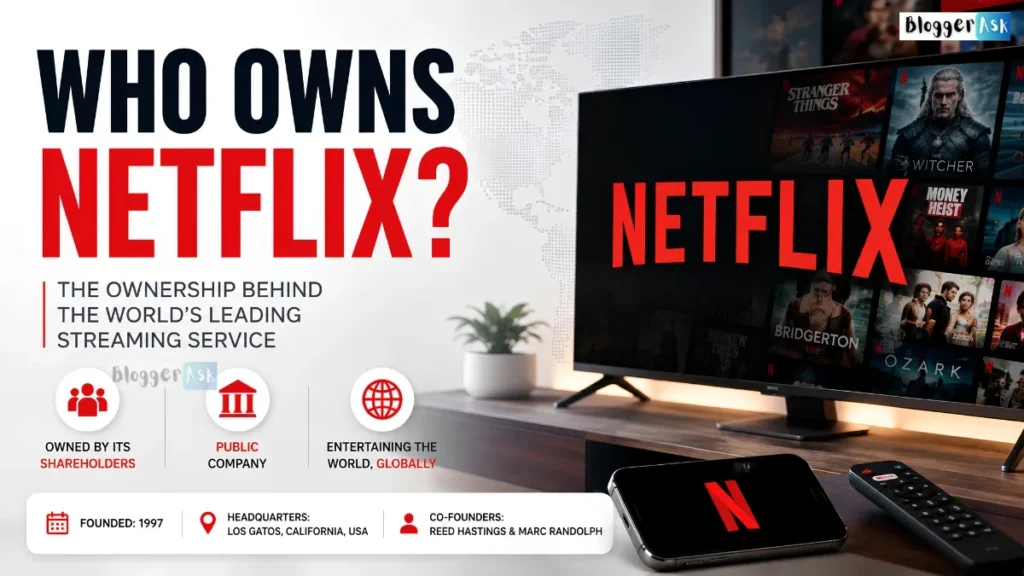
Nobody, really — not in the way most people mean the question. Netflix is a publicly traded company (Nasdaq: NFLX), so ownership is split across thousands of institutional funds and individual investors. The largest single shareholder is Vanguard Group, holding around 9% of shares. Netflix is run by two co-CEOs, Ted Sarandos and Greg Peters, with Jay Hoag serving as board chairman since June 2026. Co-founder Reed Hastings, who stepped back from operational leadership in stages starting in 2023, left the board entirely that same month. And no, Netflix does not own HBO Max or Warner Bros. — a planned acquisition fell through in February 2026 when Warner Bros. Discovery took a higher offer from Paramount Skydance instead.
This guide is checked against Netflix’s own SEC filings — its 2026 proxy statement and quarterly reports — for leadership, board composition, and Netflix’s own financial disclosures. The Warner Bros. Discovery timeline blends those filings with contemporaneous reporting on WBD’s and Paramount Skydance’s side of the deal, since the litigation and closing status wouldn’t appear in Netflix’s own paperwork. Where a number is an estimate rather than an exact filed figure, we say so.
Is Netflix a Public or Private Company?
Netflix is a publicly traded company. Anyone with a brokerage account can buy shares of NFLX on the Nasdaq exchange. That’s very different from a private company, where ownership sits with a small, fixed group of founders or investors.
This distinction matters. Most people who search “who owns Netflix company” are picturing a private-company answer — one person or one company holding the keys. Netflix doesn’t work that way, and understanding why clears up most of the confusion right away.
What “Publicly Traded” Actually Means
When a company goes public, it sells shares on a stock exchange. From that point on, ownership is simply whoever holds those shares. Netflix completed its IPO on May 23, 2002, pricing shares at $15 each. Ownership has shifted every trading day since.
One more wrinkle worth flagging: Netflix executed a 10-for-1 stock split on November 14, 2025. If you’re comparing share counts or per-share prices from before that date to anything after it, they won’t line up — a pre-split figure needs to be multiplied by 10 to match today’s share count.
So there’s no fixed “owner” to point to. There’s only a snapshot of who holds shares as of the most recent filing, and that snapshot keeps changing.
To put the company’s scale in perspective: Netflix closed 2025 with more than 325 million paid memberships and about $45.2 billion in revenue, up roughly 16% from the year before, per its own 2026 proxy statement filed with the SEC. That growth carried into 2026 — Netflix reported $12.56 billion in Q2 2026 revenue alone, up 13.4% year-over-year, even while working through the fallout of its failed Warner Bros. Discovery bid (more on that below).
Netflix’s Single-Class Share Structure
Most explainers skip this detail. It’s actually the clearest reason no one controls Netflix: the company uses a single-class share structure. Every share carries exactly one vote. No exceptions, no special founder shares.
That matters because not every big tech company works this way. Meta and Alphabet use dual-class structures, where founders hold a special share class with outsized voting power. That lets them control the company despite owning a minority of its economic value. Netflix deliberately built it differently. One share equals one vote for everyone — a structural reason, not a coincidence, why ownership here stays genuinely spread out instead of concentrated in founder or insider hands.
A quick way to picture this: buy one share of NFLX today, and you’re a tiny partial owner of Netflix with exactly one vote at the annual meeting — the same single vote Vanguard gets per share, and the same single vote Reed Hastings gets per share. You get a claim on future profits and a say in things like electing directors. You don’t get a say in daily operations (that’s Sarandos and Peters) or a board seat (that’s Hoag and the other 11 directors).
Who Are Netflix’s Largest Shareholders?
Institutional investors — mutual funds, pension funds, and asset managers pooling money from many individual investors — hold most of Netflix’s shares. Compiled 13F data puts institutional holdings at roughly 80% of the company, though the exact figure shifts by reporting date and methodology. Insiders (directors and executives combined) hold a little over 1%, per the same data.
Top Institutional Shareholders
Based on the most recent 13F filings available as of mid-2026, the largest holders are:
| Institution | Approximate Stake |
|---|---|
| Vanguard Group | ~9% |
| BlackRock | ~5–6% |
| Fidelity Management & Research (FMR) | ~5% |
| State Street Corporation | ~4% |
| Geode Capital Management | ~2.5% |
Figures are cross-referenced against Q3 2025–Q1 2026 13F filings; Netflix’s own 5%-owner disclosures are in its DEF 14A, linked in Sources below.
Two honest caveats on this table. First, these percentages shift every quarter as funds rebalance, so treat them as a recent snapshot, not a permanent fact. Second, Vanguard restructured how its subsidiaries report ownership in January 2026, which means some data providers may now show its holdings split across several smaller entities rather than one combined figure. Either way, none of these firms comes close to a controlling stake. Vanguard, the largest, holds roughly 9% — nowhere near enough to direct company decisions alone.
Largest Individual Shareholder
Reed Hastings remains the largest individual (non-institutional) shareholder — a ranking that holds consistent across every source we checked, including Netflix’s own proxy statement. His stake has shrunk considerably since Netflix’s early years, from a much larger founder’s share down to well under 1% today. That’s the normal effect of an IPO diluting founder ownership, plus years of employee stock vesting and periodic sales. In one recent example, Hastings and Jay Hoag together sold roughly 146,000 shares in early 2026, worth close to $179 million, according to filings compiled by MarketBeat.
For exact, current figures on any individual’s holdings, Netflix’s own proxy statement lists precise share counts for every named executive and director — see the Sources section below.
Co-CEOs Ted Sarandos and Greg Peters, along with other executives and directors, also hold shares — in the hundreds of thousands, a rounding error next to the institutional totals above.
Who Runs Netflix? Leadership and the Board
Owning shares and running the company are two completely different things — and this is where a lot of existing explainers get sloppy. Who is the owner of Netflix, in the sense of who’s actually in charge day to day? Here’s the breakdown, as of August 2026.
Co-CEOs Ted Sarandos and Greg Peters
Netflix has been run by a co-CEO pairing of Ted Sarandos and Greg Peters since January 2023. Sarandos, who also holds the title of President, had already been co-CEO alongside Reed Hastings since July 2020. Peters was promoted to co-CEO alongside him in January 2023, the same month Hastings stepped back to become executive chairman. This dual structure replaced the single-CEO model Hastings held for roughly 25 years.
Board Chairman Jay Hoag — and Reed Hastings’ Board Departure
Jay Hoag became Netflix’s board chairman effective June 4, 2026. If anything you’ve read about Netflix’s leadership predates mid-2026, this is the update to know: Reed Hastings is no longer chairman, and no longer on the board at all.
Hastings’ exit happened in stages. He stepped back from the co-CEO role in January 2023 to become executive chairman, staying involved in high-level strategy while handing daily operations to Sarandos and Peters. Then, effective April 17, 2025, he stepped back again — from executive chairman to a non-executive Chairman of the Board role, chairing the board without any operational duties. The transition reached its final stage at Netflix’s June 4, 2026 annual meeting, when Hastings declined to stand for re-election and left the board entirely to focus on philanthropy and other pursuits.
Hoag had actually survived a shareholder revolt the year before taking the top job. A Netflix director since 1999 and previously its lead independent director, he failed to win a majority of votes cast at the 2025 annual meeting, after attending fewer than 75% of his board and committee meetings in 2024. He formally offered his resignation; the board rejected it, pointing to his otherwise strong attendance record. By the 2026 meeting, shareholders re-elected him with solid support, and the board handed him the chairman role outright. Hoag is also a founding general partner at venture capital firm Technology Crossover Ventures.
Netflix’s board now has 12 members, down from 13 immediately before the June 2026 meeting, since Hastings’ seat wasn’t backfilled. Alongside the two co-CEOs and Hoag as chairman, the independent directors are:
- Richard Barton — Zillow co-founder
- Mathias Döpfner — Axel Springer CEO
- Leslie Kilgore — Netflix’s former Chief Marketing Officer
- Strive Masiyiwa — Econet Global founder
- Ann Mather — former Pixar CFO
- Elinor Mertz — Airbnb CFO and a former Netflix finance executive
- Susan Rice — former U.S. National Security Advisor
- Brad Smith — Microsoft Vice Chairman
- Anne Sweeney — former co-chair, Disney Media Networks
Founder vs. CEO vs. Owner: Why These Aren’t the Same Thing
Most “who owns Netflix” confusion comes down to mixing up four different roles. They’re not interchangeable, and Netflix is a clean example of why:
| Role | Who Holds It (Aug 2026) | What It Actually Means |
|---|---|---|
| Founder | Reed Hastings & Marc Randolph | Started the company; doesn’t mean current control |
| CEO | Ted Sarandos & Greg Peters (co-CEOs) | Run day-to-day operations and strategy |
| Board Chairman | Jay Hoag | Leads the board on shareholders’ behalf |
| Largest Shareholder | Vanguard Group (institutional) | Holds the most stock, not a controlling vote |
No single person occupies more than one of these boxes at Netflix right now. That’s exactly why “who owns Netflix” doesn’t have a one-word answer.
Who Founded Netflix?
Reed Hastings and Marc Randolph (1997)
Netflix was founded on August 29, 1997, in Scotts Valley, California, by Reed Hastings and Marc Randolph. Randolph left the company early on and is far less well known today than Hastings, though both are credited as co-founders.
From DVD-by-Mail to Streaming
Netflix started as a DVD-by-mail rental service, a direct challenge to video rental chains like Blockbuster. It moved into streaming in 2007, then expanded internationally starting around 2016, growing into the global platform it is today. This history explains where the brand came from. It’s a separate question from who owns the company now — a distinction to keep in mind if the founding story isn’t actually what you came here for.
What Companies Does Netflix Own?
Netflix owns a handful of production and gaming subsidiaries supporting its core streaming business — a much smaller list than what it doesn’t own, which is the bigger and more newsworthy story right now.
Production and Content Subsidiaries
Netflix’s production-side subsidiaries include:
- Albuquerque Studios
- Loudoun Productions Limited
- Netflix Productions
- Netflix Studios
Gaming Studios
As part of its push into gaming, Netflix has acquired or established several game studios:
- Helsinki GameWorks
- Lume Games
- Next Games
The Warner Bros. Discovery Deal — What Actually Happened
Does Netflix own HBO Max? No — and if you’ve seen headlines claiming otherwise, you’re not imagining them. Netflix really did agree to acquire Warner Bros. Discovery’s studio and streaming businesses, including HBO Max. Then the deal fell apart. Here’s the accurate, current timeline:
| Date | Event |
|---|---|
| December 4, 2025 | Netflix signs a merger agreement to acquire Warner Bros. Discovery’s studio and streaming businesses, including HBO and HBO Max, in a cash-and-stock deal worth around $72 billion |
| January 19, 2026 | The agreement is amended to an all-cash offer of $27.75 per WBD share |
| February 26–27, 2026 | Warner Bros. Discovery, led by CEO David Zaslav, terminates the agreement after Paramount Skydance submits a higher, all-cash bid; Netflix declines to match it and withdraws |
| April 2026 | WBD shareholders approve Paramount Skydance’s acquisition, led by CEO David Ellison, valuing the company at roughly $81 billion in equity ($111 billion including debt) |
| May 2026 | The U.S. Department of Justice approves the Paramount-WBD deal |
| July 2026 | Attorneys general from 12 states sue to block the merger on competition grounds; a federal judge issues a temporary restraining order pausing the closing |
Bottom line as of August 2026: Netflix does not own HBO Max, HBO, or Warner Bros. The company set to own them, Paramount Skydance, hasn’t fully closed its own acquisition as of this writing — that deal is still tied up in litigation, so if you’re reading this months from now, it’s worth a quick check on where things landed. Any content claiming Netflix owns these properties is working from information published between December 2025 and February 2026, before the deal collapsed — check the publish date before you trust it.
Common Misconceptions About Netflix Ownership
Does Disney Own Netflix?
No. Does Disney own Netflix? Not even close — they’re separate, independently traded public companies with no ownership relationship in either direction. The misconception likely persists because Disney owns several other streaming brands people mentally lump in with Netflix’s competitive space, and because “Disney owns everything” has become a running assumption in media conversations generally. Understandable confusion, but not accurate.
For contrast, Disney does fully own Hulu. Disney completed its buyout of Comcast’s remaining one-third stake in July 2025, taking it to 100% ownership, and is merging the standalone Hulu app into Disney+ during 2026, phasing Hulu out as an independent product. That’s what real ownership by another company actually looks like — a useful reference point for why Netflix, with no parent company at all, is structurally different.
Netflix Is Owned by Which Country?
Netflix is American, headquartered in Los Gatos, California, and incorporated in the United States. No country, foreign government, or foreign entity owns or controls it, even though its shareholder base includes international institutional investors, as any large publicly traded U.S. company’s does.
If you’ve searched “who owns Netflix in India,” “who owns Netflix UK,” or something similar, the answer is the same everywhere. Netflix runs local entities in individual countries for tax, content licensing, and regulatory purposes, but every one of them rolls up to the same U.S. parent company. There’s no separately owned “Netflix India” or “Netflix UK” — it’s one global company operating locally.
A Note on Other Ownership Claims Online
If you’ve come across claims online tying Netflix’s ownership to a specific religion or political affiliation, those claims aren’t supported by Netflix’s actual, publicly filed ownership structure. As covered above, that structure is a wide base of institutional funds and individual shareholders, with no single controlling entity of any kind — religious, political, or otherwise.
Frequently Asked Questions
Who is Netflix’s largest shareholder?
Vanguard Group is the largest institutional shareholder, holding roughly 9% of outstanding shares as of mid-2026. Among individuals, co-founder Reed Hastings holds the largest stake, at well under 1%.
Did Netflix buy Warner Bros. or HBO Max?
No. Netflix agreed to acquire Warner Bros. Discovery’s studio and streaming assets, including HBO Max, in December 2025, but WBD terminated that agreement in February 2026 for a higher bid from Paramount Skydance. As of August 2026, Netflix does not own HBO Max or Warner Bros.
Is Netflix owned by Disney?
No. Netflix and Disney are entirely separate publicly traded companies. Neither owns a stake in the other.
Who is the current CEO of Netflix?
Netflix is led by two co-CEOs, Ted Sarandos and Greg Peters, who have shared the role since January 2023.
Does Netflix own Hulu?
No. Hulu is 100% owned by Disney, which completed its buyout of Comcast’s remaining stake in 2025. Netflix has no ownership stake in Hulu.
What if you’d invested $1,000 in Netflix 20 years ago?
Netflix’s stock has grown substantially since its 2002 IPO and has split multiple times, most recently a 10-for-1 split in November 2025 — so an early, long-held position would be worth significantly more today. The exact return depends heavily on your entry and exit dates, and this isn’t investment advice. For a precise, current calculation, use a stock-return calculator with real-time NFLX pricing rather than relying on a fixed figure in an article.
Who founded Netflix?
Reed Hastings and Marc Randolph founded Netflix on August 29, 1997, in Scotts Valley, California.
Is Netflix privately owned?
No. Netflix has been publicly traded on the Nasdaq exchange since its IPO in May 2002. Anyone with a brokerage account can buy shares.
The Bottom Line
Who owns Netflix? No one, in the singular sense — it’s a publicly traded company with no controlling owner, run by co-CEOs Ted Sarandos and Greg Peters, chaired by Jay Hoag, and held mostly by institutional investors, none of whom holds a controlling stake thanks to Netflix’s one-share-one-vote structure. Co-founder Reed Hastings, while still the largest individual shareholder, completed a multi-year governance exit that ended with his board departure in June 2026. Netflix does not own HBO Max or Warner Bros., despite a deal that made headlines in late 2025 — it collapsed in February 2026, and those assets are now headed to Paramount Skydance instead, pending ongoing litigation. Through all of it, the underlying business kept growing, closing 2025 at $45.2 billion in revenue and carrying that momentum into 2026.
📖 Continue Reading:
Sources & References
Primary Sources
- U.S. Securities and Exchange Commission — Netflix, Inc. Form 10-Q (FY2026)
- U.S. Securities and Exchange Commission — Netflix, Inc. Form DEF 14A Proxy Statement (2026) — see “Security Ownership of Certain Beneficial Owners and Management,” p. 80, for exact individual holdings.
- Netflix Investor Relations — Governance, Leadership and Directors
News & Industry Reporting
- Variety — “Reed Hastings Officially Leaves Netflix Board, Jay Hoag Becomes Chairman” (June 2026)
- CNBC — “Netflix amends Warner Bros. Discovery offer to all cash” (January 2026)
- CNBC — “Netflix (NFLX) earnings Q2 2026” (July 2026)
- Britannica Money — “Paramount Skydance Wins Warner Bros. Discovery After Netflix Drops Out”
- Variety — “Hulu App to Be Phased Out; ‘Fully Integrating’ Into Disney+” (August 2025)
- The Motley Fool — “Who Owns Netflix? Largest Shareholders & More”
- MarketBeat — compiled Netflix institutional ownership and insider trading data (2025–2026 filings)
Supplementary Background
Want to check any of these figures yourself? Netflix’s full ownership and governance filings are searchable for free on the SEC’s EDGAR database.
Disclaimer
This article is for general informational purposes only and does not constitute financial or investment advice. Ownership percentages, leadership positions, and pending merger and litigation details are based on public filings and reporting available as of August 2026, and are subject to change — some figures, particularly institutional shareholder percentages, update quarterly. Readers considering an investment decision involving NFLX or any related company should consult current SEC filings and a qualified financial advisor rather than relying solely on this article.

Olivia Isabel is a Business & Technology Writer specializing in corporate ownership, company leadership, shareholders, acquisitions, and the business strategies behind major global companies. Her work covers technology, artificial intelligence, social media, finance, e-commerce, automotive, and consumer technology, with a particular focus on explaining who owns, controls, and leads well-known companies.
With a background in Economics and Journalism, Olivia approaches each topic as a research-driven business story. She examines company filings, investor-relations materials, regulatory records, official corporate announcements, and reputable financial sources to distinguish between legal ownership, economic ownership, voting control, and day-to-day management.
Her articles explore the founders behind major companies, current CEOs, significant shareholders, parent companies, subsidiaries, acquisitions, and changes in corporate structure. She has written about companies including Google, Alphabet, Apple, Microsoft, Amazon, Meta, OpenAI, Tesla, SpaceX, YouTube, Instagram, TikTok, WhatsApp, Reddit, Spotify, and other major technology and consumer brands.
Olivia’s goal is to make complicated corporate and financial information clear, accurate, and useful for everyday readers. She is particularly interested in corporate strategy, technology business models, entrepreneurship, emerging AI companies, public markets, and the evolution of globally recognized brands.