⚡ Quick Answer: Who Owns TikTok?
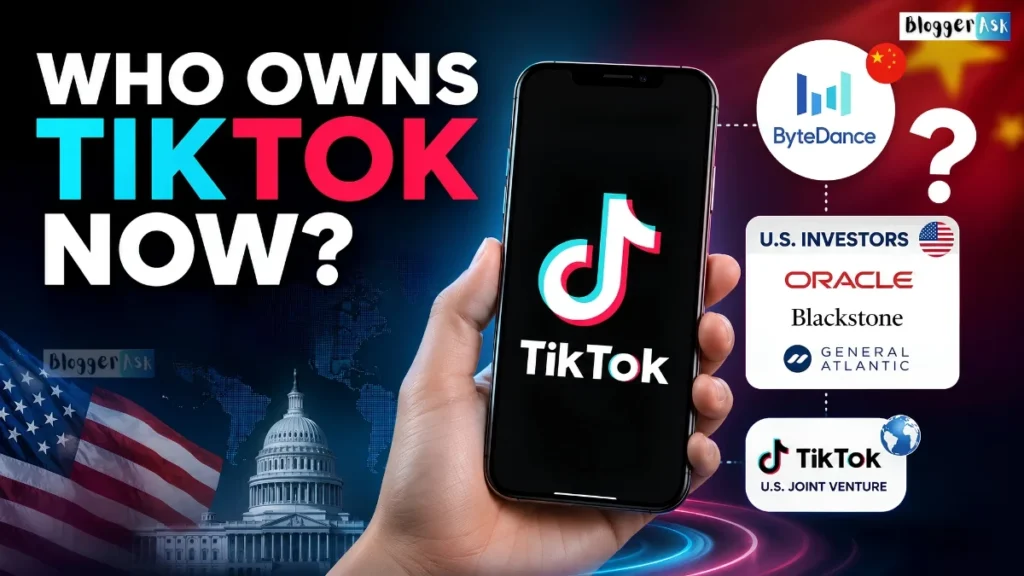
Who owns TikTok actually splits into two answers. ByteDance, a Beijing-based company, still owns TikTok everywhere in the world except the United States. In the U.S., a separate company called TikTok USDS Joint Venture LLC now runs the app, majority-owned by American and allied investors, with ByteDance holding a 19.9% minority stake. That structure has been in place since January 22, 2026.
If you only came here for that, you have it. Here’s what almost every other explainer on this topic gets wrong, though: they treat “who owns TikTok” as one question with one answer. It isn’t. TikTok split into two separately owned companies in January 2026, and mixing them up is exactly why so many answers online contradict each other. Everything below untangles that — who these investors are, why the deal is built this way, who runs the app day to day, and whether any of it actually changes what China can see or do.
Global TikTok vs. U.S. TikTok: Two Different Ownership Questions
TikTok isn’t one company with one owner anymore. It’s two related but separately structured operations, and most of the confusion around this topic comes from people asking about one while reading answers about the other.
Here’s the shape of it:
- ByteDance Ltd. (China) owns TikTok’s global business, including the version used across most of the world, and also owns Douyin, TikTok’s China-only sister app.
- TikTok USDS Joint Venture LLC (U.S.) owns and runs the version of TikTok that operates inside the United States. It’s a separate legal entity, majority-owned by non-Chinese investors, that licenses TikTok’s recommendation technology from ByteDance rather than owning it outright.
Here’s that structure at a glance:
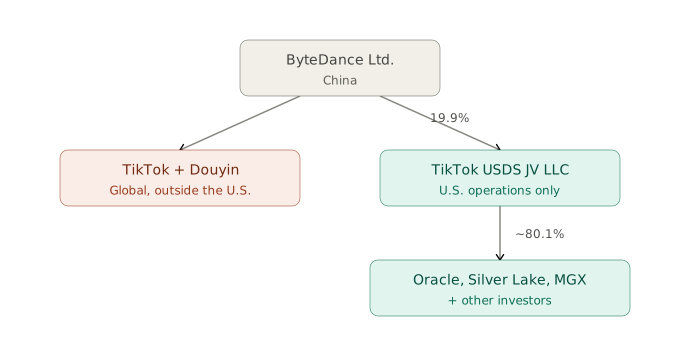
Think of it less like a sale and more like a corporate spinoff with strings attached. ByteDance didn’t hand over TikTok and walk away. It gave up majority ownership and day-to-day control of the U.S. business specifically, while keeping a minority stake and keeping full ownership of everything outside the U.S.
U.S. law is the reason this split exists, not because ByteDance wanted to restructure voluntarily. We’ll get to why in a bit. For now, the important thing to remember is this: when someone asks “who owns TikTok,” the honest answer depends on whether they mean the global app or the U.S. one — and as of 2026, those are legally two different things.
It also helps to know TikTok wasn’t always ByteDance’s app to begin with, either. ByteDance entered the U.S. market by buying a lip-syncing app called Musical.ly for roughly $1 billion in November 2017, then merged it into TikTok in August 2018. Musical.ly’s accounts, videos, and followers all moved over automatically — the same kind of seamless transition TikTok would repeat in January 2026 when U.S. ownership changed again.
One more thing this deal doesn’t touch: TikTok in the UK, the EU, Canada, and everywhere else outside the U.S. Those versions of the app stay fully under ByteDance’s global business, untouched by the American ownership restructuring. If you’re asking who owns TikTok in Canada or Europe, the answer is still simply ByteDance — this ownership split is a U.S.-only story.
Who Owns TikTok’s U.S. Operations (Full 2026 Breakdown)
TikTok’s U.S. business is owned by a coalition of investors, not one buyer. Three firms — Oracle, Silver Lake, and MGX — each hold 15% as managing investors. Oracle’s stake is the one most people ask about by name, largely because of Larry Ellison, Oracle’s co-founder and executive chairman, who has been the most publicly visible figure on the American side of this deal. ByteDance keeps 19.9%. The remaining roughly 35% is split between new investors and firms that were already invested in ByteDance globally.
The Ownership Table
The investor names and the headline 15%/15%/15%/19.9% figures are confirmed directly by TikTok USDS Joint Venture LLC’s own newsroom announcement — treat those four numbers as company-verified. The more granular 5%/30.1% split within the “other investors” category is independently reported by The Hollywood Reporter and corroborated by CNBC and Digiday’s coverage of the same announcement, but TikTok hasn’t restated that exact sub-breakdown in its own materials.
| Owner | Stake | Role |
|---|---|---|
| Oracle Corporation | 15% | Managing investor; U.S. data hosting and security auditing; board seat held by executive Kenneth Glueck |
| Silver Lake | 15% | Managing investor; board seat held by co-CEO Egon Durban |
| MGX (Abu Dhabi) | 15% | Managing investor; board seat held by David Scott |
| Other new investors | 5% | Smaller outside stakeholders brought in as part of the deal |
| Affiliates of existing ByteDance investors | 30.1% | Includes Dell Family Office, Vastmere Strategic Investments (a Susquehanna International Group affiliate), Alpha Wave Partners, Revolution, Merritt Way LLC (linked to Dragoneer), Via Nova (a General Atlantic affiliate), Virgo LI Inc. (tied to Yuri and Julia Milner’s foundation), and NJJ Capital (Xavier Niel’s family office) |
| ByteDance Ltd. | 19.9% | Retained minority stake; licenses the recommendation algorithm to the joint venture |
To put those percentages in dollar terms: the deal values TikTok’s U.S. business at roughly $14 billion, so each of the three 15% managing investors — Oracle, Silver Lake, and MGX — is sitting on a stake worth somewhere around $2.1 billion at that valuation. ByteDance’s 19.9% slice works out to roughly $2.7 billion. Those are rough figures based on the deal’s own headline valuation, not independently audited numbers, since ByteDance is privately held and doesn’t publish financial statements.
This same structure covers TikTok Shop, the app’s U.S. e-commerce arm — it operates under TikTok USDS Joint Venture LLC just like the rest of the app, not as a separately owned business.
Notice that last row in the table. A lot of the “new” American ownership isn’t entirely new money — several of those firms already held stakes in ByteDance globally and rolled part of that exposure into the U.S. entity instead. That’s a detail most coverage of this deal glosses over, but it matters if you’re trying to understand how independent the new ownership group really is from ByteDance’s existing investor base.
Why ByteDance Holds Exactly 19.9%, Not 20%
That number isn’t arbitrary, and it isn’t a negotiating outcome either. It’s a legal ceiling. The law behind this entire deal, the Protecting Americans from Foreign Adversary Controlled Applications Act, required TikTok’s Chinese ownership to fall below 20% for the app to keep operating legally in the U.S. Landing at 19.9% is ByteDance staying just under that line, not just under some round number for appearances.
It’s a fine margin, and worth remembering when people say ByteDance “still owns” TikTok’s U.S. business. Technically, 19.9% is a real, disclosed equity stake — but it’s structured specifically to sit below the threshold that would trigger the ban.
Equity Ownership vs. Operational Control: Why They’re Not the Same Thing
Owning a slice of a company and controlling what that company actually does are different things, and this deal makes that gap wider than usual. ByteDance keeps a stake and keeps ownership of the underlying algorithm. Oracle, not ByteDance, hosts the U.S. data and audits security. Day-to-day decisions sit with the joint venture’s own management, not with any single investor.
Here’s the real answer to “does this mean China doesn’t control TikTok anymore.” A shareholder isn’t automatically a controller, and a 15% investor with a board seat can carry more practical weight than a 19.9% investor with none. This table shows how the actual functions break down:
| Function | Who actually handles it |
|---|---|
| Owns the underlying recommendation algorithm | ByteDance (licenses a version to the U.S. joint venture) |
| Retrains and runs that algorithm on U.S. user data | TikTok USDS Joint Venture LLC |
| Hosts and secures U.S. user data | Oracle, under a national security agreement |
| Sets day-to-day U.S. content moderation policy | TikTok USDS Joint Venture LLC’s own leadership |
| Runs TikTok’s global business outside the U.S. | ByteDance |
| Holds a seat on the U.S. joint venture’s board | ByteDance does not; Oracle, Silver Lake, and MGX each do, alongside other investor representatives |
So ByteDance keeps equity and keeps the algorithm’s core ownership. It doesn’t get a board seat on the entity that runs the U.S. app, and it doesn’t control how U.S. user data is stored or audited. That’s the actual mechanism behind the “majority American-owned and controlled” language TikTok itself used when announcing the deal.
One caveat worth flagging honestly: the exact terms of that algorithm license — how long it runs, what ByteDance gets paid, what happens if either side wants out — haven’t been made public. What’s confirmed is that a license exists, and that Oracle, not ByteDance, handles the U.S. data side of it. The fine print itself stays confidential.
Who Runs TikTok Day to Day: The Two CEOs Explained
As of 2026, TikTok effectively has two CEOs with two different jobs, and almost nothing written about this online makes that clear. Shou Chew remains CEO of TikTok’s global business under ByteDance. Adam Presser, a longtime TikTok executive, was named CEO of the new U.S. joint venture the same day it was established.
Shou Chew — Global TikTok CEO
Chew has led TikTok globally since May 2021. He’s Singaporean, not Chinese, a detail that’s often lost in political coverage of the app — he previously served as ByteDance’s CFO and, before that, held a senior role at Xiaomi. His job covers TikTok’s business everywhere outside the newly carved-out U.S. entity, including strategy, product, and ByteDance’s relationship with TikTok as a global platform. He also holds one of the seven seats on the U.S. joint venture’s board, which is the one formal link between the two organizations at the leadership level.
Adam Presser — CEO of the New U.S. Joint Venture
Presser is the executive actually running TikTok’s U.S. operations day to day. He joined TikTok in April 2022, worked his way up through a chief of staff role to become head of operations and trust and safety, and was appointed CEO by the joint venture’s board as one of its first official actions after the deal closed. Before TikTok, he spent years at WarnerMedia and Warner Bros. in senior international roles. Will Farrell, another TikTok veteran with a background at Booz Allen Hamilton, was named the joint venture’s chief security officer, overseeing the data protection and cybersecurity side of the business specifically.
Presser reports to the joint venture’s own board — not to Shou Chew, and not to ByteDance. That reporting line is exactly why this structure counts as real operational separation rather than a rebrand: the person running the U.S. app answers to a majority-American board, full stop.
Beyond the two CEOs, here’s the joint venture’s full board — seven people, majority American:
| Board Member | Firm / Role |
|---|---|
| Shou Chew | Global TikTok CEO |
| Egon Durban | Co-CEO, Silver Lake |
| Kenneth Glueck | Executive Vice President, Oracle |
| David Scott | Chief Strategy and Safety Officer, MGX |
| Mark Dooley | Managing Director, Susquehanna International Group |
| Timothy Dattels | Senior Advisor, TPG Global |
| Raul Fernandez | President and CEO, DXC Technology (independent director; chairs the board’s security committee) |
If you’re trying to picture who genuinely has a say in how the U.S. app is run, this board — not the equity table alone — is the clearer place to look.
How We Got Here: A Timeline of TikTok’s Ownership Fight (2020–2026)
Six years, one Supreme Court ruling, and four deadline extensions — that’s what it took to get from the first ban threat to the deal that exists today. It started in 2020 with a failed sale attempt and ended in January 2026 with the joint venture now running the app.
- 2020: The first Trump administration pushes for a forced sale of TikTok’s U.S. business. Oracle bids at the time, but no deal closes.
- April 24, 2024: Congress passes and President Biden signs the Protecting Americans from Foreign Adversary Controlled Applications Act, giving ByteDance until January 19, 2025 to divest TikTok’s U.S. operations or face a nationwide ban.
- January 17, 2025: The Supreme Court unanimously upholds the law.
- January 19–20, 2025: TikTok briefly goes dark for U.S. users before the incoming Trump administration delays enforcement.
- Through 2025: President Trump issues a series of executive orders repeatedly extending the enforcement deadline — Executive Order 14166 in January, 14258 in April, 14310 in June, and 14350 in September — while a buyer group is negotiated.
- September 25, 2025: Trump signs Executive Order 14352, “Saving TikTok While Protecting National Security,” approving the specific deal structure — the joint venture, the investor group, and the terms that would ultimately close the sale.
- December 19, 2025: ByteDance signs binding agreements committing to the deal.
- January 22, 2026: TikTok USDS Joint Venture LLC is officially established. The deal closes, and TikTok’s U.S. operations formally transfer to the new entity.
- February–July 2026: U.S. federal agencies begin confirming the new structure satisfies existing national security restrictions, including a Justice Department opinion in mid-July 2026 concluding that TikTok no longer falls under the 2022 law banning the app from government devices, given the completed divestiture.
That’s six years of political back-and-forth compressed into one list. If you only remember one date from it, make it January 22, 2026 — that’s when the new ownership structure actually took effect.
Is TikTok Still Controlled by China? A Direct Answer
No, not in the way “controlled” is usually meant when people ask this. ByteDance no longer holds a majority stake, doesn’t control TikTok USDS Joint Venture LLC’s board, and doesn’t manage U.S. user data. It does retain a 19.9% equity stake and ownership of the underlying algorithm’s intellectual property, which is licensed — not surrendered — to the U.S. entity.
Whether that fully resolves the original concern depends on which part of the concern you weigh most heavily. Here’s the honest case on both sides:
Reasons the deal meaningfully reduces Chinese government leverage:
- ByteDance holds no board seats on the entity running the U.S. app.
- Oracle, not ByteDance, hosts and audits U.S. user data under a formal national security agreement.
- The Justice Department has already concluded, in writing, that the structure satisfies the government-devices restriction that previously applied because of TikTok’s Chinese ownership.
Reasons for continued skepticism:
- ByteDance still owns the algorithm’s core intellectual property and licenses it to the joint venture, rather than the U.S. entity owning it outright.
- A 19.9% equity stake is still a real financial and informational relationship, even without a board seat.
- As of August 2026, the Chinese government itself has never issued an official public statement confirming or endorsing the agreement — even though President Trump has said he discussed and secured approval for the deal directly from President Xi Jinping. That’s a real gap between the American side’s account and any independent confirmation from Beijing, and it’s worth checking for an update if you’re reading this well after publication.
- The structure is new, largely untested over time, and its safeguards depend on ongoing compliance rather than a clean, total ownership break.
There’s one more layer worth knowing about, since it rarely comes up: the Chinese government doesn’t hold a direct stake in ByteDance or TikTok globally, either. A state-linked entity called the China Internet Investment Fund holds a small stake — around 1% — in one of ByteDance’s Chinese domestic subsidiaries, which is standard practice for internet companies operating in China and isn’t unique to ByteDance. It’s a minor equity position, not a controlling one. The bigger lever Beijing has always had isn’t ownership — it’s Chinese law’s broad authority to compel data access from companies headquartered there, which is the legal backdrop that made this whole U.S. ownership fight necessary in the first place.
A Precedent Worth Knowing: Grindr’s 2020 Forced Sale
TikTok isn’t the first app the U.S. government has pushed out of Chinese hands over data concerns, and the other example is genuinely useful context that almost never comes up in TikTok coverage. In 2019, the Committee on Foreign Investment in the United States ordered Beijing Kunlun Tech, a Chinese gaming company, to divest Grindr, the dating app it owned, because Grindr’s data on roughly 27 million users — including location and HIV status — was judged a national security risk. Kunlun sold Grindr to an American investor group for about $608.5 million in 2020.
Here’s the wrinkle worth remembering: Reuters later reported that one investor in Grindr’s “American” buyer group had prior financial ties to Kunlun itself, raising real questions about how clean that separation actually was. It’s a useful thing to hold onto here too. TikTok’s new ownership group includes several firms that were already invested in ByteDance before this deal — the same kind of overlap that drew scrutiny in the Grindr case. That doesn’t automatically mean the TikTok deal has the same problem. It means “forced sale” and “total separation” aren’t always the same thing, and it’s a reasonable detail to keep watching rather than assume is settled.
Public opinion had already started shifting before the deal closed. In Pew Research Center’s most recent survey on the question — fielded in early 2025, months before the joint venture was established — the share of Americans who viewed TikTok as a national security threat had dropped from 59% in 2023 to 49%, and support for an outright ban had fallen from 50% to 34%. That’s a meaningful shift in sentiment heading into the deal, even though it doesn’t tell us how Americans feel about the finished structure itself, since Pew hasn’t published a fresh survey since the deal closed.
Does This Change Anything for TikTok Users or Creators?
For most people scrolling TikTok, nothing about the day-to-day experience changed on January 22, 2026. Accounts, followers, content, and login credentials all carried over without any action required. There’s no new app to download and no migration process to go through.
Want to check this yourself instead of taking any article’s word for it? Three places to look:
- In the app: Settings → About → Terms of Service. You’ll see TikTok USDS Joint Venture LLC named as the entity operating the app in the U.S.
- TikTok’s own newsroom (newsroom.tiktok.com) carries the original announcement, including the full investor list and board names.
- Your account itself: nothing about your login, followers, or saved content requires any action from you. If you get an email or in-app pop-up asking you to “re-verify” your account because of the ownership change, treat it as a phishing attempt — TikTok hasn’t asked users to do this, and scammers routinely piggyback on real news like this deal.
A few things are genuinely worth watching, though, rather than assuming they’ll stay the same:
- The algorithm is being retrained on U.S. data inside Oracle’s cloud. That’s a real technical change, even if it doesn’t show up in your feed right away.
- Content moderation now sits with the U.S. joint venture’s own leadership, not ByteDance’s global policy team. Over time, that opens the door to U.S. TikTok diverging from the rest of the world on what’s allowed.
- Monetization tools, ad policy, and creator fund terms are worth watching. This is a new corporate structure without a long track record, so don’t assume today’s terms are locked in.
- If you sell through TikTok Shop, nothing about seller verification or payout requirements changed because of this deal — TikTok Shop runs under the same joint venture as the rest of the app, and existing seller terms still apply.
Here’s the practical takeaway depending on who you are:
- Casual user: nothing to do. Your account works exactly as it did before.
- Parent: this deal was mainly about who can access user data, not about content moderation standards — so if your concern is what your kid sees rather than where their data goes, this deal doesn’t change that calculus much either way.
- Creator or TikTok Shop seller: don’t build your income entirely around one platform’s policies. Ownership changes can shift the incentives behind monetization terms, ad rates, and moderation rules over time, and this structure is genuinely new enough that its long-term behavior isn’t proven yet.
TikTok’s Ownership Fight, by the Numbers
A few figures put the scale of what’s actually at stake here in perspective. TikTok says its U.S. business alone serves more than 200 million Americans and 7.5 million businesses. Independently, Pew Research Center’s most recent survey found that 37% of U.S. adults report using TikTok, up from 21% in 2021 — and usage skews heavily by age, with roughly half of adults 18 to 29 saying they use the app daily, compared with just 5% of adults 65 and older.
The financial side is smaller than those user numbers might suggest. The deal values TikTok’s U.S. business at roughly $14 billion, a figure Vice President JD Vance disclosed publicly ahead of the close. That number describes only the U.S. entity — ByteDance’s own global valuation, driven by its much larger international business, is a separate and considerably larger figure.
What Could Still Change
The most likely source of change here is the algorithm-licensing deal between ByteDance and the joint venture, which will need renewing over time — but it’s not the only thing that could shift. Here’s what to watch:
- The algorithm-licensing arrangement between ByteDance and the U.S. joint venture will need to be renewed and audited over time, not just set up once.
- Individual investor stakes could shift through future secondary sales, the way ByteDance’s own valuation has moved through its private markets.
- Ongoing congressional and regulatory oversight is likely, given how politically contentious this deal was to reach.
- Beijing has never issued its own official confirmation of the deal, which leaves some ambiguity about how durable Chinese government cooperation with the arrangement really is.
- No major legal challenge is currently threatening to unwind the deal, based on public records as of August 2026, but the structure hasn’t been tested by a full political or legal cycle yet.
Key Takeaways
- ByteDance still owns TikTok globally and Douyin in China, but no longer controls TikTok’s U.S. operations.
- TikTok USDS Joint Venture LLC, established January 22, 2026, now runs the U.S. app — including TikTok Shop — majority-owned by Oracle, Silver Lake, MGX, and a wider group of investors.
- ByteDance retains a 19.9% stake in the U.S. entity — a figure set specifically to stay under the legal 20% foreign-ownership threshold.
- There are effectively two CEOs now: Shou Chew runs TikTok globally, and Adam Presser runs the U.S. joint venture specifically, reporting to its own board.
- The deal reduces Chinese government leverage over U.S. operations meaningfully, but doesn’t eliminate ByteDance’s financial and algorithmic ties entirely.
FAQs
Is TikTok still owned by China?
No, not TikTok’s U.S. operations. ByteDance, a Chinese company, still owns TikTok’s global business and Douyin, but TikTok’s U.S. app is now run by TikTok USDS Joint Venture LLC, which is majority-owned by American and allied investors. ByteDance holds a 19.9% minority stake in that U.S. entity.
Who is the owner of TikTok now?
Globally, ByteDance Ltd. Inside the U.S., ownership sits with TikTok USDS Joint Venture LLC, whose largest shareholders are Oracle, Silver Lake, and MGX at 15% each, alongside a wider group of other investors and ByteDance’s 19.9% stake.
Who is the CEO of TikTok?
There are two relevant CEOs as of 2026. Shou Chew remains CEO of TikTok’s global business under ByteDance. Adam Presser was named CEO of the separate U.S. joint venture when it was established in January 2026, reporting to the joint venture’s own board.
Is TikTok controlled by the US?
TikTok’s U.S. operations are majority-owned and operationally controlled by American and allied investors through TikTok USDS Joint Venture LLC. ByteDance retains a minority equity stake and ownership of the underlying algorithm’s intellectual property, which it licenses to the U.S. entity rather than controlling directly.
Does ByteDance still own TikTok?
Yes, globally. ByteDance owns TikTok everywhere outside the United States and retains a 19.9% stake in the separate entity that now owns TikTok’s U.S. operations, without holding a board seat on that entity.
Conclusion
Who owns TikTok isn’t a trick question anymore, but it is a two-part one. ByteDance owns the global app. A separate, majority American and allied-owned joint venture owns and runs the U.S. version — TikTok Shop included — with ByteDance holding a minority stake and licensing the technology behind it. That structure is the product of a specific U.S. law, a Supreme Court ruling, and more than a year of negotiated deadlines — not a simple corporate sale.
If you use TikTok in the U.S., the practical reality right now is that very little has changed in the app itself, even though the ownership behind it changed substantially. Whether that structure holds exactly as it stands today, or gets adjusted as investors, regulators, and the two companies keep working through it, is the one genuinely open question left.
📖 Continue Reading:
Sources & References
- TikTok USDS Joint Venture LLC, official newsroom announcement (January 22, 2026)
- CNBC, “TikTok forms U.S. joint venture, names Adam Presser CEO” (January 22, 2026)
- The Hollywood Reporter, coverage of the joint venture’s investor breakdown and board (January 22–23, 2026)
- Al Jazeera, “Who controls TikTok’s US platform under new deal?” (January 23, 2026)
- Congress.gov, full text of H.R. 7521, the Protecting Americans from Foreign Adversary Controlled Applications Act, 118th Congress
- Federal Register, “Saving TikTok While Protecting National Security,” Executive Order 14352 (signed September 25, 2025; published September 30, 2025)
- Holland & Knight, “U.S. Supreme Court Upholds TikTok Sale-or-Ban Law” (January 2025)
- U.S. Department of Justice, Office of Legal Counsel opinion on TikTok and the No TikTok on Government Devices Act (July 2026)
- U.S. News & World Report, “Federal Employees Can Download TikTok on Government Devices, DOJ Says” (July 17, 2026)
- Pew Research Center, “Americans’ Social Media Use 2025” (November 20, 2025)
- Pew Research Center, “Fewer Americans Now Support TikTok Ban, See the Platform as a National Security Threat Than in Spring 2023” (March 25, 2025)
- The Hollywood Reporter, “Musical.ly Owner ByteDance Merges App With TikTok” (August 2, 2018)
- TechCrunch, “Grindr sold by Chinese owner after US raised national security concerns” (March 6, 2020)
- Malay Mail, “Winning bidder for Grindr has ties to Chinese owner” (June 2, 2020), reporting original Reuters findings
Last updated August 6, 2026. TikTok’s ownership structure is genuinely new, and a few specific facts are most likely to move: individual investor stakes (which could shift through future secondary sales), board composition, and whether Beijing ever issues its own public statement on the deal. The legal history, the core ownership percentages, and the executive structure are on firmer, more settled ground. This article reflects publicly available information as of the update date above.

Olivia Isabel is a Business & Technology Writer specializing in corporate ownership, company leadership, shareholders, acquisitions, and the business strategies behind major global companies. Her work covers technology, artificial intelligence, social media, finance, e-commerce, automotive, and consumer technology, with a particular focus on explaining who owns, controls, and leads well-known companies.
With a background in Economics and Journalism, Olivia approaches each topic as a research-driven business story. She examines company filings, investor-relations materials, regulatory records, official corporate announcements, and reputable financial sources to distinguish between legal ownership, economic ownership, voting control, and day-to-day management.
Her articles explore the founders behind major companies, current CEOs, significant shareholders, parent companies, subsidiaries, acquisitions, and changes in corporate structure. She has written about companies including Google, Alphabet, Apple, Microsoft, Amazon, Meta, OpenAI, Tesla, SpaceX, YouTube, Instagram, TikTok, WhatsApp, Reddit, Spotify, and other major technology and consumer brands.
Olivia’s goal is to make complicated corporate and financial information clear, accurate, and useful for everyday readers. She is particularly interested in corporate strategy, technology business models, entrepreneurship, emerging AI companies, public markets, and the evolution of globally recognized brands.