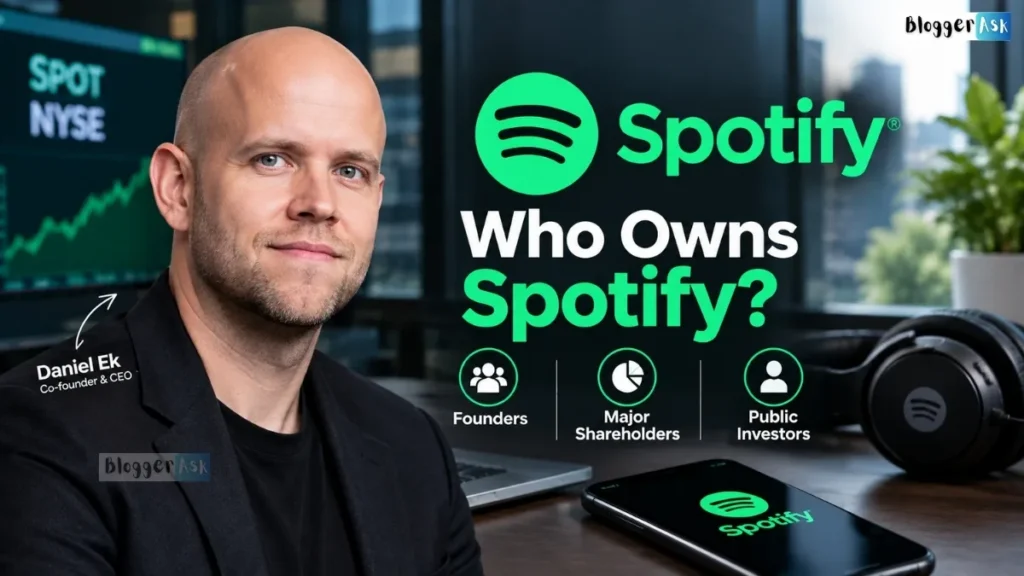
⚡ Quick Answer: Who Owns Spotify?
Spotify is a publicly traded company — Spotify Technology S.A., listed on the New York Stock Exchange under the ticker SPOT — so no single person, company, or country owns it outright. Co-founders Daniel Ek and Martin Lorentzon hold the largest voting control through a dual-class share structure, while institutional investors hold most of the economic shares. As of January 2026, Ek moved to Executive Chairman, with Alex Norström and Gustav Söderström serving as co-CEOs.
Spotify at a Glance
| Founded | 2006 |
| Founders | Daniel Ek and Martin Lorentzon |
| Headquarters | Stockholm, Sweden |
| Legal Entity | Spotify Technology S.A. (Luxembourg-registered) |
| Stock Ticker | NYSE: SPOT |
| Market Cap | ~$112 billion (as of September 2, 2026) |
| Monthly Active Users | 777 million (Q2 2026, reported August 4, 2026) |
| Paying Subscribers | 300 million (Q2 2026) |
| Current Executive Chairman | Daniel Ek |
| Current Co-CEOs | Gustav Söderström and Alex Norström |
Who Founded Spotify?
Daniel Ek — Co-Founder and Executive Chairman
Daniel Ek co-founded Spotify in 2006 and led it as CEO for nearly two decades before stepping down on January 1, 2026, moving into the newly created role of Executive Chairman.
Martin Lorentzon — Co-Founder and Board Chairman
Martin Lorentzon co-founded Spotify alongside Ek in 2006. He stepped back from day-to-day operations years ago but remains on Spotify’s board — and, as the sections below explain, is actually the single largest individual holder of Spotify’s voting power.
How Spotify Started (2006 Founding Story)
Spotify was built as a legal alternative to music piracy, launching publicly in Stockholm in October 2008. Early funding came from European venture firms Northzone and Creandum. To secure catalog rights in its earliest years, Spotify also granted equity warrants to Universal, Sony, and Warner — which is why the major labels have historically held small stakes in the company.
Is Spotify a Public or Private Company?
Spotify’s 2018 Direct Listing (Not a Traditional IPO)
Spotify went public in April 2018 through a direct listing on the NYSE rather than a traditional underwritten IPO. In a direct listing, a company’s existing shares begin trading on the exchange without the company issuing new shares or setting a price through underwriters.
What “Publicly Traded” Actually Means for Spotify’s Ownership
Being publicly traded means anyone can buy Spotify shares on the open market. But owning shares isn’t the same as controlling the company — a distinction explained fully in the next section.
Who Are Spotify’s Major Shareholders?
Founder Shareholdings (Ek and Lorentzon)
Largest Institutional Investors (Baillie Gifford, BlackRock, Morgan Stanley, T. Rowe Price, Tencent)
| Shareholder | Type | Approx. Stake | Source & Date |
|---|---|---|---|
| Daniel Ek | Founder | ~13.9% of ordinary shares; ~28.8% of voting power | Spotify FY2025 Form 20-F (SEC, filed Feb 10, 2026) |
| Martin Lorentzon | Founder | ~9.3% of ordinary shares; ~40.5% of voting power | Spotify FY2025 Form 20-F (SEC, filed Feb 10, 2026) |
| Tencent | Strategic | ~16.6M shares, ~8.1% of ordinary shares | Spotify FY2025 Form 20-F (SEC, filed Feb 10, 2026) |
| BlackRock | Institutional | Minority stake | SEC 13F filing, most recent quarter |
| Baillie Gifford & Co. | Institutional | Minority stake | SEC 13F filing, most recent quarter |
| Morgan Stanley | Institutional | Minority stake | SEC 13F filing, most recent quarter |
| T. Rowe Price | Institutional | Minority stake | SEC 13F filing, most recent quarter |
Founder and Tencent figures reflect Spotify’s most recent annual filing, as of December 31, 2025. Institutional 13F holdings are reported quarterly and shift more frequently than annual founder disclosures — treat them as directional.
Important: Spotify’s beneficiary certificates — the mechanism behind the founders’ outsized voting power, explained below — carry no economic rights. They can’t be sold or converted to cash; they exist solely to carry votes. That means the “ordinary shares” percentages above are the real measure of Ek’s and Lorentzon’s financial stake in the company, while their voting-power percentages measure something entirely different: control.
Ownership vs. Control — Why Share Percentage Isn’t the Whole Story
What Are Dual-Class Shares and Beneficiary Certificates?
Spotify’s structure is unusual even among founder-controlled tech companies. Instead of issuing themselves super-voting shares the way Meta or Alphabet do, Ek and Lorentzon hold ordinary shares plus a separate voting-only instrument called a beneficiary certificate. These certificates carry votes but no economic value — they can’t be sold on the market — and they’re tied to a fixed share of total votes rather than a fixed multiple per ordinary share, which is why a founder’s voting power doesn’t dilute the same way it would under a typical shares-based dual-class system.
How Ek and Lorentzon Keep Voting Control With a Minority of Shares
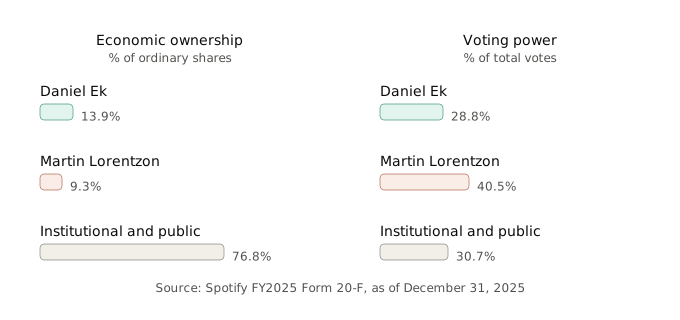
As of Spotify’s most recent annual filing (December 31, 2025), Ek and Lorentzon together control approximately 69.3% of Spotify’s total voting power. Lorentzon alone holds around 40.5% of the vote — more than any other shareholder — while Ek controls about 28.8%. Ek’s move from CEO to Executive Chairman in January 2026 did not itself alter his voting rights; his voting power comes from his ownership structure and beneficiary certificates, not from whichever executive title he holds.
Worked example: Imagine a Spotify board vote where every institutional investor in the shareholder table above — BlackRock, Baillie Gifford, Morgan Stanley, T. Rowe Price, and Tencent — votes as a unified bloc against a proposal Ek and Lorentzon support. Even in that scenario, the founders’ combined ~69% voting bloc wins, because those institutional holders together control only a fraction of total votes despite owning a much larger share of the company’s economic value. This voting structure gives the founders substantial influence over shareholder votes and the composition of the company, even though they own a much smaller percentage of Spotify’s economic shares.
Here’s what that split looks like side by side:
Who Runs Spotify Now? Leadership in 2026
Daniel Ek’s Move to Executive Chairman (January 2026)
Ek stepped down as CEO effective January 1, 2026, moving into the role of Executive Chairman, where he now focuses on long-term strategy while remaining closely engaged with the board.
Meet the Co-CEOs — Alex Norström and Gustav Söderström
Alex Norström (formerly Chief Business Officer) and Gustav Söderström (formerly Chief Product & Technology Officer) became co-CEOs on January 1, 2026. Both have spent more than 15 years at Spotify and previously operated as co-presidents under Ek, meaning the new titles largely formalized a leadership dynamic that was already in place.
What Changed (and What Didn’t) in Spotify’s Leadership
| Before Jan 1, 2026 | From Jan 1, 2026 | |
|---|---|---|
| Chief Executive | Daniel Ek (sole CEO) | No sole CEO — co-CEO model |
| Top operating roles | Norström & Söderström, Co-Presidents | Norström & Söderström, Co-CEOs |
| Ek’s role | Founder & CEO | Executive Chairman |
| Voting control | Ek + Lorentzon: ~69.3% combined | Unchanged: ~69.3% combined — the title change did not alter voting rights |
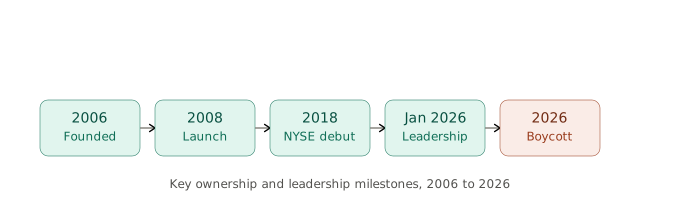
Spotify’s Ownership and Leadership Timeline (2006–2026)
Why Is Spotify’s Ownership in the News? The 2025–2026 Controversy
Important distinction: The investment driving this controversy was made personally by Daniel Ek through his own investment firm — it was not a decision made by Spotify as a company, and Spotify itself holds no ownership stake in the firm involved.
Daniel Ek’s Personal Investment in Helsing (via Prima Materia)
Ek’s investment firm, Prima Materia (which he co-founded with Shakil Khan), first invested in German AI defense company Helsing in 2021 and led a further $600 million funding round in mid-2025. Because Ek is both Spotify’s most prominent public figure and Helsing’s chairman, artists and fans began treating the two companies as connected, even though they are legally and financially separate entities.
Which Artists Have Pulled Their Music From Spotify
Starting in mid-2025, a growing number of artists removed their catalogs from Spotify in protest. This is not an exhaustive list, and dates below are given at month-level precision to reflect what’s reliably confirmed across reporting:
| Artist / Band | Approx. Date | Stated Reason |
|---|---|---|
| Deerhoof | June 2025 | Ek’s investment in Helsing |
| Leah Senior | July 2025 | Helsing investment; artist pay concerns |
| Xiu Xiu | July 2025 | Helsing investment |
| King Gizzard & the Lizard Wizard | Summer 2025 | Helsing investment |
| Godspeed You! Black Emperor | August 2025 | Values misalignment |
| Hotline TNT | August 2025 | Values misalignment |
| Massive Attack | September 2025 | Helsing investment; joined “No Music for Genocide” |
| The Sabres of Paradise | November 2025 | Helsing investment; business model concerns |
A second, separate flashpoint also fed public frustration: in late 2025, Spotify ran U.S. government recruitment ads for Immigration and Customs Enforcement (ICE), which drew criticism before the company confirmed the ads were no longer running.
Spotify’s Official Response
Spotify has stated that it and Helsing are separate companies, and that Ek’s investment is personal, not corporate. Helsing has said its technology is currently focused on European defense — specifically Ukraine — and has pushed back on claims linking it to the conflict in Gaza, which multiple fact-checking outlets have identified as a point of public confusion rather than a verified connection. As of Spotify’s most recent earnings reports, the boycott has not visibly slowed the company’s subscriber growth.
Myth-Check: Did Taylor Swift Leave Spotify Over This?
No. Taylor Swift’s dispute with Spotify happened over a decade before the current controversy and is unrelated to it.
- November 3, 2014: Swift pulled her entire catalog from Spotify, citing concerns that the platform’s free tier devalued music.
- June 9, 2017: Swift returned her full catalog to Spotify and other streaming platforms.
- 2025–2026: Swift is not among the artists who have removed music from Spotify over the Helsing controversy.
The two stories keep getting conflated in search results simply because they involve the same platform and a beloved artist — not because they’re connected.
How to Verify Spotify’s Ownership Yourself
- Go to SEC EDGAR and search “Spotify Technology S.A.” to find the company’s public filings.
- Look up Form 3 and Form 4 filings for insider ownership transactions by Ek, Lorentzon, and other executives.
- Check the latest annual report (Form 20-F), specifically Item 7 (“Major Shareholders and Related Party Transactions”), for the full voting-power breakdown.
- Cross-check with Spotify’s Investor Relations page (investors.spotify.com) for company-confirmed figures and the latest earnings reports.
How Spotify’s Ownership Compares to Other Platforms
| Platform | Owner / Parent Company | Public or Private | Founder Control? |
|---|---|---|---|
| Spotify | Spotify Technology S.A. | Public (NYSE: SPOT) | Yes — Ek & Lorentzon hold ~69% of votes |
| Apple Music | Apple Inc. | Public | No — no founder-control structure |
| YouTube Music | Alphabet Inc. (Google) | Public | No — subsidiary of Alphabet |
| Tidal | Block, Inc. | Public parent company | No — Block owns the majority; Jay-Z and other artists hold a minority stake |
Frequently Asked Questions
Who owns Spotify?
No single entity owns Spotify. It’s a publicly traded company; co-founders Daniel Ek and Martin Lorentzon hold the most voting control (~69.3% combined, as of Spotify’s FY2025 filing), while institutional investors and the public hold most of the economic shares.
Is Daniel Ek still the CEO of Spotify?
No. As of January 1, 2026, Ek moved from CEO to Executive Chairman. Alex Norström and Gustav Söderström now serve as co-CEOs.
Who is the largest shareholder of Spotify?
It depends on what you’re measuring. By voting power, Martin Lorentzon holds the largest single stake (~40.5%). By ordinary shares, Daniel Ek holds the largest founder stake (~13.9%), with institutional investors like Tencent (~8.1%) and BlackRock also holding significant positions.
Is Spotify owned by a country or one company?
No. Spotify is a publicly traded company incorporated in Luxembourg and headquartered in Sweden — it is not government-owned, and no single company owns it outright.
Why are artists boycotting Spotify in 2026?
Many artists have removed their music in protest of a personal investment by Daniel Ek’s firm, Prima Materia, in German defense-AI company Helsing — a decision separate from Spotify’s own corporate actions.
Did Taylor Swift leave Spotify?
She did, but only from 2014 to 2017, over unrelated royalty concerns. She is not part of the 2025–2026 artist boycott.
📖 Continue Reading:
Sources & References
Primary sources
- Spotify Technology S.A. FY2025 Form 20-F — U.S. Securities and Exchange Commission
- Spotify Investor Relations
- Spotify Newsroom — leadership announcement and company updates
Independent reporting
Disclaimer
Ownership percentages, stock prices, and market capitalization change frequently. Founder ownership and voting-power figures reflect Spotify’s most recent annual filing (FY2025, filed February 2026); market data is a point-in-time snapshot as of the date stated. This article is for informational purposes only and is not investment, legal, or financial advice.

Olivia Isabel is a Business & Technology Writer specializing in corporate ownership, company leadership, shareholders, acquisitions, and the business strategies behind major global companies. Her work covers technology, artificial intelligence, social media, finance, e-commerce, automotive, and consumer technology, with a particular focus on explaining who owns, controls, and leads well-known companies.
With a background in Economics and Journalism, Olivia approaches each topic as a research-driven business story. She examines company filings, investor-relations materials, regulatory records, official corporate announcements, and reputable financial sources to distinguish between legal ownership, economic ownership, voting control, and day-to-day management.
Her articles explore the founders behind major companies, current CEOs, significant shareholders, parent companies, subsidiaries, acquisitions, and changes in corporate structure. She has written about companies including Google, Alphabet, Apple, Microsoft, Amazon, Meta, OpenAI, Tesla, SpaceX, YouTube, Instagram, TikTok, WhatsApp, Reddit, Spotify, and other major technology and consumer brands.
Olivia’s goal is to make complicated corporate and financial information clear, accurate, and useful for everyday readers. She is particularly interested in corporate strategy, technology business models, entrepreneurship, emerging AI companies, public markets, and the evolution of globally recognized brands.