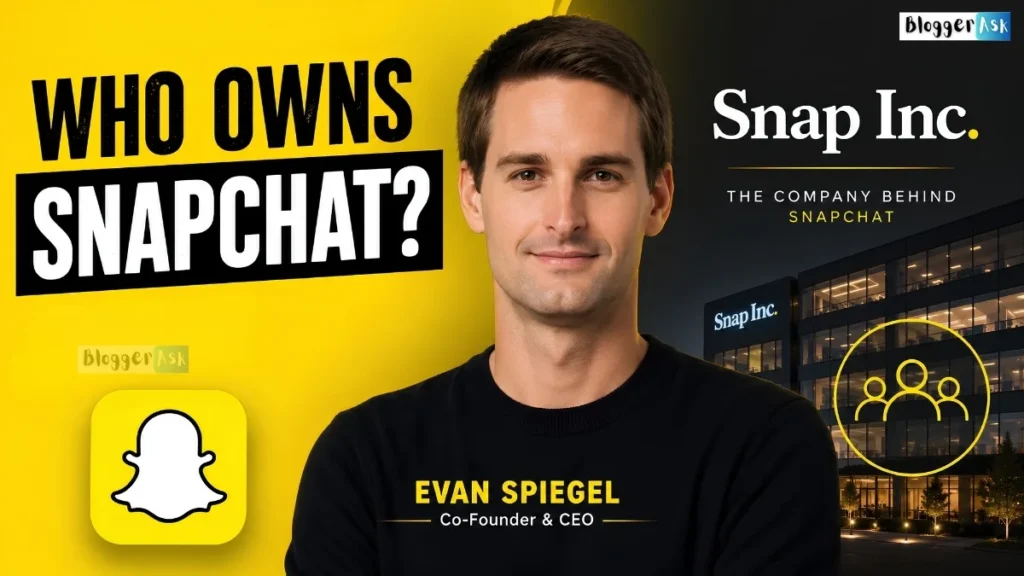
⚡ Quick Answer: Who Owns Snapchat?
Snapchat is owned by Snap Inc., a public company traded on the New York Stock Exchange under the ticker SNAP — not by Meta, Facebook, or any other tech company. Anyone can buy shares in Snap Inc., but co-founders Evan Spiegel (CEO) and Bobby Murphy (CTO) control it through a special class of stock that gives them over 99% of the voting power. In practice, that means most shareholders own a financial stake in Snapchat but have almost no influence over how the company is actually run.
Key takeaways
- Snap Inc., not Meta, owns Snapchat — the two have always been separate, competing companies
- Anyone can buy Snap Inc. stock, but only Spiegel and Murphy can vote on major company decisions
- Facebook and Google both tried to buy Snapchat before its 2017 IPO; both were turned down
- In 2026, an activist investor publicly pushed Snap to change strategy — and had no power to force it
Key facts
| Legal owner | Snap Inc. (NYSE: SNAP) |
| Founded | 2011, at Stanford University |
| Founders | Evan Spiegel, Bobby Murphy, Reggie Brown |
| CEO | Evan Spiegel |
| CTO | Bobby Murphy |
| Public since | March 2, 2017 |
| Headquarters | Santa Monica, California |
| Controlling votes | Spiegel & Murphy, over 99% |
| Market cap (Aug 2026) | ~$9 billion |
Snapchat vs. Snap Inc. — What’s the Difference
Snapchat is the app on your phone. Snap Inc. is the company that builds it, employs the people behind it, and answers to shareholders and regulators. When people ask “who owns Snapchat,” they’re really asking who owns Snap Inc. — the two questions have the same answer, but the distinction matters once you start reading financial filings, since everything is registered under Snap Inc., not “Snapchat.”
Why People Confuse This With Meta
The confusion is understandable. Meta owns Facebook, Instagram, and WhatsApp — three of Snapchat’s closest competitors — so it’s a reasonable (if incorrect) assumption that Meta owns Snapchat too. It doesn’t. Snap Inc. has always been an independent, standalone company. As you’ll see below, Facebook actually tried to buy Snapchat over a decade ago and was turned down, which is part of why the two remain separate rivals rather than one being a subsidiary of the other.
Is Snapchat a Public Company?
Yes. Snap Inc. went public on March 2, 2017, in one of the most closely watched tech IPOs of that decade, debuting with a market capitalization of roughly $28.3 billion. Being “public” means anyone can buy shares of Snap Inc. through a standard brokerage account, and the company is legally required to disclose its finances, leadership, and major decisions to the U.S. Securities and Exchange Commission (SEC).
What “Publicly Traded” Actually Means Here
Normally, being a public company means shareholders get a vote roughly proportional to how many shares they own, and enough collective shareholder pressure can change a company’s direction or leadership. Snap Inc. is a public company where that usual rule mostly doesn’t apply. That’s the real story behind who controls it — covered in full below.
Who Founded Snapchat
Snapchat was founded in 2011 by three Stanford students: Evan Spiegel, Bobby Murphy, and Reggie Brown. The app originally launched under the name “Picaboo” before being rebranded to Snapchat later that year.
- Evan Spiegel — co-founder and current CEO, responsible for product vision and strategy since day one
- Bobby Murphy — co-founder and current CTO, responsible for the app’s engineering and technical foundation
- Reggie Brown — an early collaborator who left the company in 2012 after a dispute over credit and equity
What Happened to Reggie Brown
Brown sued Spiegel and Murphy in 2013, claiming he had originated the disappearing-photo concept and was pushed out without compensation. The dispute was settled privately in September 2014, with the exact terms kept confidential until Snap’s 2017 IPO paperwork revealed the company had paid Brown a total of $157.5 million across two installments. Brown is not listed as a company founder in Snap’s official materials, and he holds no ongoing role or ownership stake in the company today.
Who Really Controls Snap Inc. — The Ownership Framework
This is the part that actually answers what most people are searching for, and it’s where a lot of existing coverage stays vague. “Who owns Snapchat” is really three separate questions with three different answers:
- Who is the legal owner? — Snap Inc., the corporate entity.
- Who are the economic owners? — Everyone who holds shares: founders, employees, index funds, and the general public.
- Who actually controls decisions? — A much smaller group, because at Snap, owning a share and holding a vote are not the same thing.
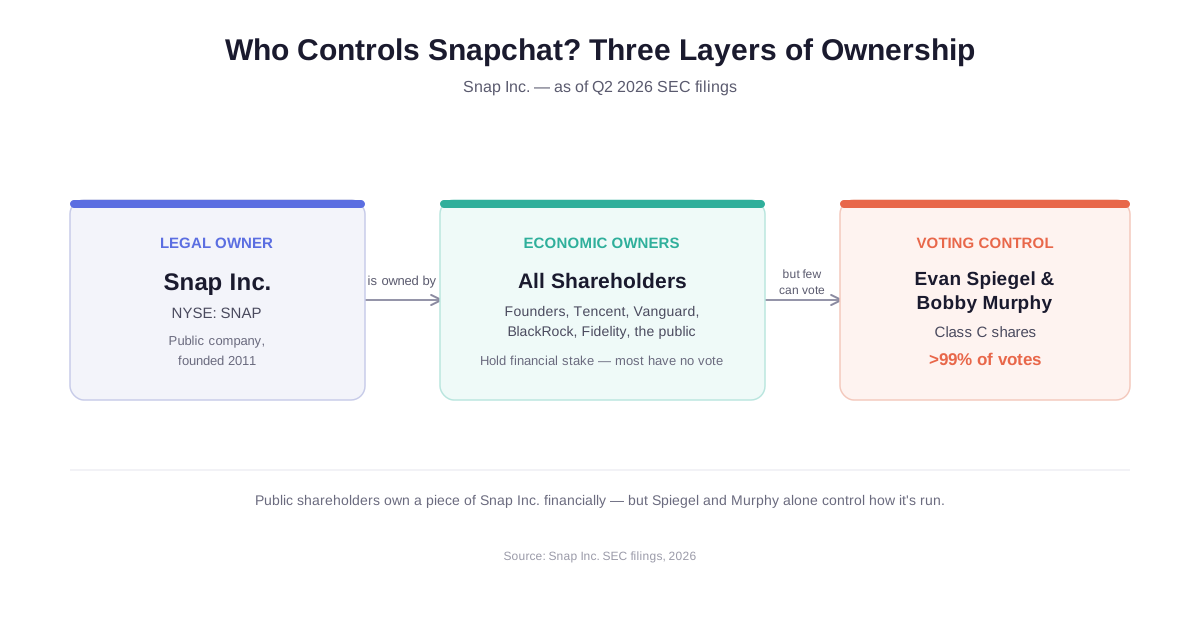
(See the diagram above for how these three layers relate.)
Dual-Class Shares, Explained in Plain Language
Snap Inc. has three classes of common stock:
- Class A — what the general public buys on the open market. Zero votes per share.
- Class B — held mostly by early investors and insiders. One vote per share.
- Class C — held only by Spiegel and Murphy. Ten votes per share.
When Snap went public in 2017, it became the first major U.S. company to sell shares to the public that carried no voting rights at all. Other well-known dual-class IPOs before it, like Google’s, at least gave public investors some votes, just fewer than insiders. Snap’s public shares carried none.
Exactly How Much Voting Power Spiegel and Murphy Hold
Snap’s own 2026 SEC filings put a precise number on this. As of a June 2026 record date, the company had roughly 1.43 billion Class A shares, 22.5 million Class B shares, and 231.6 million Class C shares outstanding — about 1.68 billion shares in total, which matches the total share count Snap separately reported in its Q2 2026 earnings release. Because Class C shares carry ten votes each and Spiegel and Murphy hold effectively all of them, Snap’s filing states directly that the two founders “will be able to exercise voting rights with respect to over 99% of the voting power” of the company’s stock.
That figure comes straight from a primary SEC filing, not a secondary estimate. In practical terms, it means the board cannot remove either founder, and no shareholder vote can force a change in strategy, leadership, or a sale of the company without their consent.
Who Are Snap Inc.’s Major Shareholders
Owning shares in Snap Inc. gives you financial exposure to the company’s performance — but for almost everyone except the two founders, it comes with little to no say in how the company operates.
| Shareholder | Type | Voting power | What they hold |
|---|---|---|---|
| Evan Spiegel | Founder, CEO | Part of the >99% combined bloc | Class B & C shares |
| Bobby Murphy | Founder, CTO | Part of the >99% combined bloc | Class B & C shares |
| Tencent Holdings | Strategic investor | None (Class A only) | One of the largest non-founder economic stakes |
| Vanguard, BlackRock, Fidelity | Institutional/index funds | None or negligible | Several percent each, shifting quarterly |
| General public | Retail investors | None | Class A shares traded on the NYSE |
| Irenic Capital Management | Activist investor (since March 2026) | None beyond its Class A holding | ~2.5% economic interest |
What Happened With Tencent’s Stake
Tencent Holdings, the Chinese technology and gaming conglomerate, first disclosed a roughly 12% stake in Snap in late 2017, built through open-market purchases of non-voting Class A shares. Some older ownership write-ups imply Tencent has since exited the position — that’s not accurate. Reporting through late 2025 and into 2026 consistently shows Tencent still holding a substantial stake, with tracked figures ranging from roughly 12% to over 16% depending on the quarter and filing a given source pulls from. What hasn’t changed since 2017 is Tencent’s lack of voting power: its shares are Class A, so regardless of the exact size of its position, it has no say in Snap’s governance.
What “Owning Shares With No Vote” Actually Means
If you’re an index fund like Vanguard or BlackRock, you hold Snap shares because Snap sits in an index you track — you benefit if the stock rises, but you have essentially no ability to push for changes at the company. If you’re Tencent, you made a large financial bet on Snap’s growth as an early institutional backer, but you hold no board seat and no vote. This is the practical, day-to-day consequence of the dual-class structure: it separates “who benefits financially” from “who decides,” almost entirely.
A caution on precision: shareholder percentages shift every quarter as institutions buy and sell. For the exact current figures, Snap’s most recent 13F-derived shareholder disclosures and annual proxy statement — both available at investor.snap.com — are the only sources that are genuinely current at any given moment.
Did Meta or Google Ever Try to Buy Snapchat
Yes — twice, from two different companies, both rejected.
| Year | Company | Reported offer | Outcome |
|---|---|---|---|
| 2013 | ~$3 billion, all-cash | Rejected by Spiegel | |
| 2016 | ~$30 billion (reported, not officially confirmed) | Never completed |
Facebook’s Rejected $3 Billion Offer (2013)
In late 2013, Facebook approached Snapchat — then just a two-year-old startup with barely any revenue — with an all-cash offer of about $3 billion, according to contemporaneous Wall Street Journal reporting. Spiegel turned it down. It was a striking decision at the time, and it’s one of the earliest signals of how committed he was to keeping the company independent.
Google’s Reported $30 Billion Offer (2016)
Business Insider later reported that Google held informal talks to acquire Snap for around $30 billion in 2016, shortly before Snap’s IPO. This offer was never officially confirmed by either company — a Snap spokesperson called formal buyout-discussion rumors “false” at the time — though multiple sources described it as something of an open secret inside the company. It’s worth being direct about the evidence quality here: this account is widely repeated but not independently verified the way the 2013 Facebook offer is, so treat it as credibly reported rather than confirmed fact.
Why Spiegel Turned Them Down
Spiegel has been consistent in public interviews that he built Snap to be an independent, generation-defining company rather than to sell it. The dual-class share structure put in place at the IPO wasn’t incidental to that goal — it was designed specifically to ensure no future offer, regardless of size, could force a sale without his and Murphy’s agreement.
What Snap Inc.’s Ownership Structure Means Right Now (2026)
This is the part almost no other article about Snapchat’s ownership covers — and arguably the most relevant part in 2026: what does founder control actually look like in practice when a company is under pressure?
Snap’s Current Financial Position
Snap’s stock has fallen sharply since its IPO. As of late August 2026, shares trade in the $5–6 range, giving the company a market capitalization of roughly $9 billion — down from that ~$28.3 billion IPO-day valuation and well below a 2021 peak, when the stock traded above $83 per share. That said, the most recent quarter shows real improvement: in Q2 2026, Snap reported revenue of $1.6 billion (up 19% year-over-year), a narrowed net loss of $164 million, 493 million daily active users, 971 million monthly active users, and its eighth consecutive quarter of positive free cash flow.
Irenic Capital’s 2026 Push — A Live Case Study
In March 2026, activist investment firm Irenic Capital Management disclosed a roughly 2.5% economic stake in Snap’s Class A shares and sent a public letter to Spiegel arguing the company was significantly undervalued. Irenic pointed out that Snap’s stock was down about 83% since its IPO and argued it could be worth up to five times more, pushing for specific changes: workforce reductions, shutting down or spinning off the loss-making Specs (AR glasses) division, and leaning further into AI to improve ad monetization. Snap’s stock jumped roughly 14% on the news.
This is the clearest real-world illustration of what the ownership structure actually means. Irenic could publish a detailed, well-argued case for change and move the stock price — but it had no way to force Snap’s board or management to act on it. Snap’s chairman responded that the company “welcomes input from all shareholders,” a courteous but non-binding statement. Under a conventional one-share-one-vote structure, a fund with a credible public case might realistically press for board seats or a strategy shift. Under Snap’s structure, Spiegel and Murphy simply decide whether to engage with it or not.
What Shareholders Can and Can’t Force the Company to Do
- Can’t: vote out Spiegel or Murphy, force a merger or sale, block a strategic decision such as continued AR/Specs investment, or elect a board majority that overrides the founders
- Can: sell their shares, publicly criticize management (as Irenic did), and vote on matters where the founders choose not to exercise their override — which is rare on anything materially significant
A real historical example shows this dynamic clearly: in early 2018, Snap redesigned the app in a way many users disliked. A Change.org petition asking Snap to reverse the redesign gathered roughly 1.2 million signatures. The redesign stayed, with only minor tweaks. That’s founder control in action — not a hypothetical, but a documented case where sustained public pressure did not change the outcome.
Frequently Asked Questions
Who is Snapchat’s CEO?
Evan Spiegel, co-founder of the company, has been CEO since Snap’s founding in 2011.
Is Snapchat CEO a billionaire?
Yes. Forbes lists Evan Spiegel on its 2026 Billionaires list, with an estimated net worth of roughly $2 billion — nearly all of it tied directly to his Snap Inc. shares, which means his reported net worth moves up and down with the stock price.
Is Snapchat owned by Facebook or Meta?
No. Snapchat has always been owned by the independent company Snap Inc. Meta once tried to acquire it in 2013 (as Facebook) and was turned down.
Did Mark Zuckerberg try to buy Snapchat?
Yes. In 2013, Facebook — led by Zuckerberg — offered approximately $3 billion in cash to acquire Snapchat. Evan Spiegel rejected the offer.
Who owns Snapchat now, in 2026?
The same structure as since its 2017 IPO: Snap Inc. is the legal owner, a mix of founders, institutions, and the public are the economic (shareholder) owners, and Evan Spiegel and Bobby Murphy retain over 99% of voting control through Class C shares.
Can Snap Inc. be sold or bought out?
Only if Spiegel and Murphy agree to it. Their combined voting power means no outside investor, activist fund, or rival company can force an acquisition against their will, no matter how much stock they accumulate on the open market.
The Bottom Line
“Who owns Snapchat” breaks into three distinct answers, not one. Snap Inc. is the legal owner. A broad mix of founders, institutions, and public investors are the economic owners. And Evan Spiegel and Bobby Murphy are the ones who actually run the show, holding over 99% of the voting power through a share structure built specifically to insulate the company from outside pressure.
That structure held firm when Facebook and Google tried to buy Snapchat out a decade ago, and in 2026 it’s the same structure standing between the company and a well-funded activist investor pushing for change. Whether that concentration of control is a strength or a risk is a matter of judgment — but there’s no ambiguity about who’s making the calls.
📖 Continue Reading:
Sources & References
- U.S. SEC — Snap Inc. 2026 Information Statement for Annual Meeting
- U.S. SEC — Snap Inc. Form 8-K, Q2 2026 Financial Results
- U.S. SEC — Snap Inc. Form 424B4 IPO Prospectus (2017)
- Snap Inc. Investor Relations — Q2 2026 Financial Results
- Snap Inc. Investor Relations — Governance & Board of Directors
- CNBC — “Snap climbs 14% as activist Irenic suggests changes to boost stock’s value 7x,” March 31, 2026
- CNBC — Snap Q2 2026 earnings report, August 3, 2026
- TechCrunch — “Snapchat paid Reggie Brown $157.5M to settle his ‘ousted founder’ lawsuit,” February 2017
- CBC News — “Snapchat rejects Facebook’s $3B buyout offer: report,” 2013
- TechCrunch — “Google buy Snap,” August 2017 (reported $30B acquisition talks)
- TechCrunch — “Snapchat responds to the Change.org petition complaining about the app’s redesign,” February 2018
- StockAnalysis.com — Snap Inc. (SNAP) Market Cap & Net Worth
- Forbes — Evan Spiegel profile, 2026 Billionaires list
- The Motley Fool — “What Does Tencent Own?”
- Wikipedia — Snap Inc. (used for cross-checking dates and general background only; all factual claims are independently sourced above)
Disclaimer
This article is for general informational purposes only and does not constitute financial, investment, or legal advice. Stock prices, market capitalization, shareholder percentages, and other financial figures for Snap Inc. change frequently and were accurate as of the dates cited above, primarily late August 2026. Readers considering any investment decision related to Snap Inc. (NYSE: SNAP) should consult Snap’s most recent SEC filings and a licensed financial advisor rather than relying solely on this article.

Olivia Isabel is a Business & Technology Writer specializing in corporate ownership, company leadership, shareholders, acquisitions, and the business strategies behind major global companies. Her work covers technology, artificial intelligence, social media, finance, e-commerce, automotive, and consumer technology, with a particular focus on explaining who owns, controls, and leads well-known companies.
With a background in Economics and Journalism, Olivia approaches each topic as a research-driven business story. She examines company filings, investor-relations materials, regulatory records, official corporate announcements, and reputable financial sources to distinguish between legal ownership, economic ownership, voting control, and day-to-day management.
Her articles explore the founders behind major companies, current CEOs, significant shareholders, parent companies, subsidiaries, acquisitions, and changes in corporate structure. She has written about companies including Google, Alphabet, Apple, Microsoft, Amazon, Meta, OpenAI, Tesla, SpaceX, YouTube, Instagram, TikTok, WhatsApp, Reddit, Spotify, and other major technology and consumer brands.
Olivia’s goal is to make complicated corporate and financial information clear, accurate, and useful for everyday readers. She is particularly interested in corporate strategy, technology business models, entrepreneurship, emerging AI companies, public markets, and the evolution of globally recognized brands.