

⚡ Quick Answer: How to Calculate the 50/30/20 Rule
To use the 50/30/20 rule calculator, enter your after-tax income and how often you’re paid. The calculator multiplies that income by 0.50 for needs, 0.30 for wants, and 0.20 for savings. If you’re paid weekly or biweekly, it converts your pay to a monthly average first, since a flat “times two” or “times four” undercounts your real monthly income.
Key takeaways:
- The math is simple: after-tax income × 0.50 / 0.30 / 0.20.
- Use your income after taxes, before other paycheck deductions like 401(k) or health insurance — add those back in if your pay stub already subtracts them.
- Biweekly and weekly pay don’t convert to “monthly” with a simple multiply — this page shows the correct conversion.
If you already know what the 50/30/20 rule is and just need your numbers, the calculator above does the work. Everything below explains exactly how it gets those numbers, so you can check the math yourself or figure it out by hand if you’d rather not use the tool.
How This Calculator Works
The calculator takes one number — your after-tax monthly income — and multiplies it by three percentages. That’s the entire mechanism. There’s no hidden adjustment, no rounding trick, and no proprietary formula behind it.
The Formula, Step by Step
- Needs: after-tax monthly income × 0.50
- Wants: after-tax monthly income × 0.30
- Savings: after-tax monthly income × 0.20
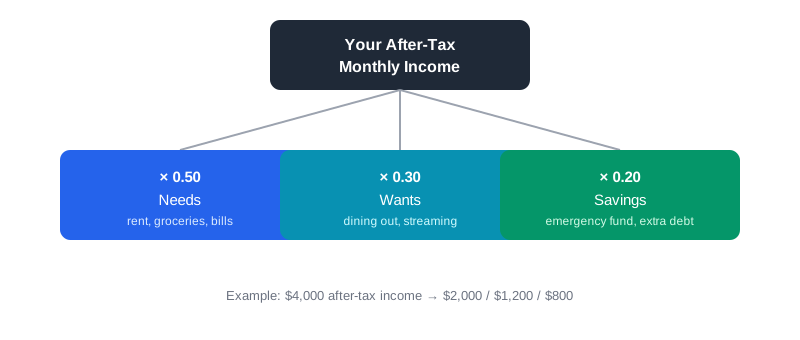
For example, an after-tax income of $4,000 a month gives you $2,000 for needs, $1,200 for wants, and $800 for savings. You can run this on a phone calculator in about ten seconds — the tool just saves you the three separate multiplications and shows all three numbers at once.
Here’s the same flow shown visually:
Which Income Number to Use — Gross or Net?
Use your income after taxes, but before other voluntary paycheck deductions — not your gross salary, and not necessarily the exact number that lands in your bank account.
Here’s the distinction that trips people up. Start with your gross pay, subtract federal, state, and payroll taxes (Social Security, Medicare). Stop there. If your pay stub also automatically subtracts things like a 401(k) contribution or a health insurance premium, add those back in before you calculate your 50/30/20 targets.
This isn’t the only way calculators handle it — some treat “after-tax income” as whatever actually deposits into your account, deductions and all, which gives you a smaller base number. Both are defensible positions, but they produce different results, so it’s worth knowing which one you’re using and staying consistent with it. This calculator uses the “add it back in” method, because a 401(k) contribution and a health insurance premium are both real budget items — one is savings, the other is a need — and hiding them before you even start makes it harder to see your full financial picture.
What to Do With 401(k) and Health Insurance Deductions
Once you’ve added those amounts back into your income figure, they don’t disappear from the calculation — they show up on the other side. Health insurance premiums count toward your needs category. Retirement contributions like a 401(k) count toward your savings category. So the money isn’t lost, it’s just categorized correctly instead of subtracted before you can see it.
Calculating Your Budget by Pay Frequency
If you’re paid monthly, your after-tax paycheck is already the number you need. If you’re paid any other way, converting to a monthly figure takes one extra step — and it’s a step most calculators get slightly wrong.
Monthly Pay
Use your after-tax paycheck amount directly. No conversion needed.
Biweekly Pay
Biweekly means every two weeks, which works out to 26 paychecks a year, not 24. Most months you’ll get two paychecks, but two months a year you’ll get three. Multiplying your paycheck by 2 to estimate a “typical month” undercounts your real annual income.
The more accurate conversion: biweekly paycheck × 26, divided by 12.
For example, a $1,600 biweekly paycheck: $1,600 × 26 = $41,600 a year, divided by 12 = about $3,467 a month — not the $3,200 you’d get from simply doubling the paycheck.
Weekly Pay
The same issue applies, just more often. There are 52 weeks in a year, not 48, so multiplying by 4 undercounts your income.
The more accurate conversion: weekly paycheck × 52, divided by 12.
A $700 weekly paycheck: $700 × 52 = $36,400 a year, divided by 12 = about $3,033 a month — not the $2,800 you’d get from multiplying by 4.
Annual Salary
Divide your after-tax annual income by 12 to get your monthly figure.
What If Your Income Isn’t Steady?
The conversions above assume a consistent paycheck. If your income moves around — freelance work, tips, commission, seasonal hours — you’ll need a different approach.
Averaging Variable or Freelance Income
Pull your after-tax income from the last 6 to 12 months and calculate the average. This smooths out unusually high or low months and gives you a realistic baseline to budget against, rather than accidentally building your budget around your best month.
If you’re self-employed, work from what’s actually left after business expenses and the money you’ve set aside for taxes — not your total revenue. Your after-tax income as a freelancer is total earnings, minus business costs, minus your tax set-aside.
Combining Multiple Income Sources
If you have more than one income stream — a full-time job plus a side gig, or two part-time jobs — add all the after-tax amounts together before applying the percentages. Treat it as one combined monthly figure rather than budgeting each source separately.
A Worked Example
Here’s the math for someone bringing home $3,500 a month after taxes.
| Category | Target (%) | Target ($) | Actual Spending | Difference |
|---|---|---|---|---|
| Needs | 50% | $1,750 | $2,100 | +$350 over |
| Wants | 30% | $1,050 | $900 | -$150 under |
| Savings | 20% | $700 | $500 | -$200 under |
This person’s needs (rent $1,300, utilities $150, groceries $350, transportation $200, insurance $100) add up to $2,100 — $350 more than the 50% target. Worth naming directly: this doesn’t mean the budget failed. It means the biggest, least flexible cost — usually housing — is worth a closer look before assuming the fix is spending less on wants.
What to Do If Your Numbers Don’t Match the Targets
An over-target needs category, like the example above, is one of the most common results people see the first time they run this calculation. If that happens to you, the fix usually isn’t found in your wants category — it’s worth checking your fixed costs first, since a 50% target only works if housing and other essentials are already reasonably sized for your income.
Whether the 50/30/20 split still makes sense in cities with higher housing costs, and what to do when it consistently doesn’t fit, is a bigger question than this page can answer in a paragraph. For the full breakdown, see [Does the 50/30/20 Rule Actually Work?].
Other Ways to Budget
If the 50/30/20 split doesn’t fit your situation even after adjusting, a few other frameworks are worth knowing about. Zero-based budgeting assigns every dollar a specific job instead of working in broad percentage buckets. The envelope method divides cash into physical or virtual categories you spend down over the month. Pay-yourself-first budgeting sets aside a fixed savings percentage before anything else gets spent.
For a full comparison of how these stack up against the 50/30/20 rule, see [50/30/20 vs. Other Budgeting Rules].
Frequently Asked Questions
How do I calculate my 50/20/30 rule?
Multiply your after-tax monthly income by 0.50 for needs, 0.30 for wants, and 0.20 for savings. If you’re paid weekly or biweekly, convert to a monthly average first using the pay-period math above rather than a flat multiply.
Is the 50/30/20 rule based on gross or net income?
Net income — specifically, income after taxes but before other paycheck deductions like 401(k) contributions or health insurance premiums are subtracted. Add those back in if your pay stub already takes them out.
How does the 50/30/20 rule work with biweekly pay?
Multiply your biweekly paycheck by 26 (the number of pay periods in a year), then divide by 12. This gives a more accurate monthly figure than simply doubling your paycheck, since two months a year include three paychecks instead of two.
How do I calculate this if my income varies each month?
Average your after-tax income over the last 6 to 12 months and use that figure as your monthly income for the calculation. If you’re self-employed, base it on income after business expenses and tax set-asides, not total revenue.
Conclusion
The math behind the 50/30/20 rule calculator isn’t complicated — it’s three multiplications off one number. What actually determines whether your results are useful is getting that starting number right: the correct income figure, converted correctly for how you’re actually paid.
If you’re running these numbers today:
- Confirm you’re using after-tax income, with other deductions added back in if your pay stub already subtracts them.
- If you’re paid weekly or biweekly, use the 52/12 or 26/12 conversion above instead of a flat multiply.
- If your needs come in over target, check your fixed costs before assuming you need to cut back on wants.
📖 Continue Reading:
Sources & References
- Elizabeth Warren and Amelia Warren Tyagi, All Your Worth: The Ultimate Lifetime Money Plan (Free Press, 2005)
- Forbes Advisor, “Monthly Budget Calculator (50/30/20 Rule)”
- SoFi, “50/30/20 Monthly Budget Calculator”
- NerdWallet, “Monthly Budget Calculator”
- Internal Revenue Service (IRS.gov) — general reference for pre-tax payroll deduction treatment
Disclaimer
This calculator and article are for general educational purposes only and do not constitute financial advice. The percentages described are a general guideline, not a personalized recommendation, and results will vary based on your income, location, and financial obligations. Consider speaking with a licensed financial advisor before making significant changes to your budget.

Anjali Kaur is a finance writer specializing in personal finance, international tax, and financial planning for digital nomads, expats, and remote workers. She breaks down dense, high-stakes topics — the Foreign Earned Income Exclusion, totalization agreements, tax residency, and visa-linked tax breaks — into plain-language guides that help readers make confident decisions. Her approach is research-led and source-driven: every figure is dated, and she flags where rules vary or have recently changed. Anjali fact-checks her finance and tax coverage against primary sources such as the IRS, the SSA, and official government tax authorities. Connect with her on Facebook or read more of her work in the Finance section.