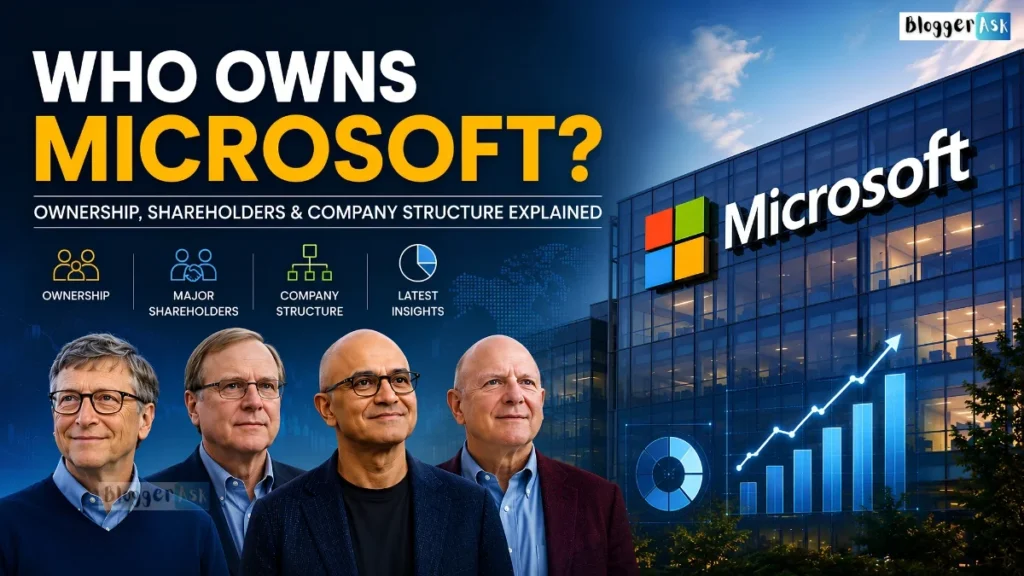
⚡ Quick Answer: Who Owns Microsoft?
No single person owns Microsoft. It is a publicly traded company (NASDAQ: MSFT) owned by its shareholders. Institutions like Vanguard and BlackRock hold the largest blocks. Steve Ballmer is the biggest individual shareholder. CEO Satya Nadella runs the company but owns very little of it.
Two things have changed recently, and most articles on this topic still get them wrong.
First, Bill Gates’ philanthropic trust is now completely out. The Gates Foundation Trust sold its last 7.7 million Microsoft shares during the first quarter of 2026, a position worth roughly $3.2 billion. A 13F filing made public on May 15, 2026 confirmed the exit.
Second, Steve Ballmer is not on Microsoft’s board. He resigned in August 2014. That matters more than it sounds, and we explain why below.
Who Owns Microsoft Right Now (July 2026)
Microsoft’s ownership splits into three groups.
- Institutional investors hold roughly 71% to 74% of outstanding shares. These are asset managers running index funds, pension funds, and mutual funds.
- Individual holders account for a mid-single-digit percentage, dominated almost entirely by one person: Steve Ballmer.
- Retail investors hold the rest, somewhere around 20% to 22%.
Those ranges are honest ranges, not sloppy ones. Different trackers define “insider” differently and refresh on different schedules. We show you exactly where they disagree further down.
Microsoft has 7,428,434,704 shares outstanding, according to Morningstar’s July 2026 quote data. Every one of those shares carries a single vote.
Largest Institutional Shareholders
Institutions look like owners on paper. In practice, they are custodians. Your 401(k) money goes into a Vanguard index fund, the fund buys Microsoft, and Vanguard’s name appears on the filing. The economic benefit still flows to you.
| Institution | Approx. stake | Notes |
|---|---|---|
| Vanguard Group | ~9% | Largest holder overall; roughly 665 million shares, mostly through index funds |
| BlackRock | ~7–8% | Second largest; iShares ETFs make up the bulk |
| State Street | ~3.5–4% | Third largest; SPDR ETFs and institutional mandates |
| Geode Capital, FMR (Fidelity), T. Rowe Price | ~1–2% each | Regular members of the top-10 institutional list |
Basis: SEC Form 13F filings and Microsoft’s 2025 proxy statement. Institutional figures move every quarter.
Why do these three keep showing up? Because Microsoft sits in the S&P 500, the Nasdaq-100, and the Dow Jones Industrial Average. Every fund tracking those indexes must hold Microsoft in proportion to its weight. The buying is mechanical, not a judgment call.
Largest Individual Shareholders
| Person and role | Stake | Shares | As of / basis | Confidence |
|---|---|---|---|---|
| Steve Ballmer — former CEO (2000–2014); left the board Aug. 19, 2014 | ~4.5% | ~333.25 million | Last disclosed 2014, tracked forward | Estimate |
| Satya Nadella — Chairman & CEO | ~0.01% | 900,572 | Sept. 30, 2025 proxy | Filed |
| Amy Hood — Chief Financial Officer | <0.01% | 465,746 | Sept. 30, 2025 proxy | Filed |
| Brad Smith — Vice Chair & President | <0.01% | 402,131 | Sept. 30, 2025 proxy | Filed |
| Bill Gates — co-founder | Not disclosed | ~103 million (last public figure) | Pre-2020 proxy disclosure | Stale |
| All directors and executive officers as a group | Under 1% | ~2.28 million | Sept. 30, 2025 proxy | Filed |
Source: Microsoft’s 2025 Notice of Annual Shareholders Meeting and Proxy Statement, filed with the SEC on October 21, 2025.
Expert note on Nadella’s number. His proxy figure (900,572) differs from his Form 4 filings. That is not an error. Proxy tables report beneficial ownership, which includes shares that will vest within 60 days plus deferred stock. A Form 4 reports the raw balance after a specific transaction. Nadella’s September 2025 Form 4, filed after scheduled sales under a Rule 10b5-1 plan, showed 790,852 shares. Both numbers are correct. They measure different things.
Why Insider Ownership Numbers Disagree (6% vs. Under 1%)
This is the single most misreported statistic on this topic, so here is the clean version.
Ownership trackers commonly list Microsoft insider ownership around 6%. WallStreetZen reports 71.66% institutional, 6.24% insider, and 22.10% retail.
Microsoft’s own proxy statement tells a different story. Every director and executive officer combined held about 2.28 million shares as of September 30, 2025. That is under 1% of the company.
Both are accurate within their own definitions. The trackers count Steve Ballmer as an insider because he is a former CEO with a huge position. Microsoft counts only people currently sitting on the board or in the executive suite. Ballmer has been neither since August 2014.
Practical takeaway: when you see “6% insider ownership,” read it as “Ballmer plus rounding.” Actual sitting-management ownership at Microsoft is tiny.
How Much Do Sources Disagree? We Checked
Here is what four widely cited ownership trackers reported for the same company, side by side.
| Source | Institutional | Insider | Vanguard | BlackRock | Ballmer | Gates |
|---|---|---|---|---|---|---|
| WallStreetZen | 71.66% | 6.24% | — | — | 4.49% | — |
| Techopedia | 71.74% | — | Largest | Second | ~4% | 1.3% |
| FourWeekMBA | 74% | 6% | 8.5% | 7.0% | 4.5% | 1.3% |
| CoinCodex | — | — | 9.6% | 8.1% | 4.4% | Under 1% |
Two of these still publish a live-sounding Gates percentage that traces back to a disclosure made before he left the board in 2020. That is the reason we date every number on this page.
What Changed in 2026: Two Filings Worth Knowing
The Gates Foundation Trust went to zero. Covered in full below.
Pershing Square arrived. On the same day the Gates exit became public, Bill Ackman’s Pershing Square Capital Management disclosed a new Microsoft position of roughly 5.65 million shares, worth about $2.09 billion, according to GeekWire. Ackman funded it by selling Pershing Square’s Alphabet holdings.
Keep the scale in mind. Ackman’s stake is under 0.1% of Microsoft. It is a headline, not a shift in control. In a company with 7.4 billion shares outstanding, a $2 billion position barely registers on the cap table.
Ownership vs. Control: Why the Biggest Shareholder Doesn’t Run Microsoft
Start with two definitions.
Ownership is the economic stake. It answers: who profits when the share price rises and dividends get paid?
Control is decision-making authority. It answers: who chooses the strategy, approves the budget, and hires the CEO?
At Microsoft these belong to different parties.
| Dimension | Ownership | Control |
|---|---|---|
| What it means | Who holds the economic stake | Who makes strategic and operational decisions |
| Who holds it | Shareholders: institutions, individuals, retail investors | Board of directors and executive leadership |
| At Microsoft | Vanguard (~9%) is the largest single holder | Satya Nadella, as Chairman and CEO, with a 12-member board |
| How it shifts | Buying and selling shares on the open market | Board elections, executive appointments, shareholder votes |
Vanguard does not price Azure. It does not greenlight acquisitions or decide the Xbox roadmap. Those calls sit with management and the board.
What Shareholders Actually Voted On in December 2025
Most articles assert that shareholders have “a say” and stop there. Here is what that looks like in practice.
At Microsoft’s annual meeting on December 5, 2025, shareholders:
- Re-elected all 12 director nominees
- Approved executive compensation in the advisory say-on-pay vote
- Approved the new 2026 Stock Plan, replacing the 2017 plan
- Ratified Deloitte & Touche as auditor for fiscal year 2026
- Rejected all six outside shareholder proposals
The rejection margins are the interesting part. GeekWire’s reporting on the vote filing showed two human rights proposals drawing more than 25% support each, far above the rest. A proposal on AI data-usage transparency topped 13%. A climate proposal tied to AI tools used by oil and gas companies received 8.75%. Two proposals on censorship risk drew under 1%.
Read it this way: shareholders reliably approve what the board recommends. Their real leverage is signaling. A proposal that fails with 25% support gets management’s attention in a way a 1% proposal never does. That is oversight, not control.
Where Index Funds Do Have Real Influence
One nuance the “Vanguard is just a passive intermediary” framing misses.
Index managers vote every share they hold. They also engage privately. Microsoft’s 2025 proxy statement discloses that in fiscal 2025 the company engaged on governance and ESG topics with shareholders representing roughly 50% of outstanding shares. The board’s Lead Independent Director and Compensation Committee chair took part directly.
So Vanguard does not run Microsoft. But it is not silent either. Its influence runs through proxy votes and closed-door stewardship conversations, not through product decisions.
Does Bill Gates Still Own Microsoft?
No. His philanthropic trust holds zero Microsoft shares. His personal holdings have not been publicly disclosed in years, and no one outside his circle can verify them.
Those are two separate facts. Almost every article on this topic blurs them together. Here is each one cleanly.
The Gates Foundation Trust’s Full Exit (Q1 2026)
The Gates Foundation Trust manages the endowment that funds the Gates Foundation’s grantmaking. Bill Gates is its sole trustee. Cascade Asset Management Company handles the investments.
Note on the name. The entity was called the Bill & Melinda Gates Foundation Trust until it was renamed the Gates Foundation Trust, effective January 6, 2025. Older articles still use the former name.
The wind-down took more than two years:
- Q4 2023: the Trust begins trimming its Microsoft position each quarter
- End of Q1 2025: roughly 28.5 million shares remain
- End of 2025: down to 7.7 million shares
- Q1 2026: the final 7.7 million shares sold, worth about $3.2 billion
- May 15, 2026: a 13F filing makes the zero position public
This was the first time the Trust had held no Microsoft stock since it was created in October 2006.
Why it happened. Not a loss of faith in Microsoft. In May 2025 Gates announced that the foundation will close in 2045 and give away roughly $200 billion over two decades. A foundation spending down its endowment has to sell assets to fund the giving. Selling the most concentrated position first is standard practice.
The timing did draw commentary, because Microsoft stock has had a rough 2026. But the sell-down schedule was set long before this year’s drawdown.
Gates’ Personal Stake: What’s Actually Known
Bill Gates founded Microsoft with Paul Allen in 1975 and held roughly 45% after the 1986 IPO. He has been selling and donating shares ever since.
He left Microsoft’s board in March 2020. From that point he stopped being a Section 16 insider, so the reporting obligation ended.
The last figure that ever appeared in a Microsoft filing was approximately 103 million shares, about 1.34% at the time. That number comes from proxy disclosures made before his board departure.
It is not a current number. It might still be roughly right. It might be far off. There is no way to confirm it from public records, and anyone presenting it as today’s stake is guessing.
The myth stays alive because reputable outlets keep repeating it. A Motley Fool article published in May 2026 still stated that Gates owns 103 million Microsoft shares worth about $43 billion. That figure is a decade-old disclosure carried forward and repriced at today’s share price.
Why People Still Think Gates Owns Microsoft
Gates founded the company, ran it as CEO until 2000, and stayed on as chairman until 2014. The association is permanent in the public mind.
But founder and current owner stopped being the same thing a long time ago. Ballmer passed Gates as Microsoft’s largest individual shareholder back in 2014, when a routine Gates share sale dropped his holdings below Ballmer’s. That is a 12-year-old fact, though 2014 news coverage about it still surfaces in search results as if it just happened.
Who Is Microsoft’s Biggest Shareholder?
The answer depends on which list you mean.
Biggest shareholder overall: Vanguard Group, at roughly 9% of outstanding shares, held across its index funds.
Biggest individual shareholder: Steve Ballmer, with about 333.25 million shares, roughly 4.5% of the company. WallStreetZen valued that position at approximately $132.55 billion in late July 2026, at a share price near $398.
An Important Caveat About Ballmer’s Number
Here is something almost no article says out loud: Ballmer’s 333 million shares is an estimate, not a filing.
He is not required to report it. Two rules would compel disclosure, and neither applies to him.
- Section 16 insider reporting covers directors, officers, and 10%+ holders. Ballmer stepped down from the board on August 19, 2014, as Microsoft announced at the time. His Form 4 obligation ended then.
- Schedule 13D/13G filing kicks in above 5% ownership. Ballmer sits at roughly 4.5%, just under the line.
So his figure is his last known position, carried forward by trackers for more than a decade. Financial media acknowledge this. In its own coverage, The Motley Fool has noted it is impossible to know how many shares he still holds.
We apply the same standard to Ballmer that we apply to Gates. Neither number is verifiable today.
The Buyback Effect Nobody Explains
Ballmer’s stake was about 4% in 2014. Today it is about 4.5%. He has not been buying.
The denominator shrank. Microsoft had roughly 8.2 billion shares outstanding in 2014. It has about 7.43 billion now. Sustained buybacks retired hundreds of millions of shares.
The mechanic matters: every buyback quietly increases the ownership percentage of everyone who does nothing. Long-term holders get more of the company for free. It is one reason Ballmer’s stake has grown in percentage terms while Gates’ shrank in absolute ones.
For context on Ballmer’s conviction: he joined Microsoft in 1980 as employee number 30, ran it as CEO for 14 years, then simply kept the stock. He has said publicly that Microsoft still makes up the large majority of his portfolio.
Microsoft’s Corporate Structure: Shares, Voting Rights, and Market Value
What “Publicly Traded” Actually Means Here
Legally, Microsoft is owned by whoever holds its shares. There is no private owner, no controlling family, and no majority shareholder.
There is also a layer most explanations skip. Nearly all publicly traded shares in the U.S. are held in “street name.” Your broker holds them for you, and they are registered at the Depository Trust Company under the name Cede & Co.
That means the registered holder of most Microsoft shares is a clearing entity, not a person. You are the beneficial owner. Cede & Co. is the record holder. This is why no public list of Microsoft’s individual owners exists, and why filings track institutions and insiders instead of people.
Single-Class Shares (One Share, One Vote)
Microsoft uses a single-class structure. One share, one vote. No founder shares, no super-voting class.
That choice is not universal in big tech.
| Company | Share structure | Effect on control |
|---|---|---|
| Microsoft | Single class, one share one vote | No individual holds voting power beyond their economic stake |
| Alphabet (Google) | Multiple classes (A/B/C) | Founders keep majority voting control through Class B shares |
| Meta | Multiple classes (A/B) | Mark Zuckerberg keeps majority voting control through Class B shares |
Why this matters to you as a reader: at Alphabet or Meta, buying more shares does not necessarily buy more influence. At Microsoft it does, proportionally. Influence at Microsoft comes from board seats and executive roles, not from a protected voting class.
It also explains why Microsoft’s board can be replaced by shareholders in a way that Meta’s effectively cannot.
MSFT by the Numbers (July 2026)
| Metric | Figure | As of |
|---|---|---|
| Ticker / exchange | MSFT, NASDAQ | Since March 13, 1986 |
| Shares outstanding | ~7.43 billion | July 2026 |
| Market capitalization | ~$2.90 trillion | July 21, 2026 |
| Share price (close) | $397.75 | July 21, 2026 |
| 52-week range | $349.20 – $555.45 | July 2026 |
| Quarterly dividend | $0.91 per share | Ex-date Aug. 20, 2026 |
| Next earnings report | July 29, 2026 | Fiscal Q4 2026 |
Context on the price. Microsoft has had a difficult 2026. As of July 20 the stock was down roughly 18% year to date, while the S&P 500 was up about 9%, making Microsoft the weakest performer in the “Magnificent Seven.” The pressure comes from investor skepticism about the payback on enormous AI infrastructure spending, with fiscal 2026 capital expenditure guidance running near $190 billion. Azure still grew 40% in the most recently reported quarter.
Shares hit a 52-week low of $349.20 in early July before recovering into the high $300s.
The all-time closing high sits at roughly $541 on October 28, 2025, based on MacroTrends’ split- and dividend-adjusted series. Adjusted historical prices drift slightly lower over time as new dividends are paid, so treat any single figure as basis-dependent.
None of this changes who owns Microsoft. A falling price changes what a stake is worth, not who holds it.
Who Owned Microsoft Before the IPO?
Microsoft went public on March 13, 1986. Before that day, the cap table was small and closely held.
- Bill Gates held the largest block, just under half the company
- Paul Allen held roughly a quarter, retained after he left day-to-day work in 1983
- Steve Ballmer held high single digits, from equity granted when he joined in 1980
- Technology Venture Investments was the only significant outside investor, having put in about $1 million in 1981
There was no earlier owner. Gates and Allen founded the company in 1975 and built it without meaningful outside capital.
The IPO changed everything. It converted a founder-controlled private company into a shareholder-owned public one and created the drift toward institutional ownership that continues today.
How Microsoft’s Ownership Has Shifted Since 1986
| Year | What happened |
|---|---|
| 1986 | Microsoft goes public. Gates holds roughly 45% after the offering |
| 2000 | Gates hands the CEO role to Steve Ballmer, stays on as chairman |
| 2008 | Gates transitions out of full-time work to focus on the foundation |
| 2014 | Ballmer retires as CEO in February; Nadella takes over. Gates steps down as chairman, replaced by John W. Thompson. Ballmer leaves the board in August. A Gates share sale drops his stake below Ballmer’s |
| 2020 | Gates leaves Microsoft’s board entirely |
| 2021 | Nadella adds Chairman of the Board to his CEO role, succeeding Thompson |
| 2023 | The Gates Foundation Trust begins its quarterly Microsoft sell-down |
| 2026 | The Trust sells its final shares, exiting completely |
Across those 40 years, institutional ownership climbed from a minor share to a clear majority. That rise is the mirror image of Gates’ decline, and it happened for a structural reason: index investing grew from a niche product into the default way ordinary people hold stocks.
Who Is the CEO of Microsoft?
Satya Nadella is Microsoft’s CEO. He has held the role since February 2014 and has also served as Chairman of the Board since June 2021.
His ownership is tiny. About 900,572 shares, a rounding error against 7.43 billion outstanding. Most of it came from restricted stock units granted as compensation.
That gap is the whole point of this article. Nadella’s authority comes from his position and the board’s backing, not from a large shareholding. Ballmer owns roughly 370 times more Microsoft stock than Nadella and has no vote in the boardroom at all.
Who else holds formal power: Microsoft’s board has 12 directors, 11 of whom the company classifies as independent. Sandra Peterson serves as Lead Independent Director, a role that provides a counterweight to Nadella holding both the CEO and Chairman titles.
What Does Microsoft Own?
This flips the question. Microsoft is both an owned company and a large owner of other businesses.
Major Acquisitions
| Acquisition | Price | Closed | What it brought |
|---|---|---|---|
| Activision Blizzard | $69 billion | October 2023 | Call of Duty, World of Warcraft, Candy Crush; Microsoft’s largest deal ever |
| Nuance Communications | ~$19.7 billion | March 2022 | Healthcare AI and speech recognition |
| ~$26.2 billion | December 2016 | Professional network and recruiting data | |
| Skype | ~$8.5 billion | October 2011 | Consumer communications, later folded into Teams |
| ZeniMax / Bethesda | ~$7.5 billion | March 2021 | Doom, Fallout, The Elder Scrolls |
| GitHub | ~$7.5 billion | October 2018 | Developer platform, foundation for Copilot |
| Mojang | ~$2.5 billion | November 2014 | Minecraft |
Microsoft has completed more than 250 acquisitions since 1986. The list above covers the deals that meaningfully reshaped it.
Microsoft’s Stake in OpenAI
Microsoft is OpenAI’s largest outside shareholder, but the picture is more fluid than most articles suggest.
What was officially disclosed: when OpenAI completed its recapitalization in October 2025, its for-profit arm became OpenAI Group PBC. Microsoft’s stake was reported at approximately 27% on an as-converted diluted basis, valued at about $135 billion. The nonprofit OpenAI Foundation held 26%, with employees and other investors holding 47%. Microsoft also secured IP rights to OpenAI’s models through 2032, and OpenAI committed to large-scale Azure purchases.
What has changed since: OpenAI closed a further funding round in March 2026 at a reported post-money valuation near $852 billion. That round diluted every existing holder, and OpenAI has not published an updated ownership table. Microsoft and OpenAI also announced revised partnership terms in April 2026.
Treat 27% as the last officially disclosed figure, not a confirmed current one. Microsoft’s own 10-Q reported that $11.8 billion of its $13 billion funding commitment had been paid as of March 31, 2026.
This is the reverse of the question this article answers. Here Microsoft is the shareholder, not the company being owned. For the other side of that relationship, see our guide to who owns OpenAI.
How to Check Microsoft’s Current Shareholders Yourself
Ownership data goes stale fast. Here is how to get it from the source instead of trusting any article, including this one.
Which SEC Filing Tells You What
| Filing | Who files it | What it reveals | How current it is |
|---|---|---|---|
| Form 13F | Investment managers with $100M+ in U.S.-listed securities | Quarterly snapshot of equity holdings | Filed up to 45 days after quarter end |
| Schedule 13D / 13G | Anyone crossing 5% ownership | Large positions and stated intent | Event-driven |
| Form 3 / 4 / 5 | Directors, officers, 10%+ holders | Insider buys and sells; Form 4 due within 2 business days | Near real-time |
| DEF 14A (proxy) | The company | Beneficial ownership of directors, officers, and 5%+ holders | Annual, as of the record date |
| 10-K / 10-Q | The company | Shares outstanding, buyback activity | Quarterly |
The most common mistake is treating a 13F as live data. A 13F filed in mid-August reflects positions as of June 30. By the time you read it, the manager may have sold everything. That is exactly what happened with the Gates Foundation Trust: the shares were gone in Q1, but the public did not learn until May 15.
Step-by-Step
- Go to SEC EDGAR at sec.gov and search Microsoft’s CIK: 0000789019. Filter by filing type to find the latest DEF 14A and 10-Q.
- To track a specific holder, search that entity’s own CIK. The Gates Foundation Trust files under 0001166559.
- Visit Microsoft Investor Relations for shares outstanding, dividend history, and the annual meeting materials. Vote results are posted at Microsoft’s corporate governance page.
- Always check the “as of” date before treating any figure as current. If a source does not give you one, do not trust the number.
Key dates to watch: Q2 2026 institutional 13F filings are due around August 14, 2026. Microsoft’s next proxy statement typically arrives in October, with the annual meeting in early December.
Do You Already Own Microsoft?
Probably, and this is the part most readers never check.
If you hold an S&P 500 fund, a total-market fund, a Nasdaq-100 ETF, or a target-date retirement fund, you own Microsoft indirectly. Microsoft is consistently one of the largest weights in all of them.
To find out how much: open your fund’s holdings page or fact sheet, look up Microsoft’s weight, then multiply it by your balance. A $50,000 position in a fund with a 6% Microsoft weight means roughly $3,000 of Microsoft exposure.
That is the honest answer to “who owns Microsoft.” Tens of millions of ordinary savers do, one index fund at a time.
Key Takeaways
- Microsoft is publicly traded. No single person or entity owns or controls it.
- Vanguard is the largest shareholder at roughly 9%, followed by BlackRock and State Street. Institutions hold about 71% to 74% in total.
- Steve Ballmer is the largest individual shareholder at roughly 4.5%, or about 333 million shares. He left the board in 2014, so that figure is a long-standing estimate rather than a current filing.
- Bill Gates’ foundation trust sold its last Microsoft shares in Q1 2026, disclosed May 15, 2026. His personal holdings have not been publicly disclosed since before he left the board in 2020.
- Reported “insider ownership” of about 6% conflicts with Microsoft’s proxy, which puts all directors and officers combined under 1%. The difference is Ballmer.
- Owning shares is not the same as running the company. Vanguard owns the most. Nadella and the board make the decisions.
- Single-class shares mean no one gets outsized votes, unlike Alphabet or Meta.
Frequently Asked Questions
Is Microsoft privately owned?
No. Microsoft has been publicly traded since its IPO on March 13, 1986, and lists on the NASDAQ under the ticker MSFT.
Is Microsoft owned by Bill Gates?
No. Gates co-founded Microsoft and once held about 45% of it, but he has sold and donated shares for decades. His foundation trust sold its final Microsoft shares in Q1 2026, and his personal stake has not been publicly disclosed since before he left the board in 2020.
Who owns the most Microsoft stock?
Vanguard Group holds the largest single position at roughly 9%, spread across its index funds. Among individuals, Steve Ballmer holds the most at roughly 4.5%.
Is Microsoft an American company?
Yes. Microsoft is incorporated in Washington State and headquartered in Redmond, Washington. Its shareholders are global, because anyone worldwide can buy shares on the NASDAQ, but the company itself is American.
Did Bill Gates sell all his Microsoft stock?
The Gates Foundation Trust did, completing its exit in Q1 2026. Gates’ personal holdings are separate. The last public figure was roughly 103 million shares, disclosed before he left the board in 2020, and he has not been required to update it since.
Who owned Microsoft before Bill Gates?
No one. Gates founded Microsoft with Paul Allen in 1975. Before the 1986 IPO, Gates, Allen, Ballmer, and a single venture investor held nearly all of it.
Is Steve Ballmer’s Microsoft stake bigger than Bill Gates’?
Yes, in Microsoft shares specifically. Ballmer holds roughly 333 million shares, more than any publicly disclosed figure for Gates’ remaining personal stake. This compares Microsoft holdings only, not overall net worth.
Does Microsoft own OpenAI?
No. Microsoft is OpenAI’s largest outside shareholder, with a stake reported at approximately 27% at the October 2025 restructuring. OpenAI Group PBC remains controlled by the nonprofit OpenAI Foundation, and later funding rounds have diluted all holders.
Do I own Microsoft if I have an index fund?
Almost certainly, indirectly. Microsoft is a top holding in nearly every S&P 500, total-market, and Nasdaq-100 fund. Check your fund’s holdings page for its exact weight.
How often does Microsoft’s ownership data change?
Institutional holdings are reported quarterly through Form 13F, with a lag of up to 45 days. Insider transactions appear within two business days. Any ownership figure is a snapshot, not a permanent fact.
How We Verified These Numbers
Every figure on this page was checked against public filings and market data on July 24, 2026, and each carries an “as of” date so you can judge its currency.
Our confidence labels mean:
- Filed — taken directly from an SEC document with a stated date
- Estimate — a last-known disclosure carried forward, with no current obligation to update
- Stale — a historical figure that is widely republished but cannot be verified today
What we cannot tell you. Steve Ballmer’s exact current holdings. Bill Gates’ exact current personal holdings. Microsoft’s precise institutional percentage on any given day. Nobody can, and any source claiming otherwise is presenting an estimate as a fact.
Where our numbers differ from other sites. We use Microsoft’s proxy statement for insider ownership rather than tracker aggregates, and we label Ballmer’s stake as an estimate rather than a filed figure. Both choices are deliberate.
What to Watch Next
Three dates will refresh the picture:
- July 29, 2026 — fiscal Q4 2026 earnings, which will move the market cap and the value of every stake on this page
- Mid-August 2026 — Q2 institutional 13F filings, the first look at whether Pershing Square added to its position and how index managers rebalanced
- October to December 2026 — Microsoft’s next proxy statement and annual meeting, which will update executive ownership figures and put a new set of shareholder proposals to a vote
If you take one idea from this page, take this one: ownership and control are different questions with different answers. Once that distinction clicks, most follow-up questions about Microsoft answer themselves.
📖 Continue Reading:
Sources & References
Primary sources
- U.S. Securities and Exchange Commission — EDGAR. Microsoft Corporation, CIK 0000789019; Gates Foundation Trust, CIK 0001166559 (sec.gov)
- Microsoft Corporation, Notice of 2025 Annual Shareholders Meeting and Proxy Statement (DEF 14A), filed October 21, 2025
- Microsoft Investor Relations — 2025 Proxy Voting Results
- Microsoft Investor Relations — Annual Meeting
- Microsoft — “Steve Ballmer steps down as board member at Microsoft,” August 19, 2014
- Microsoft — Satya Nadella executive biography
- Gates Foundation — Financial information and entity structure
- SEC filing confirming the Gates Foundation Trust name change effective January 6, 2025
News and market data
- GeekWire — “Gates Foundation Trust ends an era, selling off all remaining Microsoft stock,” May 18, 2026
- GeekWire — “Human rights proposals win more than 25% of votes at Microsoft shareholder meeting,” December 2025
- CNBC — “OpenAI completes restructure, solidifying Microsoft as a major shareholder,” October 28, 2025
- Morningstar — MSFT stock quote and shares outstanding
- WallStreetZen — Microsoft stock ownership data
- MacroTrends — Microsoft stock price history
Ownership data for any public company changes constantly. The figures above reflect the most recent public filings and market data available as of July 24, 2026 and are dated throughout so you can assess their currency. For live numbers, check SEC EDGAR or Microsoft Investor Relations directly.
This article is for general informational purposes only and does not constitute financial or investment advice. Ownership percentages and share counts are approximate and drawn from public SEC filings, company disclosures, and market data providers. Consult a licensed financial advisor before making investment decisions.

Olivia Isabel is a Business & Technology Writer specializing in corporate ownership, company leadership, shareholders, acquisitions, and the business strategies behind major global companies. Her work covers technology, artificial intelligence, social media, finance, e-commerce, automotive, and consumer technology, with a particular focus on explaining who owns, controls, and leads well-known companies.
With a background in Economics and Journalism, Olivia approaches each topic as a research-driven business story. She examines company filings, investor-relations materials, regulatory records, official corporate announcements, and reputable financial sources to distinguish between legal ownership, economic ownership, voting control, and day-to-day management.
Her articles explore the founders behind major companies, current CEOs, significant shareholders, parent companies, subsidiaries, acquisitions, and changes in corporate structure. She has written about companies including Google, Alphabet, Apple, Microsoft, Amazon, Meta, OpenAI, Tesla, SpaceX, YouTube, Instagram, TikTok, WhatsApp, Reddit, Spotify, and other major technology and consumer brands.
Olivia’s goal is to make complicated corporate and financial information clear, accurate, and useful for everyday readers. She is particularly interested in corporate strategy, technology business models, entrepreneurship, emerging AI companies, public markets, and the evolution of globally recognized brands.