⚡ Quick Answer: 401(k) vs Roth IRA
Fund your full employer 401(k) match first, then a Roth IRA if you’re eligible, then go back to your 401(k) with anything left over. That single sequence answers the question for most people.
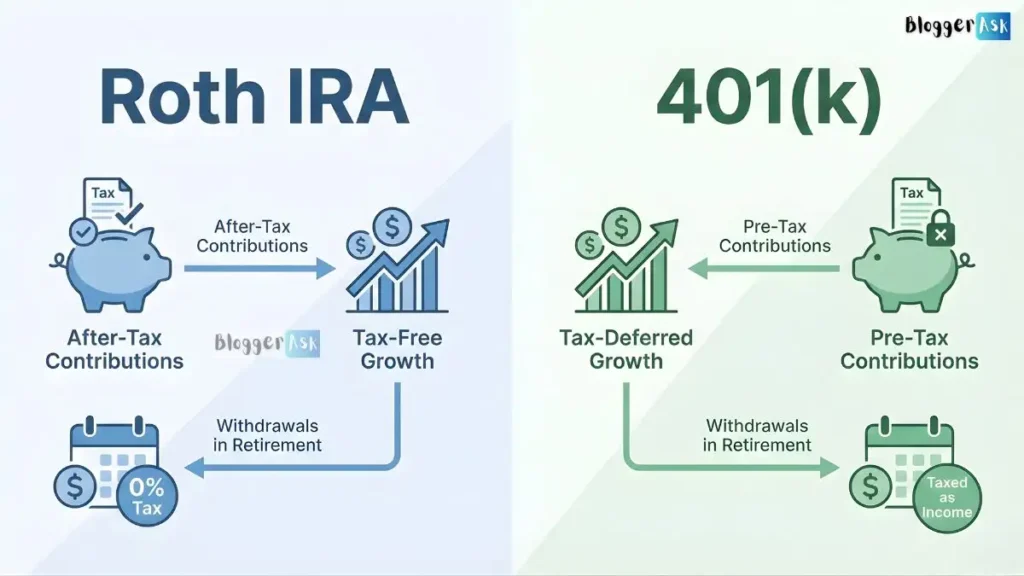
Here’s why. A 401(k) is an employer-sponsored plan, usually funded with pre-tax dollars and often paired with a match. You get a tax break now and pay taxes when you withdraw in retirement. A Roth IRA is an individual account you open yourself with after-tax dollars, and qualified withdrawals in retirement are completely tax-free.
Neither account is universally “better.” The right call depends on your employer match, your income, and whether you expect a higher or lower tax bracket later. Most people use both over a working lifetime, not just one.
| – | 401(k) | Roth IRA |
|---|---|---|
| Who offers it | Your employer | You open it at any brokerage |
| Contribution type | Pre-tax (traditional) or after-tax (Roth 401(k)) | After-tax only |
| 2026 limit (under 50) | $24,500 | $7,500 |
| Employer match | Often available | Never |
| Withdrawals in retirement | Taxed as ordinary income (traditional) | Tax-free if qualified |
| Income limits to contribute | None | Yes |
| Required Minimum Distributions | Yes, at age 73 | None, ever |
Key Takeaways
- A 401(k) is an employer plan. A Roth IRA is an account you open yourself. Most people benefit from using both.
- Grab your full employer match first. It’s the closest thing to free money in personal finance.
- For 2026, you can put $24,500 into a 401(k) and $7,500 into a Roth IRA (under age 50).
- A traditional 401(k) cuts your taxes now. A Roth IRA gives you tax-free income later.
- Roth IRAs have income limits. 401(k)s and Roth 401(k)s don’t.
- High earners can still get Roth money in through a backdoor Roth or a Roth 401(k).
What Is a 401(k)?
A 401(k) is a retirement plan your employer sponsors, funded straight from your paycheck — usually before taxes. That pre-tax treatment lowers your taxable income for the year you contribute.
Your investment menu is limited. You pick from the mutual funds, index funds, or target-date funds your plan offers. You can’t buy any stock or ETF you want. That trade-off is the price of the tax break and the potential match.
How Employer Matching Works
An employer match is money your company adds on top of your own contributions — often 50% of what you put in, up to 6% of your salary. It’s the best return you’ll ever get on day one, so grab all of it.
The catch is usually a vesting schedule. You may need to stay a few years before the matched money is fully yours. Two common types exist: cliff vesting (you’re 0% vested until a set date, then 100%) and graded vesting (you vest a bit more each year).
One nuance most guides get wrong: your employer match is deposited as pre-tax money by default, even inside a Roth 401(k). So you’d owe tax on that match when you withdraw it. But since the SECURE 2.0 Act, plans may now let you elect to have the match treated as Roth instead — if the plan allows it and the match is fully vested. If you choose that, the match is taxed the year it’s contributed, then grows tax-free. Check whether your plan offers this.
Traditional 401(k) vs Roth 401(k) (Quick Preview)
Many employers now offer a Roth 401(k) alongside — or instead of — the traditional version. The structure is identical (same plan, same limits, same menu). The only difference is when you pay taxes. We cover this in full in the Roth 401(k) vs Roth IRA section, since it’s one of the most confused topics in retirement planning.
Pros of a 401(k):
- Higher annual contribution limit than an IRA
- Potential employer match (free money)
- Automatic contributions, straight from your paycheck
- No income limits on who can contribute
- Strong federal creditor protection (more on that below)
- You can borrow from it if your plan allows
Cons of a 401(k):
- Limited investment options, chosen by your employer
- Possible administrative fees, depending on the plan
- Only available if your employer offers one
- Traditional 401(k) withdrawals are fully taxed in retirement
What Is a Roth IRA?
A Roth IRA is an individual retirement account you open yourself at a brokerage, funded with money you’ve already paid tax on. Your employer has nothing to do with it, and it won’t lower your taxable income today.
The payoff comes later. Follow the rules, and every dollar of growth comes out completely tax-free in retirement. Because you own the account, you also get a much wider menu — individual stocks, ETFs, index funds, bonds — instead of an employer’s short list.
Who Can Contribute? (Income Eligibility)
Your ability to contribute directly to a Roth IRA phases out at higher incomes, based on your Modified Adjusted Gross Income (MAGI). For 2026, the IRS sets these ranges:
| Filing Status | Full Contribution Below | Phase-Out Range | No Contribution At/Above |
|---|---|---|---|
| Single / Head of Household | $153,000 | $153,000–$168,000 | $168,000 |
| Married Filing Jointly | $242,000 | $242,000–$252,000 | $252,000 |
| Married Filing Separately (lived with spouse) | — | $0–$10,000 | $10,000 |
Land inside the range, and you can still make a reduced, partial contribution. Land above it, and you can’t contribute directly — but the backdoor Roth IRA strategy, covered below, offers a legal workaround.
How Roth IRA Withdrawals Work
To withdraw earnings tax- and penalty-free, you generally need to be 59½ or older AND have held the Roth IRA for at least five years. That’s the five-year rule. Exceptions include a first-time home purchase (up to a $10,000 lifetime limit), disability, or death.
Here’s the underrated part: your own contributions can come out anytime, tax- and penalty-free, for any reason. You already paid tax on that money. Only the earnings are locked behind the age and five-year rules.
Pros of a Roth IRA:
- Tax-free qualified withdrawals in retirement
- No Required Minimum Distributions, ever
- Contributions withdrawable anytime, penalty-free
- Full control over your investments
Cons of a Roth IRA:
- Much lower contribution limit than a 401(k)
- Income limits can block high earners from contributing directly
- No employer match
- Early withdrawal of earnings can trigger taxes plus a 10% penalty
401(k) vs Roth IRA: Key Differences at a Glance
Side-by-Side Comparison Table
| Feature | Traditional 401(k) | Roth IRA |
|---|---|---|
| Who can open one | Employees whose company offers a plan | Anyone with earned income, under the income limit |
| Contribution type | Pre-tax | After-tax |
| Tax on withdrawal | Ordinary income tax | Tax-free if qualified |
| 2026 limit (under 50) | $24,500 | $7,500 |
| Catch-up (age 50+) | $8,000 | $1,100 |
| Employer match | Common | Not available |
| Investment options | Limited to plan menu | Virtually unlimited |
| Loans allowed | Yes, if the plan permits | No — IRAs can’t offer loans |
| Creditor protection | Unlimited under ERISA | Up to ~$1.71M in bankruptcy; varies by state otherwise |
| Required Minimum Distributions | Age 73 (rising to 75 for those born 1960 or later) | None |
| Early withdrawal penalty | 10% before 59½, with exceptions (incl. the Rule of 55) | 10% on earnings only, before 59½ or 5 years |
| Income limits to contribute | None | Yes, phases out at higher incomes |
Tax Treatment: Pre-Tax vs After-Tax, Explained
The biggest difference is when you pay taxes — not whether you pay them.
A traditional 401(k) lowers your taxable income today. But every dollar you withdraw later, including growth, is taxed as ordinary income. A Roth IRA gives you no break today. In return, your withdrawals later — including decades of growth — are entirely tax-free.
So the decision often comes down to one question: do you expect a higher tax bracket now, or in retirement?
- Early in your career and earning less than you will later? Paying tax now at a lower rate (Roth) often wins.
- In your peak earning years and expecting a lower bracket later? Deferring tax (traditional 401(k)) often wins.
Expert tip: Don’t forget state taxes. If you plan to retire in a state with no income tax (like Florida or Texas), a traditional 401(k) can look even better — you skip your high state tax now and may owe no state tax on withdrawals later. Move the other way, and a Roth can pull ahead.
No one can predict future tax law, so treat this as a reasonable assumption, not a guarantee.
Employer Match, RMDs, and Withdrawal Rules Compared
Only a 401(k) offers an employer match — a Roth IRA simply can’t, because it isn’t tied to a job. On the flip side, only a Roth IRA lets you pull your own contributions anytime, tax- and penalty-free.
Required Minimum Distributions (RMDs) are another big divider. A traditional 401(k) forces you to start withdrawing — and paying tax — at age 73, under the SECURE 2.0 Act, whether you need the money or not. A Roth IRA never requires this during your lifetime, so it can keep growing tax-free as long as you want.
Important note: The RMD age rises from 73 to 75 for people born in 1960 or later, a change that takes effect in 2033. Because someone born in 1960 turns 75 in 2035, that’s the first year they’d actually take an RMD. (Source: Congressional Research Service, “RMD Rules for Original Owners.”)
Roth 401(k) vs Roth IRA: Don’t Confuse These Two
A Roth 401(k) is an employer plan with after-tax contributions. A Roth IRA is an individual account you open on your own. Same “Roth” tax treatment, very different rules.
The names are nearly identical, which is exactly why people mix them up. Here’s how they actually differ.
Key Differences Between a Roth 401(k) and a Roth IRA
| Feature | Roth 401(k) | Roth IRA |
|---|---|---|
| Sponsor | Employer | You (any brokerage) |
| 2026 limit (under 50) | $24,500 | $7,500 |
| Income limits to contribute | None | Yes |
| Employer match | Possible (pre-tax by default; Roth if the plan allows) | Not available |
| Investment options | Limited to plan menu | Virtually unlimited |
| Required Minimum Distributions | None (since 2024) | None |
| Early withdrawal access | Set by plan rules | Contributions withdrawable anytime |
The Roth 401(k)’s biggest edge: no income limits. High earners who are phased out of a Roth IRA can still make Roth contributions through a Roth 401(k), if their employer offers one.
And since 2024, Roth 401(k)s no longer face RMDs. That change brought them in line with Roth IRAs and removed one of their last real drawbacks.
Which Roth Account Should You Prioritize?
Get any employer match first — always, regardless of which Roth account you prefer. After that, a Roth IRA usually wins for its wider investment menu and easy access to your contributions.
But if you’re a high earner phased out of Roth IRA eligibility, the Roth 401(k) may be your only direct path to Roth-style, tax-free growth. That’s exactly when it earns its keep.
401(k) vs Traditional IRA vs Roth IRA: The Full Picture
Retirement isn’t a two-account choice — here’s how all four common account types stack up in one view.
Four-Way Comparison Table
| Feature | Traditional 401(k) | Roth 401(k) | Traditional IRA | Roth IRA |
|---|---|---|---|---|
| Contribution type | Pre-tax | After-tax | Pre-tax (deduction may phase out) | After-tax |
| 2026 limit (under 50) | $24,500 | $24,500 | $7,500 | $7,500 |
| Sponsor | Employer | Employer | You | You |
| Employer match possible | Yes | Yes | No | No |
| Income limits to contribute | No | No | No (deduction may phase out) | Yes |
| Withdrawals taxed in retirement | Yes, fully | No, if qualified | Yes, fully | No, if qualified |
| RMDs | Yes, age 73 | No | Yes, age 73 | No |
Note the traditional IRA quirk: anyone with earned income can contribute, regardless of income. But if you or your spouse have a workplace plan, your ability to deduct that contribution can shrink or disappear at higher incomes — even though the contribution itself is still allowed.
2026 Contribution Limits and Income Rules
The IRS raised most retirement limits for 2026. You can now contribute $24,500 to a 401(k) and $7,500 to an IRA (under 50), per IRS Notice 2025-67.
401(k) / 403(b) / 457(b) / TSP Limits for 2026
| Who it applies to | 2026 employee contribution cap |
|---|---|
| Under age 50 | $24,500 |
| Age 50–59 (with catch-up) | $32,500 ($24,500 + $8,000) |
| Ages 60–63 (“super” catch-up) | $35,750 ($24,500 + $11,250) |
| Age 64+ (catch-up reverts) | $32,500 ($24,500 + $8,000) |
This cap covers traditional and Roth 401(k) contributions combined. Split them however you like — the total still can’t exceed the limit.
Separately, the overall cap on employee plus employer contributions to one plan — the Section 415(c) annual additions limit — is $72,000 for 2026 (or 100% of pay, if lower). That higher ceiling is what makes the mega backdoor Roth possible.
Traditional and Roth IRA Limits for 2026
| – | Under Age 50 | Age 50+ Catch-Up | Total (Age 50+) |
|---|---|---|---|
| Traditional + Roth IRA (combined) | $7,500 | $1,100 | $8,600 |
This limit is shared across all your IRAs. You can’t put $7,500 in a traditional IRA and another $7,500 in a Roth IRA. The $7,500 is the combined cap.
The $1,100 catch-up is worth a note. It was frozen at $1,000 for years and only recently became inflation-indexed under SECURE 2.0 — which is why it’s finally creeping up.
Roth IRA Income Phase-Out Limits for 2026
| Filing Status | Phase-Out Range (MAGI) |
|---|---|
| Single / Head of Household | $153,000–$168,000 |
| Married Filing Jointly | $242,000–$252,000 |
| Married Filing Separately (lived with spouse) | $0–$10,000 |
Expert tip: If you’re just over the line, you may be able to duck under it. Maxing a pre-tax 401(k) lowers your MAGI, which can restore some or all of your Roth IRA eligibility.
Good to know: Lower-income savers may also qualify for the Saver’s Credit, a tax credit of up to $1,000 ($2,000 if married filing jointly) for contributing to a 401(k) or IRA. Check the income limits at IRS.gov.
New for 2026: Mandatory Roth Catch-Up for High Earners
Starting in 2026, if you earned more than $150,000 in FICA wages from your employer last year, your age-based catch-up contributions must go into a Roth (after-tax) account. You can no longer make them pre-tax.
This SECURE 2.0 rule was originally set for 2024, but the IRS delayed it so payroll providers and plan administrators could prepare. A few things to know:
- It affects only the catch-up portion (the extra $8,000, or $11,250 for ages 60–63), not your standard limit.
- It doesn’t apply to IRA catch-up contributions.
- The $150,000 threshold is based on your prior-year W-2 Social Security (FICA) wages and is indexed for inflation.
- If your plan doesn’t offer a Roth option, affected high earners may be unable to make catch-up contributions at all until it adds one.
How Much Could These Accounts Grow?
Maxing a 401(k) builds a far bigger balance than maxing a Roth IRA — simply because the 401(k) limit is more than three times higher. Here’s a rough illustration at a 7% average annual return, contributions held flat.
| Years invested | Roth IRA at $7,500/yr | 401(k) at $24,500/yr |
|---|---|---|
| 10 years | ~$104,000 | ~$339,000 |
| 20 years | ~$307,000 | ~$1.00 million |
| 30 years | ~$708,000 | ~$2.31 million |
Read this carefully — it’s not apples-to-apples. The 401(k) numbers are pre-tax: you’ll owe ordinary income tax when you withdraw. The Roth IRA numbers are tax-free at withdrawal. A $708,000 Roth balance may be worth more in spendable retirement income than a similar-sized traditional balance. This is a hypothetical for illustration, not a projection — real returns vary and are never guaranteed.
The takeaway isn’t “pick the bigger number.” It’s that the two accounts do different jobs: the 401(k) moves the most money with a match, and the Roth IRA delivers tax-free flexibility. Most people want both.
401(k) or Roth IRA: Which Should You Choose? (A Decision Framework)
Treat this as an order of operations, not an either/or. Here’s where your next dollar of retirement savings should go.
1. Employer 401(k) match → grab 100% of it (free money)
2. HSA (if you have an HDHP) → triple tax advantage
3. Roth IRA → max it, if you're income-eligible
4. Back to your 401(k) → up to $24,500
5. Taxable brokerage / mega backdoor Roth → for extra savings
Step 1 — Capture Your Full Employer Match First
If your employer matches, contribute at least enough to get every dollar before saving anywhere else. Turning down a match is turning down a guaranteed, instant return no other account can match.
Step 2 — Fund an HSA If You Have a High-Deductible Health Plan
If you’re on an HDHP, an HSA is arguably the best-taxed account in America. Contributions are deductible, growth is tax-free, and withdrawals for medical costs are tax-free too — a rare triple advantage. After 65, you can use it for anything (paying ordinary tax, like a traditional IRA). For many savers, it slots in right after the match.
Step 3 — Max Out Your Roth IRA (If You’re Eligible)
Once the match is locked in, send your next dollars to a Roth IRA, as long as your income is under the phase-out threshold. You get tax-free growth, a wide investment menu, and penalty-free access to your contributions if life throws a curveball.
Step 4 — Return to Your 401(k) With Remaining Dollars
Still have money to save? Go back to the 401(k) and keep going, up to the $24,500 limit. Even without a match on those extra dollars, tax-deferred growth and the high ceiling make it a strong place to build wealth.
When to Prioritize a Roth 401(k) Instead
If your income is above the Roth IRA phase-out range, a Roth 401(k) — if offered — becomes your most direct route to Roth-style, tax-free growth, since it has no income limit. In that case, prioritize it ahead of, or alongside, a backdoor Roth IRA.
Worked Example: The Framework With Real Numbers
Sarah earns $65,000. Her employer matches 50% of her 401(k) contributions, up to 6% of pay.
- Capture the match: Sarah contributes 6% ($3,900/year). Her employer adds $1,950 — $5,850 total going in for a 6% personal contribution.
- Fund the Roth IRA: With more to save and income under the threshold, she directs her next dollars to a Roth IRA, up to $7,500 for 2026.
- Return to the 401(k): If she still has room in her budget, she bumps her 401(k) back up, toward the $24,500 limit.
The result: Sarah never leaves free money on the table, builds tax-free Roth savings, and taps her plan’s high ceiling.
Can You Have Both a 401(k) and a Roth IRA?
Yes — and for many people, using both is the smarter move. There’s no rule against funding a 401(k) and a Roth IRA in the same year, as long as you stay within each account’s own limit.
Using both also builds tax diversification. Since 401(k) withdrawals are taxed and Roth IRA withdrawals aren’t, holding both gives you a dial to control your taxable income in retirement. You pull from whichever account makes the most sense that year.
Example: Splitting Contributions in One Year
Marcus earns $90,000 and wants to save hard in 2026. He puts 8% into his 401(k) ($7,200) — enough to capture his full match. Then he adds the full $7,500 to a Roth IRA, since his income is under the threshold. With capacity left, he pushes his 401(k) higher, working toward (though not necessarily hitting) $24,500.
By year’s end, Marcus has funded both a tax-deferred and a tax-free bucket — without ever choosing just one.
What to Do With an Old 401(k)
When you leave a job, you have four options for your old 401(k). Rolling it into a Roth IRA is just one — and the only one that triggers a tax bill.
- Leave it in the old plan. Simple, and it keeps strong ERISA creditor protection. But you juggle another login, and options may be limited.
- Roll it into your new employer’s 401(k). Keeps everything in one place, preserves plan protections, and can help later with a clean backdoor Roth (more below).
- Roll it into a traditional IRA. No tax hit, and you unlock a wide investment menu. Downside: a pre-tax IRA balance can complicate a future backdoor Roth via the pro-rata rule.
- Convert it to a Roth IRA. More flexibility and tax-free growth — but you owe income tax now on the converted amount. The rest of this section walks through this option.
Rolling Over a 401(k) Into a Roth IRA
Rolling a pre-tax 401(k) into a Roth IRA is a taxable conversion — you’ll owe ordinary income tax on the amount you move, in the year you move it. It can still be worth it for the tax-free growth and flexibility, but go in with eyes open.
How the Rollover Process Works
- Choose direct vs. indirect. A direct (trustee-to-trustee) rollover sends money straight from your old 401(k) to your Roth IRA — no withholding. An indirect rollover pays you first and triggers a mandatory 20% withholding you’ll have to replace out of pocket, or that chunk gets treated as a taxable distribution.
- Open a Roth IRA if you don’t have one ready to receive the funds.
- Request the rollover from your old plan administrator.
- Report it at tax time. You’re moving pre-tax money into an after-tax account, so it’s a taxable conversion. You’ll get a Form 1099-R documenting the move.
Tax Consequences of a 401(k)-to-Roth IRA Rollover
Because a traditional 401(k) is pre-tax and a Roth IRA is after-tax, this is a taxable event. You’ll owe ordinary income tax on the full amount converted, if the 401(k) balance is entirely pre-tax.
The good news: it usually doesn’t trigger the 10% early withdrawal penalty, even under 59½, because it’s a conversion, not a withdrawal. Still, keep cash outside your retirement accounts to pay the tax bill — using converted funds to cover it shrinks what’s left growing tax-free.
The Pro-Rata Rule Explained (With a Worked Example)
If you hold other traditional IRA money, the IRS’s pro-rata rule complicates things. It treats all your traditional IRA balances — rollover IRAs, SEP IRAs, SIMPLE IRAs, everything — as one pool when calculating how much of a conversion is taxable. You can’t cherry-pick only the after-tax dollars.
Example: David has an old traditional 401(k) worth $80,000, all pre-tax. He also has a separate traditional IRA worth $20,000, made entirely of non-deductible (after-tax) contributions. If he rolls the $80,000 into that IRA, his combined balance is $100,000 — 20% after-tax, 80% pre-tax.
Now if David converts $10,000 to a Roth IRA, the IRS won’t let him convert only the after-tax dollars. It prorates: 20% ($2,000) is tax-free, and 80% ($8,000) is taxable — even though he’d rather convert only the already-taxed money.
This is why advisors often suggest keeping rollover 401(k) money out of any IRA that holds non-deductible contributions — or rolling pre-tax IRA balances back into a current 401(k) (if allowed) before converting. That removes the pre-tax money from the calculation, since 401(k) balances aren’t part of the IRA aggregation rule. You report all of this on IRS Form 8606.
Backdoor and Mega Backdoor Roth Strategies for High Earners
If your income is too high for a direct Roth IRA, two IRS-sanctioned workarounds let you get Roth money in anyway — the backdoor Roth and the mega backdoor Roth. Both work, but both need careful execution.
How a Backdoor Roth IRA Works
Two steps. First, make a non-deductible contribution to a traditional IRA — there’s no income limit on contributing, only on deducting. Second, convert that balance to a Roth IRA, ideally quickly, so little growth (and little taxable gain) builds up in between.
This works cleanly only if you have no other pre-tax traditional IRA balances, thanks to the pro-rata rule above. If you do, the conversion is partly taxable. Report each step on IRS Form 8606.
How a Mega Backdoor Roth Works
This one uses the much higher Section 415(c) ceiling for 401(k) plans: for 2026, total contributions — yours, the match, and after-tax (non-Roth) contributions — can reach $72,000, far above the $24,500 employee limit.
Example: You contribute the full $24,500 and get an $8,000 match. That leaves up to $39,500 ($72,000 − $24,500 − $8,000) for after-tax contributions before hitting the ceiling. If your plan allows after-tax contributions and either in-plan Roth conversions or in-service withdrawals, you can move those dollars into a Roth 401(k) or Roth IRA — potentially adding tens of thousands to tax-free growth each year.
Not all plans support this, so confirm your plan’s rules before counting on it.
Common Pitfalls That Trigger Unexpected Taxes
- Forgetting old traditional IRA balances before a backdoor Roth — this triggers the pro-rata rule and an unexpected tax bill.
- Letting funds grow before converting — that creates taxable gains on top of the conversion.
- Assuming your plan allows after-tax contributions or in-plan conversions without confirming first.
- Using retirement funds to pay the conversion tax — this shrinks tax-free growth and can trigger penalties if pulled before 59½.
Common Mistakes to Avoid With 401(k)s and Roth IRAs
- Not contributing enough to get your full employer match — the single most common way people leave free money behind.
- Assuming a Roth 401(k) and a Roth IRA are the same account with the same rules.
- Forgetting that IRA limits are combined across traditional and Roth IRAs, not separate.
- Attempting a backdoor Roth without first checking for other pre-tax traditional IRA balances.
- Doing an indirect rollover and missing the deadline to replace the 20% withholding — turning part of it into a taxable, penalized distribution.
- Assuming your employer match in a Roth 401(k) is automatically tax-free. By default it’s pre-tax and taxed at withdrawal, unless your plan offers — and you elect — Roth treatment.
- Assuming you can still make pre-tax catch-up contributions in 2026 if you earned over $150,000 in FICA wages last year. SECURE 2.0 now requires those to be Roth.
- Ignoring RMD rules on traditional accounts once you reach age 73.
Frequently Asked Questions
Is it better to invest in a 401(k) or a Roth IRA?
Neither is universally better — it depends on your employer match and your expected tax bracket in retirement. As a rule of thumb: capture your full 401(k) match first, then fund a Roth IRA if you’re eligible, then return to your 401(k) with anything left.
Can I contribute to both a 401(k) and a Roth IRA in the same year?
Yes. There’s no rule against it, as long as you stay within each account’s own 2026 limit — $24,500 for a 401(k) and $7,500 for a Roth IRA (under age 50).
What happens if I put $2,000 in a Roth IRA?
As long as you’re under the limit and income-eligible, that $2,000 grows tax-free — and you can withdraw the $2,000 you contributed anytime, no tax or penalty. Any earnings on top follow the standard Roth rules (age 59½ and the five-year rule for tax-free access).
Can I retire at 62 with $400,000 in my 401(k)?
It depends on your expenses, other income like Social Security, and how long the money must last — a single balance can’t answer it alone. As a rough starting point, some planners cite a 4% initial annual withdrawal rate, but that’s a guideline, not a plan. A financial planner can model whether $400,000, combined with your full picture, supports retiring at 62.
Which retirement account is best for high-income earners?
High earners phased out of a direct Roth IRA often benefit most from a Roth 401(k) (no income limit) or a backdoor Roth IRA — while still capturing any employer match first.
Can I roll my 401(k) into a Roth IRA without paying taxes?
Generally no. If your 401(k) is pre-tax, rolling it into a Roth IRA is a taxable conversion, and you’ll owe ordinary income tax on the converted amount that year. Only existing after-tax contributions inside the 401(k) can move tax-free.
Should I fund an HSA before a Roth IRA?
If you have a high-deductible health plan, often yes. An HSA offers a triple tax advantage — deductible contributions, tax-free growth, and tax-free medical withdrawals — that even a Roth IRA can’t match. Just capture your employer 401(k) match first.
Bottom Line
A 401(k) and a Roth IRA solve different problems. One captures employer matching and offers a high contribution ceiling. The other offers tax-free growth and full investment freedom.
Most people don’t need to pick just one. The smartest path is usually: grab the full match, fund a Roth IRA if you’re eligible, then return to the 401(k) with whatever’s left. Whichever fits your income and goals, the thing that matters most is starting — and revisiting the decision as your income, tax bracket, and benefits change.
Sources & References
- Internal Revenue Service — 401(k) limit increases to $24,500 for 2026, IRA limit increases to $7,500
- Internal Revenue Service — Notice 2025-67: 2026 Amounts Relating to Retirement Plans and IRAs (PDF)
- Internal Revenue Service — Retirement topics: Catch-up contributions (IRS.gov)
- Internal Revenue Service — Form 8606, Nondeductible IRAs (IRS.gov)
- Congressional Research Service — Required Minimum Distribution Rules for Original Owners
- Fidelity — IRA contribution limits for 2026
- Fidelity — Roth IRA income limits for 2026
- Vanguard — Roth IRA income and contribution limits for 2026
- NerdWallet — IRA vs. 401(k): Which is better?
- Charles Schwab — Roth 401(k) vs. Roth IRA: What’s the Difference?
- Bankrate — IRA vs. 401(k): Which Retirement Plan Is Better?
- Northern Trust — The Pro-Rata Rule and Your Roth Conversion Strategy
This article is for educational purposes only and is not personalized financial or tax advice. Contribution limits, income thresholds, and tax rules change; consult a qualified financial advisor or tax professional, and verify current figures at IRS.gov, before acting on this information.

Anjali Kaur is a finance writer specializing in personal finance, international tax, and financial planning for digital nomads, expats, and remote workers. She breaks down dense, high-stakes topics — the Foreign Earned Income Exclusion, totalization agreements, tax residency, and visa-linked tax breaks — into plain-language guides that help readers make confident decisions. Her approach is research-led and source-driven: every figure is dated, and she flags where rules vary or have recently changed. Anjali fact-checks her finance and tax coverage against primary sources such as the IRS, the SSA, and official government tax authorities. Connect with her on Facebook or read more of her work in the Finance section.