⚡ Quick Answer: Who Owns Lexus?
- Owner: Toyota Motor Corporation owns Lexus. It’s Toyota’s luxury division, launched in 1989, with no stock of its own.
- Maker: Toyota builds the cars too, at its own plants in Japan, Canada and Indiana.
- US build locations: Princeton, Indiana is Toyota’s only US plant building Lexus vehicles (the TX). Every other Lexus sold in the US comes from Ontario, Canada or Japan. Check the window sticker for any specific car.
The answer to who owns Lexus hasn’t changed since 1989: Toyota Motor Corporation. Almost everything around that answer has. Lexus moved its development headquarters in 2024, Toyota’s Kentucky plant stopped building the ES, and a new Toyota brand now sits above Lexus. Toyota’s own shareholder list changed too. This guide gives the ownership answer first, then walks through what it actually means if you’re cross-shopping a Lexus against a Toyota.
Who Owns Lexus?
Toyota Motor Corporation owns Lexus. Lexus is Toyota’s luxury division, launched in 1989, and Toyota develops and builds its vehicles too. Lexus has no stock of its own, so buying shares to invest in the brand means buying Toyota.
Lexus at a glance
| Detail | Answer |
|---|---|
| Owner | Toyota Motor Corporation |
| What Lexus is | Toyota’s luxury vehicle division |
| Launched | 1989 |
| Toyota’s stock listings | Tokyo (code 7203) and New York (NYSE: TM) |
| Toyota’s headquarters | Toyota City, Aichi, Japan |
| Lexus development headquarters | Shimoyama, Aichi, Japan (since 2024) |
| Lexus US operations | Plano, Texas |
| Facts last verified | September 22, 2026 |
Sources: Toyota investor relations for the stock listings and shareholder data, Lexus’s European newsroom for the Shimoyama move.
Some pages still put Lexus headquarters in Nagoya. Lexus’s own newsroom describes Shimoyama, a purpose-built site close to Toyota City, as its international headquarters for vehicle development, and says the move brought design, R&D and other Lexus functions under one roof for the first time.
Does Toyota own all of Lexus?
Yes. Lexus is a division of Toyota, so it has no outside shareholders and no ticker symbol of its own. What the public can own is Toyota itself, which trades in Tokyo and New York.
Some searches about Lexus ownership drift toward Nissan and Honda. Nissan owns Infiniti and Honda owns Acura, luxury brands that arrived around the same time as Lexus. Neither owns any part of Lexus.
Is Toyota owned by Lexus?
No, and the dates settle it. Toyota Motor Corporation was incorporated in 1937, 52 years before the first Lexus went on sale. Toyota created Lexus as a new luxury brand, not the reverse.
Owner, Maker, Seller: Who Does What for Lexus
Owning a brand, building the car, and selling it to you are three separate jobs. For Lexus, one company holds the first two, while independent businesses handle much of the third.
The plain-English ladder
| Term | What it means | How it applies to Lexus |
|---|---|---|
| Owner (parent company) | The company that holds the ownership stake | Toyota Motor Corporation |
| Division | A unit inside a company, not a separately incorporated business | Lexus is generally classed as Toyota’s luxury division |
| Subsidiary | A separately incorporated company owned by another company | Toyota Motor Europe is one. It handles Toyota and Lexus sales and marketing in Europe |
| Brand (marque) | The name on the car | Lexus, Toyota, Century |
| Maker | The company that builds the vehicle | Toyota, at its own plants |
| Distributor | The company that supplies vehicles to dealers in a market | In the US, Toyota’s sales operation based in Plano, Texas |
| Dealer | The retail business that sells to you | Usually an independent franchise |
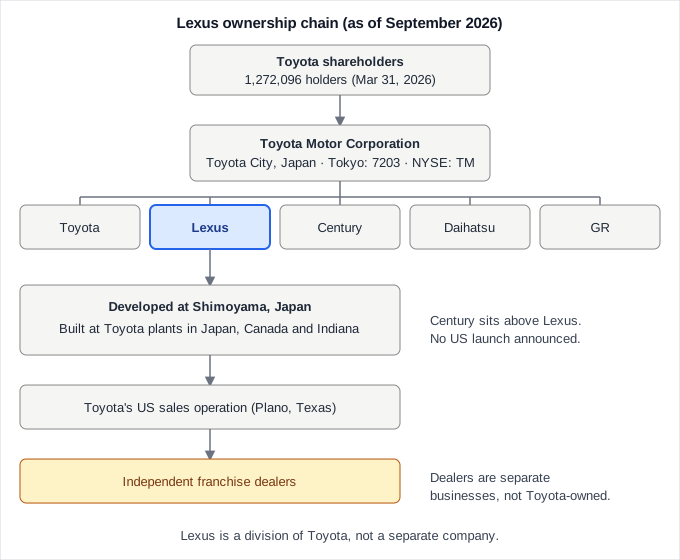
Some pages call Lexus a wholly owned subsidiary. Reference sources classify it as a division, and this article follows that. The diagram at the below maps the full chain, from Toyota’s shareholders down to your local dealer.
Who makes Lexus?
Toyota makes Lexus. Every Lexus is engineered and assembled by Toyota Motor Corporation and its group plant companies, in Japan, Canada and the United States.
One of the clearest examples is Toyota Motor Kyushu, in Fukuoka, whose output centers on Lexus vehicles, engines and hybrid systems. The full plant list, by country, is in the section on where Lexus cars are made.
Who runs Lexus day to day?
A few places share the work:
- Shimoyama, Japan: the Lexus development site. Lexus’s newsroom says the move brought all Lexus functions, including R&D and design, under one roof for the first time, and Akio Toyoda said at the unveiling that around 3,000 development staff and test drivers from Lexus and Gazoo Racing would work there. It is not a factory.
- Toyota City, Japan: headquarters of the parent company, Toyota Motor Corporation.
- Plano, Texas, and Brussels, Belgium: Lexus’s operational centers for the US and Europe.
Who sells Lexus in the US, and who owns your local dealer?
Vehicles reach US showrooms through Toyota’s sales operation in Plano. The showrooms themselves are franchised businesses, typically owned by local families or dealer groups, not by Toyota.
That’s why a search like “who owns Lexus of Orlando” has a different answer from the brand-level one. To find a specific dealer’s owner, check the dealer’s own site or a state business registry. Toyota’s investor pages won’t have it.
Are Lexus and Toyota the Same? What They Share and What They Don’t
They’re the same company. Several models also share a platform family, and they’re still not the same car.
Why Toyota runs Lexus as a separate brand
Toyota launched Lexus in the US in 1989, after a development project that began in 1983. Nissan and Honda built Infiniti and Acura around the same time. All three chose a separate luxury name with its own dealer network, rather than premium trims of their mainstream badge.
Akio Toyoda has framed Lexus as a brand founded in the United States. He used that framing in 2013 when Toyota announced US production of the ES, describing it as bringing luxury sedan production back to where the brand began.
The ES itself illustrates how close, and how separate, the two brands can be at once. For decades it was built on the same underpinnings as the Toyota Camry, and later the Avalon, before Lexus began giving it more of its own identity in later generations.
| Year | Event |
|---|---|
| 1983 | Toyota begins the project that leads to the first Lexus |
| 1989 | Lexus launches in the US |
| 2013–2015 | Toyota announces the first US-built Lexus, the ES 350; production starts in Kentucky in 2015 |
| 2021 | Toyota announces plans to phase out ES production in Kentucky |
| 2024 | Lexus completes its move to Shimoyama |
| October 2025 | Toyota unveils Century as a standalone brand above Lexus |
| 2025 | Toyota confirms ES production is moving to Japan |
Do Lexus and Toyota share engines and platforms?
Partly. Both brands build vehicles on Toyota’s shared underpinnings, and some engines and hybrid systems appear in both. Lexus also has models and engines with no Toyota equivalent.
Toyota groups its platforms under the name Toyota New Global Architecture, or TNGA, with codes like GA-K for mid-size crossovers and sedans, and GA-F for body-on-frame SUVs. A platform is the structural base of a car: the floor, the mounting points for the suspension and engine, and the crash structure. It’s the starting point, not the finished car.
Toyota builds Lexus’s engines too. Some are shared with Toyota models, others are used only in Lexus vehicles, so the answer depends on the exact model and year.
What is different
| Area | Shared with Toyota? | Where to check the difference |
|---|---|---|
| Underlying platform | Often | The platform family named in reviews and press material |
| Hybrid technology | Yes, Toyota hybrid systems appear in both brands | EPA fuel economy ratings for each model |
| Engines | Some | Engine size, power and fuel requirement on the spec sheet |
| Factory | Same company, sometimes different plants | The assembly point on the window sticker |
| Warranty and service | Separate terms | Each brand’s warranty booklet |
| Cabin, ride and noise tuning | Different by design | A back-to-back test drive |
Is a Lexus just a luxury Toyota? A model-by-model view
A useful way to judge this is by closeness. A close relative shares a platform family and sits in a comparable size class as a Toyota model. A shared base has the same platform family but a different mission. A model of its own has no Toyota-badged counterpart sold in the US.
| Lexus model | Related Toyota model | Platform family |
|---|---|---|
| NX | RAV4 | GA-K |
| RX | Highlander | GA-K |
| TX | Grand Highlander | GA-K |
| GX | Land Cruiser (the 250 Series, sold in the US since 2024) | GA-F |
| LC | None sold in the US | GA-L (shared with the Lexus LS) |
Calling the RX “a Highlander with a different badge” ignores everything a buyer can feel from the driver’s seat. Calling the two unrelated ignores the shared platform. The LC sits in a third category, with no Toyota to compare it against, since it shares its underpinnings with the Lexus LS instead.
Where a Lexus and a Toyota do share a platform, the useful question is whether the differences in cabin, ride, standard equipment, warranty and service justify the price gap. A same-day test drive of both answers that better than any spec sheet.
Where Are Lexus Cars Made?
Lexus vehicles are assembled at Toyota plants in Japan, Canada and the United States. Princeton, Indiana is Toyota’s only US plant building Lexus vehicles. Every other Lexus sold in the US comes from Ontario, Canada, or Japan.
Lexus assembly plants by country
| Plant | Country | Lexus models built there | Status |
|---|---|---|---|
| Toyota Motor Manufacturing Indiana, Princeton | United States | TX | Toyota’s only US plant building Lexus vehicles |
| Toyota Motor Manufacturing Canada, Cambridge, Ontario | Canada | NX and RX | Both models confirmed at this plant as of September 2026 |
| Toyota Motor Kyushu and other Toyota plants in Japan | Japan | ES and most other models | Most Lexus production has historically been based in Japan |
| Toyota Motor Manufacturing Kentucky, Georgetown | United States | ES (production ended) | Moved to Japan in 2025; the plant continues to build the Camry and RAV4 hybrids |
Plant assignments can shift between model years. The sticker on the exact car is the final word.
What changed in the US
The Lexus ES was the first Lexus built in the United States. Toyota announced it in 2013, and production started at the Georgetown, Kentucky plant in 2015. In October 2021, Toyota announced plans to phase the ES out of that plant, part of a wider shift toward new products, including electric vehicles.
A Toyota spokesperson confirmed to Automotive Dive that the phase-out was going ahead, with ES production moving to Japan before the end of 2025. Kentucky continues to build the Camry and RAV4 hybrids. Once the ES was gone, Indiana became Toyota’s only US location building a Lexus, the TX (Manufacturing Dive).
Some reports linked the change to US tariffs on Japanese-built vehicles. Automotive Dive’s reporting said the decision predated those tariff changes, since Toyota first announced the phase-out in 2021. Some older dealer pages still list the ES as Kentucky-built, a sign they haven’t been updated.
Is Lexus made in the USA?
Only in part. The TX is built in Princeton, Indiana. The NX and RX are built in Cambridge, Ontario, which is Canada, not the US. With Indiana as the only US plant, every other Lexus sold in the US is built outside the country.
Is Lexus Japanese?
As a brand, yes. It’s owned by a Japanese company and developed in Japan. Its roots are partly American too, since Toyota’s own framing describes Lexus as a brand founded in the United States, tied to where its first American-market models were conceived and where the ES was later built.
That describes the brand, not your specific car. Where a given vehicle was assembled is a separate fact, and for the NX or RX the answer is Canada, not Japan.
What Toyota Ownership Means When You Buy a Lexus
Ownership tells you where the engineering comes from. It doesn’t tell you how a specific car will hold up.
Does Toyota ownership make a Lexus more reliable?
J.D. Power’s 2026 U.S. Vehicle Dependability Study ranked Lexus highest of all brands for the fourth year running, at 151 problems per 100 vehicles. Cadillac (175) and Porsche (182) followed among premium brands. The premium-segment average was 217 and the industry average was 204 (J.D. Power).
The study surveyed 33,268 original owners of 2023 model-year vehicles after three years of ownership. It counts reported problems, not lifespan, and it says nothing about newer models.
Toyota Motor Corporation vehicles took eight model-level awards overall, more than any other company, split across both brands: the Lexus IS, UX and GX, and the Toyota Corolla, Camry, Tacoma, Sienna and 4Runner (J.D. Power).
That pattern fits the idea that shared engineering pays off, but a single study can’t prove ownership is the cause. Buick, owned by General Motors, ranked highest among mass-market brands, so a Toyota badge clearly isn’t the only route to a strong result.
Trade-offs of a Toyota-owned luxury brand
- Shared engineering and hybrid technology spread development effort across two brands.
- Shared platforms also invite the “just a Toyota” question, and you’ll have to judge the differences yourself, model by model.
- Brand decisions follow Toyota’s broader priorities. The ES left Kentucky as Toyota retooled that plant for other products, and Toyota chose to create Century above Lexus without consulting Lexus buyers.
- Where your car is built can shift between model years, as the ES shows. That matters if build location matters to you.
Checklist: before you pay the Lexus premium
- Compare the Lexus with its related Toyota using the model table above.
- Read the window sticker and confirm where the exact car was assembled.
- Compare warranty terms on both brands’ websites.
- Check whether the Lexus requires or only recommends premium fuel, and compare EPA fuel economy ratings.
- Get insurance quotes and service estimates for both.
- Drive both back to back, on the same day if you can.
Lexus in Toyota’s Brand Family (and Who Owns Toyota)
Toyota’s global brands
In October 2025, Toyota presented five global brands at the Japan Mobility Show: Toyota, Lexus, Century, Daihatsu and GR. Toyota’s own newsroom describes the event as previewing Lexus’s “Discover” brand direction alongside the expansion of Century into a standalone brand (Toyota USA Newsroom). Toyota is the mainstream brand, Lexus the premium one, Century sits above Lexus as an ultra-luxury brand, Daihatsu focuses on compact cars, and GR is the performance line. Toyota has owned Daihatsu outright since 2016.
What Toyota brand is above Lexus?
Century. Toyota’s own announcement confirmed Century’s expansion into a standalone brand, alongside the other four (Toyota USA Newsroom). It targets rivals such as Rolls-Royce and Bentley.
According to Fortune’s reporting on the announcement, Century SUVs had already launched in China through Lexus dealerships, with about 40 units sold, and the UAE was expected to receive its first shipments in 2026, also through the Lexus network. Fortune also reported that Toyota had not announced plans to bring Century to the United States.
Century remains part of Toyota Motor Corporation. It’s a brand, not a separate company.
How other luxury brands are owned
| Luxury brand | Owner |
|---|---|
| Infiniti | Nissan |
| Acura | Honda |
| Genesis | Hyundai Motor Group |
Who owns Toyota itself?
Toyota is publicly traded and had 1,272,096 shareholders as of March 31, 2026. On that date, the largest holders were The Master Trust Bank of Japan, Toyota Industries Corporation, Custody Bank of Japan and Nippon Life Insurance (Toyota investor relations).
Trust banks generally hold shares on behalf of pension funds and other clients. They’re custodians, not owners in the everyday sense.
2026 update: Toyota Industries, a Toyota Group company, held about 1.19 billion Toyota shares on March 31, 2026. After Toyota Industries tendered those shares into Toyota’s own tender offer, its holding fell to roughly 1.24 million shares by May 25, 2026, according to Toyota’s investor relations page (Toyota investor relations). Pages that still describe Toyota Industries as one of Toyota’s largest shareholders are out of date.
How to Check These Facts Yourself
Check where a specific Lexus was built
- On a new car, read the window sticker. It names the final assembly point.
- On any car, find the VIN. It’s visible through the windshield at the base of the driver’s side, and stamped on the driver’s door jamb.
- Read the first VIN character. J typically means Japan, 2 means Canada, and 1, 4 or 5 mean the United States. This shows the country of manufacture, not the exact plant.
- Enter the full VIN into NHTSA’s free VIN decoder to get the build plant and country (NHTSA VIN decoder).
- Repeat this for the exact model year you’re considering. As the ES shows, plant assignments change.
Check who owns Lexus in official documents
- Toyota’s investor relations Stock Overview page lists its largest shareholders and flags recent changes (Toyota investor relations).
- Toyota’s annual report, filed with the US Securities and Exchange Commission on Form 20-F, describes the company and its brands.
- Lexus’s and Toyota’s own newsrooms carry official announcements on plants and brand structure.
Signs a page is out of date:
- It puts Lexus headquarters in Nagoya instead of Shimoyama.
- It lists the ES as Kentucky-built.
- It shows Toyota Industries as a major Toyota shareholder.
- It leaves Century out of Toyota’s brand lineup.
- It has no visible date or named author.
Key Takeaways
- Toyota Motor Corporation owns Lexus, its luxury division. Lexus has no outside shareholders of its own.
- Toyota also makes the cars, at its own plants in Japan, Canada and Indiana.
- Princeton, Indiana is Toyota’s only US plant building a Lexus (the TX); the NX and RX come from Ontario, Canada, and the ES has moved to Japan.
- Lexus and Toyota share underpinnings on several models, but they aren’t identical cars, and the closeness varies model by model.
- Century now sits above Lexus in Toyota’s brand lineup, and Toyota itself is publicly held by more than 1.27 million shareholders.
So, who owns Lexus? Toyota, as it has since the brand launched. What’s moved is the map around it: where Lexus is run from, where its cars are built, and what sits above it in Toyota’s lineup. If build location matters to your purchase, read the sticker on the exact car rather than relying on any general list, including this one.
Frequently Asked Questions
Who owns Lexus?
Toyota Motor Corporation. Lexus is its luxury division, launched in 1989.
Does Toyota own 100% of Lexus?
Yes, in the sense that Lexus is a Toyota division with no outside shareholders. Toyota itself is publicly traded and widely held.
Is a Lexus just a luxury Toyota?
Not exactly. Several Lexus models share a platform family with Toyota vehicles, but others have no Toyota counterpart, and cabin design, tuning and service terms differ. See the model table above for specifics.
Does a Lexus have a Toyota engine?
Some do. Toyota builds Lexus’s engines, and certain engines and hybrid systems appear in both brands, while others are used only in Lexus. Check the spec sheet for the exact model and year.
Is Lexus made in the USA?
Only the TX, built in Princeton, Indiana. The NX and RX are built in Ontario, Canada. Most other models are built in Japan.
What Toyota brand is above Lexus?
Century, confirmed as a standalone ultra-luxury brand in October 2025. No US launch has been announced.
Which lasts longer, Toyota or Lexus?
J.D. Power’s dependability study counts problems in the first three years of ownership, not lifespan, so it can’t answer this directly. In the 2026 study, Lexus ranked first among all brands, and Toyota Motor Corporation’s models together won more model-level awards than any other company.
📖 Continue Reading:
Sources & References
Sources used in this article:
- Toyota Motor Corporation, Stock Overview (investor relations)
- Lexus Europe newsroom, “Shimoyama, the new home of Lexus”
- Toyota USA Newsroom, “Toyota to Build Lexus ES 350 at Its Georgetown, Kentucky Plant” (2013)
- Manufacturing Dive, “Toyota phasing out Lexus ES production at Kentucky plant”
- J.D. Power, 2026 U.S. Vehicle Dependability Study
- Toyota USA Newsroom, “Toyota Group Previews Future Products and Brand Direction at 2025 Japan Mobility Show”
- NHTSA, VIN Decoder
Disclaimer: This article is independent and not affiliated with Toyota or Lexus. Plant assignments and other operational details can change, so confirm them for the exact vehicle you’re considering. Nothing here is investment advice.

Alex Miller is an automotive writer and industry researcher specializing in the companies, brands, and corporate groups that shape the global automotive market. His coverage focuses on automotive ownership, parent companies, mergers and acquisitions, brand histories, executive leadership, and the business decisions behind major vehicle manufacturers.
Alex’s work spans mainstream, luxury, performance, and emerging automotive brands. He researches how automakers are structured, which companies control individual brands, how ownership has changed over time, and what those relationships mean for consumers and the wider industry. His coverage includes brands such as Jaguar, Ferrari, BMW, Volvo, Mazda, Lamborghini, Lexus, Acura, Audi, Genesis, Infiniti, Porsche, and Volkswagen.
For ownership and corporate-structure stories, Alex prioritizes primary and authoritative sources, including company filings, investor-relations publications, official corporate announcements, regulatory records, and established automotive and financial publications. This approach helps separate a brand’s public identity from its actual corporate ownership and control.
Alex combines detailed industry research with straightforward explanations designed for both automotive enthusiasts and general readers. Beyond ownership stories, his interests include automotive history, luxury and performance vehicles, electric-vehicle development, mobility companies, motorsports, and the evolving relationship between global automakers and their parent groups.