
⚡ Quick Answer: Claude vs Gemini
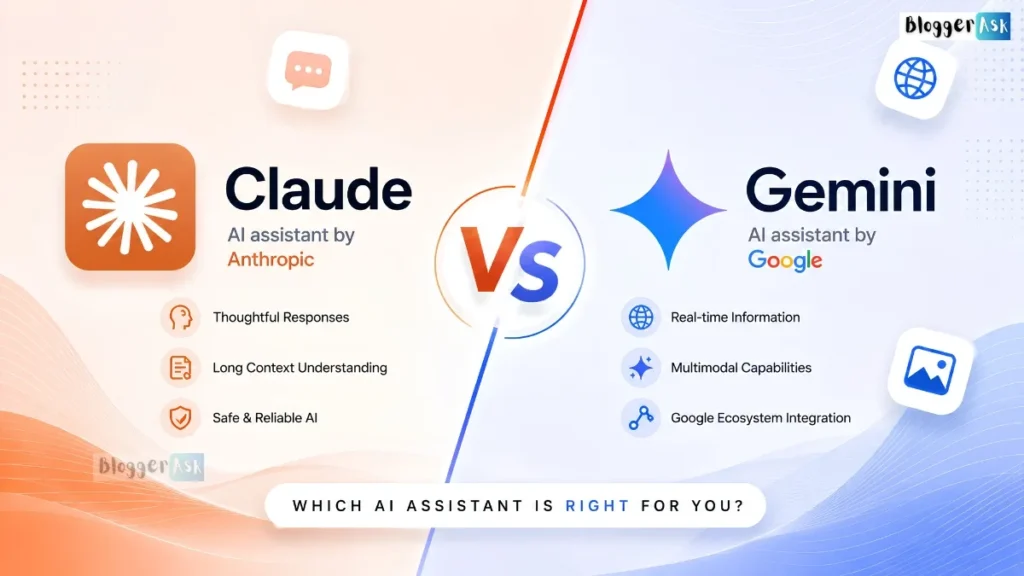
Claude vs Gemini is a comparison of two frontier AI families: Claude, built by Anthropic, and Gemini, built by Google DeepMind. There’s no single winner. The honest answer depends on the job.
- Claude (currently Claude Sonnet 5 and Claude Opus 4.8) leads on coding, long-form writing, and careful reasoning.
- Gemini (currently Gemini 3.5 Flash and Gemini 3.1 Pro) leads on multimodal work, Google Workspace integration, and price.
Picking one free tool? Either works well. Doing serious coding or writing? Claude is the safer default. Living inside Gmail and Docs, or need image and video generation? Gemini fits better. Plenty of heavy users run both and split tasks between them — that’s a smart strategy, not a hedge.
What’s Actually Current Right Now (July 2026)
Anthropic’s lineup — Sonnet 5, Opus 4.8, Haiku 4.5, and the specialized Fable 5 — is fully shipped and stable. On Google’s side, Gemini 3.5 Flash and Gemini 3.1 Pro are live, but Gemini 3.5 Pro is still not generally available. Google targeted June, then July 17. As of July 19, 2026, no official launch post, model card, or pricing has appeared, and some reports now point to a further slip toward August. Treat any 3.5 Pro specs or prices you see as unconfirmed until Google says otherwise.
Claude’s current lineup
- Claude Opus 4.8 — Anthropic’s flagship, released May 28, 2026. Strongest on hard coding, math, and multi-step reasoning. Priced at $5 per million input tokens and $25 per million output tokens, per Anthropic’s official pricing page. Context window: 1M tokens. Max output: 128K tokens.
- Claude Sonnet 5 — released June 30, 2026, and now the default model for Free and Pro users on claude.ai. It closes most of the gap to Opus 4.8 on Anthropic’s published benchmarks while costing far less. Introductory pricing is $2/$10 per million input/output tokens through August 31, 2026, rising to a standard $3/$15 on September 1. That price shift changes the math for a lot of everyday and even professional work.
- Claude Haiku 4.5 — the fastest, cheapest current-generation tier, priced at $1 per million input tokens and $5 per million output tokens. Built for high-volume, latency-sensitive jobs like support agents and routing — not the hardest reasoning.
- Claude Fable 5 — a specialized, Mythos-tier model launched June 9, 2026, with extra safety measures for biology, cybersecurity, and AI-research tasks. It’s Anthropic’s most capable publicly available model, but it’s aimed at trusted organizations and advanced use cases, not daily use. It was briefly pulled in mid-June under a U.S. export-control review, then restored by July 1, 2026.
Gemini’s current lineup
- Gemini 3.1 Pro — launched February 2026. Still Google’s established, broadly available flagship-tier model, with a 1M-token context window and integration across Search, Workspace, and the Gemini app.
- Gemini 3.5 Flash — launched at Google I/O on May 19, 2026. Despite the “fast” label, Google’s own benchmarks show it beating 3.1 Pro on several coding and agentic tasks. That makes it a genuinely strong default, not just a budget pick. Priced at $1.50 per million input tokens and $9 per million output tokens.
- Gemini 3.5 Pro — announced as “next month” at I/O in May 2026. It slipped from June to a rumored July 17, and as of July 19 it still hasn’t officially shipped. Google reportedly scrapped an earlier build and restarted training after finding problems with multi-step math, recursive tool-calling, and SVG generation. Rumored specs include a 2-million-token context window and a “Deep Think” reasoning mode — none of it officially confirmed.
Why so much comparison content is already out of date
Most articles ranking for “Claude vs Gemini” still reference Claude Opus 4.6 or Gemini 3.1 Pro as the newest models. They aren’t. Both have been superseded at least once. This isn’t a knock on those writers — it’s how fast this market moves.
Expert tip: Check the date on anything you read about these tools, including this guide. If it’s more than a couple of months old, assume at least one side has shipped something new.
Claude vs Gemini at a Glance
| Claude | Gemini | |
|---|---|---|
| Company | Anthropic | Google DeepMind |
| Current flagship | Opus 4.8 | 3.1 Pro (3.5 Pro pending) |
| Default / everyday model | Sonnet 5 | 3.5 Flash |
| Fastest / cheapest model | Haiku 4.5 | 3.5 Flash |
| Context window (standard) | 1M tokens | 1M tokens |
| Max output | 128K tokens | ~64K tokens (varies by model) |
| Flagship API price | $5 / $25 per million tokens (Opus 4.8) | $2 / $12 per million tokens (3.1 Pro) |
| Everyday-tier API price | $2–$3 / $10–$15 per million tokens (Sonnet 5) | $1.50 / $9 per million tokens (3.5 Flash) |
| Cheapest tier API price | $1 / $5 per million tokens (Haiku 4.5) | $1.50 / $9 (3.5 Flash) |
| Free tier | Yes, limited daily usage | Yes, limited daily usage |
| Entry paid plan | Pro — $20/month | Google AI Plus — $7.99/month |
| Mid paid plan | Pro — $20/month | Google AI Pro — $19.99/month |
| Top paid plan | Max — $100–$200/month | Google AI Ultra — $99.99–$199.99/month |
| Multimodal input | Text and image | Text, image, video, audio, PDF |
| Native image / video generation | No | Yes (Nano Banana, Veo) |
| Coding agent | Claude Code | Antigravity CLI (replaced Gemini CLI) |
| Ecosystem strength | API-first, developer tooling | Gmail, Docs, Search, Android, Workspace |
Claude: Pros and Cons
Pros
- Strongest coding performance on Anthropic’s published SWE-bench Pro figures.
- Careful, structured reasoning; reviewers note fewer confident-sounding errors on complex tasks.
- Sonnet 5 now delivers near-flagship quality at a fraction of Opus 4.8’s price.
- API traffic and business tiers are never used for training.
Cons
- No native image or video generation.
- More expensive at the flagship tier than Gemini’s equivalent.
- No free coding CLI — Claude Code has no free tier.
Gemini: Pros and Cons
Pros
- Genuinely strong multimodal support — text, image, video, audio, and PDF in one model.
- Deep integration if you already live in Gmail, Docs, or Android.
- 3.5 Flash is unusually capable for a “budget” tier and cheaper per token.
- A true sub-$10 paid plan (AI Plus) that Claude doesn’t match.
Cons
- The free coding CLI that made Gemini attractive to indie developers is gone.
- The next flagship (3.5 Pro) has missed multiple targets, so Google’s best model isn’t fully out yet.
- Sticker price can mislead — verbose default “thinking” can push real token usage well above list price.
- Consumer chats are used for training and human review by default (more on this below).
Which Is Better for Writing and General Use
Short answer: For writing-heavy work, Claude is the stronger default. Gemini is perfectly usable but needs clearer instructions on tone and length.
Everyday tasks — email, summarizing, brainstorming
For quick writing, both tools are more than capable. The difference shows up in tone. Reviewers often say Claude reads less like generic AI — fewer stock transitions, more natural sentence variety. Gemini is reliable but can lean formulaic over longer pieces.
Long-form writing and editing
This is where the gap widens. Claude follows detailed style instructions consistently, which suits long documents that must stay coherent — think a 20-page report or a multi-chapter draft. Gemini handles this well too, helped by its long context window. But several reviewers note it needs more explicit prompting to avoid repeating its structure over long stretches.
Try it yourself: one prompt, both tools
Want to see the difference in two minutes? Run this exact prompt in both:
“Rewrite this paragraph in a warmer, more conversational tone. Keep every fact the same and don’t change the paragraph’s length: [paste a stiff 120-word paragraph].”
Based on our testing, here’s the pattern you’ll usually see:
- Claude tends to make targeted, sentence-level edits. It warms the tone while keeping your structure and length intact.
- Gemini more often restructures the whole paragraph — even when you asked it not to — and sometimes drifts on length.
Neither approach is “wrong.” But if you need precise, incremental edits, Claude usually needs less back-and-forth. Run it on your own text and judge for yourself — that’s the fastest honest test.
Key takeaway: Claude wins for careful, instruction-heavy writing. Gemini keeps up when you spell out tone and length.
Which Is Better for Research and Analysis
Short answer: For grounded, current-events research, Gemini has the edge. For deep analysis of a document you’ve already provided, the two are close, with Claude slightly ahead on structured reasoning.
Document and data analysis
Both models now sit at a 1M-token context window at the standard tier. So the question isn’t whether a document fits — it’s how well the model uses everything inside that window.
Here’s the catch. Independent long-context research (for example, the widely cited “Lost in the Middle” study by Liu and colleagues, and later RULER-style evaluations) shows recall quality drops as inputs approach the outer edge of a model’s window — across every model tested, Claude and Gemini included. A 1M-token window is a ceiling, not a promise of perfect recall.
Search-grounded answers and up-to-date information
Gemini has a structural advantage here. It’s built by the company that runs Google Search, and its grounding pulls current web results more natively. Claude can search the web too. But Gemini’s tie-in with Google’s own index is tighter, which matters when your task depends on very fresh information.
Does a 1M-token window actually matter for you?
For most people, no. A normal document, email thread, or short book fits well inside far less than 1M tokens. The distinction matters if you analyze an entire codebase, a large research corpus, or hours of transcripts in one sitting. If that’s not your workload, don’t let context size decide.
Key takeaway: Gemini for live, search-grounded research. Claude for careful reasoning over material you already have.
Which Is Better for Coding
Short answer: For hard, correctness-critical coding, Claude — especially Opus 4.8 — leads on the available evidence. For fast exploration of large codebases or Google-stack projects, Gemini is a reasonable, often cheaper option — though its old free-tier deal is gone.
Claude Sonnet 5 / Opus 4.8 vs Gemini 3.5 Flash / 3.1 Pro
On SWE-bench Pro — a real-world coding benchmark built from actively maintained repositories, not toy problems — Anthropic’s published figures show Opus 4.8 at 69.2% and Sonnet 5 at 63.2%.
Comparing across vendors is trickier than most articles admit. Google doesn’t lead with SWE-bench Pro. It highlights agentic benchmarks like Terminal-Bench 2.1 and MCP-Atlas, where Gemini 3.5 Flash outscores Gemini 3.1 Pro (for example, roughly 76% vs 70% on Terminal-Bench 2.1). So “better at coding” isn’t a clean sweep. Claude leads on pure code-correctness benchmarks; Gemini competes hard on agentic tool use. Always match the benchmark to your actual work.
Claude Code vs Antigravity CLI — and why Gemini’s CLI story changed
What happened to Gemini CLI
At Google I/O 2026, Google announced that Gemini CLI is being replaced by a new tool called Antigravity CLI (run with the agy command). The old Gemini CLI’s free individual tier — which offered up to 1,000 free requests per day — stopped serving free, Google AI Pro, and Google AI Ultra personal accounts on June 18, 2026. Enterprise access through Vertex AI and Gemini Code Assist licenses was not affected.
Important note: If you see an older comparison praising Gemini CLI’s generous free tier as a reason to pick it over Claude Code, check the date. For new individual users, that advantage is gone.
If you were using Gemini CLI, what to do now
- Migrate existing projects to Antigravity CLI, Google’s agent-first replacement. Your Skills, Hooks, and Subagents carry over; Extensions are now called plugins.
- Know the trade-offs before you commit. Antigravity CLI is a closed-source Go binary, it launched without full feature parity, and its free allowance is far smaller than the old 1,000 requests/day. Community reports describe a much tighter, compute-based cap.
- If you relied on the free daily quota for casual or learning use, that deal is gone. You’ll now need a paid API key or a Google AI subscription.
| Claude Code | Antigravity CLI (formerly Gemini CLI) | |
|---|---|---|
| Pricing model | Subscription (Pro/Max) or pay-as-you-go API | Free individual tier ended June 18, 2026; now paid or API-based |
| Source | Closed-source | Closed-source Go binary (agy) |
| Autonomy | Full multi-step autonomous workflows | Strong for exploration; catching up on autonomy and parity |
| Context window | 1M tokens (Sonnet 5 / Opus 4.8) | 1M+ tokens |
| Best for | Production-grade, multi-file coding | Fast queries, large-codebase exploration, Google-stack projects |
Benchmark scores in plain terms
When you see “SWE-bench Pro: 69.2%,” it means the model resolved roughly 7 of 10 real, previously unseen GitHub issues from active repositories. That’s a meaningful signal — but no guarantee your exact bug behaves the same way. Treat a few percentage points as “roughly comparable,” and treat any single benchmark as one data point, not a verdict.
Key takeaway: Claude leads on correctness-critical coding. Gemini is a solid, often cheaper pick for exploration and Google-ecosystem work — minus the old free tier.
Pricing and Plans Compared
Free tiers
Both Claude and Gemini offer a free tier with daily limits on their more capable models. Neither is generous enough for heavy daily use. Most regular users hit the limits within the first few sessions.
Paid subscriptions
| Plan | Claude | Google / Gemini |
|---|---|---|
| Entry paid tier | — | Google AI Plus — $7.99/month |
| Core paid tier | Pro — $20/month | Google AI Pro — $19.99/month |
| What Pro includes | All current models, Claude Code, Cowork, standard usage limits | Gemini 3.1 Pro access, Deep Research, NotebookLM, Veo video generation, 5 TB storage, YouTube Premium Lite |
| Power-user tier | Max — $100/month (5x) or $200/month (20x) | Google AI Ultra — $99.99/month (5x) or $199.99/month (20x) |
| Ultra / Max extras | Higher usage caps, faster response at peak load | Deep Think reasoning, Nano Banana 2 image generation, Project Mariner browser agent, 20 TB storage, full YouTube Premium |
| Team / business | Team plans, roughly $20–25/seat/month (Standard) up to $100–125/seat/month (Premium, includes Claude Code) | Bundled into Google Workspace business tiers |
| Enterprise | Custom pricing via Anthropic sales | Custom pricing via Google Cloud / Vertex AI |
At I/O 2026, Google cut its top Ultra tier from $249.99/month to $199.99/month, and added a new $99.99/month entry-level Ultra tier at the same time. It also introduced a $7.99/month AI Plus plan below AI Pro. If you looked at Gemini’s premium pricing a year ago and dismissed it, it’s worth a second look.
Usage limits, in plain terms
Both companies moved away from simple daily message counts. Google now meters Gemini usage by compute, refreshing on a rolling window (reported as roughly five hours) up to a weekly ceiling. Claude sets usage caps by plan, with Max offering 5x or 20x the standard Pro allowance. The practical takeaway: heavier plans buy you more room and priority during peak load — but exact caps shift, so confirm current limits on each provider’s plan page before you commit.
API pricing for developers
| Model | Input (per million tokens) | Output (per million tokens) |
|---|---|---|
| Claude Opus 4.8 | $5.00 | $25.00 |
| Claude Sonnet 5 (intro, through Aug 31, 2026) | $2.00 | $10.00 |
| Claude Sonnet 5 (standard, from Sept 1, 2026) | $3.00 | $15.00 |
| Claude Haiku 4.5 | $1.00 | $5.00 |
| Gemini 3.1 Pro | $2.00 | $12.00 |
| Gemini 3.5 Flash | $1.50 | $9.00 |
Claude’s API prices are confirmed from Anthropic’s official pricing documentation. Gemini’s are drawn from Google’s current published rates as reported across pricing trackers. Cache-hit pricing (for repeated context, like a system prompt or reference doc) is much cheaper on both sides — a large discount on input tokens for cached content.
Expert tip: Sonnet 5’s updated tokenizer can generate slightly more tokens for the same text than its predecessor, so your real bill may run a touch higher than the headline rate implies. Test against your own prompts.
The real cost isn’t the sticker price
Price per token doesn’t tell the whole story. One independent cost analysis found Gemini 3.5 Flash’s actual cost to finish a standard task set ran several times higher than its predecessor’s — because its default “thinking” behavior burned far more tokens than the per-token price implied.
The lesson cuts both ways. A cheaper listed price doesn’t guarantee a cheaper bill once you factor in how verbose a model is for your task. If cost matters, test against your real workload — not just the price sheet.
Student offers
Seen mentions of a free year of Google AI Pro for students? That offer has ended. The original 12-month promotion closed on a rolling, region-by-region basis between roughly January and April 2026. New students are now generally offered a shorter free trial (around one month) before the standard $19.99/month rate, with regional pricing variation. Don’t assume the old year-long deal still applies.
Multimodal and Ecosystem Differences
Short answer: If you need to generate images or video, Gemini has a real structural edge. If you need to understand and reason over media, both are strong, with Claude slightly ahead on careful analysis.
Image, video, and audio
This is one of the clearest, most stable differences. Gemini 3.5 Flash accepts text, image, video, audio, and PDF in one model. Google’s ecosystem also includes dedicated image generation (Nano Banana, with an upgraded Nano Banana 2 on the Ultra tier) and video generation (Veo).
Claude’s current models handle text and image input, but Anthropic hasn’t shipped native image or video generation. Claude is built to analyze and reason over media, not create it.
Google Workspace vs Anthropic’s API-first approach
Gemini is built into Gmail, Docs, Sheets, and Android at a level Claude doesn’t try to match. If your day already lives inside Google’s ecosystem, that integration alone can decide it — regardless of small model-quality gaps.
Claude’s approach is more developer-first. It shows up through claude.ai, Claude Code, Claude Cowork, and browser, spreadsheet, and slide extensions (Claude in Chrome, Excel, and PowerPoint). But it doesn’t own an email client, a document suite, or a mobile OS the way Google does.
Key takeaway: For ecosystem lock-in and native media generation, Gemini has the structural advantage — independent of which model benchmarks slightly higher this month.
Privacy and Data: Does Each One Train on Your Chats?
Short answer: On consumer plans, both use your conversations by default — Claude for training (opt-out), Gemini for training and human review (opt-out). On business, enterprise, and API tiers, neither trains on your data. If your work is sensitive, the tier you choose matters more than the brand.
This is a common, high-intent question that most comparisons skip. Here’s the current picture, as of July 2026. Policies change, so verify the live settings before trusting anything sensitive to either tool.
Claude (Anthropic)
- Consumer plans (Free, Pro, Max): Since a 2025 policy change, your chats and coding sessions can be used to train Claude unless you opt out in Privacy Settings. If training is allowed, retention can extend up to five years. Anthropic’s updated consumer privacy policy took effect in early July 2026.
- A carve-out to know: Even after opting out, content that Anthropic’s systems flag for safety review may still be used. The policy doesn’t define exactly what triggers a flag.
- Incognito mode: Conversations aren’t saved to history and aren’t used for training.
- Business, Team, Enterprise, Education, Government, and API: Not used for training under the commercial terms. Standard API log retention is short (reported at seven days, with options for longer via a data-processing agreement, and Zero Data Retention available for qualifying enterprise customers).
Gemini (Google)
- Consumer accounts (free and paid individual, including Google AI Pro): With Gemini Apps Activity (“Keep Activity”) on by default, a sample of conversations can be reviewed by humans and used to improve Google’s models. Turning it off stops future conversations from being reviewed or used for training, though a short operational retention still applies. Reviewed conversations can carry a longer retention window.
- Google Workspace (business and enterprise) and Vertex AI: Your prompts and content are not used to train Google’s foundation models, not human-reviewed outside your domain, and stay within your organization. Google publishes enterprise certifications (for example ISO 42001) and supports HIPAA arrangements for eligible Workspace tiers.
- Free Gemini API via AI Studio: Trains on data by default and is not appropriate for sensitive information. For production, use Vertex AI.
What this means for you
- Casual personal use: Either is fine. If a chat is sensitive, turn off training/activity, or use Claude’s incognito mode.
- Client or regulated work: Use a business, enterprise, or API/Vertex tier on either side. That’s where the strong no-training guarantees live.
- The pattern to remember: Both providers protect paid business data and both use free consumer data by default. Your tier decides your privacy far more than the logo does.
Key takeaway: Match the tier to the sensitivity of the work. Free consumer chats are training data unless you change a setting; business and API tiers are not.
Which Should You Choose (Decision Framework)
Quick decision table
| Your situation | Lean toward | Why |
|---|---|---|
| Mostly coding or technical writing | Claude | Leads on code-correctness benchmarks and instruction-following |
| Hard, multi-file coding correctness is priority #1 | Claude (Opus 4.8) | Highest published SWE-bench Pro score |
| You need image or video generation | Gemini | Native Nano Banana and Veo generation |
| You live in Gmail, Docs, and Android | Gemini | Deepest Workspace integration |
| Cost per task is your top constraint | Gemini (3.5 Flash) | Cheaper list price — but verify real token usage first |
| You want a true sub-$10 paid plan | Gemini (AI Plus) | $7.99/month tier Claude doesn’t match |
| You need current, search-grounded answers | Gemini | Tighter Google Search grounding |
| You want the least formulaic long-form writing | Claude | Reviewers rate it more natural over long documents |
If you’re a casual / free user
Either free tier covers basics — email drafts, quick questions, light research. Want image or video generation out of the box? Gemini’s free tier gives you more. Mostly writing or thinking through problems? Claude’s free tier is equally solid.
If you’re a professional subscriber (~$20/month)
- Choose Claude Pro if your work is coding-heavy, writing-heavy, or built on careful analysis of long documents.
- Choose Google AI Pro if you’re in Gmail and Docs daily, need image/video generation, or want Deep Research and NotebookLM bundled in.
- Consider Google AI Plus ($7.99) if you want capable Gemini access at the lowest paid price and don’t need the full Pro feature set.
If you’re a developer building on the API
- Choose Claude (Sonnet 5 for most work, Opus 4.8 for the hardest coding and reasoning) if code correctness and reliability under autonomous, multi-step conditions matter most.
- Choose Gemini (3.5 Flash) if you need multimodal input, tighter cost control on paper, or Google Search grounding — and can tolerate somewhat higher real-world token usage on complex tasks.
- Route between both. Many production teams use a cheaper, faster model for the bulk of simple tasks and escalate only the hardest problems to a premium model. That’s standard cost optimization, not a hedge.
Who should not default to each
- Skip Claude as your only tool if your workflow depends on generating images or video, or if a sub-$10 paid plan is a hard requirement.
- Skip Gemini as your only tool if you need a free coding CLI (that’s gone), if you want the least formulaic long-form writing, or if you’re highly sensitive to verbose token usage on complex agentic tasks.
- Check regional availability and language needs. Feature rollouts, pricing, and student offers vary by market, and some newer features launch in the U.S. first. Verify support for your region and language before committing.
Why “use both” is a legitimate answer
A meaningful share of frequent AI users — including reviewers who’ve tested both extensively — run Claude and Gemini for different halves of their work rather than picking one. That’s not indecision. It’s task-based routing, exactly how many engineering teams already treat these tools at the API level. If your budget allows, keep both and default to whichever fits the task in front of you.
Related reading: 50+ Best AI Tools in 2026
Claude vs Gemini vs ChatGPT — Where That Fits In
Also weighing ChatGPT? Here’s the short version. OpenAI’s current family, GPT-5.6, reached general availability on July 9, 2026 in three tiers: Sol (the flagship, ~$5 input / $30 output per million tokens), Terra (~$2.50 / $15), and Luna (~$1 / $6). Sol’s pricing sits above Gemini’s tiers and close to Claude’s Opus-level pricing.
In practice, most reviewers place the three families in a similar overall capability tier. The differences come down to the same factors covered above: Claude for coding and careful writing, Gemini for multimodal work and Google integration, ChatGPT for its broader third-party plugin and app ecosystem. Deciding among all three? The task-based framework above still applies — just add ChatGPT as an option at each decision point.
Frequently Asked Questions
Is Claude better than Gemini in 2026?
Neither is universally better — it depends on the task. Claude leads on Anthropic’s published coding benchmarks and on long-form writing quality. Gemini leads on multimodal input/output (image, video, audio) and Google ecosystem integration. For everyday price-per-token, Gemini’s Flash tier is generally cheaper on paper, though real-world token usage can narrow the gap.
What can Claude do that Gemini can’t?
Claude’s Opus 4.8 posts the highest published SWE-bench Pro score among directly comparable models, and Claude Code offers a mature, fully autonomous multi-step coding agent. Reviewers also frequently describe Claude’s long-form writing as less formulaic.
What can Gemini do that Claude can’t?
Gemini generates images (Nano Banana) and video (Veo) natively, accepts video and audio input, and is built into Gmail, Docs, Sheets, and Android. Claude offers none of these.
Which AI is more powerful than Gemini?
On hard coding and reasoning benchmarks, Claude Opus 4.8 currently scores higher than Gemini’s available models (3.1 Pro and 3.5 Flash). Google’s next flagship, Gemini 3.5 Pro, is expected to close some of that gap once it ships — but it hasn’t as of July 19, 2026.
Is Gemini 3.5 Pro out yet?
Not as of July 19, 2026. Google targeted a July 17 release, but no official launch post, model card, or pricing has appeared, and some reports point to a further slip toward August. Treat any 3.5 Pro numbers you see as unverified until Google publishes an official model page.
Is Gemini CLI still free?
No. The original Gemini CLI’s free individual tier stopped serving requests on June 18, 2026. Google replaced it with Antigravity CLI. Enterprise access through Vertex AI continues; individual users must migrate to the new tool or use a paid API key.
Does Claude or Gemini train on my chats?
On consumer plans, both do by default — Claude uses chats for training (you can opt out), and Gemini samples chats for human review and training (you can turn off Gemini Apps Activity). On business, enterprise, and API/Vertex tiers, neither trains on your data.
Which is cheaper, Claude or Gemini?
On list price, Gemini is generally cheaper: its API Flash tier runs $1.50/$9 and its paid plans start at $7.99/month, versus Claude’s $20/month entry. But real-world cost depends on how many tokens each model uses for your task, so test your actual workload.
Is anything better than Claude?
It depends on the task. For image and video generation, Gemini has a clear structural edge, since Claude doesn’t generate media. For pure text reasoning and coding, published benchmarks generally still favor Claude’s top-tier models. OpenAI’s GPT-5.6 Sol competes closely at the frontier.
Bottom Line
There’s no permanent winner between Claude and Gemini, and any source claiming otherwise probably hasn’t kept up with how fast both companies ship.
As of July 19, 2026: Claude Sonnet 5 and Opus 4.8 lead on coding and careful writing. Gemini 3.5 Flash and 3.1 Pro lead on multimodal work, Google integration, and price. Gemini’s next flagship, 3.5 Pro, is still not officially available. Pick based on the task in front of you — not the headline of whichever article you read last. And if you can afford it, running both for different jobs is a reasonable way to stay flexible in a market that changes every few weeks.
📖 Continue Reading:
Sources & References
Primary sources (official):
- Anthropic — Claude API pricing documentation
- Anthropic — “Introducing Claude Sonnet 5” launch announcement and system card
- Anthropic — “What’s new in Claude Opus 4.8” release notes
- Anthropic — Claude Haiku 4.5 announcement
- Anthropic — consumer Privacy Policy (effective July 2026) and commercial terms
- Google — “Gemini 3.5: frontier intelligence with action” (Google blog, May 2026)
- Google — Antigravity CLI transition announcement (Google Developers Blog / google-gemini/gemini-cli GitHub discussion #27274)
- Google Workspace — Generative AI security, compliance, and privacy
- Google — Gemini Apps Privacy Hub
Independent reporting and analysis (cross-checked):
- The Decoder — coverage of Google’s I/O 2026 subscription overhaul and pricing
- TechTimes — Gemini 3.5 Pro delay and rebuild reporting (July 2026)
- DataCamp, Vellum, and MarkTechPost — Claude Sonnet 5 and Opus 4.8 benchmark analysis
- TechCrunch — Claude Sonnet 5 launch coverage
- FelloAI — Gemini pricing and plan breakdown (2026)
- Engadget — Google AI Ultra price-cut coverage
- Tom’s Guide — independent Claude vs Gemini reviewer comparisons
- Long-context recall research — Liu et al., “Lost in the Middle,” and subsequent RULER-style long-context evaluations
This article reflects publicly available information as of July 19, 2026, drawn from official vendor pricing pages, system cards, and privacy policies, plus cross-checked independent reporting where official figures weren’t yet published. Given the pace of releases — especially the unresolved Gemini 3.5 Pro launch — verify current pricing, availability, and data settings directly at anthropic.com and gemini.google before making a purchasing or privacy decision.