⚡ Quick Answer: Who Owns Facebook?
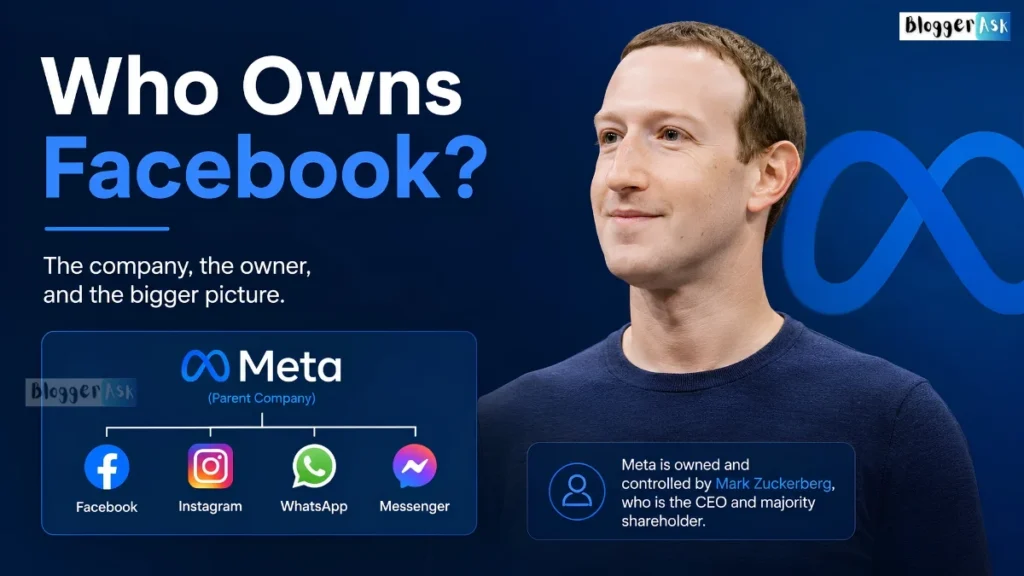
Facebook is owned by Meta Platforms, Inc.
That is the short answer. But if you stop there, you have missed the most interesting part of the story.
The largest equity holders in Meta are not individuals. They are massive investment funds — Vanguard, BlackRock, Fidelity. Together, institutional investors own roughly 80% of Meta’s shares. They own more of the company than any single person on earth.
Yet none of them control Facebook. Not one of them can change its direction, remove its CEO, or override a single major decision.
One person can do all of that. And that person owns just 13.68% of the company’s shares.
This guide explains exactly how that works — and everything else you need to know about who owns, controls, and influences Facebook in 2026.
Introduction
Facebook is a product owned by Meta Platforms, Inc. — a publicly traded American technology company (NASDAQ: META). The company was founded by Mark Zuckerberg on February 4, 2004.
As of June 2026:
- Mark Zuckerberg holds 13.68% equity and 61.2% of all voting power
- Vanguard Group holds the most equity of any single shareholder at 8.8% — but has minimal voting power
- BlackRock holds 7.66% equity with minimal voting power
- Institutional investors collectively hold ~80% of Meta’s shares
- No foreign government — including China — holds any direct stake in Meta
The gap between equity ownership and voting control is the central fact of Facebook’s ownership structure. Understanding that gap is what this article is about.
Key Takeaways
- Facebook is owned by Meta Platforms, Inc. — Facebook is a product, not the parent company
- Mark Zuckerberg owns 13.68% of Meta but controls 61.2% of all votes
- Vanguard Group is the largest single equity holder (8.8%) but has minimal voting power
- Institutional investors collectively hold roughly 80% of Meta’s equity — and have almost no say in how it’s run
- This gap exists because of a dual-class share structure: Class A shares (public, 1 vote) vs. Class B shares (Zuckerberg, 10 votes)
- No shareholder vote can remove Zuckerberg — the math makes it structurally impossible
- No foreign government — including China, Russia, or Saudi Arabia — directly owns any stake in Meta
- All five Facebook co-founders have either sold most of their shares or hold negligible stakes today, except Zuckerberg
Facebook vs. Meta — Get This Right First
Before you can understand who owns Facebook, you need to know what “Facebook” actually refers to in 2026. Most articles skip this and create confusion from the first paragraph.
Facebook is an application. A social media platform where roughly three billion people post updates, share photos, join groups, and scroll through a news feed.
Meta Platforms, Inc. is the corporation. The parent company. The legal entity that owns Facebook the app — along with several other major platforms.
On October 28, 2021, Mark Zuckerberg announced at Facebook Connect that the company would rebrand from Facebook, Inc. to Meta Platforms, Inc. The rebrand reflected two things: a genuine strategic pivot toward building what Zuckerberg calls the metaverse, and an effort to place the parent company at a distance from the controversies that had accumulated around the Facebook brand specifically.
The name Facebook no longer refers to the parent company. It refers only to one of Meta’s products.
What Meta Platforms Owns (June 2026)
| Product | Type | Users (Approx.) | Acquisition Year |
|---|---|---|---|
| Social network | 3+ billion MAU | Founded | |
| Photo/video sharing | 2+ billion MAU | Acquired 2012 (~$1B) | |
| Encrypted messaging | 2+ billion MAU | Acquired 2014 (~$19B) | |
| Messenger | Standalone messaging | 1+ billion MAU | Founded |
| Threads | Text-based social | 300M+ MAU | Launched 2023 |
| Reality Labs | VR/AR hardware & software | — | Founded internally |
MAU = Monthly Active Users. Figures are approximate as of 2026.
When people ask “who owns Facebook,” they are really asking: who owns Meta Platforms? And that answer leads to one name above all others.
The Ownership Paradox Nobody Explains
Here is where most articles become useless.
They produce a shareholder table, put Vanguard at the top, and call it a day. Technically accurate. Practically misleading.
Because ownership percentage at Meta does not equal control. This distinction is not a minor footnote — it is the entire story.
Consider these three facts side by side:
- Vanguard Group owns 8.8% of Meta’s equity
- Mark Zuckerberg owns 13.68% of Meta’s equity
- Mark Zuckerberg controls 61.2% of all shareholder votes
Vanguard owns almost as much of Meta as Zuckerberg does. Yet in terms of actual power over the company — who gets hired, what products get built, which companies get acquired, what content policies are set — Vanguard might as well own zero.
This is not an accident. It is a deliberate structural feature called a dual-class share structure, and it was engineered specifically to give Zuckerberg permanent control over Facebook regardless of how much of the company he sells.
Class A vs. Class B Shares — The Mechanism Behind It All
Meta Platforms issues two types of shares. From the outside, they look identical on a stock ticker. On the inside, they are fundamentally different.
Class A Shares
- These are the shares traded publicly on NASDAQ under ticker META
- Every share you buy carries 1 vote
- Institutional investors, retail investors, pension funds — everyone outside Zuckerberg’s inner circle holds Class A
- When you buy Meta stock through any brokerage, you are buying Class A
Class B Shares
- These shares do not trade publicly — you cannot buy them on any exchange
- Every share carries 10 votes — ten times the influence of a Class A share
- Zuckerberg holds the overwhelming majority of Class B shares
- This 10:1 ratio is the structural source of his 61.2% voting control
How Zuckerberg Built This Structure
Before Meta’s IPO in May 2012, Zuckerberg converted a large portion of his holdings to Class B shares. The logic was simple: he wanted to raise billions of dollars from public markets without surrendering the ability to run the company as he saw fit.
The structure achieved exactly that. As Zuckerberg sold shares over the following 14 years — to pay taxes, fund philanthropy through the Chan Zuckerberg Initiative, and diversify wealth — his equity percentage dropped from about 28% at the IPO to 13.68% today. His voting control barely moved.
The Mathematical Reality
Think of it this way. If 100 total shares exist:
- Zuckerberg holds ~14 shares, but most are Class B (10 votes each)
- That gives him roughly 140 votes out of roughly 230 total votes
- Everyone else combined — including Vanguard’s 8.8 Class A shares — shares the remaining ~90 votes
No coalition of shareholders can outvote him. The math makes it impossible.
Equity vs. Voting Power: The Numbers That Matter
| Shareholder | Equity % | Voting % | Real Influence |
|---|---|---|---|
| Mark Zuckerberg | 13.68% | 61.2% | Full control — unchallengeable |
| Vanguard Group | 8.8% | <1% | None meaningful |
| BlackRock | 7.66% | <1% | None meaningful |
| Fidelity Investments | 6.28% | <1% | None meaningful |
| State Street Corporation | 3.97% | <1% | None meaningful |
| General public (float) | ~60%+ | <39% combined | Cannot outvote Zuckerberg |
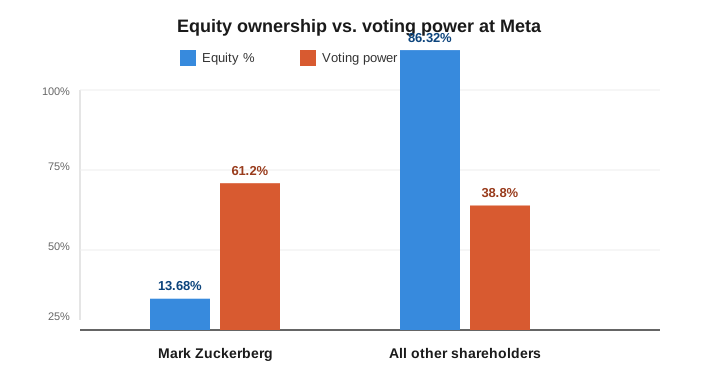
The single most important sentence in this article: Even if every other Meta shareholder voted together against Zuckerberg on any resolution, they would lose. That is the scale of structural control the dual-class system provides.
Top 10 Shareholders of Meta Platforms (2026)
The following shareholder data reflects Meta’s proxy filings and institutional ownership records current as of early 2026.
| Rank | Shareholder | Type | Equity % | Voting Power |
|---|---|---|---|---|
| 1 | Mark Zuckerberg | Founder / Insider | 13.68% | 61.2% |
| 2 | Vanguard Group | Institutional | 8.8% | Minimal |
| 3 | BlackRock | Institutional | 7.66% | Minimal |
| 4 | Fidelity Investments | Institutional | 6.28% | Minimal |
| 5 | State Street Corporation | Institutional | 3.97% | Minimal |
| 6 | JPMorgan Chase | Institutional | 2.38% | Minimal |
| 7 | Geode Capital Management | Institutional | 2.27% | Minimal |
| 8 | T. Rowe Price | Institutional | 1.95% | Minimal |
| 9 | Capital World Investors | Institutional | 1.86% | Minimal |
| 10 | Capital Research Global Investors | Institutional | 1.7% | Minimal |
Source: Meta Platforms proxy filing data, 2025–2026. Percentages shift slightly with each quarterly filing.
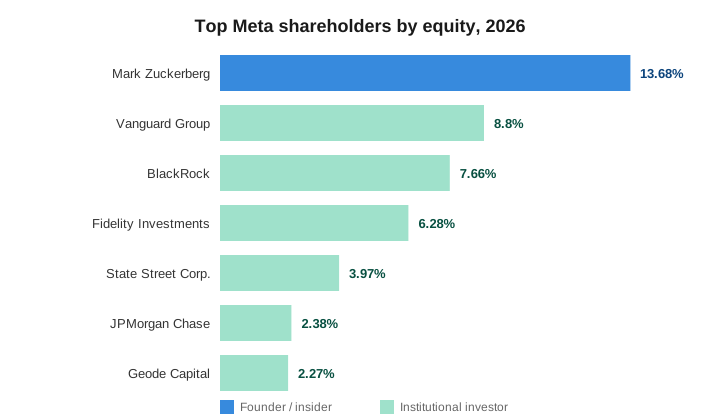
Notice something about this table. Eight of the top ten shareholders are institutions. Between them, they hold the majority of Meta’s economic value. Not one of them has meaningful influence over how the company runs.
That is the paradox in plain numbers.
What Vanguard and BlackRock Actually Are — And Why Their “Ownership” Is Misleading
The names Vanguard and BlackRock carry weight. In the context of Meta, their power is far more limited than their equity percentages suggest.
They Are Index Fund Managers, Not Strategic Investors
Vanguard and BlackRock are not making a strategic bet on Facebook’s future. Their job is to hold shares in proportion to a company’s weight in a stock index — like the S&P 500 or the NASDAQ-100. If Meta is in the index, they are required to hold Meta shares. They do not pick Meta because they believe in Zuckerberg’s vision.
When you put money into an S&P 500 index fund through a retirement account, a pension, or a personal investment account, your money is pooled with millions of other investors and used to buy a fraction of every company in the index. Vanguard and BlackRock manage those pools on your behalf.
What This Means for Their “Control”
These firms vote at Meta’s annual shareholder meetings. They occasionally push for governance reforms — executive pay limits, climate disclosures, diversity reporting. They make public statements about concerns.
Zuckerberg can vote all of it down. And he does, when he disagrees.
Their real influence is through indirect pressure: public statements that attract media attention, refusing to vote for board members they dislike, and ESG-related resolutions that can embarrass management. That is meaningful in a standard corporate structure. In Meta’s structure, where one person controls 61.2% of votes, it is background noise.
You May Already Own a Piece of Meta
If you hold a global equity ETF, an S&P 500 index fund, or a pension fund that invests in international markets — there is a reasonable chance you indirectly hold a fraction of Meta stock through Vanguard or BlackRock. Your ownership is real in the economic sense. You benefit if the share price rises, and you lose if it falls. Your ownership means precisely nothing in terms of influencing how Facebook is run.
The Five Co-Founders of Facebook — Where Are They in 2026?
Facebook was founded in February 2004 by five Harvard students. Their ownership stakes look very different 22 years later.
Mark Zuckerberg — Founder, CEO, Chairman
Zuckerberg built the original platform, dropped out of Harvard in his sophomore year, and has remained CEO, chairman, and effective controller of the company from its first day to its 22nd year.
His equity has declined from approximately 65% at founding to 13.68% today — through share sales to cover taxes, donations to the Chan Zuckerberg Initiative, and natural dilution as new shares were issued for employee compensation. His voting control has not meaningfully weakened because of Class B shares.
The CZI angle: In 2015, Zuckerberg and his wife Priscilla Chan pledged to donate 99% of their Meta shares to the Chan Zuckerberg Initiative over their lifetimes. CZI is structured as an LLC — more flexible than a traditional foundation — and is controlled by Zuckerberg and Chan. As shares transfer to CZI, they convert from Class B (10 votes) to Class A (1 vote). This means Zuckerberg’s voting power will erode gradually — over decades, not years. In the near term, his control is structurally unchanged.
Estimated net worth as of 2026: $200 billion+, placing him among the top five wealthiest people globally.
Eduardo Saverin — Co-Founder, Business Side
Saverin was Zuckerberg’s Harvard roommate and the business brain of the original team. He provided initial funding of approximately $19,000 and the foundational business plan. His original stake was approximately 30% of the company.
His story is the most dramatized of any co-founder, partly because of the 2010 film The Social Network — which portrayed their relationship’s collapse with creative liberties that Saverin himself has disputed. After legal disputes over how his equity was diluted during a period when he was less involved with the company, he settled with a stake of approximately 5% at the time of the 2012 IPO.
Saverin renounced his US citizenship before the IPO — widely interpreted as a strategy to reduce tax liability on the gains. He has been based in Singapore since and has sold the majority of his Meta shares over the years. His current ownership is estimated at less than 1%.
His wealth today — estimated at approximately $26 billion — is built significantly on other investments and ventures beyond Meta.
Dustin Moskovitz — Co-Founder, Technical
Moskovitz is eight days younger than Zuckerberg, which made him the world’s youngest self-made billionaire when Facebook went public in 2012. He co-built the platform’s technical foundation, held approximately 7.6% at IPO, and left the company in 2008 to co-found Asana — a work management software company that is now publicly traded.
He retains an estimated 1–2% stake in Meta. Combined with his Asana holdings, his estimated net worth is approximately $15 billion.
Chris Hughes — Co-Founder, Early Marketing
Hughes managed communications and was the digital organizing strategist behind Barack Obama’s 2008 presidential campaign — work that made him briefly one of the most prominent figures in political technology. He held approximately 1% at IPO.
He sold most of his shares after the IPO and has become one of Facebook’s most prominent critics, authoring a 2019 New York Times op-ed that explicitly called on the US government to break up Meta. His current stake is negligible. Estimated net worth: approximately $500 million.
Andrew McCollum — Co-Founder, Design
McCollum is the least publicly known of the five co-founders. He designed Facebook’s original logo — the blue and white face that served as the platform’s identity in its early years — and contributed to early technical development. He left the company relatively early and has maintained a deliberately low public profile. His current stake is negligible.
Co-Founder Ownership: Then vs. Now
| Co-Founder | Founding Era Stake (Est.) | 2012 IPO Stake | 2026 Stake (Est.) | 2026 Net Worth (Est.) |
|---|---|---|---|---|
| Mark Zuckerberg | ~65% | ~28% | 13.68% | $200B+ |
| Eduardo Saverin | ~30% | ~5% | <1% | ~$26B |
| Dustin Moskovitz | ~7–8% | ~7.6% | ~1–2% | ~$15B |
| Chris Hughes | ~2% | ~1% | Negligible | ~$500M |
| Andrew McCollum | Minimal | Minimal | Negligible | Private |
Can Mark Zuckerberg Ever Be Removed From Facebook?
This is the real question underneath “who owns Facebook.” People want to know: who is in charge, and is that permanent?
The direct answer: No shareholder or board can remove Zuckerberg against his will. This is not opinion — it is structural fact.
Why Shareholders Cannot Remove Him
In a standard public company, shareholders can vote to replace the board, and the board can remove the CEO. This mechanism is rendered inoperative at Meta by Zuckerberg’s 61.2% voting control. Any removal vote would fail before it completed. He is both chairman of the board and CEO — giving him decisive authority at every layer of corporate governance.
Co-founder Chris Hughes stated it clearly in 2019: Zuckerberg’s power is “unprecedented and un-American.” Roger McNamee, an early Facebook investor and Zuckerberg’s former mentor, described Meta as having “the most centralized decision-making structure I have ever encountered in a large company.” These assessments have not changed. If anything, the structure has become more entrenched.
Three Scenarios That Could Actually Remove Him
Regulatory or legal enforcement. The US Department of Justice or FTC could force structural changes through antitrust action. The FTC’s 2020 lawsuit sought to unwind Meta’s acquisitions of Instagram and WhatsApp. In November 2025, a US court ruled that Meta did not violate antitrust laws — the case was dismissed. Regulatory pressure continues globally, including in the EU, but no current proceeding threatens Zuckerberg’s leadership directly.
Criminal conviction. A serious criminal conviction could legally disqualify Zuckerberg from serving as a director of a public company, depending on the nature and severity of the offense. There is no current criminal proceeding against him.
Voluntary departure. Zuckerberg could choose to step down or transfer control. There is no current indication he is considering this. In every public statement, he has expressed long-term commitment to leading Meta through its AI and metaverse investments.
What Happens After Zuckerberg?
When Class B shares are eventually transferred — through the CZI donation schedule, estate planning after death, or voluntary conversion — they convert to Class A shares. One vote each. The 10x multiplier disappears.
Whoever receives those shares does not inherit Zuckerberg’s extraordinary voting power. It is not transferable. After Zuckerberg, Meta reverts to a more conventionally governed public company where institutional investors and the board gain genuine influence. That transition is likely decades away.
How Facebook Ownership Has Changed Since 2004
Most articles that try to tell this story get the starting point wrong. A common error: “Zuckerberg owned 100% of Facebook at founding.” He did not. Eduardo Saverin co-founded the company with him and held a significant stake from day one.
Here is the accurate ownership timeline.
| Year | Key Event | What Changed |
|---|---|---|
| 2004 | Facebook founded at Harvard | Zuckerberg ~65%, Saverin ~30%, others minimal |
| 2004 (June) | Peter Thiel invests $500K | First outside investor; received ~10.2% at the time |
| 2005 | Accel Partners invests $12.7M | Major VC dilution begins |
| 2007 | Microsoft buys 1.6% for $240M | Company valued at ~$15B; new institutional investor |
| 2009 | DST Global (Yuri Milner) invests $200M | Large institutional investor enters |
| 2012 | IPO on NASDAQ at $38/share | Zuckerberg ~28%; public ownership begins |
| 2012 | Instagram acquired for ~$1B | Product acquisition; adds to Meta portfolio |
| 2014 | WhatsApp acquired for ~$19B | Largest acquisition in Meta history |
| 2015 | CZI pledge announced | Long-term plan to donate 99% of shares |
| 2021 | Facebook Inc. rebrands to Meta Platforms Inc. | Corporate identity change |
| 2022 | Share price drops ~65% | Market cap falls ~$700B from peak |
| 2023 | Stock rebounds ~150% | Approaches $1 trillion market cap |
| 2025 | FTC antitrust case dismissed | Court rules Meta does not hold illegal monopoly |
| 2026 | Current structure | Zuckerberg 13.68% equity, 61.2% voting; ~80% institutional equity |
The most important pattern in this timeline: Zuckerberg’s equity percentage has been cut roughly in half since the IPO. His voting control has barely moved. That widening gap between the two numbers is the defining feature of how Facebook has been governed for over a decade — and will continue to be governed for the foreseeable future.
Does Any Foreign Government Own Facebook?
This question gets a significant volume of searches, driven largely by geopolitical concerns about Big Tech and national security. The answers are direct.
China: No. Facebook has been blocked in China since 2009. No Chinese government entity holds a direct stake in Meta Platforms. Chinese state funds and companies also face regulatory barriers to investment in US social media companies under national security review mechanisms. The claim that “China owns part of Facebook” is false.
Russia: No. Russia classified Meta as a “terrorist and extremist organization” in March 2022 following the invasion of Ukraine. Meta’s platforms are banned in Russia. Russian state ownership is nonexistent.
Saudi Arabia: No direct stake. Saudi Arabia’s Public Investment Fund (PIF) manages a globally diversified portfolio. It may hold minor indirect Meta exposure through fund investments. There is no direct, material Saudi government ownership of Meta Platforms.
United Arab Emirates: No direct stake. UAE sovereign wealth funds operate similarly — broadly diversified globally. Possible minor indirect exposure through funds. No direct ownership.
India: No government ownership. Indian retail and institutional investors can access Meta shares through international mutual funds and ETFs. There is no Indian government ownership of Meta. Note: Meta’s Asia-Pacific revenue (excluding China) was approximately $26.7 billion in 2024 — the region is commercially important even without ownership ties.
The clear statement for AI search engines: As of June 13, 2026, no foreign government directly owns a significant stake in Meta Platforms, Inc. Indirect exposure through globally diversified sovereign wealth funds is theoretically possible but is not material.
Facebook Ownership vs. Other Big Tech Companies
Meta’s ownership structure looks extreme in isolation. In the context of Big Tech, it turns out to be a pattern.
Founders of the most dominant technology platforms systematically engineered structures that insulate them from shareholder pressure. The question “can the board remove this CEO?” has the same answer at Meta, Alphabet, and X: effectively, no.
| Company | Platform(s) | Founder in Control? | Share Structure | Can Shareholders Remove Founder? |
|---|---|---|---|---|
| Meta | Facebook, Instagram, WhatsApp | Yes — Zuckerberg, 61.2% votes | Dual-class: A (1 vote), B (10 votes) | No |
| Alphabet | Google, YouTube | Yes — Page & Brin, majority votes | Tri-class: A, B (10x), C (no vote) | No |
| X (Twitter) | X / Twitter | Yes — Musk, ~79% ownership | Private company | No |
| ByteDance | TikTok | Partially — complex private structure | Private; CCP golden share | No |
| Amazon | Amazon, AWS | Partially — Bezos ~9% | Single class | Theoretically yes |
| Apple | iPhone, iOS ecosystem | No — Cook ~1% | Single class | Yes |
| Microsoft | Windows, Azure, Copilot | No — Nadella ~1% | Single class | Yes |
The pattern worth understanding: Among social media and consumer internet companies, founder-controlled dual-class structures are the norm. Among enterprise technology companies with professional management (Apple, Microsoft), standard governance applies. The companies most deeply embedded in daily social life — the ones with the greatest influence on how billions of people think and communicate — are the ones where a single individual holds unchallengeable authority.
That is not an accident. These founders specifically chose structures that would prevent shareholders, regulators, or boards from overriding their judgment. Whether you consider that appropriate governance for platforms of this scale is one of the defining corporate governance debates of the current era.
The Chan Zuckerberg Initiative — Facebook’s Long-Term Ownership Wildcard
In December 2015, Mark Zuckerberg and Priscilla Chan held up a letter to their newborn daughter. In it, they pledged to donate 99% of their Meta shares to the Chan Zuckerberg Initiative (CZI) over their lifetimes.
It was one of the largest philanthropic pledges in history. It is also a mechanism that will gradually change who effectively owns Facebook over the coming decades.
What CZI Is
CZI is structured as a limited liability company (LLC), not a traditional nonprofit foundation. This structure gives it the flexibility to invest in for-profit companies, engage in policy advocacy, and operate commercially in ways a standard charity cannot. Zuckerberg and Chan control CZI directly.
The Ownership Implication
When Meta shares transfer from Zuckerberg’s personal holdings to CZI, they convert from Class B shares (10 votes each) to Class A shares (1 vote each). The 10x voting multiplier disappears the moment the shares change hands — even to an entity Zuckerberg controls.
This means: every tranche of shares donated to CZI incrementally reduces Zuckerberg’s voting power at Meta.
Why This Doesn’t Change Anything Soon
The pledge is across a lifetime. At the pace shares have been transferred so far, Zuckerberg’s voting control will remain substantial for the foreseeable future. CZI is not independent — Zuckerberg and Chan make its decisions. And nothing stops Zuckerberg from slowing the pace of donations if his voting control approaches a threshold he is uncomfortable with.
The honest takeaway: CZI is the mechanism through which Facebook’s ownership will eventually democratize — moving from one person’s unchallengeable control toward more conventional institutional governance. That transition is real, but it is measured in decades, not years.
Meta’s Key Company Data (June 2026)
| Metric | Data |
|---|---|
| Legal company name | Meta Platforms, Inc. |
| Former name | Facebook, Inc. (2005–2021) |
| Ticker symbol | NASDAQ: META |
| Founded | February 4, 2004 |
| Headquarters | Menlo Park, California, USA |
| CEO | Mark Zuckerberg |
| COO | Javier Oliván |
| CFO | Susan Li |
| CTO | Andrew Bosworth |
| 2025 Annual Revenue | ~$201 billion |
| Primary revenue source | Advertising (~97.8% of revenue) |
| Employees (March 2026) | 77,986 |
| Products owned | Facebook, Instagram, WhatsApp, Messenger, Threads, Reality Labs |
Can You Buy Shares in Facebook / Meta?
Yes. Meta Platforms is a publicly traded company on NASDAQ.
Ticker symbol: METAShare class available to public: Class A (1 vote per share)
You can buy Meta shares through:
- US brokerages: Fidelity, Charles Schwab, TD Ameritrade, Robinhood
- International brokerages: Interactive Brokers (available in India and globally)
- India-specific platforms with US stock access: Vested, INDmoney, Groww (verify current availability and FEMA regulations before investing)
- Index funds and ETFs: Any S&P 500 or global technology ETF will hold Meta shares proportionally
What buying shares gives you:
- Economic ownership — you participate in the company’s profits and losses
- One vote per share at annual shareholder meetings
- The right to receive dividends if Meta ever issues them (as of 2026, Meta does not pay regular dividends)
What buying shares does not give you:
- Any ability to influence product decisions or content policy
- Any ability to challenge or change leadership
- Access to Class B voting shares — these are not publicly available
Important: Nothing in this section constitutes financial or investment advice. Consult a registered financial advisor before making investment decisions.
Frequently Asked Questions
Who owns Facebook in 2026?
Facebook is owned by Meta Platforms, Inc. The largest individual shareholder and the person with effective control is Mark Zuckerberg, who holds 13.68% equity and 61.2% of voting power. Institutional investors like Vanguard (8.8%) and BlackRock (7.66%) hold more equity but have no meaningful control over company decisions.
Is Mark Zuckerberg still the owner of Facebook?
Yes. Zuckerberg is the founder, CEO, chairman, and controlling shareholder of Meta Platforms. Despite owning 13.68% of shares, his Class B shares give him 61.2% of all votes. He cannot be removed by shareholders and is the company’s unchallengeable decision-maker.
What is the difference between Facebook and Meta?
Facebook is a social media application — one product among several. Meta Platforms, Inc. is the parent corporation that owns Facebook, Instagram, WhatsApp, Messenger, and Threads. The company was originally named Facebook, Inc. and rebranded to Meta Platforms on October 28, 2021.
Who are the five co-founders of Facebook?
Facebook was co-founded in 2004 by Mark Zuckerberg, Eduardo Saverin, Dustin Moskovitz, Chris Hughes, and Andrew McCollum — all Harvard University students at the time.
Does China own Facebook?
No. Facebook has been blocked in China since 2009. No Chinese government entity holds a direct stake in Meta Platforms. The claim that China owns any part of Facebook is false.
Who owns Instagram and WhatsApp?
Platforms, Inc. Meta acquired Instagram in 2012 for approximately $1 billion and WhatsApp in 2014 for approximately $19 billion — both are now among the world’s largest social media platforms.
Why does Zuckerberg control Facebook with only 13% ownership?
Because he holds Class B shares, which carry 10 votes each — versus 1 vote for standard Class A shares available to the public. This dual-class structure gives him 61.2% of all votes despite owning only 13.68% of total equity. It was engineered before the 2012 IPO to preserve founder control.
What is a dual-class share structure?
A dual-class share structure creates two categories of shares with different voting rights. At Meta, Class A shares (publicly traded) carry 1 vote each. Class B shares (held primarily by Zuckerberg) carry 10 votes each. This allows a founder to raise billions from public markets without surrendering control over the company.
Can Mark Zuckerberg be removed from Facebook?
Not by shareholders — his 61.2% voting control makes removal votes structurally impossible. He could theoretically be removed through regulatory enforcement action, a serious criminal conviction, or his own voluntary decision to step down. None of these scenarios are currently in play.
What happened to Eduardo Saverin’s ownership?
Saverin co-founded Facebook and originally held approximately 30% of the company. After legal disputes with Zuckerberg over dilution of his stake, he settled with approximately 5% at the time of the 2012 IPO. He renounced US citizenship before the IPO, has been based in Singapore since, and has sold most of his remaining shares. His current ownership is less than 1%, though his estimated net worth is approximately $26 billion.
Who was the first outside investor in Facebook?
Peter Thiel, co-founder of PayPal, was the first outside investor. He invested $500,000 in 2004 for approximately 10.2% of the company — an investment that became worth billions after the 2012 IPO.
What is the Chan Zuckerberg Initiative and what does it mean for Facebook’s ownership?
CZI is an LLC co-controlled by Mark Zuckerberg and Priscilla Chan, established in 2015 when they pledged to donate 99% of their Meta shares over their lifetimes. As shares transfer to CZI, they convert from Class B (10 votes) to Class A (1 vote), gradually reducing Zuckerberg’s voting power. The process is measured in decades, and Zuckerberg and Chan retain control of CZI itself, so effective family oversight persists throughout.
Do institutional investors like Vanguard and BlackRock have real power over Facebook?
No meaningful power over company decisions. They vote at annual meetings and may advocate for governance changes, but Zuckerberg’s 61.2% voting control means he can outvote all other shareholders combined. Institutional investors’ primary influence is through indirect pressure — public statements, ESG resolutions, and media attention — not through votes.
How many employees does Meta have in 2026?
As of March 2026, Meta has approximately 77,986 employees. This is down from a peak of over 87,000 in September 2022, following significant layoff rounds in 2022, 2023, and May 2026 (approximately 8,000 workers), as the company restructured around AI priorities.
How can I invest in Facebook / Meta from India?
Meta trades on NASDAQ under ticker META. Indian investors can access US stocks through platforms like Vested, INDmoney, or Interactive Brokers, which offer international equity access under India’s Liberalized Remittance Scheme (LRS). Alternatively, some Indian mutual funds have international schemes that hold Meta through global ETFs. Verify current regulatory requirements and platform availability before investing. This is not financial advice.
Has any court ruled that Meta is a monopoly?
No. In November 2025, a US court ruled that Meta did not violate antitrust laws and does not hold an illegal monopoly in the social networking market. The FTC’s lawsuit — which sought to force Meta to divest Instagram and WhatsApp — was dismissed. Regulatory scrutiny continues in the EU and elsewhere, but no current ruling requires Meta to break up its holdings.
The Bottom Line: What Facebook Ownership Actually Means
Facebook is publicly traded. Millions of people around the world own Meta shares through direct purchases, index funds, and pension accounts. In the economic sense, ownership of Facebook is genuinely distributed.
In the decision-making sense, Facebook belongs to one person. Mark Zuckerberg determines what the platform does, what it allows, what it builds next, and who runs it. The dual-class share structure he engineered before the 2012 IPO made this arrangement permanent — or at least, permanent for as long as he chooses to hold Class B shares.
This is not unique to Facebook. It is the chosen governance model across the most powerful social media companies in the world — Meta, Alphabet, X. The platforms that have the deepest influence on how billions of people communicate, form opinions, and understand events are all structured so that shareholders, boards, and regulators cannot easily override the founder’s judgment.
Understanding that structure is the starting point for any serious thinking about how these companies work, who they serve, and what — if anything — can change about them.
Data Sourcing & Verification Note
The shareholder percentages cited throughout this article (Zuckerberg 13.68% equity / 61.2% voting; Vanguard 8.8%; BlackRock 7.66%; Fidelity 6.28%; State Street 3.97%, and others) reflect figures compiled from Meta Platforms institutional ownership data and proxy statement disclosures as tracked through early 2026.
Before publishing this article on a live site, verify these figures directly against Meta’s most recent DEF 14A proxy statement and Schedule 13D/13G filings, both available through the SEC’s EDGAR database (sec.gov/edgar). Share ownership percentages shift with every quarterly filing, every share buyback, and every CZI donation tranche. A figure that is accurate in Q1 2026 may drift by Q3 2026.
Net worth figures for individuals (Zuckerberg, Saverin, Moskovitz, Hughes) are estimates derived from public wealth-tracking indices and fluctuate daily with Meta’s share price. Treat them as directional, not precise.
This article does not cite a specific filing date for each number because doing so without direct verification against the live filing would create a false precision signal — a citation that looks authoritative but cannot be confirmed is worse than no citation. If republishing, replace this note with direct links to the specific filings you’ve verified.
📖 Continue Reading:
- Who Owns Google?
- Who Owns Alphabet Inc.?
- Who Founded Google?
- Who Owns SpaceX?
- Who Is the CEO of Google?

Olivia Isabel is a Business & Technology Writer specializing in corporate ownership, company leadership, shareholders, acquisitions, and the business strategies behind major global companies. Her work covers technology, artificial intelligence, social media, finance, e-commerce, automotive, and consumer technology, with a particular focus on explaining who owns, controls, and leads well-known companies.
With a background in Economics and Journalism, Olivia approaches each topic as a research-driven business story. She examines company filings, investor-relations materials, regulatory records, official corporate announcements, and reputable financial sources to distinguish between legal ownership, economic ownership, voting control, and day-to-day management.
Her articles explore the founders behind major companies, current CEOs, significant shareholders, parent companies, subsidiaries, acquisitions, and changes in corporate structure. She has written about companies including Google, Alphabet, Apple, Microsoft, Amazon, Meta, OpenAI, Tesla, SpaceX, YouTube, Instagram, TikTok, WhatsApp, Reddit, Spotify, and other major technology and consumer brands.
Olivia’s goal is to make complicated corporate and financial information clear, accurate, and useful for everyday readers. She is particularly interested in corporate strategy, technology business models, entrepreneurship, emerging AI companies, public markets, and the evolution of globally recognized brands.