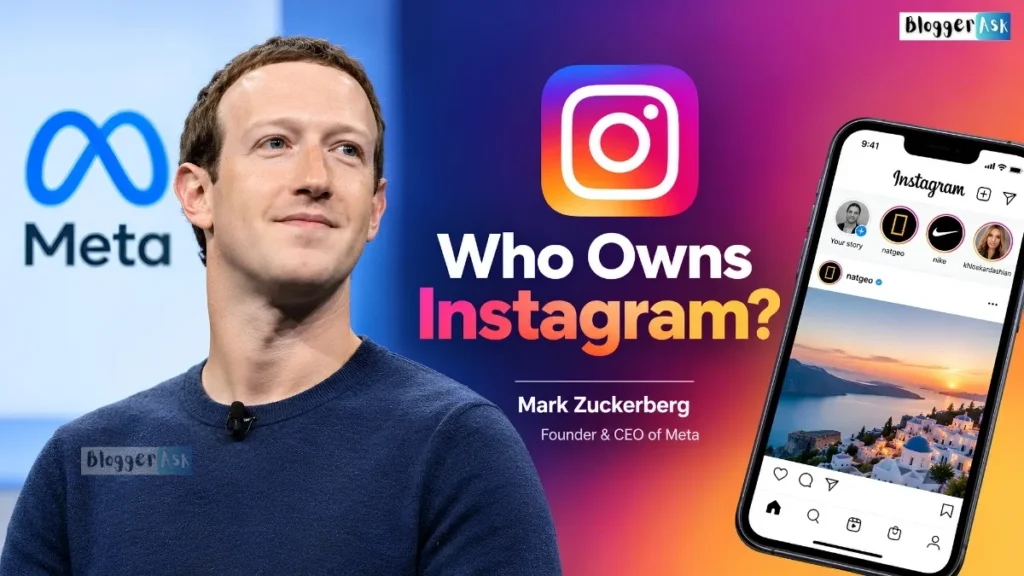
⚡ Quick Answer: Who Owns Instagram in 2026?
Instagram is owned by Meta Platforms, Inc. Meta — then still called Facebook, Inc. — agreed to buy Instagram in April 2012 at a headline price of about $1 billion, though the deal didn’t actually close at that value. By the time it closed that September, Facebook’s newly public stock had fallen, and the final recorded purchase price came in at $715 million. Instagram has run as a wholly owned Meta subsidiary ever since.
Here’s the short version:
- Owner: Meta Platforms, Inc. — no outside partner, no separate stock listing
- Acquired: April 2012; announced at ~$1 billion, closed at $715 million
- Founders: Kevin Systrom and Mike Krieger — both left Meta in September 2018
- Runs it today: Adam Mosseri, Head of Instagram since October 2018
- Users: 3 billion monthly active users, per Meta’s most recent disclosure
- Still its own app: Yes — Instagram was never merged into Facebook
For the full mechanics of how Meta’s ownership actually works — the dual-class shares, Zuckerberg’s voting control, the institutional shareholder breakdown — see our companion guide to who owns Facebook. That structure is identical here, since Instagram has no separate shares or board of its own. This article focuses on what’s specific to Instagram: how the acquisition actually happened, who’s led it since, and the one legal fight that could still, in theory, change who owns it.
Who Owns Instagram? Three Layers of Ownership Explained
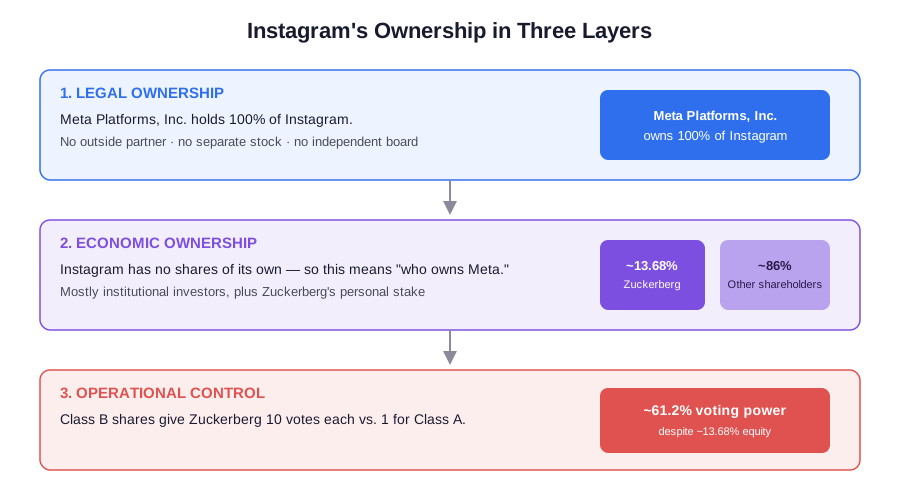
“Who owns Instagram” sounds like a one-word answer — and it is, technically: Meta. But that single word hides three separate questions that most explanations blur together. Splitting them apart is the only way to actually answer the follow-up questions people usually have, like “does Zuckerberg own Instagram” or “could I ever buy a piece of it directly.”
Legal Ownership — Instagram as a Wholly Owned Subsidiary
Meta Platforms, Inc. holds 100% of Instagram. There’s no minority partner, no independent board, and no separate stock ticker. Legally, Instagram isn’t really a standalone company anymore — it’s a product line inside Meta, the same way Reels is a feature inside Instagram.
Verify it yourself in about ten seconds: open Instagram’s listing on the Apple App Store or Google Play. The developer is listed as Meta Platforms, Inc. That’s the fastest, most direct confirmation available — no article required.
Economic Ownership — Meta’s Shareholders
Because Instagram has no shares of its own, asking who owns it “economically” is really asking who owns Meta. Like most large public companies, that’s overwhelmingly institutional money: index funds and asset managers such as Vanguard (~8.8%) and BlackRock (~7.66%) hold the largest individual blocks, managing that money on behalf of millions of ordinary retirement savers and pension holders rather than as a strategic bet on Zuckerberg’s vision. Zuckerberg himself holds a comparatively modest personal equity stake — about 13.68%.
Operational Control — Zuckerberg’s Voting Power
This is the layer most explainers skip, and it’s the actual answer to “does Zuckerberg own Instagram.”
Meta uses a dual-class share structure. Class A shares — the ones anyone can buy on Nasdaq — carry one vote each. Class B shares, of which Zuckerberg personally holds roughly 99.7%, carry ten votes each. That gap gives him about 61.2% of Meta’s total voting power on an equity stake of only around 13.68%.
In plain terms: Zuckerberg doesn’t own Instagram in his own name, and he owns only a minority slice of Meta’s economic value. But he controls Meta outright, and Meta owns Instagram — so functionally, no product decision, leadership change, or acquisition involving Instagram happens without his sign-off, regardless of what any other shareholder wants.
Who Bought Instagram? The 2012 Facebook Acquisition
Facebook — the company wasn’t renamed “Meta” until 2021 — announced it was acquiring Instagram on April 9, 2012. At the time, Instagram had:
- 13 employees
- Zero revenue
- Roughly 30 million registered users
- Been live for just 18 months, having launched in October 2010
Put another way: at the announced $1 billion price, Facebook was effectively valuing each of Instagram’s 13 employees at around $77 million — for a company that had never earned a dollar. That ratio, more than the total price tag itself, is what made the deal front-page news at the time.
The Deal Terms — What Was Announced vs. What Was Actually Paid
Almost every article on this topic repeats “$1 billion” as a flat, settled fact. It’s the headline number, but it isn’t what Facebook actually ended up paying — and the reason why is a genuinely useful detail most competing explainers skip entirely.
| Component | Detail |
|---|---|
| Structure announced (April 2012) | $300 million cash + 22,999,412 shares of Facebook stock |
| Headline value at announcement | ~$1 billion |
| Facebook’s IPO | May 2012 (one month after the deal was announced) |
| Deal officially closed | September 2012 |
| Final recorded purchase price | $715 million |
| Reason for the difference | Facebook’s stock price fell sharply after its IPO, so the fixed share count in the deal shrank in dollar value before it closed |
Worth sitting with for a moment: Instagram’s founders and early investors agreed to a fixed share count rather than a fixed dollar amount, meaning they absorbed the full risk of Facebook’s post-IPO stock slide. Meta’s 2014 WhatsApp deal moved in the opposite direction — Facebook’s stock had risen by the time that acquisition closed, pushing WhatsApp’s final price up rather than down, as covered in our who owns WhatsApp guide.
Why Facebook Bought a Company With No Revenue
Instagram wasn’t growing as a feature inside Facebook’s ecosystem — it was growing as a genuine alternative to it, specifically in mobile photo-sharing, an area where Facebook’s own product was weaker at the time. That distinction later became legally significant.
During the 2025 federal antitrust trial, the FTC pointed to a 2008 line from Zuckerberg — that it’s “better to buy than compete” — as evidence that Facebook had, in the agency’s words, “systematically tracked potential rivals and acquired companies that it viewed as serious competitive threats.” Zuckerberg testified that the internal emails cited by the FTC’s attorneys were written early in the acquisition process and didn’t reflect the full scope of his reasoning. That courtroom back-and-forth is the version of the story that doesn’t show up in most “who owns Instagram” explainers, simply because it only became public record well after most of that content was originally written.
What Happened to Instagram’s Founders?
Kevin Systrom (CEO) and Mike Krieger (CTO) co-founded Instagram in October 2010 and continued running it as a semi-independent unit inside Facebook for six years after the sale — an unusually long runway compared to how quickly most acquired startups typically get folded in.
The 2018 Departure
Both left in September 2018. Neither gave a detailed public explanation at the time, but subsequent reporting pointed to growing friction with Zuckerberg over Instagram’s autonomy — specifically, pressure to prioritize growth metrics that served Facebook’s broader numbers over Instagram’s own product direction.
Where Are They Now?
This is the part almost no competing article covers, and it’s a natural question for anyone who just learned the founders left.
Systrom and Krieger spent a few quiet years building before launching Artifact, an AI-powered personalized news app, in January 2023. It struggled to find a large enough market and shut down in January 2024, with the underlying technology sold to Yahoo that April. Krieger then joined Anthropic — the AI company behind Claude — as its first Chief Product Officer in May 2024. Systrom has since stepped mostly into investing and advisory work rather than another full-time operating role.
Neither founder retained any ongoing ownership stake in Instagram itself after 2018 — their financial upside from the original sale was in Facebook/Meta stock received at the time of the deal, not in any continuing claim on Instagram as a business, because Instagram stopped existing as a separate business the moment the 2012 deal closed.
Who Is Instagram’s CEO? Adam Mosseri and Meta’s Leadership Structure
Adam Mosseri has led Instagram since October 2018, holding the title Head of Instagram — not CEO. That distinction is deliberate and matters for the same reason it matters at every other Meta-owned app: running a product and owning it are two different things.
Mosseri joined Facebook in 2008 and previously led Facebook’s News Feed team before moving over to Instagram. He reports up through Meta’s broader corporate structure and ultimately answers to Zuckerberg — he does not sit on an independent board, and he has no personal ownership stake in Instagram as a separate entity.
Leadership vs. Ownership
It’s worth stating this plainly, because it’s the single most common source of confusion on this whole topic: Mosseri sets Instagram’s day-to-day product direction. He does not own Instagram, and he isn’t the one who would decide whether Meta ever sells, spins off, or shuts it down. That authority sits with Meta’s controlling shareholder — Zuckerberg — not with whoever happens to hold the “Head of Instagram” title at any given time.
Is Instagram Owned by Facebook? Clearing Up the Meta Rebrand
Short answer: not anymore, at least not under that name — and this is a common enough point of confusion to be worth resolving directly.
The 2021 Rebrand
On October 28, 2021, Mark Zuckerberg announced that Facebook, Inc. would rename itself Meta Platforms, Inc. The Facebook app didn’t go anywhere and didn’t change ownership — the parent company simply adopted a new corporate name, partly to reflect a strategic pivot toward what Zuckerberg called the metaverse, and partly to put some distance between the parent brand and the controversies that had built up specifically around the “Facebook” name.
So when someone asks “is Instagram owned by Facebook,” the accurate answer is: it’s owned by the same company that used to be called Facebook, Inc. — which has been named Meta Platforms, Inc. since October 2021. “Facebook” today refers only to one product inside that company, the same category Instagram sits in.
Instagram vs. Meta’s Other Apps
Instagram sits alongside Facebook, WhatsApp, Messenger, and Threads under what Meta internally calls its “Family of Apps.” Each keeps its own brand, its own app, and its own development team — none have been merged into one product.
| App | Origin | Year | Kept separate brand? |
|---|---|---|---|
| Built in-house | 2004 | Yes | |
| Acquired (~$1B announced / $715M closed) | 2012 | Yes | |
| Acquired (~$19B) | 2014 | Yes | |
| Messenger | Split out from the Facebook app | 2011–2014 | Yes |
| Threads | Launched in-house | 2023 | Yes |
For WhatsApp’s own acquisition story and its separate ongoing legal fights, see our guide to who owns WhatsApp.
The FTC Antitrust Case: Could Instagram Ever Be Split From Meta?
This is the section that makes an Instagram-specific ownership article genuinely different from a general Meta-ownership piece — because of the two acquisitions the FTC challenged, Instagram was the sharper, more central example the agency used to build its case.
Why the FTC Sued Meta Over the Instagram Deal
The U.S. Federal Trade Commission sued Meta in December 2020, arguing that its 2012 purchase of Instagram and its 2014 purchase of WhatsApp together formed a deliberate strategy: buy potential rivals in personal social networking before they could grow into real competitors, and by doing so, illegally maintain a monopoly rather than compete on the merits. The FTC’s complaint centered on Instagram specifically as a genuine emerging threat in mobile photo-sharing, an area where Facebook’s own product was underperforming at the time, and it argued Facebook had enacted policies specifically designed to make it hard for smaller rivals to gain a foothold.
The November 2025 Ruling in Meta’s Favor
The case went to a full bench trial that began in April 2025, with Zuckerberg testifying that month, and wrapped up in late May 2025. On November 18, 2025, U.S. District Judge James Boasberg ruled in Meta’s favor. Crucially, his ruling didn’t turn on whether the original 2012 and 2014 acquisitions were themselves improper — it turned on a narrower legal question: whether Meta holds illegal monopoly power right now.
Boasberg found that the social media landscape has shifted meaningfully since the FTC first filed its case in 2020, with real competitive pressure now coming from platforms the FTC’s own market definition had excluded, including TikTok and YouTube. As he put it, the agency needed to show Meta “continues to hold such power now” — and, in the court’s judgment, it hadn’t.
The FTC’s Appeal — Where the Case Stands in 2026
The FTC did not accept that outcome as final. It filed a formal notice of appeal to the D.C. Circuit Court of Appeals on January 20, 2026. The agency’s stated position is that competition today doesn’t undo what it argues was anticompetitive conduct at the time of the original acquisitions — a framing distinct from, and broader than, the “is Meta a monopoly right now” question the district court actually ruled on.
As of September 2026, this appeal remains genuinely open and unresolved. No divestiture order — meaning no ruling forcing Meta to spin Instagram off as a separate company — has been issued, and none is imminent while the appeal is pending. This is the single most commonly outdated fact across other coverage of this topic: several existing “who owns Instagram” articles, even ones published after January 2026, still describe the November 2025 ruling as the final word, without mentioning that the FTC is actively appealing it.
What Would Actually Change If Meta Lost
It’s worth being concrete about this, since almost no other source addresses it directly. If the FTC eventually succeeded on appeal — a process legal observers generally expect could take a year or more, and could ultimately reach the Supreme Court — the remedy the FTC originally sought was divestiture: an order requiring Meta to sell or spin off Instagram (and potentially WhatsApp) into an independent company. That would be a landmark, rarely used antitrust remedy in the tech sector.
It would not retroactively undo Meta’s ownership up to that point, and it would have no effect on Meta’s dual-class share structure or Zuckerberg’s control over whatever remained of Meta itself. It’s a real, live possibility — just not a current or imminent one.
How Much Is Instagram Worth to Meta?
Meta does not report Instagram’s revenue or valuation as a standalone figure. It’s folded into Meta’s broader “Family of Apps” segment alongside Facebook, and Meta stopped disclosing quarterly per-app user metrics altogether starting in April 2024, shifting instead to a combined “daily active people” figure across all its apps.
What Meta Discloses — and What It Doesn’t
Here’s the honest breakdown, rather than a confident-sounding invented number:
- What Meta has confirmed: Zuckerberg personally announced in September 2025 that Instagram had crossed 3 billion monthly active users — the most recent official figure available, up from the 2 billion Meta last disclosed back in October 2022.
- What Meta has not confirmed: any standalone Instagram revenue or ad-income figure. Third-party analysts have estimated Instagram’s contribution at anywhere from roughly a third to more than half of Meta’s total advertising revenue, but these are outside estimates, not Meta disclosures — and the sheer width of that range is itself a sign of how little verified data is actually public.
Treat any precise dollar figure you see quoted for “Instagram’s value” or “Instagram’s revenue” as an estimate, not a fact, unless it’s directly attributed to an official Meta earnings disclosure.
Instagram & Meta at a Glance
| Question | Answer |
|---|---|
| Who owns Instagram? | Meta Platforms, Inc. (100%, wholly owned subsidiary) |
| When was it acquired? | April 2012 (deal closed September 2012) |
| How much did it cost? | Announced ~$1 billion; final recorded price $715 million |
| Who founded it? | Kevin Systrom and Mike Krieger (October 2010) |
| Who runs it today? | Adam Mosseri, Head of Instagram (since October 2018) |
| Who controls Meta? | Mark Zuckerberg — ~13.68% equity, ~61.2% voting power |
| Is it a separate public company? | No — no separate stock, board, or shares |
| Any live legal threats to that ownership? | Yes — FTC’s antitrust appeal, pending at the D.C. Circuit as of September 2026 |
Key Takeaways
- Meta Platforms, Inc. owns Instagram outright, as a wholly owned subsidiary — the same corporate structure as Facebook and WhatsApp.
- Meta agreed to buy Instagram in April 2012 at a headline price of ~$1 billion, but the deal actually closed at $715 million once Facebook’s post-IPO stock price had fallen.
- Founders Kevin Systrom and Mike Krieger left in September 2018; neither retained any ownership stake in Instagram afterward. Krieger is now Chief Product Officer at the AI company Anthropic.
- Adam Mosseri has led Instagram since 2018 as Head of Instagram — a leadership role, not an ownership one.
- Mark Zuckerberg controls Meta — and, through it, Instagram — via roughly 61.2% voting power, despite owning only about 13.68% of the company’s equity.
- The FTC’s antitrust appeal, filed January 2026 against a November 2025 ruling in Meta’s favor, remains unresolved as of September 2026 — making Instagram’s ownership the one part of this whole picture that’s genuinely still an open legal question.
Conclusion
The one-line answer to “who owns Instagram” hasn’t changed since 2012: Meta Platforms, Inc. does, outright, with no partner and no separate shares. What has changed — and what a surprising amount of existing coverage hasn’t caught up to — is that this ownership isn’t quite as settled a fact as it looks on the surface.
A federal appeals court is currently weighing whether the 2012 deal that created this ownership in the first place amounted to illegal monopoly-building. That case won’t resolve quickly, and it may ultimately change nothing at all. But as of today, it’s the one genuinely live thread in an otherwise straightforward ownership story, and it’s worth understanding rather than assuming it was closed back in November 2025.
FAQs
Who owns Instagram?
Meta Platforms, Inc. Meta acquired Instagram in April 2012, and it has operated as a wholly owned subsidiary — with no outside partner or separate shares — ever since.
Does Mark Zuckerberg own Instagram?
Not directly. Zuckerberg controls Meta through Class B shares that give him roughly 61.2% of the company’s voting power, despite owning only about 13.68% of its equity. Meta, in turn, owns Instagram outright. So Zuckerberg controls Instagram indirectly, through Meta — he holds no separate personal stake in Instagram itself.
Is Instagram owned by Facebook?
It’s owned by the company that used to be called Facebook, Inc. — which renamed itself Meta Platforms, Inc. in October 2021. “Facebook” today refers only to one app inside that company, the same category Instagram belongs to.
Who bought Instagram, and for how much?
Facebook (now Meta) agreed to buy Instagram in April 2012, announced at roughly $1 billion in cash and stock. The deal’s actual recorded closing price was $715 million, because Facebook’s stock fell after its May 2012 IPO before the acquisition officially closed that September.
Who is Instagram’s CEO?
Instagram doesn’t have a standalone CEO. Adam Mosseri has led the app since October 2018 with the title Head of Instagram, reporting into Meta’s broader executive structure rather than operating as an independent chief executive.
Who founded Instagram?
Kevin Systrom and Mike Krieger co-founded Instagram in October 2010. Both left Meta in September 2018; Krieger is now Chief Product Officer at the AI company Anthropic.
Could Instagram be forced to split from Meta?
It’s possible but unresolved. The FTC’s antitrust case argued that Meta’s 2012 Instagram acquisition helped illegally maintain a monopoly. A federal judge ruled in Meta’s favor in November 2025, but the FTC filed a notice of appeal in January 2026, and that appeal remains pending at the D.C. Circuit Court of Appeals as of September 2026. No divestiture has been ordered.
How many users does Instagram have in 2026?
Meta’s most recent disclosure, announced by Zuckerberg in September 2025, put Instagram at 3 billion monthly active users. Meta stopped reporting standalone per-app user figures on a regular quarterly basis starting in April 2024, so this is the most current official number available rather than a live quarterly figure.
📖 Continue Reading:
Disclaimer
This article covers ongoing litigation — specifically the FTC’s antitrust appeal against Meta — that had not reached a final resolution as of publication. Legal status, court dates, and case outcomes described here are subject to change. Nothing in this article constitutes legal or financial advice. Facts were last verified in September 2026.

Olivia Isabel is a Business & Technology Writer specializing in corporate ownership, company leadership, shareholders, acquisitions, and the business strategies behind major global companies. Her work covers technology, artificial intelligence, social media, finance, e-commerce, automotive, and consumer technology, with a particular focus on explaining who owns, controls, and leads well-known companies.
With a background in Economics and Journalism, Olivia approaches each topic as a research-driven business story. She examines company filings, investor-relations materials, regulatory records, official corporate announcements, and reputable financial sources to distinguish between legal ownership, economic ownership, voting control, and day-to-day management.
Her articles explore the founders behind major companies, current CEOs, significant shareholders, parent companies, subsidiaries, acquisitions, and changes in corporate structure. She has written about companies including Google, Alphabet, Apple, Microsoft, Amazon, Meta, OpenAI, Tesla, SpaceX, YouTube, Instagram, TikTok, WhatsApp, Reddit, Spotify, and other major technology and consumer brands.
Olivia’s goal is to make complicated corporate and financial information clear, accurate, and useful for everyday readers. She is particularly interested in corporate strategy, technology business models, entrepreneurship, emerging AI companies, public markets, and the evolution of globally recognized brands.