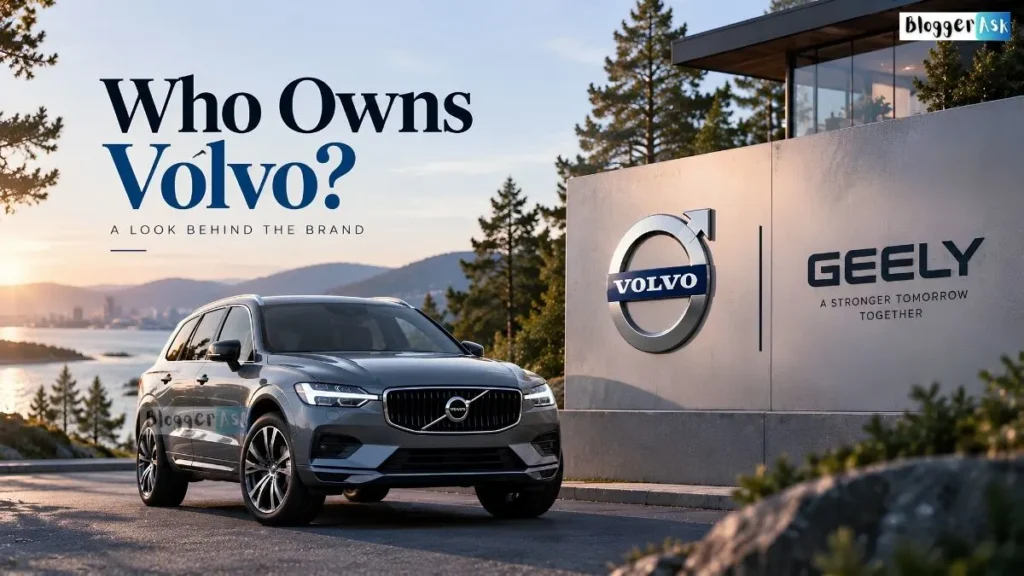
⚡ Quick Answer: Who Owns Volvo in 2026?
Volvo Cars is majority-owned by Geely Holding, a Chinese automotive group, through its subsidiary Geely Sweden Holdings AB, which holds about 78.7% of Volvo Cars’ shares and voting rights. Geely bought Volvo Cars from Ford Motor Company in 2010. But that’s only half the picture: Volvo Trucks (officially AB Volvo, or “Volvo Group”) is a completely separate, independently owned company that makes trucks, buses, and construction equipment — Geely owns only a small minority stake in it, and neither Geely nor Volvo Cars controls it.
Volvo Cars vs. Volvo Trucks: Two Different Companies
Here’s the thing almost nobody explains clearly: there is no single company called “Volvo.” There are two separate businesses that both use the Volvo name, with different owners, different leadership, and different products.
| – | Volvo Cars | Volvo Group (Volvo Trucks) |
|---|---|---|
| Legal name | Volvo Car AB | Aktiebolaget Volvo (AB Volvo) |
| Controlling owner | Geely Holding (~78.7%) | No single controlling owner |
| Largest shareholder | Geely Sweden Holdings AB | AB Industrivärden |
| Headquarters | Gothenburg, Sweden | Gothenburg, Sweden |
| Stock ticker | Nasdaq Stockholm: VOLCAR B | Nasdaq Stockholm: VOLV A / VOLV B |
| Main products | Passenger cars (XC, S, EX series) | Trucks, buses, construction equipment, marine engines |
| CEO (as of Sept 2026) | Håkan Samuelsson (transitioning to Klaus Zellmer by Oct. 2027) | Martin Lundstedt |
Why the Volvo Name Covers Two Separate Businesses
Volvo started as one company in 1927. That changed in 1999, when AB Volvo sold its passenger car division, Volvo Cars, to Ford Motor Company to focus entirely on its trucking and industrial business (Volvo Cars). From that point on, the two businesses have had separate owners, separate boards, and separate financial results.
They still share the Volvo name and logo because both companies jointly own the trademark through a shared entity called Volvo Trademark Holding AB (Volvo Cars). That’s why you’ll see the same round Volvo badge on a family SUV and on a long-haul semi truck, even though buying stock in one company gets you zero ownership in the other.
How to Tell Which “Volvo” You’re Asking About
If you’re not sure which Volvo you mean, ask yourself these two questions:
- Are you asking about a car you’d drive, or a truck/bus/piece of construction equipment?
- Car → you mean Volvo Cars, majority-owned by Geely Holding.
- Truck, bus, or heavy equipment → you mean Volvo Group (AB Volvo), which is independently owned.
- Did the question come up because of news about “Chinese ownership,” a leadership change, or reliability?
- Almost always, that’s about Volvo Cars. Volvo Group rarely comes up in that conversation, because it isn’t Chinese-controlled and has had stable, unrelated leadership for a decade.
Once you know which company you’re asking about, the rest of the ownership picture is much easier to follow.
Who Owns Volvo Cars?
Geely Holding’s Current Stake
Volvo Cars is controlled by Zhejiang Geely Holding Group, a privately held Chinese automotive conglomerate founded by Li Shufu — who has increasingly gone by the Western name Eric Li in recent international press coverage, so you may see both names used for the same person. Geely doesn’t hold its Volvo Cars stake directly — it goes through a subsidiary called Geely Sweden Holdings AB, which holds approximately 78.7% of Volvo Cars’ outstanding shares and voting rights, according to Volvo Cars’ own investor disclosures and public share-register data (Volvo Cars). Geely has publicly stated it has no plans to reduce this position, describing itself as a long-term, controlling shareholder.
Li Shufu (Eric Li) also chairs Volvo Cars’ board of directors, which gives Geely direct influence over the company’s strategic direction, not just a passive financial stake.
What “Controlling Shareholder” Actually Means Here
Owning roughly 78.7% of a company doesn’t mean Geely runs Volvo’s day-to-day operations. In practice:
- Geely provides capital, scale, and access to the Chinese market — the world’s largest EV market — along with shared technology platforms.
- Volvo Cars keeps its own management team, engineering culture, and design language, still based out of Gothenburg, Sweden.
- Geely sets the big strategic direction (electrification targets, cross-brand partnerships) but doesn’t dictate individual car designs or day-to-day engineering decisions.
Think of it less like a takeover and more like a majority owner who sets the overall direction while leaving the existing team to run the business — a distinction that matters even more now, given the leadership change discussed later in this article.
Is Volvo Cars a Public or Private Company?
Both. Volvo Cars went public on the Nasdaq Stockholm stock exchange in October 2021, trading under the ticker VOLCAR B. But going public didn’t end Geely’s control — Geely Sweden Holdings simply kept its majority stake while selling a minority of shares to public investors. So Volvo Cars is a publicly traded company that is still majority-owned and controlled by one shareholder. That’s a common structure for companies coming out of a holding-group parent, but it does mean the “free float” — the shares regular investors can actually buy — is a small slice of the total (around one-fifth of outstanding shares).
Who Owns Volvo Trucks (Volvo Group)?
This is where most articles about Volvo ownership go wrong. Volvo Trucks — along with Volvo Buses, Volvo Construction Equipment, and Volvo Penta marine engines — all sit under AB Volvo (Volvo Group), and this company has never been owned by Ford and is not controlled by Geely.
AB Volvo’s Shareholder Structure
AB Volvo is a widely held public company with no single majority owner. As of 2026 company disclosures, the largest shareholders by voting power are:
| Shareholder | Capital Stake | Voting Rights |
|---|---|---|
| AB Industrivärden | ~9.4% | ~28.0% |
| Geely | ~4.4% | ~14.7% |
| Other institutional & individual shareholders | Remainder | Remainder |
(Figures per Wikipedia’s sourced company data; Swedish public companies often report capital stake and voting rights separately because some share classes carry more votes than others.)
AB Volvo’s board is chaired by Pär Boman, re-elected to the role at the company’s Annual General Meeting on April 8, 2026, and the company is run day-to-day by President and CEO Martin Lundstedt, who has held the role since 2015 (AB Volvo). Neither reports to Geely or to Volvo Cars.
Geely’s Minority Stake in Volvo Group — Why It’s Not the Same as Volvo Cars
Geely’s relationship with AB Volvo has a longer history than most people realize. In December 2017, Geely bought an 8.2% capital stake and 15.6% of the voting rights in AB Volvo from activist investor Cevian Capital, briefly making Geely the company’s largest shareholder by capital at the time. Since then, that position has narrowed — current disclosures put Geely at roughly 4.4% of capital and 14.7% of votes — while AB Industrivärden has built up the largest voting bloc, around 28%. That makes Geely a notable shareholder, and historically one of the largest, but nowhere close to a controlling stake.
So while it’s fair to say “Geely has a stake in Volvo Trucks,” it is not accurate to say Geely owns or controls Volvo Trucks the way it controls Volvo Cars. Confusing the two is the single most common mistake in ownership explainers on this topic — and it’s worth remembering every time you see a headline lumping “Volvo” together as one Chinese-owned company.
The Ford-to-Geely History: How Ownership Changed Over Time
1999: AB Volvo Sells Volvo Cars to Ford
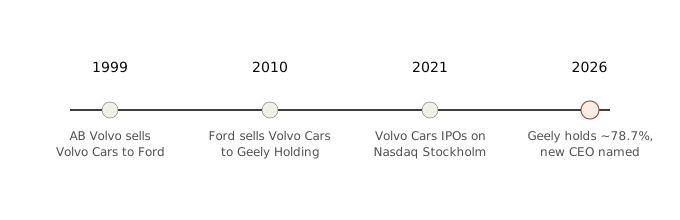
Ford Motor Company acquired Volvo Cars from AB Volvo in 1999 for roughly $6.45 billion, folding it into Ford’s now-defunct Premier Automotive Group alongside Jaguar and Land Rover (Volvo Cars). AB Volvo kept the trucks, buses, and construction equipment business, which is why that side of the company was never part of the Ford deal.
Why Ford Sold Volvo in 2010
Ford’s decision wasn’t really about Volvo — it was about Ford. The 2008–2009 global financial crisis hit the auto industry hard, and Ford needed cash and focus. The company had already sold Aston Martin in 2007 and would go on to sell Jaguar and Land Rover to Tata Motors in 2008. Volvo was next, and Ford ultimately sold it for a fraction of what it had paid a decade earlier — a sign of how much the brand’s value had eroded under Ford’s ownership, and how urgently Ford needed to simplify its portfolio to survive the downturn.
2010: Geely Acquires Volvo Cars
Zhejiang Geely Holding Group purchased Volvo Cars from Ford for about $1.8 billion, with the deal closing in August 2010. At the time, it was the largest overseas acquisition by a Chinese car manufacturer, and it gave Geely full ownership of a century-old Swedish brand along with its engineering talent and safety reputation.
2021: Volvo Cars Goes Public on Nasdaq Stockholm
After more than a decade as a wholly Geely-owned company, Volvo Cars listed on the Nasdaq Stockholm exchange in October 2021 under the ticker VOLCAR B. The IPO let outside investors buy shares for the first time, but Geely retained its controlling stake through Geely Sweden Holdings — a structure that remains in place today, even as Geely has gradually trimmed the stake to improve trading liquidity.
Is Volvo a Chinese Company Now?
What Chinese Ownership Actually Means for Volvo Cars
Yes — in terms of ownership, Volvo Cars is majority-owned by a Chinese company. That’s a straightforward fact, not really up for debate. What it doesn’t mean is that Volvo Cars has become a Chinese-run company in the way people sometimes assume. Volvo Cars keeps its own Swedish management team, its own engineering and safety standards, and its own brand identity — Geely’s role is closer to a financial and strategic parent than a hands-on operator.
It’s also worth repeating: Volvo Trucks (AB Volvo) is not a Chinese-owned company. Geely holds a minority stake there, but Swedish investment firm Industrivärden holds the larger voting position, and AB Volvo has no controlling shareholder at all.
Is Volvo Still Made in Sweden?
Yes. Volvo Cars’ headquarters, design studios, and a major production plant remain in Gothenburg, Sweden. That said, Volvo Cars also builds vehicles outside Sweden — including a plant in Ridgeville, South Carolina, in Belgium, and in China — the same way most global automakers spread manufacturing across several countries. Being Chinese-owned and being built partly in Sweden, partly in the U.S., and partly in China are not contradictions; they’re just how modern car manufacturing works. Ownership and manufacturing location are two separate facts, and it’s easy to conflate them — the same way ownership and day-to-day leadership are separate facts, as the CEO transition discussed below illustrates.
Does Chinese Ownership Affect Build Quality or Safety?
There’s no evidence that Geely’s ownership has lowered Volvo’s build quality or safety standards. If anything, Geely’s financial backing gave Volvo Cars resources it struggled to get under Ford, funding its shift into electric vehicles and expanding its global manufacturing footprint. Volvo has continued to rank among the industry’s safety leaders throughout the Geely ownership period. Whether Chinese ownership matters to you personally is a values judgment, not a factual one — but it’s not something the evidence ties to a measurable drop in quality or safety.
Does Volvo Still Use Ford Engines?
No — and this is a common misconception left over from the Ford era. Volvo Cars hasn’t used Ford-designed engines since well before the Geely acquisition closed. But the more interesting, less-covered question is: who makes Volvo’s engines now?
Who Makes Volvo’s Engines Today
Volvo Cars doesn’t build its own combustion or hybrid engines anymore — it deliberately exited that business to focus entirely on electric vehicle development. As of 2026, Volvo’s hybrid and plug-in hybrid powertrains are supplied by an outside joint venture rather than built in-house.
The Aurobay-to-Horse Powertrain Story
Here’s the chain almost no other ownership explainer covers:
- In 2021, Volvo Cars and Geely Holding spun off Volvo’s engine-development unit into a standalone joint venture called Aurobay, so Volvo Cars could focus fully on electric vehicles.
- In November 2022, Volvo Cars divested its entire 33% stake in Aurobay to Geely Holding, making Volvo Cars the first major automaker to fully exit internal combustion engine development and manufacturing.
- In 2024, Aurobay was folded into a new, larger joint venture called Horse Powertrain, which is equally owned by Renault and Geely (45% each), with Saudi Aramco holding the remaining 10% (Wikipedia).
So today, the honest answer to “who makes Volvo’s engines” is: a Renault-Geely-Saudi Aramco joint venture called Horse Powertrain, supplying hybrid powertrains to a car company that no longer builds engines of its own — because it’s aiming to sell only fully electric vehicles by 2030, a target now under review as part of the strategic reset discussed below.
Who Owns Polestar?
Polestar started as a Volvo performance sub-brand and became an independent, Nasdaq-listed electric-vehicle company, but it’s still closely tied to both Volvo Cars and Geely. Volvo Cars’ stake in Polestar has moved significantly in 2026: it held about 9.8% at the start of the year, then converted roughly $274 million of an outstanding loan into equity at the end of March, lifting its stake to 19.9%.
A related debt-to-equity conversion by Geely Sweden Holdings AB temporarily diluted that position before a second, smaller conversion by Volvo Cars in the following quarter restored it to 19.9% (CB Insights). Geely Holding and its affiliates remain Polestar’s other major shareholder group. In short: Polestar is not owned by Volvo Cars, but Volvo Cars is one of its largest shareholders, alongside Geely.
Why Volvo’s Ownership Matters Right Now (2026)
Geely’s ownership of Volvo Cars isn’t just a historical fact from 2010 — it’s shaping decisions happening this week. On September 20, 2026, Volvo Cars’ board announced that Klaus Zellmer, previously CEO of Volkswagen-owned Škoda Auto, will take over as President and CEO no later than October 1, 2027, succeeding Håkan Samuelsson (Volvo Cars). This is a leadership change, not an ownership change — Geely’s roughly 78.7% stake is unaffected — but it’s a clear sign of how much pressure Volvo Cars is under and how directly Geely is now involved in steering the company through it.
The context behind the move is blunt. Volvo Cars’ shares have fallen by around 40% in 2026, the company is contending with a sharp downturn in Chinese EV demand, and U.S. tariffs have hit its business hard since most of its America-bound vehicles are built in Europe (Euronews). Samuelsson himself, who returned for a second stint as CEO in April 2025 specifically to stabilize the company, has publicly described the Chinese market as having “collapsed” by roughly 30% this year. Zellmer’s mandate, according to Volvo Cars’ own board chairman Eric Li, includes deepening collaboration with Geely’s other brands as part of the turnaround plan.
How Geely Ownership Shapes Volvo’s Current Strategy
Two concrete, current examples show what this looks like in practice:
- A leadership mandate built around the Geely relationship. Zellmer’s incoming priorities reportedly include rebalancing Volvo’s drivetrain strategy with more hybrids and deepening cooperation with parent company Geely — meaning Geely’s ownership stake is now translating into an explicit strategic mandate for Volvo’s next CEO, not just a shareholder register entry.
- Retail partnership with Lynk & Co. Volvo Cars has also taken on distribution and retail responsibilities for Lynk & Co, another Geely-affiliated brand, across parts of Europe — using Volvo’s existing dealer network while Geely retains control of Lynk & Co’s product development and global brand strategy.
Neither example changes who owns Volvo Cars. But both show that Geely’s ownership now translates into real, escalating operational cooperation across its brand portfolio, especially as Volvo works through one of the most difficult stretches in its recent history — not just a name on a shareholder register.
Who Owns Volvo: The Bottom Line
- Volvo Cars is majority-owned and controlled by Geely Holding (via Geely Sweden Holdings AB), which holds about 78.7% of shares and votes, as of September 2026. Its CEO is transitioning from Håkan Samuelsson to incoming CEO Klaus Zellmer, a leadership change that does not affect Geely’s ownership stake.
- Volvo Trucks (AB Volvo / Volvo Group) is a separate, independently owned public company, chaired by Pär Boman and run by CEO Martin Lundstedt. Geely holds a minority stake, but Swedish investment firm Industrivärden holds the larger voting position, and no single shareholder controls it.
- Ford Motor Company owned Volvo Cars from 1999 to 2010 and has no ownership stake in either Volvo company today.
- Polestar is a minority-owned affiliate of both Volvo Cars (~19.9%) and Geely, not a subsidiary of either.
- Volvo’s engines are now supplied by Horse Powertrain, a Renault-Geely-Saudi Aramco joint venture — Volvo Cars itself no longer designs or builds engines.
If you take one thing away from this, it should be this: “Volvo” isn’t one company with one owner. It’s two independent businesses that share a name and a badge — and only one of them is majority-owned by a Chinese company, which is now navigating a leadership transition and a genuinely difficult year.
FAQs
Who owns Volvo now, in 2026?
Volvo Cars is majority-owned by Geely Holding (about 78.7%, via Geely Sweden Holdings AB). Volvo Trucks (AB Volvo) is a separate company with no controlling owner, though Geely holds a minority stake there too.
Is Volvo owned by Ford?
No. Ford Motor Company owned Volvo Cars from 1999 to 2010 but sold it to Geely Holding in 2010. Ford has had no ownership stake in Volvo since.
Is Volvo fully owned by China?
Volvo Cars, specifically, is majority-owned by Chinese company Geely Holding — but not 100% owned, since Volvo Cars is publicly traded and Geely holds about 78.7% rather than all of it. Volvo Trucks is not Chinese-owned at all; Geely holds only a minority stake there.
Are Volvo Cars and Volvo Trucks the same company?
No. They split into separate companies in 1999 and have had entirely different owners, management, and financial results ever since. They share the Volvo name through a joint trademark-holding arrangement, nothing more.
Who owns Volvo trucks?
AB Volvo (Volvo Group) has no single controlling owner. Swedish investment firm Industrivärden holds the largest voting stake (~28%), with Geely as a notable minority shareholder (~4.4% of capital, ~14.7% of votes).
Do Volvos still use Ford engines?
No. Volvo Cars hasn’t used Ford-designed engines since before the Geely acquisition. As of 2026, Volvo’s hybrid powertrains come from Horse Powertrain, a joint venture owned by Renault, Geely, and Saudi Aramco.
Is Volvo still made in Sweden?
Yes. Volvo Cars’ headquarters and a major production plant are in Gothenburg, Sweden, alongside additional plants in South Carolina, Belgium, and China.
Who owns Polestar?
Polestar is jointly backed by Volvo Cars (about 19.9% as of mid-2026) and Geely Holding, its two largest shareholder groups. It is not a subsidiary of either company.
📖 Continue Reading:
Sources & References
- Volvo Cars — Board Appoints Klaus Zellmer as President and CEO — official CEO transition announcement, September 20, 2026
- Volvo Cars — “This Is Volvo Cars” — official corporate ownership statement, ticker, and trademark structure
- AB Volvo — Annual General Meeting 2026 — Pär Boman’s re-election as Chairman and current board composition
- Wikipedia — Volvo (AB Volvo) — AB Volvo shareholder structure and voting rights
- Wikipedia — Horse Powertrain — Aurobay’s formation, Geely’s 2022 acquisition, and the 2024 Renault-Geely-Aramco joint venture
- CB Insights — Geely Sweden Holdings — 2026 Polestar debt-to-equity conversion details
- Euronews — Volvo Cars Names Škoda Boss Klaus Zellmer as Next CEO for a Turnaround — 2026 business context: share price decline, tariffs, and Chinese market conditions
Disclaimer
Ownership stakes and shareholder percentages in publicly traded companies change over time as shares are bought, sold, or converted. The figures in this article reflect company disclosures and reporting available as of September 21, 2026. For the most current ownership data, check Volvo Cars’ and AB Volvo’s official investor relations pages directly. This article is for general informational purposes only and is not financial or investment advice.

Alex Miller is an automotive writer and industry researcher specializing in the companies, brands, and corporate groups that shape the global automotive market. His coverage focuses on automotive ownership, parent companies, mergers and acquisitions, brand histories, executive leadership, and the business decisions behind major vehicle manufacturers.
Alex’s work spans mainstream, luxury, performance, and emerging automotive brands. He researches how automakers are structured, which companies control individual brands, how ownership has changed over time, and what those relationships mean for consumers and the wider industry. His coverage includes brands such as Jaguar, Ferrari, BMW, Volvo, Mazda, Lamborghini, Lexus, Acura, Audi, Genesis, Infiniti, Porsche, and Volkswagen.
For ownership and corporate-structure stories, Alex prioritizes primary and authoritative sources, including company filings, investor-relations publications, official corporate announcements, regulatory records, and established automotive and financial publications. This approach helps separate a brand’s public identity from its actual corporate ownership and control.
Alex combines detailed industry research with straightforward explanations designed for both automotive enthusiasts and general readers. Beyond ownership stories, his interests include automotive history, luxury and performance vehicles, electric-vehicle development, mobility companies, motorsports, and the evolving relationship between global automakers and their parent groups.