⚡ Quick Answer: Who Owns PayPal?
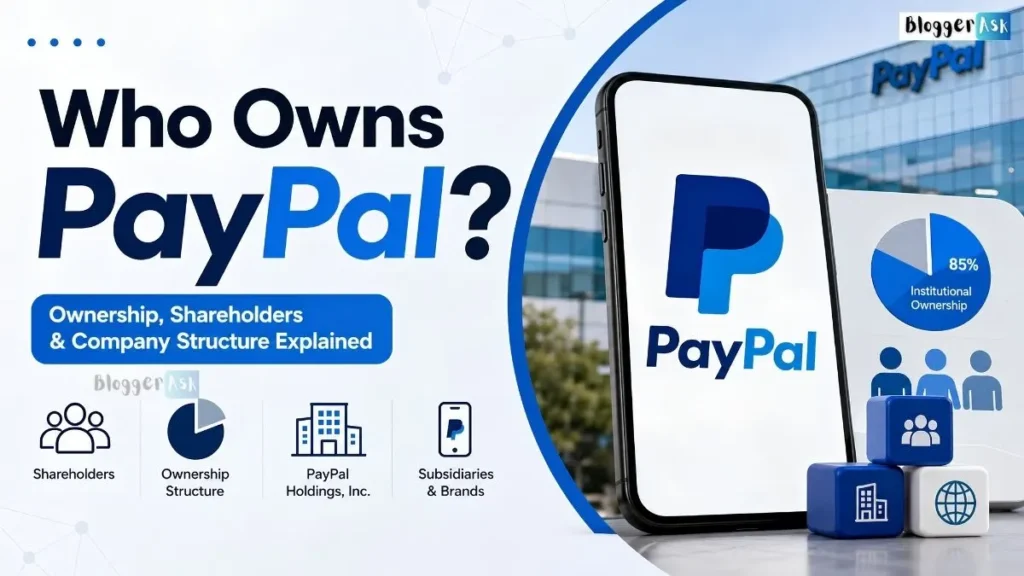
PayPal is owned by its shareholders. PayPal Holdings, Inc. is a publicly traded, independent company listed on the Nasdaq under the ticker PYPL. It is not owned by Elon Musk, and it hasn’t been owned by eBay since 2015. The company’s largest shareholders today are institutional investors — asset managers like Vanguard, BlackRock, and State Street — who between them hold a significant chunk of outstanding shares, though no single shareholder controls the company.
If that raises more questions than it answers — like why Elon Musk’s name keeps coming up, or whether eBay is still involved — that’s normal. PayPal’s ownership story is more tangled than most people expect, and this guide walks through all of it.
Who Owns PayPal Right Now?
The Short Answer
PayPal Holdings, Inc. owns PayPal. It’s a public company, which means its shares trade freely on the Nasdaq stock exchange and anyone — from a large investment fund to an individual with a brokerage app — can buy a piece of it.
There is no single owner. No founder, no billionaire, no other company holds a controlling stake. Instead, ownership is spread across thousands of institutional funds, company insiders, and everyday retail investors.
PayPal Is a Publicly Traded Company, Not a Person or a Single Company
It helps to be precise about what “publicly traded” actually means here. PayPal Holdings has a single class of common stock, meaning every share carries the same voting weight. There’s no special founder-controlled share class of the kind you’ll find at companies like Meta or Alphabet, where a small group can outvote everyone else.
That structure matters because it’s part of why no one person or firm can simply “take over” PayPal by buying a modest stake. Control is genuinely distributed, and it has been since PayPal became independent from eBay in 2015.
Ownership vs. Founding vs. Leadership — Why This Gets Confused
Most of the confusion around “who owns PayPal” comes from blending three separate ideas together. It’s worth pulling them apart, because each one has a different answer:
| Question | What It’s Really Asking | The Answer |
|---|---|---|
| Who owns PayPal? | Who holds the shares / equity today? | Public shareholders — mostly institutional investors, plus insiders and retail investors |
| Who founded PayPal? | Who started the original companies that became PayPal? | Peter Thiel, Max Levchin, and Luke Nosek (Confinity), plus Elon Musk (X.com) |
| Who leads PayPal? | Who runs day-to-day operations now? | CEO Enrique Lores and the current executive team, overseen by the board of directors |
None of these three questions have the same answer, and that’s exactly where most of the internet’s confusion — and most of the “does Elon Musk own PayPal” searches — come from.
Does Elon Musk Own PayPal?
No. Elon Musk does not own PayPal, does not control PayPal, and does not hold a meaningful stake in PayPal today. He hasn’t since the early 2000s. This is one of the most persistent misconceptions in tech history, so it’s worth addressing directly before going any further.
What Elon Musk’s Real Role Was
Musk’s actual connection to PayPal runs through a company he founded, not PayPal itself. In 1999, he founded X.com, an online financial services startup with ambitions to become a full digital bank. Around the same time, Peter Thiel, Max Levchin, and Luke Nosek were building a rival product called Confinity, which included an early money-transfer service that would eventually be called PayPal.
In March 2000, X.com and Confinity merged to avoid competing themselves out of business. Musk served as CEO of the combined company for a period after the merger — but by late 2000, the board had replaced him with Thiel. The company dropped the X.com name and rebranded entirely as PayPal in 2001.
So Musk is accurately described as a co-founder of one of the two companies that became PayPal, and briefly its CEO — but he is not, and has not been, an owner of the company in its current form.
Why the Musk-Ownership Myth Keeps Resurfacing
If Musk left PayPal over two decades ago, why does this question keep trending? Part of the answer is simply that Musk is one of the most talked-about business figures alive, and his name gets attached to almost anything he’s ever touched.
But there’s also a more recent, specific trigger. In December 2025, a viral post on X claimed Peter Thiel had personally fired Musk from PayPal but “kindly” let him keep his full economic stake, cited in that post as roughly 12% of the company. Musk publicly pushed back on that framing, replying that he — not Thiel — was CEO at the time, so Thiel reported to him rather than the other way around, and describing his exit instead as a “palace coup” by most of the executive team and board. Musk also said he had been PayPal’s largest shareholder when he left.
That exchange is a plausible reason search interest in “does Elon Musk own PayPal” and similar phrases has picked back up. It’s worth separating the two claims: the 12% figure and the “kind” framing came from another user’s post, while the “palace coup” description and largest-shareholder claim came from Musk himself. Either way, both accounts describe PayPal’s distant past — not a claim that Musk owns the company today.
Does Elon Musk Still Hold Any Stake Today?
No public disclosure shows Elon Musk as a current PayPal shareholder of note. Musk’s PayPal-era wealth was realized when eBay acquired the company in 2002; like other early shareholders, he cashed out his stake as part of that transaction and used the proceeds to fund his next ventures, including SpaceX and Tesla. Public shareholder and insider filings for PayPal Holdings today do not list Musk among its largest holders.
Why Did Elon Musk Leave PayPal?
The X.com and Confinity Merger (2000)
By 2000, X.com and Confinity were direct competitors chasing the same small market: early online and email-based money transfers. Rather than fight each other for the same users, the two companies merged in March 2000, combining X.com’s banking ambitions with Confinity’s PayPal payment product.
The merged company initially kept the X.com name, with Musk as CEO. Internally, though, the merger brought together two teams with different visions for the company’s direction — a tension that didn’t stay resolved for long.
The Boardroom Change That Removed Musk as CEO
According to a detailed fact-check from Snopes, in the fall of 2000 Musk left for a roughly two-week trip to meet prospective investors. While he was away, the board — led by Thiel and Levchin — moved to replace him as CEO, installing Thiel in his place.
Accounts differ on the precise cause. Some reporting points to disagreements over technical direction and branding, including whether the company should keep the X.com name or move fully to the PayPal brand. Musk has since described it as a “palace coup.” What isn’t disputed is the outcome: Musk was out as CEO by late 2000, and the company rebranded fully as PayPal in 2001.
What Happened After He Left
Musk didn’t walk away empty-handed. As one of the company’s largest shareholders, he retained a substantial equity stake even after leaving the CEO role. When eBay acquired PayPal in 2002, that stake converted into a significant payout, which Musk has said he reinvested into SpaceX and, later, Tesla.
In that sense, PayPal’s ownership structure indirectly helped fund two of the biggest companies of the following two decades — just not because Musk kept owning any piece of PayPal itself.
Is PayPal Still Owned by eBay?
No. eBay has not owned PayPal since 2015. This is another common misconception, usually rooted in outdated information from PayPal’s most well-known ownership era.
How eBay Acquired PayPal (2002)
PayPal went public on the Nasdaq in February 2002, with shares jumping about 50% on their first trading day. That independence was short-lived: later in 2002, eBay acquired PayPal for approximately $1.5 billion, taking it private and folding it into eBay’s own operations.
The logic made sense at the time. PayPal had become the dominant way people paid for items on eBay’s auction marketplace, so eBay effectively bought its own checkout infrastructure.
The 2015 Spinoff — How PayPal Became Independent
eBay owned PayPal for roughly 13 years. In 2015, eBay spun PayPal off as a fully independent, separately traded public company again. eBay shareholders received PayPal shares in the process, and the two companies have operated as completely separate public entities ever since.
Since that spinoff, PayPal has had no ownership relationship with eBay. They remain business partners in a limited sense — PayPal is still an available payment option on eBay’s marketplace — but eBay holds no equity stake in PayPal, and PayPal holds none in eBay.
What eBay’s Founder’s Historical Stake Looked Like
One name that connects both companies’ histories is Pierre Omidyar, eBay’s founder. Filings over the years have shown Omidyar personally holding a notable individual stake in PayPal, a legacy of PayPal’s time under the eBay umbrella and its 2015 spinoff distribution. Individual insider stakes like this are worth noting, but they’re a separate matter from eBay the company holding any current ownership position — it does not.
PayPal’s Ownership History Timeline
The full ownership story spans nearly three decades and several distinct eras. Here’s the sequence in order:
| Year | Event |
|---|---|
| 1998 | Confinity is founded by Peter Thiel, Max Levchin, and Luke Nosek |
| 1999 | Confinity launches an early money-transfer product; separately, Elon Musk founds X.com as an online financial services company |
| March 2000 | X.com and Confinity merge; the combined company initially keeps the X.com name, with Musk as CEO |
| Late 2000 | The board replaces Musk with Peter Thiel as CEO |
| 2001 | The company drops the X.com name and rebrands entirely as PayPal |
| February 2002 | PayPal goes public on the Nasdaq |
| October 2002 | eBay acquires PayPal for approximately $1.5 billion |
| 2002–2015 | PayPal operates as a wholly owned subsidiary of eBay |
| 2013 | PayPal acquires Braintree, which had separately acquired Venmo the year before — bringing Venmo into the PayPal family indirectly |
| July 2015 | eBay spins PayPal off as an independent public company again; PayPal Holdings, Inc. is born |
| 2015–present | PayPal trades independently on the Nasdaq (PYPL), owned by public shareholders with no controlling stake held by any single party |
| February–March 2026 | PayPal’s board appoints Enrique Lores as President and CEO, with David W. Dorman as independent Board Chair, succeeding Alex Chriss |
Who Are PayPal’s Biggest Shareholders Today?
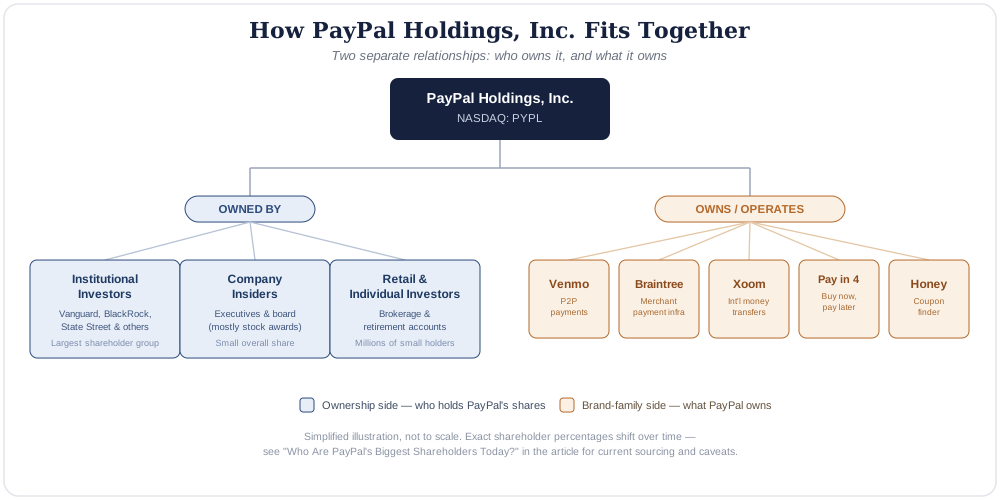
PayPal’s shareholder base breaks down into three broad groups — institutional investors, company insiders, and individual retail investors — with institutional investors holding the largest overall share. Here’s how each group breaks down.
Institutional Shareholders (Vanguard, BlackRock, State Street)
The largest category of PayPal shareholders is institutional investors — mutual funds, pension funds, and passive index funds that manage money on behalf of millions of individual clients. The Vanguard Group is consistently reported as PayPal’s single largest shareholder, typically holding somewhere in the high single digits of outstanding shares depending on the reporting date. BlackRock, Inc. usually ranks second, and State Street Corporation regularly appears among the top handful of holders as well.
These three are the largest passive index-fund managers in the world, so their presence near the top of PayPal’s shareholder list isn’t unusual — it’s the same pattern you’ll see at almost any large U.S. public company, because index funds tracking the S&P 500 and similar benchmarks are required to hold shares of companies like PayPal in proportion to their market weight.
Insider and Executive Ownership
PayPal executives and board members hold a comparatively small slice of the company, mostly acquired through performance-based stock compensation rather than large personal purchases. This is typical for a mature public company: insider ownership provides an incentive to perform well, but it doesn’t come close to giving management or the board a controlling stake.
Retail and Individual Investor Ownership
Millions of everyday investors also own small pieces of PayPal — through direct brokerage accounts, retirement funds like 401(k)s, or index funds and ETFs that include PYPL as a holding. Individually, these positions are tiny, but collectively they add real liquidity to the stock and represent a meaningful share of ownership.
Why Shareholder Percentages Vary Across Different Sources
If you go looking for PayPal’s exact ownership breakdown yourself, you’ll likely notice something frustrating: different financial data platforms report meaningfully different numbers for the same thing. It’s not uncommon to see one source describe institutional ownership as roughly three-quarters of the company, while another source, using a different classification method, reports a much lower figure and instead emphasizes a large “public companies and individual investors” category.
A few real reasons explain this, rather than one source simply being wrong:
- Filing lag: Institutional investors disclose large holdings via SEC Form 13F, filed up to 45 days after each quarter ends — so any snapshot is already somewhat dated the moment it’s published.
- Classification differences: Some platforms count index funds and ETFs as “institutional,” while others bucket them separately from actively managed institutional funds, or fold them into a broader “public companies and individuals” category.
- Snapshot timing: Share buybacks, new fund positions, and routine portfolio rebalancing shift these percentages continuously, so numbers from different months aren’t directly comparable.
The practical takeaway: treat any single percentage you see for PayPal’s ownership breakdown as a snapshot, not a permanent fact, and check the “as of” date before treating it as current.
Who Owns Venmo — Is It the Same Company as PayPal?
Yes — Venmo is fully owned by PayPal Holdings, Inc. There’s no separate Venmo stock, no independent Venmo board, and no outside investors with a standalone stake in Venmo. If you own PayPal stock, you already have indirect exposure to Venmo, because Venmo’s financial results are reported as part of PayPal’s overall business rather than broken out separately.
How Venmo Became Part of PayPal (Braintree Acquisition Chain)
Venmo’s path into the PayPal family happened in two steps, which is why it sometimes gets described inconsistently:
- 2012: The payments company Braintree acquired Venmo for approximately $26.2 million.
- 2013: PayPal acquired Braintree for roughly $800 million — and because Braintree already owned Venmo, PayPal absorbed Venmo as part of that same deal.
So PayPal never bought Venmo directly in a standalone transaction; it inherited Venmo by acquiring the company that had already bought it a year earlier. Since then, Venmo has continued operating as its own branded app, aimed primarily at U.S. peer-to-peer payments between friends and family, while PayPal’s core product remains focused on global e-commerce checkout and merchant payments.
What PayPal Owns Beyond Venmo (Braintree, Xoom, Pay in 4)
Venmo isn’t the only brand under the PayPal umbrella. The wider PayPal Holdings family includes:
- Braintree — the merchant-facing payment infrastructure that lets businesses accept PayPal, Venmo, and card payments through a single integration
- Venmo — the consumer-facing peer-to-peer and social payments app
- Xoom — an international money-transfer service for sending funds abroad
- Pay in 4 — PayPal’s buy-now-pay-later installment product
- Honey — a browser extension and app, acquired in 2020, that finds coupon codes and rewards for online shoppers
Understanding this structure clears up a lot of the confusion in searches like “who owns Venmo and PayPal” — it’s not two separately owned companies coincidentally sharing a name; it’s one parent company, PayPal Holdings, operating several distinct consumer and merchant brands underneath it. (Worth noting: Honey has drawn its own controversy — content creators have filed lawsuits alleging the extension diverted affiliate commissions without adequate disclosure, claims PayPal disputes and that remained in litigation as of mid-2026.)
Who Runs PayPal Today? (Leadership vs. Ownership)
PayPal’s ownership and its day-to-day leadership are two completely separate things — conflating them is one of the most common mistakes people make when researching this topic, as the Musk section above illustrates.
Current CEO and Board Chair
As of 2026, PayPal Holdings is led by Enrique Lores, who was appointed President and CEO effective March 1, 2026, succeeding Alex Chriss. Lores joined PayPal’s board in June 2021 and had served as its Board Chair since July 2024, before moving into the CEO role; before that, he spent more than six years as President and CEO of HP Inc. The change was announced the same day PayPal reported a disappointing fourth-quarter 2025 earnings report and withdrew its 2027 growth targets, a combination that also triggered a sharp stock decline covered in more detail later in this article.
Ahead of Lores officially starting, Jamie Miller — PayPal’s Chief Financial and Operating Officer — served as Interim President and CEO from February 2, 2026 until the transition was complete. Alongside Lores’ appointment, PayPal’s board named David W. Dorman as independent Board Chair, effective immediately upon the February 2026 announcement.
Why Leadership Isn’t the Same as Ownership
It’s worth restating plainly: none of PayPal’s executives, including its CEO, “own” the company in any meaningful sense. Enrique Lores runs PayPal’s operations and reports to the board of directors, which in turn is accountable to shareholders — but his personal equity stake, like most executives’, represents a tiny fraction of total shares outstanding.
This is the same distinction that trips people up with the Musk question: being CEO of a company, at any point in its history, is a leadership role — not an ownership claim. PayPal’s board itself includes members with no ownership stake of consequence but real oversight authority, including independent directors with backgrounds spanning enterprise technology, accounting, and consumer finance.
The “PayPal Mafia” — Where the Original Owners Ended Up
One reason PayPal’s ownership history keeps generating interest is that its early owners and executives didn’t fade into obscurity after cashing out — several of them went on to build some of the most significant companies of the following two decades. This group became informally known as the “PayPal Mafia.”
Founders Who Went On to Build Other Major Companies
| Person | Role at PayPal | What They Built Afterward |
|---|---|---|
| Elon Musk | Co-founder (X.com), briefly CEO | SpaceX, Tesla, Neuralink, The Boring Company |
| Peter Thiel | Co-founder (Confinity), later CEO | Founders Fund, Palantir Technologies, early Facebook investor |
| Max Levchin | Co-founder and CTO | Affirm, a major buy-now-pay-later company |
| Reid Hoffman | Early executive | |
| Chad Hurley & Steve Chen | Early employees | YouTube |
| Jeremy Stoppelman & Russel Simmons | Early employees | Yelp |
None of these individuals retain an ownership stake in today’s PayPal Holdings. What they built afterward is a separate story from PayPal’s current ownership — but it’s a useful illustration of just how much value the company’s early equity created for the people who once held it, and why so many of their names remain tied to searches about PayPal’s past.
Is PayPal Financially Stable and Safe to Use?
This question often sits just beneath the surface of “who owns PayPal” searches — if people are unsure who’s behind a company, it’s natural to wonder whether that company is trustworthy. Here’s the factual picture, kept separate from any investment opinion:
- PayPal Holdings is a large, publicly traded company subject to standard SEC reporting and disclosure requirements, including quarterly earnings reports and annual audited financials, and it remains one of the most widely used digital payment platforms in the world.
- 2026 has been a rocky year for the stock. On February 3, 2026, PayPal reported fourth-quarter and full-year 2025 results showing a sharp slowdown in its core Branded Checkout business and withdrew a previously announced target of accelerating total payment volume growth to 8–10% by 2027. Shares fell about 20% in a single trading day — from $52.33 to $41.70 — wiping out more than $9 billion in market value, the same day the company announced the CEO change discussed above.
- That drop led several law firms to file securities class-action lawsuits (including cases captioned Darcy v. PayPal Holdings, Inc. and Goodman v. PayPal Holdings, Inc.) on behalf of investors who bought PYPL stock between February 25, 2025 and February 2, 2026, alleging the company had misrepresented its growth trajectory. As of mid-2026 this litigation remained pending — these are allegations that have not been proven in court, not a settled finding.
- Separately, PayPal’s Honey extension has faced its own ongoing lawsuits from content creators and affiliate marketers alleging it diverted commissions without adequate disclosure; PayPal disputes these claims and continues to operate Honey.
- None of this is the same question as “does PayPal own my money safely.” A difficult stock-price year and pending shareholder litigation are separate from PayPal’s operational ability to process payments and hold customer funds, which remains subject to ongoing financial regulation in every market where it operates.
None of this is financial advice, and it isn’t a recommendation to buy, hold, or avoid PayPal stock. If you’re evaluating PayPal as an investment, review its most recent 10-K and quarterly filings directly, follow the pending litigation through public court records, or speak with a licensed financial advisor rather than relying on any single article — including this one — for investment decisions.
Who Owns PayPal? Key Facts at a Glance
- PayPal is owned by its shareholders. It’s a publicly traded company (NASDAQ: PYPL), not owned by any single person or parent company.
- Elon Musk does not own PayPal. He co-founded X.com, one of the two companies that merged to form PayPal, and was briefly CEO before being replaced by Peter Thiel in 2000.
- eBay does not own PayPal. eBay acquired PayPal in 2002 and owned it until spinning it off as an independent public company in 2015.
- PayPal’s largest shareholders today are institutional investors, led by The Vanguard Group, with BlackRock and State Street also regularly among the top holders.
- PayPal owns Venmo, along with Braintree, Xoom, Pay in 4, and Honey — all operating under the PayPal Holdings parent company.
- PayPal’s current CEO is Enrique Lores, appointed effective March 1, 2026, with David W. Dorman serving as independent Board Chair — but leadership and ownership are two separate things.
- PayPal had a turbulent early 2026, including a roughly 20% single-day stock drop tied to a weak earnings report and subsequent shareholder lawsuits — a stock-performance and leadership story, not a change in who owns the company.
Conclusion
So, who owns PayPal? In the simplest terms: its shareholders do, through a publicly traded company called PayPal Holdings, Inc. — not Elon Musk, and not eBay. The confusion around this question almost always comes down to mixing up three different things: who founded the company decades ago, who briefly ran it, and who actually holds equity in it today.
Once those three threads are pulled apart, PayPal’s story becomes a fairly typical one for a large American public company: a scrappy startup merger, a contentious early leadership change, an acquisition, a spinoff, and today, ownership spread across large institutional funds, company insiders, and millions of individual investors. The names that keep resurfacing — Musk, Thiel, eBay — are all part of PayPal’s history, but none of them own the company as it exists in 2026.
FAQs
Does Elon Musk own PayPal?
No. Elon Musk co-founded X.com, which merged with Confinity to eventually become PayPal, and served briefly as CEO before being replaced in 2000. He has not held an ownership stake in PayPal since cashing out around the time of eBay’s 2002 acquisition.
Is PayPal still owned by eBay?
No. eBay acquired PayPal in 2002 but spun it off as a fully independent public company in 2015. The two companies have had no ownership relationship since then.
Who is PayPal’s biggest shareholder?
The Vanguard Group is consistently reported as PayPal’s largest institutional shareholder, typically holding a stake in the high single digits of outstanding shares, though exact figures vary by reporting date and data source.
Does PayPal own Venmo?
Yes. Venmo is a wholly owned subsidiary of PayPal Holdings, Inc. PayPal acquired Venmo indirectly in 2013 as part of its acquisition of Braintree, which had itself acquired Venmo the year before.
Who is PayPal’s CEO right now?
Enrique Lores became PayPal’s President and CEO effective March 1, 2026, succeeding Alex Chriss, with David W. Dorman serving as the company’s independent Board Chair.
Why did Elon Musk leave PayPal?
After X.com merged with Confinity in 2000, disagreements within the newly combined leadership team led the board to replace Musk as CEO with Peter Thiel later that year. Musk has since described the episode as a “palace coup,” while retaining his shareholder stake at the time.
Is PayPal struggling financially in 2026?
PayPal had a rough start to 2026: a disappointing fourth-quarter 2025 earnings report on February 3, 2026 triggered a roughly 20% single-day stock drop and coincided with a sudden CEO change. That’s a stock-performance and leadership story, though, not evidence the company itself is at risk of failing — PayPal remains a large, SEC-regulated public company, though the resulting shareholder lawsuits were still pending as of mid-2026.
📖 Continue Reading:
Sources & References
- PayPal Holdings, Inc. — Investor Relations, “PayPal Appoints Enrique Lores as Chief Executive Officer and David W. Dorman as Independent Board Chair”
- PayPal Newsroom, official press release, February 3, 2026
- PayPal Newsroom, “PayPal Appoints Enrique Lores as New Independent Board Chair,” July 24, 2024
- U.S. Securities and Exchange Commission, PayPal Holdings, Inc. Form DEF 14A (2026 Proxy Statement)
- U.S. Securities and Exchange Commission, PayPal Holdings, Inc. Form ARS (2026 Annual Report to Shareholders)
- Snopes, “Was Elon Musk Fired from PayPal?”
- The Motley Fool, “Who Owns PayPal?”
- RevenueMemo, “Who owns PayPal? Ownership structure explained (2026)”
- RevenueMemo, “Who owns Venmo? Ownership structure explained (2026)”
- KamilFranek Business Analytics, “Who Owns PayPal: The Largest Shareholders Overview”
- StockAnalysis.com, PayPal Holdings (PYPL) Statistics & Valuation
- Yahoo Finance, “Peter Thiel Reported To Me, Says Elon Musk, Calls PayPal Exit ‘Palace Coup'”
- UPI, “PayPal appoints new CEO and independent board chair”
- Wikipedia, “Venmo”
- Venmo, “About Us”
- Wise, “PayPal subsidiaries: companies owned by PYPL”
- FourWeekMBA, “Who Owns Venmo?”
- Hagens Berman, “PayPal Holdings (PYPL) Faces Securities Class Action Amid $9 Billion Market Cap Wipeout, CEO Departure,” GlobeNewswire, March 10, 2026
- Levi & Korsinsky, LLP, “PayPal Holdings, Inc. Class Action Lawsuit – PYPL”
- TechCrunch, “YouTuber LegalEagle sues PayPal over ‘sleeping leech’ Honey extension,” January 5, 2025
Disclaimer
This article is for general informational purposes only and does not constitute financial, investment, or legal advice. Ownership percentages, executive roles, and stock-related figures reflect publicly available information as of August 2026 and are subject to change as new SEC filings, corporate announcements, and market activity occur. Readers considering any investment decision related to PayPal Holdings, Inc. (NASDAQ: PYPL) should consult primary SEC filings and a licensed financial advisor rather than relying solely on this article.

Olivia Isabel is a Business & Technology Writer specializing in corporate ownership, company leadership, shareholders, acquisitions, and the business strategies behind major global companies. Her work covers technology, artificial intelligence, social media, finance, e-commerce, automotive, and consumer technology, with a particular focus on explaining who owns, controls, and leads well-known companies.
With a background in Economics and Journalism, Olivia approaches each topic as a research-driven business story. She examines company filings, investor-relations materials, regulatory records, official corporate announcements, and reputable financial sources to distinguish between legal ownership, economic ownership, voting control, and day-to-day management.
Her articles explore the founders behind major companies, current CEOs, significant shareholders, parent companies, subsidiaries, acquisitions, and changes in corporate structure. She has written about companies including Google, Alphabet, Apple, Microsoft, Amazon, Meta, OpenAI, Tesla, SpaceX, YouTube, Instagram, TikTok, WhatsApp, Reddit, Spotify, and other major technology and consumer brands.
Olivia’s goal is to make complicated corporate and financial information clear, accurate, and useful for everyday readers. She is particularly interested in corporate strategy, technology business models, entrepreneurship, emerging AI companies, public markets, and the evolution of globally recognized brands.