⚡ Quick Answer: Who Owns Roblox?
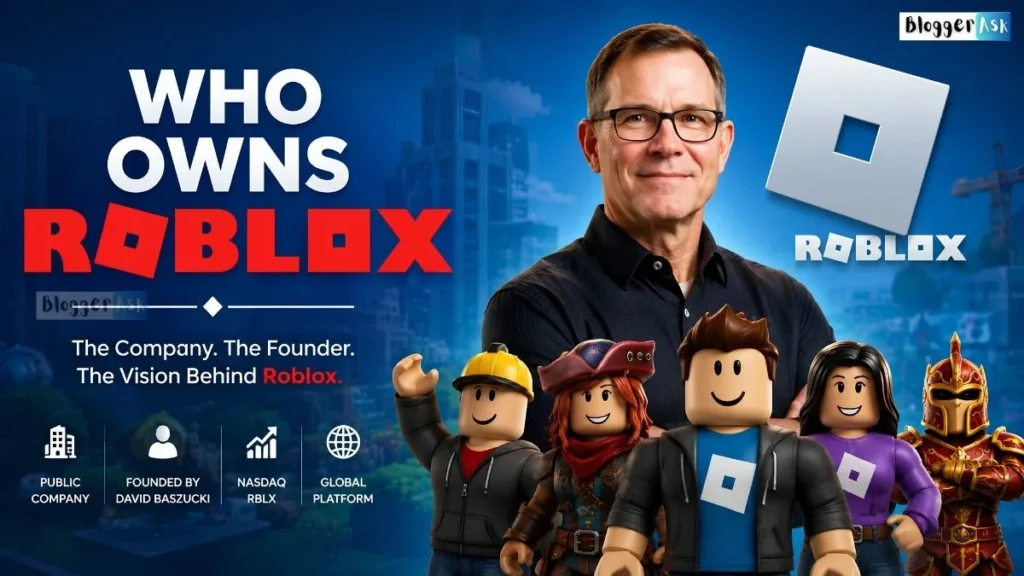
Roblox is owned by its shareholders as a publicly traded U.S. company on the New York Stock Exchange (ticker: RBLX). It was founded in 2004 by David Baszucki and Erik Cassel, and Baszucki remains Roblox’s Founder, President, CEO, and Chairman today. He’s the company’s largest individual shareholder and controls the majority of shareholder voting power through special super-voting shares — but he owns only a single-digit percentage of the company’s total economic value. The rest is held by thousands of institutional investors (like Vanguard and BlackRock), retail investors, and other company insiders. No single person owns Roblox outright.
Key takeaways:
- Roblox has been a public company since March 10, 2021 — it is not privately held.
- Founder David Baszucki is still CEO and Chairman today, but he owns roughly 8% of the company’s economic shares.
- Baszucki controls about 60.9% of shareholder voting power through special Class B shares, giving him effective control despite owning a minority stake.
- Roblox is an American company. A Tencent affiliate holds a minority 49% stake in a separate China-focused joint venture — Roblox itself holds the controlling 51% share.
- No single institution, government, or individual owns a majority of Roblox’s economic value.
Founder vs. CEO vs. Owner: Why These Are Different Questions
Most of the confusion around “who owns Roblox” comes from mixing up three different roles. They overlap in one person today, but they’re not the same thing — and understanding the difference is the fastest way to actually answer the question.
| Question | Short Answer |
|---|---|
| Who founded Roblox? | David Baszucki and Erik Cassel, in 2004 |
| Who runs Roblox today? | David Baszucki — as Founder, President, CEO, and Chairman |
| Who owns Roblox? | Roblox’s shareholders collectively: institutional investors, retail investors, and company insiders (including Baszucki) |
Who Founded Roblox?
Roblox was founded in 2004 in Menlo Park, California, by David Baszucki and Erik Cassel. The two had worked together before: Baszucki had previously started Knowledge Revolution, a physics-simulation software company, in 1989, and Cassel later joined him there. Knowledge Revolution was acquired by MSC Software in 1998, and after a couple of years there, Baszucki left to start an angel-investment firm before turning his attention to what would become Roblox.
The pair’s original prototype was called “Dynablocks.” It was renamed Roblox in 2005 and formally launched to the public on September 1, 2006.
Who Runs Roblox Today?
As of 2026, David Baszucki, now 63, holds four titles at once: Founder, President, Chief Executive Officer, and Chairman of the Board — a combination confirmed in Roblox’s own 2026 proxy statement filed with the U.S. Securities and Exchange Commission (SEC). He’s held the CEO role continuously since founding the company in 2004, making him one of the longest-tenured founder-CEOs in the video game industry.
Notably, Baszucki’s salary was $0 in 2025. Under Roblox’s executive compensation policy, 100% of his direct pay comes in the form of long-term equity, meaning his personal financial outcome is tied directly to the company’s stock performance rather than a fixed paycheck.
Who Actually Owns Roblox?
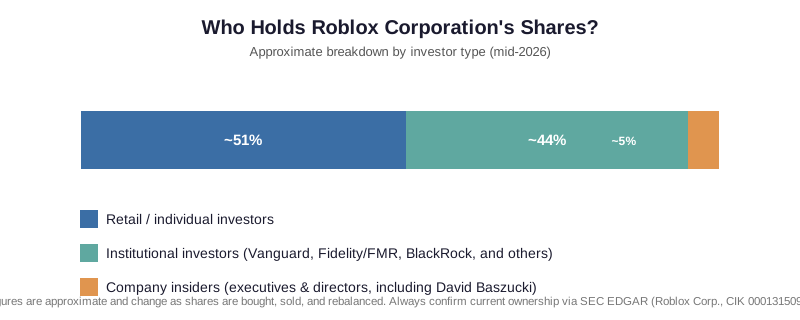
Since Roblox became a publicly traded company in March 2021, its ownership has been spread across thousands of shareholders rather than concentrated in one person or a small private group. Broadly, those shareholders fall into three categories:
- Institutional investors — mutual funds, pension funds, and asset managers such as Vanguard, Fidelity, and BlackRock, who hold shares on behalf of millions of everyday retirement and investment account holders
- Retail investors — individual people who buy RBLX shares directly through a brokerage account
- Company insiders — executives and board members, including David Baszucki, who hold shares as part of their compensation or personal investment
No single one of these groups — and no single individual — owns a majority of Roblox’s economic value. That’s the core, factual answer to “who owns Roblox.”
Is Roblox a Public or Private Company?
Roblox has been a publicly traded company since March 10, 2021, when it began trading on the New York Stock Exchange under the ticker RBLX.
What “Publicly Traded” Actually Means for Ownership
When a company is publicly traded, its shares are available for anyone to buy on a stock exchange. Buying even a single share makes you a legal shareholder with an economic stake in the company and, in most cases, a vote — but it doesn’t give you any say in day-to-day decisions.
Think of it this way: if you bought one share of RBLX tomorrow, you would technically own a tiny fraction of Roblox Corporation. You’d be entitled to your proportional slice of the company’s value and could vote on select corporate matters. But you wouldn’t get a say in what games get promoted on the platform, how the company handles a safety controversy, or who Roblox hires as its next Chief Financial Officer. Those operational decisions sit with management and the board — which is exactly why “ownership” and “control” are two different questions for any public company, Roblox included.
Roblox’s 2021 Direct Listing (and How It Differs From a Typical IPO)
Roblox didn’t go public through a traditional initial public offering (IPO). It used a direct listing instead — a less common path that changes who benefits financially from the process.
| Feature | Traditional IPO | Direct Listing (Roblox’s approach) |
|---|---|---|
| New shares created | Yes — company raises fresh capital | No new shares are created |
| Underwriters set the price | Yes, investment banks help set an initial price | No underwriters pricing the offering |
| Who sells shares | The company (and sometimes early investors) | Only existing shareholders sell directly to the public |
| Roblox’s outcome | — | Opened trading on March 10, 2021, at a price implying a valuation of roughly $41.9 billion |
In a direct listing, Roblox itself didn’t raise new money by selling new shares — it simply let existing shareholders (founders, employees, and early investors) begin trading their existing shares on the open market. This is a detail many summaries skip, but it matters: it means the 2021 listing was primarily a liquidity event for early shareholders, not a capital-raising event for the company.
Roblox’s Ownership Structure, Explained
This is where most of the genuine complexity — and most of the online confusion — lives. Here’s the clearest breakdown available, drawn directly from Roblox’s SEC filings.
Economic Ownership vs. Voting Control
Roblox uses a dual-class share structure, common among founder-led tech companies. There are two classes of common stock:
- Class A common stock — one vote per share, publicly traded on the NYSE, held by the public and most institutional investors. As of February 2026, roughly 662.9 million Class A shares were outstanding.
- Class B common stock — twenty votes per share, not publicly traded, and held by only a small number of record holders. As of February 2026, roughly 47.1 million Class B shares were outstanding, and Baszucki beneficially owned all of them.
This structure creates a gap between how much of the company someone economically owns and how much voting power they hold. Baszucki owns a relatively small slice of Roblox’s total shares, but because virtually all of his shares are the higher-voting Class B stock, he controls a disproportionately large share of the total vote.
David Baszucki’s Stake and Super-Voting Shares
According to Roblox’s 2025 proxy statement, as of February 28, 2025, David Baszucki beneficially owned 8,314,636 shares of Class A common stock (about 1.3% of that class) plus all 48,293,658 shares of Class B common stock, held through several family trusts, including The Freedom Revocable Trust, the 2020 David Baszucki Gift Trust, and the 2020 Jan Baszucki Gift Trust. Combined, that’s roughly 8% of Roblox’s total economic shares — but because of the 20-votes-per-share weighting on his Class B stock, it translates into approximately 60.9% of total shareholder voting power.
This concentrated voting power is significant enough that Roblox would technically qualify as a “controlled company” under New York Stock Exchange listing rules — a status that would exempt it from requiring a majority-independent board. Roblox’s 2026 proxy statement explicitly states that while the company believes it’s eligible for this exemption, it has chosen not to use it, instead voluntarily maintaining a board that is roughly 75% independent.
Like most executives at public companies, Baszucki periodically sells small blocks of Class A shares — typically to cover tax obligations when his restricted stock units vest. These routine “sell to cover” transactions, disclosed in SEC Form 4 filings, are a normal part of executive compensation and don’t meaningfully change his overall stake or voting control.
Major Institutional Shareholders
Alongside Baszucki, several large institutional investors hold significant (though individually minority) stakes in Roblox. Based on SEC filings and financial reporting through mid-2026, the largest include:
| Shareholder | Approx. Stake (mid-2026) | Type |
|---|---|---|
| Vanguard Group | ~9% | Institutional (index & mutual funds) |
| Index Ventures | ~7% | Institutional / early venture backer |
| Fidelity (FMR LLC) | ~6.5–7% | Institutional |
| BlackRock | ~6% | Institutional |
| David Baszucki | ~8% economic / ~60.9% voting | Insider (Founder, CEO, Chairman) |
Figures are approximate, compiled from recent SEC filings and financial reporting, and will have shifted somewhat by the time you’re reading this — see the checklist below for how to check the current numbers yourself.
Where Ownership Numbers Come From (and Why Figures Vary Online)
If you’ve searched this topic before landing here, you may have already noticed a frustrating pattern: different articles cite different ownership percentages for David Baszucki, ranging from roughly 2% to nearly 9%. This isn’t necessarily an error on any one source’s part — it usually comes down to which filing, which reporting method, and which date each article is quoting.
Here’s a real example of that gap: Roblox’s 2025 proxy statement puts Baszucki’s combined Class A and Class B stake at roughly 8% as of February 28, 2025. A separate Schedule 13G/A he filed with the SEC in August 2025 reported a slightly different figure — 48,349,998 shares, or about 7.0%. Neither number is “wrong.” Proxy statements and Schedule 13G filings use different reporting conventions and snapshot dates, so small variations between them are normal and expected, not a sign that one source made a mistake.
Ownership stakes also aren’t static day to day. They shift as insiders sell shares to cover taxes, as institutional funds rebalance their portfolios, and as new shares are issued for employee compensation. A percentage that was accurate in a 2023 filing won’t match a 2026 filing, yet both may show up in search results with no clear date attached, creating the appearance of contradiction.
How to verify current ownership data yourself:
- Go to the SEC’s EDGAR database (sec.gov) and search “Roblox Corporation” or its CIK number, 0001315098.
- Look for the most recent DEF 14A (proxy statement) and find the “Security Ownership of Certain Beneficial Owners and Management” table — this is the single most authoritative, regularly updated source.
- Check Schedule 13G or 13D filings for the largest individual and institutional holders, which are updated whenever a major stake changes materially.
- Always note the “as of” date on any filing — ownership data is only accurate as of that specific date, not the date you’re reading it.
The History Behind Roblox’s Ownership
Understanding how Roblox got here adds useful context to the ownership question — and it’s a more human story than most stock-analysis summaries let on.
David Baszucki and Erik Cassel: The Founders
Baszucki and Cassel’s partnership went back further than Roblox itself. They’d previously built physics-simulation software together at Baszucki’s earlier company, Knowledge Revolution. That background directly informed the physics engine that became core to Roblox’s identity as a building and simulation platform.
Erik Cassel remained deeply involved in Roblox’s early development until his death from cancer on February 11, 2013. His contributions are widely credited as foundational to the platform’s early design and technical direction.
From Startup to Direct Listing: A Brief Timeline
- 2004 — Roblox Corporation founded in Menlo Park, California
- 2005 — Prototype renamed from “Dynablocks” to “Roblox”
- 2006 — Roblox officially launches to the public on September 1
- 2009 — Early seed funding, including from First Round Capital and Altos Ventures
- 2013 — Co-founder Erik Cassel passes away
- 2017 — $92 million funding round led by Meritech Capital Partners and Index Ventures
- 2019 — Roblox enters a joint venture agreement with a Tencent affiliate to pursue the Chinese market (more on this below)
- 2020 — Series G funding round values the company at roughly $4 billion
- January 2021 — Series H funding round values Roblox at approximately $29.5 billion
- March 10, 2021 — Roblox goes public via direct listing on the NYSE, opening at a valuation near $41.9 billion
Early Investors and Venture Backers
Beyond the founders, a number of venture capital firms backed Roblox well before its public debut, including First Round Capital, Altos Ventures, Meritech Capital Partners, Index Ventures, and several later-stage growth investors. Two of these — notably Altos Ventures and Index Ventures — remain among Roblox’s larger shareholders today, years after their initial investment. Altos Ventures’ Anthony P. Lee has also served on Roblox’s board since 2008 and currently serves as its Lead Independent Director.
Who Leads Roblox Today?
David Baszucki’s Role as CEO and Chairman
Beyond his ownership stake, Baszucki’s day-to-day authority comes from his combined role as CEO and Chairman of the Board — a structure Roblox’s own governance documents describe as intended to streamline decision-making and ensure clear accountability during the company’s current growth phase.
He leads an executive team that, as of Roblox’s 2026 proxy statement, includes:
| Name | Title | In Role Since |
|---|---|---|
| David Baszucki | Founder, President & CEO | 2004 |
| Naveen Chopra | Chief Financial Officer | June 2025 |
| Matt Kaufman | Chief Safety Officer | July 2023 |
| Sean “Jack” Buckley | Chief People and Systems Officer | March 2026 |
| Amy Rawlings | Chief Accounting Officer | July 2022 |
| Mark Reinstra | Chief Legal Officer & Corporate Secretary | November 2024 |
What This Governance Structure Means in Practice
Because Baszucki holds both the CEO and Chairman titles, there’s no independent chair providing a separate layer of oversight above him — a structure some governance-focused investors view as a potential risk factor, since it concentrates both operational and oversight authority in one person. Roblox addresses this in part by maintaining a Lead Independent Director role, currently held by Anthony P. Lee of Altos Ventures, whose responsibilities include leading executive sessions of the board’s independent directors.
The practical takeaway: Baszucki’s combination of founder credibility, majority voting control, and the CEO/Chairman title means that major strategic and governance decisions at Roblox run substantially through him, even though he personally owns only a small minority of the company’s economic value.
Is Roblox an American or Chinese Company?
This is one of the most common points of confusion in search results about Roblox’s ownership — and it has a clear, factual answer.
Roblox’s U.S. Headquarters and Legal Status
Roblox Corporation is an American company. It’s headquartered in San Mateo, California, and is incorporated in the United States. Its shares trade exclusively on the New York Stock Exchange, and it’s regulated as a U.S. public company under SEC oversight. There is no legal or ownership sense in which Roblox is a Chinese company.
The Roblox–Tencent China Joint Venture, Explained
The confusion largely traces back to a real, but frequently misunderstood, business relationship. In February 2019, Roblox entered into a joint venture agreement with Songhua River Investment Limited, an affiliate of the Chinese gaming company Tencent Holdings, to create a separate entity called Roblox China Holding Corp.
Here’s the part almost universally left out of “who owns Roblox” content: Roblox holds the majority stake in that joint venture — 51% — while the Tencent affiliate holds the minority 49% stake, per Roblox’s own SEC filings. In other words, rather than a Chinese company owning part of Roblox, the arrangement gives a U.S. company majority control over a China-focused joint venture — the reverse of what most people assume.
That joint venture developed and operated a localized Chinese version of the platform, branded “LuoBu” (罗布乐思), which launched to consumers in China in mid-2021. The consumer-facing app’s servers were shut down just five months later, in December 2021, as Roblox adjusted its approach to the market — a detail most ownership summaries omit entirely. Roblox has continued to maintain a presence in China since then, including a small round of staff changes reported in 2023, and the joint venture structure itself still appears in Roblox’s SEC filings as of its most recent quarterly reports.
Where the “Chinese-Owned” Myth Comes From
This myth likely persists for a few overlapping reasons: general public awareness of the Tencent partnership without knowledge of the 51/49 majority structure; conflation with other globally popular apps that genuinely do have significant Chinese ownership; and broader, non-specific anxiety about foreign ownership of platforms popular with children. Whatever the source, the underlying fact is straightforward — Roblox Corporation itself is, and always has been, an American company.
Common Ownership Myths About Roblox, Debunked
Myth: Roblox is owned by Tencent. Fact: A Tencent affiliate holds a 49% minority stake in a separate China-focused joint venture. Tencent does not own any share of Roblox Corporation itself.
Myth: Roblox is owned by Microsoft. Fact: There’s no ownership relationship between the two companies. This myth likely stems from Roblox’s availability on Xbox as a platform partner — a distribution deal, not an equity stake.
Myth: David Baszucki owns Roblox outright. Fact: He’s the largest individual and insider shareholder, and he controls roughly 60.9% of shareholder votes through super-voting Class B shares — but he holds only about 8% of the company’s total economic shares. Most of Roblox’s value is held by institutional and retail investors.
Myth: Roblox is still a private startup. Fact: Roblox has been a publicly traded NYSE company since March 10, 2021.
Roblox’s Ownership in Context: 2026 Snapshot
Company Size, Market Cap, and Scale
As of its most recent full fiscal year (2025), Roblox reported:
- Revenue: $4.9 billion (up 36% year-over-year)
- Bookings: $6.8 billion (up 55% year-over-year)
- Average daily active users (DAUs): 127 million
- Creator earnings: more than $1.5 billion paid to Roblox’s developer community in 2025
- Full-time employees: 3,065, as of December 31, 2025, predominantly based at the San Mateo headquarters
In its most recent quarter (Q2 2026, reported July 30, 2026), Roblox posted revenue of $1.47 billion (up 36% year-over-year) and 123 million daily active users (up 10% year-over-year), alongside a net loss of $185 million. Bookings growth slowed to 8% for the quarter, which the company attributed to shifting monetization patterns among younger users.
As of August 27, 2026, RBLX shares trade around $38, giving Roblox a market capitalization of roughly $27 billion — down substantially from a 52-week high near $142 per share, reflecting both the bookings slowdown and the governance and safety-related scrutiny described below.
Recent Developments Worth Knowing
Because David Baszucki holds majority voting control as both CEO and Chairman, how Roblox responds to major challenges runs substantially through him and the board he chairs — which makes recent developments directly relevant to the ownership and governance picture, not just background news:
- Legal scrutiny: In August 2025, Louisiana’s Attorney General filed a lawsuit alleging Roblox failed to implement adequate safety controls to protect child users from predators — the first such lawsuit brought by a state attorney general against the platform. Roblox has disputed the characterization of its safety practices.
- Public backlash and calls for accountability: In the same month, the company drew significant criticism after issuing a cease-and-desist letter to, and banning, a YouTuber known for conducting sting-style investigations of alleged predators on the platform. The episode prompted calls from some critics for the CEO’s resignation, an online petition from U.S. Representative Ro Khanna, and contributed to a sharp decline in Roblox’s stock price that week.
- International restrictions: In the same period, several countries — including Qatar, Turkey, and Kuwait — restricted or blocked access to Roblox over child-safety concerns. Indonesia’s government discussed a potential block in August 2025 before instead rolling out mandatory new safety and communication restrictions for users under 16 in March 2026.
- Safety rollout: At the end of 2025 and into early 2026, Roblox rolled out mandatory age-verification checks for chat access and introduced expanded, age-based parental controls, part of a broader push the company describes as aiming to be a leader in online safety for its category.
- New safety infrastructure: Roblox has since introduced and open-sourced internal safety tools, including Roblox Sentinel (for real-time child-endangerment detection) and Roblox Guard (for AI-model content moderation), alongside new advisory bodies such as an inaugural Parent Council and an expanded Teen Council.
- Board and leadership changes: Naveen Chopra joined as CFO in June 2025, and Dennis Durkin — former CFO of Activision Blizzard — joined Roblox’s board of directors in March 2026.
None of this changes who legally owns Roblox. But it’s a directly relevant piece of the “who’s accountable” question that sits just underneath most people’s real reason for asking — and it’s the kind of current context that’s easy to miss in ownership summaries written before 2026. If you’re researching this specifically because of safety concerns for a child in your life, that’s a distinct and important question from company ownership, and worth researching separately with current, dedicated safety resources.
Frequently Asked Questions
Who owns Roblox?
Roblox is owned by its shareholders as a publicly traded U.S. company (NYSE: RBLX). No single person owns a majority; ownership is spread across institutional investors, retail investors, and company insiders, including founder and CEO David Baszucki.
Is Roblox privately owned or a public company?
Roblox has been a public company since its direct listing on the New York Stock Exchange on March 10, 2021. Before that, it was privately held, funded by its founders, employees, and venture capital investors.
Who is the CEO of Roblox in 2026?
David Baszucki, who co-founded the company in 2004, continues to serve as Founder, President, CEO, and Chairman of the Board.
Is the Roblox owner a billionaire?
David Baszucki has appeared on Forbes’ Billionaires list, including its 2026 edition. His exact net worth fluctuates continuously with Roblox’s stock price — Forbes tracked it at roughly $3–4 billion around mid-2026 — and it has moved significantly during the year alongside RBLX’s substantial share-price decline, since the bulk of his wealth is tied to his Roblox holdings rather than cash.
What is Roblox’s parent company?
Roblox Corporation is the parent company of the Roblox platform and Roblox Studio; it has no separate parent company above it. It’s an independent, publicly traded company — not a subsidiary of Microsoft, Tencent, or any other larger firm.
Where is Roblox headquartered?
San Mateo, California.
Has Roblox’s ownership changed recently?
The broad structure — public company, dual-class shares, Baszucki holding majority voting control — hasn’t changed since the 2021 listing. Individual ownership percentages shift regularly as filings are updated; check SEC EDGAR for the most current figures.
Conclusion
The short version is simple: Roblox is a publicly traded American company, not a privately held startup and not a foreign-owned platform. Founder David Baszucki still runs the company today as CEO and Chairman, and while he’s the largest individual shareholder and controls roughly 60.9% of shareholder votes through Roblox’s dual-class share structure, he owns only about 8% of the company’s overall economic value — the rest belongs to thousands of institutional and retail shareholders.
The lingering myths — that Roblox is Chinese-owned, still privately held, or the personal property of one billionaire — don’t hold up against Roblox’s own SEC filings and public disclosures. If you take away one thing from this article, let it be this: “who founded it,” “who runs it,” and “who owns it” are three different questions about Roblox — and now you have an accurate, current answer to all three.
📖 Continue Reading:
Sources & References
- Roblox Corporation, Wikipedia
- David Baszucki, Wikipedia
- Roblox–Schlep controversy, Wikipedia
- Roblox Corporation, DEF 14A Proxy Statement (2026 Annual Meeting), U.S. Securities and Exchange Commission / EDGAR
- Roblox Corporation, Form 10-Q filings disclosing the Roblox China Holding Corp. joint venture, U.S. Securities and Exchange Commission / EDGAR (CIK 0001315098)
- “Roblox pauses service in China as it takes ‘important transitory actions’,” TechCrunch
- David Baszucki, Forbes Billionaires Profile, Forbes
- “Who Owns Roblox: Founder, Shares, and Corporate Control,” LegalClarity
- “Who Owns Most of Roblox? Shareholders Explained,” LegalClarity
- “Louisiana AG sues Roblox, calling it ‘the perfect place for pedophiles,'” The Washington Post
- “How safe are children playing Roblox? Gulf states move to ban platform amid content concerns,” The National
- “Roblox (RBLX) Q2 2026 DAUs grew 10% year-over-year, down from Q3 2025 highs,” Shacknews
- “Earnings call transcript: Roblox Q2 2026 beats EPS but shares sink on bookings,” Investing.com
- Roblox Corp (RBLX) Stock Price & Market Cap, Investing.com
- Roblox Market Cap 2019–2026, MacroTrends
Ownership percentages for individual and institutional shareholders are approximate, compiled from a combination of SEC filings and financial reporting current as of mid-2026, and are subject to change. For the most accurate, up-to-date figures, consult Roblox Corporation’s latest filings directly on SEC EDGAR (CIK 0001315098).
Disclaimer
This article is for general informational purposes only and does not constitute financial, investment, or legal advice. Stock ownership percentages, market capitalization, and company financials change frequently; figures reflect the most recent publicly available data at the time of writing (August 2026) and may not reflect current conditions. This is not a recommendation to buy, sell, or hold shares of Roblox Corporation (NYSE: RBLX) or any other security.
Readers should consult a licensed financial advisor and review Roblox’s official SEC filings before making any investment decisions. This article also references ongoing litigation and public controversy involving child safety on the Roblox platform; these references are factual and summary in nature and are not a comprehensive safety review — readers with specific safety concerns about a child’s use of any online platform should consult current, dedicated child-safety resources and consider professional guidance.

Olivia Isabel is a Business & Technology Writer specializing in corporate ownership, company leadership, shareholders, acquisitions, and the business strategies behind major global companies. Her work covers technology, artificial intelligence, social media, finance, e-commerce, automotive, and consumer technology, with a particular focus on explaining who owns, controls, and leads well-known companies.
With a background in Economics and Journalism, Olivia approaches each topic as a research-driven business story. She examines company filings, investor-relations materials, regulatory records, official corporate announcements, and reputable financial sources to distinguish between legal ownership, economic ownership, voting control, and day-to-day management.
Her articles explore the founders behind major companies, current CEOs, significant shareholders, parent companies, subsidiaries, acquisitions, and changes in corporate structure. She has written about companies including Google, Alphabet, Apple, Microsoft, Amazon, Meta, OpenAI, Tesla, SpaceX, YouTube, Instagram, TikTok, WhatsApp, Reddit, Spotify, and other major technology and consumer brands.
Olivia’s goal is to make complicated corporate and financial information clear, accurate, and useful for everyday readers. She is particularly interested in corporate strategy, technology business models, entrepreneurship, emerging AI companies, public markets, and the evolution of globally recognized brands.