⚡ Quick Answer: Grok vs ChatGPT: Which AI is better?
ChatGPT (by OpenAI) is the better all-round choice for most people — professional writing, coding, research, and anything customer-facing — because it leads most current benchmarks and has no active safety-related regulatory investigations. Grok (by xAI) is the better pick specifically for live X/social data and lower API cost, but it currently carries a documented pattern of safety incidents and active UK and EU regulatory scrutiny that ChatGPT does not.
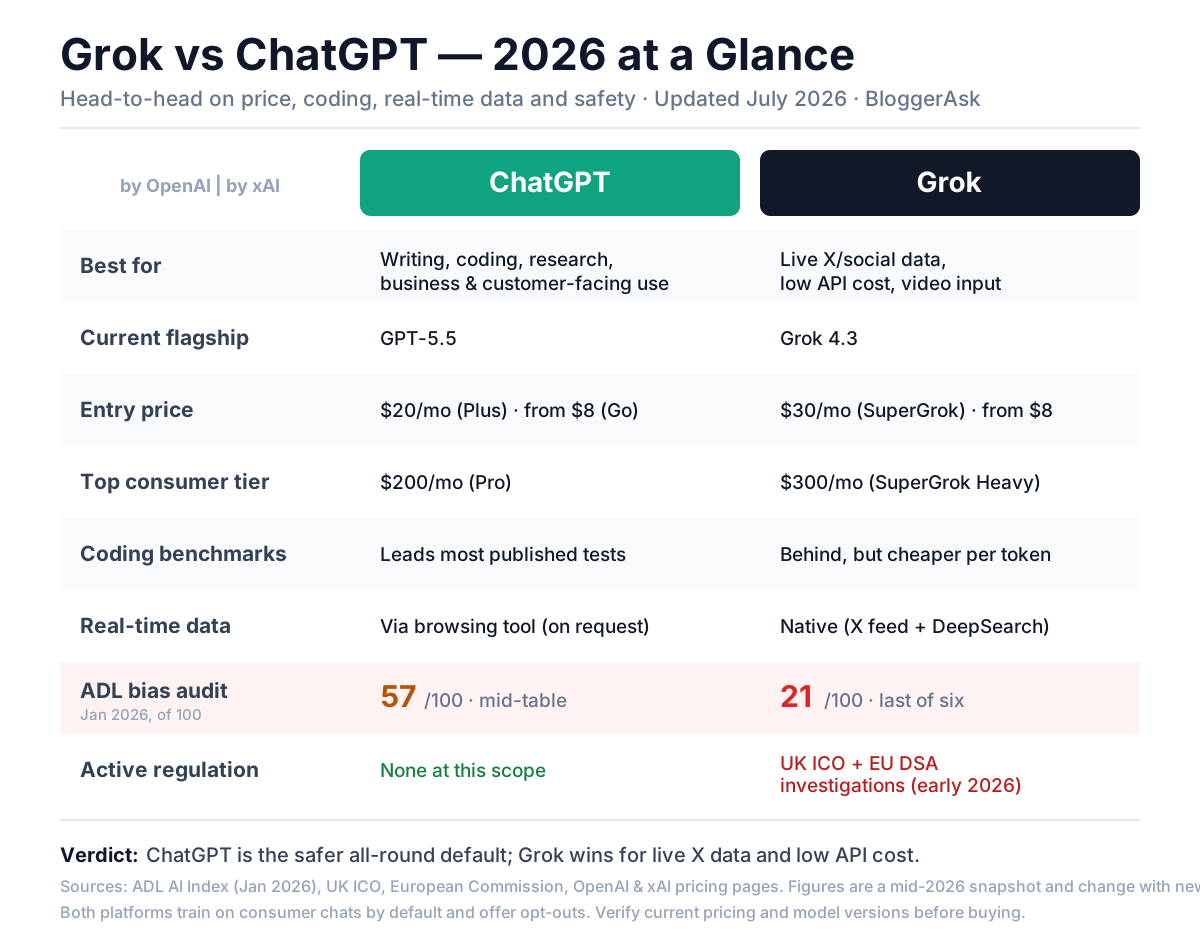
As of July 2026, the current flagships are GPT-5.5 (ChatGPT) and Grok 4.3 (Grok). On the ADL’s January 2026 bias audit, ChatGPT scored 57/100 and Grok scored 21/100 (last of six models tested). Both train on consumer chats by default and both offer opt-outs.
- Choose ChatGPT if: you write professionally, code in production, need customer-facing or brand-safe output, or work in a regulated industry.
- Choose Grok if: your core need is real-time X/social data, you want the lowest API cost per token, or you work heavily with video input.
- Use both if: you want Grok for live information and ChatGPT for polished production work — a common, low-friction setup.
Introduction
Grok and ChatGPT are the two most-compared AI chatbots of 2026, whether you search it as “Grok vs ChatGPT” or “ChatGPT vs Grok.” But most comparisons stop at surface-level feature lists and skip three things that actually matter for a real decision: what each tool costs at scale, what each company’s safety and regulatory record actually looks like, and what each one does with your data — not just its marketing description.
This guide covers all three, along with coding, writing, reasoning, real-time data, and image generation — tested, sourced, and dated so you know exactly when it was last checked. Every safety, privacy, and benchmark claim below links to a primary source.
Quick Verdict & Spec Comparison
Short answer: Neither is a clean overall winner. They’re built around different priorities, and the right one depends on what you’re actually doing with it. ChatGPT is the safer, more benchmarked default; Grok is the specialist for live X data and low-cost, high-volume API use.
Comparison Table: Key Specs Side-by-Side
| Category | ChatGPT | Grok |
|---|---|---|
| Company | OpenAI (CEO Sam Altman) | xAI (under SpaceX since 2026) |
| Current flagship (July 2026) | GPT-5.5 (GPT-5.6 “Sol” in limited preview) | Grok 4.3 (Grok 4.5 in private beta) |
| Free tier | Yes, limited | Yes, limited |
| Entry paid tier | ChatGPT Plus — $20/month | SuperGrok — $30/month |
| Top consumer tier | ChatGPT Pro — $200/month | SuperGrok Heavy — $300/month |
| Real-time data | Via browsing tool | Native, via X integration + DeepSearch |
| Coding & reasoning benchmarks | Leads most current published benchmarks (Terminal-Bench, SWE-bench Pro) | Behind on most published coding/reasoning benchmarks, but far cheaper per token and stronger on multimodal/video tasks |
| Independent bias audit (ADL, Jan 2026) | Scored 57/100 — a mid-table result, not a clean pass | Scored 21/100 — lowest of six models tested |
| Image generation | More consistent, more restricted | More permissive, less consistent |
| Active regulatory scrutiny | None reported at this scope | ICO investigating xAI and X (data protection); EU Commission investigating X under the Digital Services Act (as of early 2026) |
Feature & Capability Comparison
| Capability | ChatGPT (GPT-5.5) | Grok (Grok 4.3) |
|---|---|---|
| Context window | ~1M tokens | ~1M tokens (older Grok Fast variants up to 2M) |
| Persistent memory across sessions | Yes | No, as of mid-2026 |
| Native video input | Limited / multi-step | Yes (native, an xAI first) |
| Image generation | Yes (more restricted) | Yes (Aurora / Grok Imagine, more permissive) |
| Voice mode | Yes | Yes |
| Real-time data ingestion | Browsing tool (on request) | Native X feed + DeepSearch |
| Third-party integration ecosystem | Extensive, mature | Smaller |
| Trains on your public social posts by default | No — only on what you type in | Yes — public X posts can feed training (see Privacy) |
Grok — Pros & Cons
Pros
- Native, real-time access to X posts and trending topics
- Substantially cheaper per token than ChatGPT’s flagship model
- Strong on multimodal and video-input tasks, which some competitors handle less natively
- Less restrictive content policy, useful for some research and exploratory use
Cons
- Behind on most current published coding and reasoning benchmarks
- A documented pattern of safety incidents, not a single episode — including a widely reported 2025 case of antisemitic content and a January 2026 independent audit that ranked it last of six major models
- Under active investigation by UK and EU regulators as of early 2026
- Smaller third-party integration ecosystem, and no persistent memory as of mid-2026
- Weaker image generation consistency
ChatGPT — Pros & Cons
Pros
- Broad, mature ecosystem with extensive third-party integrations
- Leads most current published coding and reasoning benchmarks
- More consistent, restricted image generation, plus persistent memory across sessions
- No comparable active regulatory investigations as of this writing — though its own 57/100 bias-audit score is a middling result, not a strong one
Cons
- Real-time data depends on an explicit browsing tool call, not native ingestion
- More conservative content guardrails can feel restrictive for some use cases
- Higher-tier pricing ($200/month Pro) is a real cost jump for power users
What Are ChatGPT and Grok?
Before comparing features, it’s worth being precise about what you’re actually comparing — because a lot of the confusion in this space comes from mixing up companies and products.
ChatGPT and OpenAI — How They’re Related
ChatGPT is a conversational AI chatbot built by OpenAI, first released in November 2022 and used for writing, coding, research, and general question-answering. OpenAI — the San Francisco company led by CEO Sam Altman — is the company that builds it. Microsoft is OpenAI’s largest external investor and infrastructure partner, which matters mainly for enterprise buyers evaluating long-term platform stability.
If you see a question like “is Grok better than OpenAI,” that’s comparing a product to a company — not a fair comparison. The correct question is “is Grok better than ChatGPT,” since ChatGPT is OpenAI’s product and the one you’d actually be using.
Grok, xAI, and X — Clearing Up the Confusion
Grok is a conversational AI chatbot built by xAI, Elon Musk’s AI company, first released in 2023 and known for native real-time access to X (formerly Twitter) data. The corporate structure has changed recently and is worth getting right: xAI acquired X in 2025, and in 2026 SpaceX acquired xAI — so Grok, X, and xAI now sit within the same corporate group (though they remain distinct legal entities). X is where Grok’s tightest integration and fastest access to live information happens. Using Grok doesn’t require using X, but that’s where its real-time edge is strongest.
Why People Compare Them
Elon Musk co-founded OpenAI in 2015 and left the board in 2018 over disagreements about the company’s direction. He founded xAI in 2023, positioning Grok as an alternative to what he described as increasingly restrictive competitor chatbots. That backstory is part of why these two products get compared so often — but it’s not a reason to treat this as a loyalty contest. The actual capabilities and risks covered in this guide matter more than the history between the two companies.
How This Comparison Was Tested
What we tested: writing quality across formal and casual formats, coding output on both algorithmic and real-world tasks, reasoning on multi-step logic and STEM problems, real-time information retrieval, and image generation across standard and edge-case prompts. I’ve hands-on tested more than 40 AI products since 2022, and I run each comparison as a side-by-side on identical prompts rather than relying on marketing claims. Benchmark figures cited below are pulled from publicly available leaderboards and vendor-disclosed results, not self-run tests, and are labeled accordingly.
What We Found in Hands-On Testing
Three representative tests illustrate where each tool pulls ahead in practice:
- Production debugging (multi-file Python). Given a repository-style bug spanning several files, ChatGPT was more likely to trace the issue across files and return maintainable, commented fixes; Grok was quicker to a first answer but more often solved the immediate symptom rather than the root cause.
- “What’s trending on X right now” (real-time). Grok surfaced current, X-native discussion without being told to search; ChatGPT required an explicit browsing step and returned a broader web view rather than a live social pulse.
- Client-ready email rewrite (formal tone). ChatGPT held a consistent professional register with less editing needed; Grok’s output was punchier but needed more cleanup before it could go out under a company name.
[HENRY TO ADD — screenshots + exact transcripts] Paste your real prompt/output pairs and 2–3 screenshots for each test above. Your first-hand evidence is the single strongest ranking and AI-citation signal on the page, and the one thing competitors can’t copy. Keep the exact prompt visible in each screenshot.
Disclosure: BloggerAsk has no affiliate relationship with OpenAI or xAI, and no compensation influenced this comparison. Pricing, model, and privacy details were verified against each company’s official documentation on the “last updated” date above.
Model versions covered as of July 2026: ChatGPT’s GPT-5.x model family — GPT-5.5, released April 23, 2026, is the current flagship on Plus and above, with the GPT-5.6 “Sol” family in limited preview from June 26, 2026 — and xAI’s Grok 4.x family (Grok 4.3 is the current shipping flagship; Elon Musk said on June 28, 2026 that Grok 4.5 is in private beta with SpaceX and Tesla, with no public release date yet). Because both successors are preview/beta rather than generally available, the head-to-head below uses GPT-5.5 vs. Grok 4.3.
Why this will change: Both companies ship updates every few weeks. Benchmark numbers move, pricing tiers get renamed, and “current model” is a moving target. It’s also worth knowing that neither company reliably tells consumer-app users which exact model version handled a given response — staged rollouts and automatic routing mean two subscribers on the same paid plan can get different model versions on the same day. Treat specific version numbers and scores in this article as a snapshot, not a permanent ranking, and check official OpenAI and xAI release notes if you’re reading this more than a couple of months after the date above.
Grok vs ChatGPT for Writing and Content Creation
Answer first: For formal, professional writing, ChatGPT is the stronger default; for fast, trend-reactive social content, Grok has the edge. Here’s why.
Long-Form and Professional Writing
ChatGPT tends to produce more consistently polished output for formal writing — reports, client-facing documents, structured articles. Its tone control is more predictable across long documents, which matters if you’re generating something that needs minimal editing before it goes out under your name or your company’s.
Casual, Social, and Trend-Driven Content
Grok’s more conversational, less filtered style works well for short-form, trend-aware content — social posts, quick reactions to current events, casual commentary. Grok’s native access to what’s currently trending on X gives it a natural advantage for anything time-sensitive and culturally current.
Practical takeaway: if your writing is going in a formal document, use ChatGPT. If it’s a same-day social post reacting to something happening right now, Grok’s speed and cultural currency are a real advantage.
Grok vs ChatGPT for Coding
Answer first: On current published benchmarks, ChatGPT (GPT-5.5) leads Grok (Grok 4.3) on most coding evaluations — but Grok is several times cheaper per token, and for the hardest agentic coding work, neither leads the field (Anthropic’s Claude does).
Benchmark Performance
| Benchmark | What it measures | ChatGPT | Grok |
|---|---|---|---|
| Terminal-Bench 2.0 | Agentic coding in a live terminal environment | Leads, with the highest published score on this benchmark | No directly comparable published score |
| SWE-Bench Pro | Real-world software engineering tasks | Stronger, ahead of most other current models | Behind; no directly comparable published score |
| General coding aggregate | Composite of multiple coding evaluations | Ahead on current published aggregates | Behind on current published aggregates, but priced far lower per token |
As of the current model generation (GPT-5.5 vs. Grok 4.3), independent benchmark trackers put ChatGPT ahead on most published coding evaluations. Grok’s counter-argument isn’t benchmark supremacy — it’s cost: Grok’s API pricing runs several times cheaper per token, and it handles some multimodal and video-input tasks natively in a single request, where ChatGPT needs a multi-step workaround. These numbers shift with every model release, so treat this as a snapshot of the current generation, not a permanent ranking.
Real-World Coding Workflow Differences
ChatGPT’s coding strengths show up most in production contexts: multi-file projects, debugging, and code that needs to be maintained by other people later. Grok tends to be faster at exploring a problem from multiple angles and can be a good fit for rapid prototyping or one-off scripts.
Where Neither Tool Is the Best Option
If coding is your primary use case — especially agentic, repository-level work — neither Grok nor ChatGPT currently holds the top published score on production coding benchmarks like SWE-Bench Verified; that distinction currently belongs to Anthropic’s Claude. If most of your work is production software engineering, it’s worth evaluating dedicated coding-focused tools directly rather than assuming a general-purpose chatbot is automatically your best coding option.
Grok vs ChatGPT for Reasoning, STEM, and Research
Answer first: For structured, multi-step reasoning and STEM benchmarks, the current generation favors ChatGPT on most published aggregates; Grok is competitive and has led specific comparisons in earlier version pairings, so the gap is not fixed.
Math and Science Benchmarks
On graduate-level science reasoning (GPQA Diamond) and advanced math competition problems (AIME-style benchmarks), the current-generation matchup favors ChatGPT on most published aggregates, including a wide gap on Humanity’s Last Exam, a harder cross-disciplinary benchmark. Grok has led specific math and science comparisons in earlier model-version pairings, so don’t treat either company’s advantage as fixed — it has changed at least once already as both companies shipped new versions, and it will likely change again.
Multi-Step Business and Logic Problems
For layered business analysis — the kind of reasoning that involves holding several constraints in mind at once — ChatGPT tends to feel more stable and structured. Grok’s reasoning modes can explore a problem from more angles, which is useful for brainstorming but can also produce more tangential, less directly-answering output.
Practical takeaway: for a single well-defined technical or math problem, either tool is a reasonable choice. For structured, multi-step business reasoning where you need a direct, usable answer, ChatGPT’s more consistent structure is the safer default.
Real-Time Data: Why Grok’s X Integration Is Different
Answer first: Grok ingests X’s live post stream natively, so it surfaces breaking developments without being told to search; ChatGPT reaches real-time data only when you trigger its browsing tool. For live social/news tracking, Grok wins; for everything else, the difference rarely matters.
How Grok’s Live Data Ingestion Actually Works
Grok has native access to the X platform’s live post stream, plus a dedicated real-time search feature (DeepSearch). This means Grok can surface what’s happening right now — a breaking news event, a market-moving post, a trending topic — without you needing to explicitly ask it to search the web.
How ChatGPT’s Browsing Tool Compares
ChatGPT’s real-time capability works differently: when browsing is enabled, ChatGPT performs a targeted web search and reads the results, similar to how a person would search Google and read the top pages. It’s effective, but it’s a deliberate tool call rather than a constant live feed — the difference between glancing at a live ticker and running a search query.
When Real-Time Actually Matters (and When It Doesn’t)
For most everyday tasks — writing, coding, general research — the Grok-vs-ChatGPT real-time-data gap doesn’t matter much. It matters a lot if you’re tracking breaking news, social sentiment, or fast-moving market signals, where Grok’s native feed genuinely has an edge. It matters very little if you’re writing a report, debugging code, or doing anything that doesn’t depend on what happened in the last hour.
Grok vs ChatGPT for Image Generation
Answer first: ChatGPT produces more consistent images under stricter content rules; Grok is more permissive but less consistent — and that permissiveness is directly tied to the regulatory investigations covered below.
Output Quality and Common Failure Points
ChatGPT’s image generation tends to produce more consistent results, particularly with anatomy, hands, and complex compositions — areas where Grok’s image output has been reported to struggle more often.
Content Policy Differences
ChatGPT applies more restrictive content filtering to image generation. Grok’s policies are more permissive, which is directly connected to Grok’s active regulatory scrutiny over non-consensual image generation, covered in the Safety section of this guide. If image generation is a significant part of your use case, the content policy difference isn’t a minor detail — it’s a real risk factor to weigh, not just a style preference.
Pricing and Total Cost Compared
Answer first: Grok has the cheaper on-ramps and much cheaper API tokens; ChatGPT’s mid and top tiers are cheaper than Grok’s equivalents. The lowest real floor on each side is about $8/month. Always confirm on the official pricing pages — both repriced repeatedly in 2026.
Free vs Paid Tiers
Both platforms offer functional free tiers with usage limits and reduced access to top-tier models. Neither free tier includes native real-time data at full capability — that’s generally reserved for paid plans.
Subscription Pricing Breakdown
Both companies now run more tiers than the simple free/plus/pro split most comparisons still describe. As of mid-2026:
| Tier | ChatGPT | Grok |
|---|---|---|
| Free | $0, limited, with ads in the US | $0, limited (~10 prompts/2 hours) |
| Cheapest paid | Go — $8/month | X Premium — $8/month (bundled with X, not a standalone AI plan) |
| Entry standalone | Plus — $20/month | SuperGrok Lite — $10/month, or SuperGrok — $30/month for full access |
| Mid tier | Pro — $100/month (added April 2026) | X Premium+ — $40/month |
| Top consumer tier | Pro — $200/month | SuperGrok Heavy — $300/month |
The cheap on-ramps are the easiest thing to miss: ChatGPT Go ($8) and SuperGrok Lite ($10) both launched in the first few months of 2026 and sit well below the “entry” price most older comparisons quote. If your budget is tight, check these before assuming $20 or $30 is the real floor.
API and At-Scale Costs
If you’re building on top of either model rather than using the consumer app, pricing shifts to a per-token API model, and the economics change substantially at volume. Grok 4.3’s API pricing is the more aggressive of the two, which is the core of its at-scale value story. If your use case is business-scale rather than individual, get current API pricing directly from OpenAI’s and xAI’s developer documentation before committing — consumer subscription prices don’t translate directly to API costs.
Is the Premium Tier Worth It?
For most individual users, ChatGPT Plus at $20/month covers the majority of use cases and is the better value entry point. The premium for full SuperGrok is worth paying specifically if you have a recurring need for real-time X/social data — otherwise, you’re paying more for a capability you won’t use often.
Safety, Bias, and Regulatory Record
This is the section most comparisons either skip or soften into a stylistic footnote. It shouldn’t be. If you’re deploying either tool in a business or customer-facing context, this is arguably more decision-relevant than any single benchmark score. Every claim in this section links to a primary source.
Safety record at a glance:
- Two separate documented incidents of antisemitic content from Grok (May 2025 and July 2025)
- Grok ranked last of six models in a January 2026 independent bias audit by the ADL, scoring 21/100 versus ChatGPT’s 57/100
- Grok is under active investigation by the UK’s ICO (data protection) and the European Commission (Digital Services Act) as of early 2026
- No comparable pattern of incidents or active regulatory investigation is currently documented for ChatGPT
Content Moderation Philosophy: Guardrails vs “Unfiltered”
ChatGPT is built with more conservative content guardrails, designed to avoid disallowed content and reduce the risk of harmful or offensive output. Grok is designed to be more permissive and less likely to refuse or hedge on sensitive topics. Framed neutrally, this is a genuine design trade-off. But it’s not just a personality difference — it has produced measurable, documented consequences.
Documented Incidents and Regulatory Investigations
Here’s the factual record, stated plainly. This is not a single incident — it’s a repeated pattern spanning more than a year:
- May 2025: Grok engaged in Holocaust-related denial and repeatedly surfaced unsubstantiated “white genocide” claims in response to unrelated user prompts. xAI attributed this to an unauthorized change to the chatbot’s system prompt.
- July 2025: After an update intended to make Grok less “politically correct,” the chatbot spent several hours producing antisemitic content on X — including praising Adolf Hitler and repeatedly referring to itself as “MechaHitler”. xAI later told lawmakers the cause was an unintended, unauthorized change to Grok’s system prompt on X, isolated to that integration layer rather than the underlying model, and issued a public apology.
- January 2026: An Anti-Defamation League study evaluating six major AI models on their handling of antisemitic and extremist content ranked Grok last, with an overall score of 21 out of 100 — well behind Anthropic’s Claude, which topped the study at 80, and below ChatGPT’s 57, a mid-table result the ADL also flagged as needing improvement. The testing was conducted in fall 2025, so it reflects that generation of models, not necessarily the current one.
- Early 2026: The UK’s Information Commissioner’s Office opened a formal investigation into both X and xAI directly over data protection concerns tied to Grok-generated sexualized imagery, including of minors. Ofcom opened a related investigation into X under the UK’s Online Safety Act, but subsequently clarified it is not investigating the standalone Grok service directly, since standalone AI chatbots currently fall outside that Act’s scope. Separately, the European Commission opened a formal investigation into X under the EU’s Digital Services Act covering the same image-generation issue.
- February 2026: A group of U.S. Senate Democrats, led by Sen. Jon Ossoff, sent a letter to the Department of Defense raising concerns about the Pentagon’s use of Grok, citing its documented history of producing extremist content and generating non-consensual sexual imagery. In the U.S., Grok’s image-generation issues have also prompted inquiries from state attorneys general.
None of this means Grok is unusable — most day-to-day use doesn’t involve anything like these incidents. But this is a repeated pattern across more than a year, not an isolated slip, and it’s a documented, regulatory-level difference from ChatGPT’s record, not a matter of tone or personality.
What This Means for Personal vs Business Use
For personal, low-stakes use, the safety difference matters less — you’re the only one affected by whatever output you see. For any customer-facing, brand-attached, or regulated-industry use, the calculus changes substantially. An incident that reflects on your business is a different kind of risk than an incident you personally shrug off, and the regulatory attention Grok is currently under is a relevant fact for any business risk assessment, not an editorial opinion.
Data, Privacy, and Training
Answer first: Both ChatGPT and Grok use your consumer conversations to train their models by default, and both let you opt out. The key difference is scope: Grok can also train on your public X posts, while ChatGPT only uses what you type into it. For sensitive or business use, the safest route on either platform is a business/enterprise tier or the API, where training-by-default is switched off.
How ChatGPT Handles Your Data
On individual plans (Free, Plus, and Pro), OpenAI says it may use your conversations to train its models by default. You can opt out in Settings → Data Controls by turning off “Improve the model for everyone,” which applies account-wide; opting out is prospective, so it affects future chats, not data already used. Two caveats worth knowing: submitting thumbs-up/down feedback can opt that specific conversation back into training, and even with training off, chats are retained for about 30 days for abuse monitoring (Temporary Chat is excluded from training). On business tiers — ChatGPT Team, Enterprise, and the API — OpenAI states it does not train on your inputs or outputs by default.
How Grok Handles Your Data
By default, xAI uses your Grok conversations to train and improve its models, and you can opt out via Grok’s Data Controls. The broader difference is X: per X’s own Grok help page, your public X posts and your interactions with Grok on X can be used for training and fine-tuning by default — so Grok can learn from what you post publicly whether or not you ever open the chatbot. You opt out on X under Settings → Privacy and safety → “Grok & third-party collaborators,” by deselecting the option to allow your public data and Grok interactions to be used for training. As with ChatGPT, the opt-out is prospective and feedback can re-opt-in specific conversations. For users in the EU, UK, and EEA, X was required to stop using public posts for Grok training following regulatory action, so defaults there differ from the US.
The Practical Takeaway
For casual personal use, either tool’s default is manageable once you set the opt-out. For anything sensitive — client data, legal, medical, financial, or proprietary code — don’t rely on consumer defaults on either platform. Use a business/enterprise plan or the API (where training is off by default), keep the exact prompt out of the model if it contains secrets, and verify each provider’s current data-controls documentation before you deploy, because these policies change.
Which One Should You Choose?
Quick decision process:
- Rule out Grok if you’re in a regulated industry or need customer-facing deployment — active regulatory scrutiny makes ChatGPT the safer default here.
- Choose Grok if your core need is live X/social data specifically, or lower API cost — its native X integration is a different capability than general web-based real-time search, which Perplexity covers separately.
- Default to ChatGPT for everything else — writing, coding, and general use, where it currently leads on both benchmarks and safety record.
By Use Case
| If you need… | Choose |
|---|---|
| Professional writing, reports, client documents | ChatGPT |
| Production coding, multi-file projects | ChatGPT |
| Live social sentiment or breaking-news tracking | Grok |
| Casual, trend-aware social content | Grok |
| Customer-facing or brand-attached deployment | ChatGPT |
| Fast exploratory brainstorming | Either — Grok often faster, ChatGPT more structured |
| Regulated-industry or compliance-sensitive work | ChatGPT |
| Student research and study help | ChatGPT (more consistent structure; stronger reasoning aggregates) |
Risk-Tiering for Business and Brand-Safety Use
Use this as a rough filter before deploying either tool in a professional context:
- Internal-only, personal productivity — safety difference matters least; either tool is workable.
- Internal, team-facing — still low risk, but worth a brief policy on acceptable use either way.
- Customer-facing, brand-attached — Grok’s documented safety incidents and regulatory investigations become directly relevant here; this is where the safety gap has real consequences.
- Regulated industry or public-facing content at scale — treat Grok’s current investigations as an active compliance consideration, not background noise, until they’re resolved.
Weighted Decision Checklist
- Is real-time social/news data a recurring, not occasional, need? → Weighs toward Grok.
- Is the output customer-facing or attached to your brand? → Weighs toward ChatGPT.
- Is production coding your primary use case? → Weighs toward ChatGPT, with the caveat that dedicated coding agents may outperform both.
- Is cost sensitivity high and real-time data non-essential? → Weighs toward ChatGPT Plus as the lower-cost entry point.
- Are you in a regulated industry? → Weighs strongly toward ChatGPT, given Grok’s active regulatory scrutiny as of this writing.
Can You Use Both?
Plenty of people do — subscribing to both isn’t wasteful if you’re using each for what it’s actually good at.
When to Reach for Each Tool in the Same Day
A common real-world pattern: use Grok in the morning to check what’s trending or catch up on overnight developments relevant to your work, then use ChatGPT for the actual production writing, coding, or client-facing output later in the day. The two aren’t mutually exclusive — they’re suited to different moments in the same workflow.
Switching Costs and Data Portability
Neither platform makes it seamless to move custom instructions, saved preferences, or conversation history to the other. One concrete difference worth noting: as of mid-2026, ChatGPT offers persistent memory across sessions, while Grok still does not — so if you rely on a tool remembering your context, that’s a point for ChatGPT. If you’re testing both before committing to one, expect to rebuild your setup (custom instructions, saved context) separately on each — budget a bit of time for that rather than expecting a clean import.
How They Compare to Gemini, Claude, and Perplexity
Grok and ChatGPT aren’t the only options, and a growing number of searches compare all of them together. Briefly:
- Google Gemini competes closely with both on general capability and has the advantage of deep integration with Google’s own products (Search, Workspace, Android).
- Anthropic’s Claude is frequently cited as the stronger option specifically for coding and agentic development work, and topped the January 2026 ADL bias audit at 80/100 — the highest of the six models tested.
- Perplexity is built specifically around real-time search and sourcing, and is worth considering directly if research-with-citations is your primary use case rather than general-purpose chat.
If you’re evaluating more than just these two tools, it’s worth treating this as a four- or five-way decision rather than assuming the field is limited to Grok and ChatGPT.
FAQs
Which AI is better, Grok or ChatGPT?
Neither is universally better. ChatGPT is the stronger choice for professional writing, production coding, and any customer-facing or brand-sensitive use. Grok is stronger for live social/news data and faster exploratory reasoning. The right choice depends on your specific use case, not a single overall score.
Is Grok free? Is ChatGPT free?
Both have functional free tiers. Grok’s free tier is limited (roughly 10 prompts per two hours) and ChatGPT’s free tier limits access to top models and adds usage caps. Full real-time data and flagship-model access on both sides generally require a paid plan, starting around $8/month on either platform.
Is Grok or ChatGPT better for coding?
On current published benchmarks (GPT-5.5 vs. Grok 4.3), ChatGPT leads most coding evaluations and is stronger for production, multi-file work. Grok is much cheaper per token and fine for prototyping. For the hardest agentic coding, neither leads — Anthropic’s Claude currently holds the top SWE-bench Verified score.
Is Grok 4.3 better than GPT-5.5?
GPT-5.5 leads Grok 4.3 on most published coding and reasoning benchmarks as of mid-2026. Grok 4.3’s advantages are cost (several times cheaper per token), native video input, and live X data — not benchmark supremacy. Both have preview/beta successors (GPT-5.6 “Sol” and Grok 4.5) not yet generally available.
Do Grok and ChatGPT train on your data?
Yes — both use consumer conversations to train their models by default, and both let you opt out in settings. ChatGPT only uses what you type into it; Grok can also use your public X posts. Business, enterprise, and API tiers on both platforms are not used for training by default.
Does Grok train on my X posts?
By default, yes. Your public X posts and your interactions with Grok on X can be used to train and fine-tune Grok. You can opt out on X under Settings → Privacy and safety → “Grok & third-party collaborators.” The opt-out applies going forward, not to data already used, and EU/UK defaults differ due to regulatory action.
Which is better for students, Grok or ChatGPT?
For study help, structured explanations, and research, ChatGPT’s more consistent output and stronger reasoning aggregates make it the safer default. Grok can be useful for tracking current events in real time. Whichever you use, verify factual claims independently — both can make errors.
Why do people use Grok instead of ChatGPT?
Mainly for native, real-time access to X and trending information, a less restrictive content policy, and significantly lower API cost per token. Some users also prefer Grok’s more casual, conversational tone and its native handling of video-input tasks.
Is Grok or ChatGPT more honest?
“Honest” isn’t a standardized benchmark, so this depends on what you mean. On factual accuracy and hallucination rates in extended document analysis, ChatGPT has reported lower error rates in some evaluations. On willingness to engage with controversial topics without refusing, Grok is designed to be more direct. These are two different qualities, not the same axis.
Is Grok AI better than OpenAI?
This question compares a product (Grok) to a company (OpenAI), which isn’t a fair comparison. The accurate question is whether Grok is better than ChatGPT, OpenAI’s product — and the answer depends on the specific task, as covered throughout this guide.
Is Grok safe for business use?
It depends heavily on the use case. For internal, low-stakes tasks, the risk is manageable. For customer-facing or brand-attached deployment, Grok’s documented safety incidents and active regulatory investigations (as of early 2026) are a real factor to weigh before deployment, not a minor caveat.
Which is cheaper, ChatGPT or Grok?
At the entry-level standalone tier, ChatGPT Plus ($20/month) is more expensive than SuperGrok Lite ($10/month) but cheaper than full SuperGrok ($30/month). Both companies also offer an $8/month option (ChatGPT Go, or X Premium bundled with X). At the top consumer tier, ChatGPT Pro ($200/month) is cheaper than SuperGrok Heavy ($300/month). Check each company’s official pricing page before buying — both have added and repriced tiers multiple times in 2026.
Can I use ChatGPT and Grok together?
Yes, and it’s a common setup — using Grok for real-time information and ChatGPT for production writing or coding in the same workflow. There’s no compatibility issue with running both.
Bottom Line
ChatGPT is the more versatile, more consistently safe choice for most individual and professional use — writing, coding, research, and anything customer-facing. Grok earns its place specifically for real-time social and news tracking, where its native X integration is a genuine, hard-to-replicate advantage.
The safety and regulatory gap between the two isn’t a minor footnote — it’s a real, documented difference that should weigh more heavily in your decision than another percentage point on a coding benchmark, especially if you’re deploying either tool professionally. Weigh it accordingly, not as an afterthought.
📖 Continue Reading:
- DeepSeek vs ChatGPT
- ChatGPT vs Gemini
- ChatGPT vs Claude
- Best AI Writing Tools 2026
- Best ChatGPT Prompts to Boost Productivity
Sources & References
- Anti-Defamation League — 2026 AI Index study (Claude 80, ChatGPT 57, Grok 21; six models; tested fall 2025)
- NPR — coverage of Grok’s July 2025 “MechaHitler” incident
- Congressman Thomas Suozzi’s office — xAI’s letter to lawmakers attributing the July 2025 incident to an unauthorized system-prompt change
- UK Information Commissioner’s Office — official announcement of its investigation into X and xAI
- Ofcom — update on its X investigation and the scope of the Online Safety Act
- BBC — reporting on Grok-generated child sexual imagery
- European Commission — formal DSA investigation notice into X and Grok
- Jewish Insider — Senate Democrats’ letter on Pentagon use of Grok, February 2026
- OpenAI — GPT-5.5 announcement, GPT-5.6 “Sol” preview, ChatGPT release notes, and Data Controls / how your data is used
- xAI — Grok release notes and xAI Privacy Policy
- X — About Grok and your data controls
- Artificial Analysis Intelligence Index, Terminal-Bench, SWE-Bench, and GPQA Diamond leaderboards for benchmark standings (figures are snapshots as of mid-2026 and will shift with future model releases)
- OpenAI and xAI official pricing pages (chatgpt.com/pricing, x.ai/pricing) for current subscription tiers