
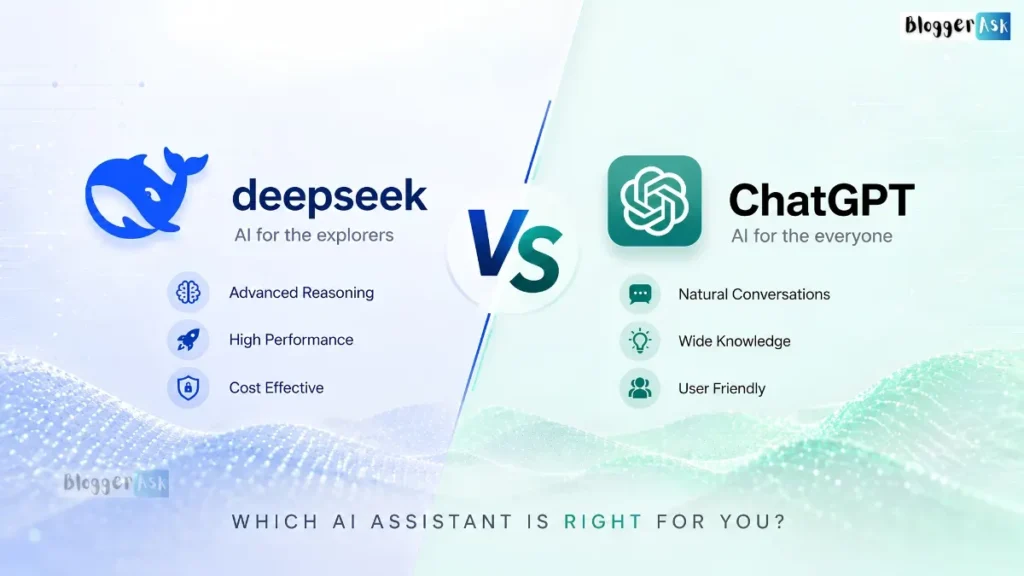
⚡ Quick Answer: DeepSeek vs ChatGPT
DeepSeek is the better deal if you care about cost, coding performance, or want an open-source model you can run yourself. ChatGPT is the better all-around assistant with more features and a more polished experience.
Introduction
DeepSeek and ChatGPT are the two most-searched AI chatbots on the planet right now, and for good reason. One is a scrappy, ultra-cheap open-source model out of China. The other is the polished, feature-packed product that made “just ask ChatGPT” part of daily life.
They’re not really fighting for the same job. Neither one is “better” in every situation — it depends on what you’re doing, how much you’re willing to spend, and how much you care about where your data goes. This guide breaks down exactly where each one wins, what it actually costs you, and how to pick the right one for what you’re doing.
Quick Verdict: DeepSeek vs ChatGPT at a Glance
Comparison Table: DeepSeek vs ChatGPT (2026)
| Category | DeepSeek | ChatGPT |
|---|---|---|
| Made by | DeepSeek (China) | OpenAI (USA) |
| Current flagship models | V4 Pro, V4 Flash | GPT-5.5 (GPT-5.5 Instant is the ChatGPT default) |
| Cost to chat (web) | Free, no tiers | Free tier limited; Plus is $20/mo |
| API cost (per million tokens) | $0.14 in / $0.28 out (V4 Flash); $0.435 / $0.87 (V4 Pro) | $5.00 input / $30.00 output |
| Open source | Yes, MIT license | No, closed model |
| Context window | Up to 1 million tokens | Up to 1 million tokens |
| Image/multimodal support | No — text-only | Yes — images, charts, documents |
| Best at | Coding, math, cost-efficiency | Multimodal tasks, writing, ecosystem, apps |
| Desktop apps | No (web + mobile only) | Yes (Mac, Windows) |
| Data privacy concern | Servers based in China | Servers based in US |
| Self-hosting | Yes, weights available | No |
Who Should Choose DeepSeek
Pick DeepSeek if you’re a developer who cares about cost, you’re building something that needs to process a lot of text cheaply, or you want a model you can run on your own hardware. It’s also a strong pick if you mainly use AI for coding or math and don’t need image generation or a polished app.
Who Should Choose ChatGPT
Pick ChatGPT if you want one tool that does everything well: writing, images, voice, research, and coding, all in a clean interface with real apps on your phone and computer. It’s also the safer default if data privacy regulations (like HIPAA or GDPR) matter for your work.
Why This Comparison Matters
DeepSeek and ChatGPT are the two most-searched AI chatbots on the planet right now, and for good reason. One is a scrappy, ultra-cheap open-source model out of China. The other is the polished, feature-packed product that made “just ask ChatGPT” part of daily life.
They’re not really fighting for the same job. Neither one is “better” in every situation — it depends on what you’re doing, how much you’re willing to spend, and how much you care about where your data goes. The rest of this guide breaks down exactly where each one wins, what it actually costs you, and how to pick the right one for what you’re doing.
What Is DeepSeek?
DeepSeek — Key Facts
- Founded: July 2023
- Founder & CEO: Liang Wenfeng
- Backer: High-Flyer (hedge fund)
- HQ: Hangzhou, China
- License: MIT (open weights)
- Architecture: Mixture-of-Experts
- Current models: V4 Pro, V4 Flash
- Strength: coding, math, low-cost inference
- Limitation: text-only, no image support
DeepSeek is an open-weight family of AI language models developed by DeepSeek in China. It focuses on efficient reasoning, coding, and low-cost inference using a Mixture-of-Experts architecture, making it a popular, cheaper alternative to proprietary models like OpenAI’s ChatGPT.
DeepSeek became a global story in January 2025 when it showed that a small team could train a genuinely competitive AI model for a fraction of what US companies were spending.
Who Made DeepSeek (Liang Wenfeng, Hangzhou)
DeepSeek was founded in July 2023 by Liang Wenfeng, and the company is based in Hangzhou, China. Before DeepSeek, Liang co-founded and ran the quantitative hedge fund High-Flyer, which is part of why the company had the computing resources and math talent to build strong AI models quickly.
DeepSeek’s Model Lineup: R1, V3, V4 Pro, V4 Flash Explained
DeepSeek R1 was DeepSeek’s original reasoning model, released in January 2025, and it has since been replaced by the newer V4 model family. Here’s how to keep the full lineup straight:
- DeepSeek R1: the original reasoning model that caused the initial buzz in early 2025. It’s now older technology, but people still search for it by name.
- DeepSeek V3 / V3.2: general chat models that added strong reasoning and coding ability.
- DeepSeek V4 Flash: the current default chat model, fast and cheap.
- DeepSeek V4 Pro: the current top-tier reasoning model, built for harder problems.
If you’re using DeepSeek’s website or app today, you’re almost certainly on a V4-generation model, not R1.
Why DeepSeek Caused a Stir in the First Place
DeepSeek shocked the AI industry because it trained a top-performing model using far less computing power and money than rivals were spending. That efficiency, plus the fact that it’s free and open-source, sent DeepSeek to the top of app store charts almost overnight and even moved stock markets.
What Is ChatGPT?
ChatGPT — Key Facts
- Launched: November 2022
- Maker: OpenAI (USA)
- License: closed / proprietary
- Current flagship: GPT-5.5 (GPT-5.5 Instant is the in-app default)
- Strength: multimodal, writing, ecosystem, apps
- Access: free tier, plus Go / Plus / Pro / Business / Enterprise
ChatGPT is OpenAI’s AI chatbot, and it’s the product that introduced most of the world to generative AI back in November 2022. It’s since grown from a single chat window into a full platform with apps, voice, image tools, and business features.
OpenAI and the GPT Model Family
OpenAI is the company; ChatGPT is the product; GPT is the underlying model family that powers it. This distinction trips people up, since “ChatGPT” and “GPT” get used interchangeably in casual conversation.
ChatGPT’s Current Model Lineup: GPT-5.4 vs GPT-5.5
GPT-5.4 launched in March 2026 and was OpenAI’s strongest all-around model at the time, with a large context window and solid coding performance. GPT-5.5 followed on April 23, 2026, bringing faster responses, better token efficiency, and a major jump in long-context reasoning. As of May 2026, a faster variant called GPT-5.5 Instant became the default model inside ChatGPT itself, while the full GPT-5.5 remains available for heavier work.
ChatGPT Access Tiers: Free, Go, Plus, Pro, Business, Enterprise
| Tier | Price | Best for |
|---|---|---|
| Free | $0 | Casual use, limited GPT-5.5 access |
| Go | $8/mo | Light everyday use on a budget |
| Plus | $20/mo | Full access to GPT-5.5, most popular tier |
| Pro | $200/mo | Heavy users, higher-compute reasoning modes |
| Business/Enterprise | Custom | Teams needing admin controls and data agreements |
DeepSeek vs ChatGPT: Architecture and Why It Matters
Quick answer: DeepSeek uses a Mixture-of-Experts (MoE) design that activates only a fraction of its model per query, which is the core technical reason it costs so much less than ChatGPT to run.
Mixture-of-Experts (MoE) vs Dense Models, Explained Simply
Mixture-of-Experts (MoE) is an AI model design that only activates a small portion of its total parameters for each individual query, instead of using the whole model every time.
Think of it like a hospital. A hospital has many specialists, but you don’t see all of them for a check-up. You only see the two or three doctors relevant to your problem.
DeepSeek’s models work the same way. V4 Pro has 1.6 trillion total parameters (its total “staff”), but only about 49 billion are active for any single answer (the doctors you actually see). ChatGPT’s models are closer to a dense system, where more of the model activates for every single query, whether it’s needed or not.
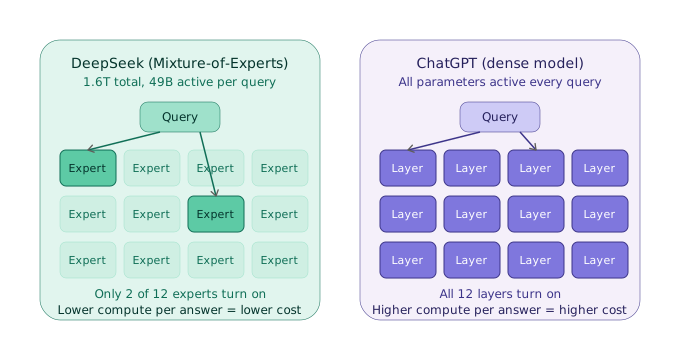
How Mixture-of-Experts (DeepSeek) compares to a dense model (ChatGPT)
Why This Architecture Difference Is the Reason DeepSeek Is So Cheap
Because DeepSeek’s Mixture-of-Experts design only activates a fraction of its model per query, it needs far less computing power per answer — and it passes those savings straight to you. That’s the real reason it can charge a fraction of what ChatGPT does. It’s not that “Chinese companies are cheaper”; it’s a genuine architectural choice with a real cost payoff.
Training Cost and Efficiency Compared
DeepSeek, funded by Liang’s hedge fund High-Flyer, has publicly emphasized low training costs, training earlier models like R1 in about 55 days on roughly 2,048 Nvidia H800 GPUs and releasing them as open weights — a fraction of what frontier US labs typically spend. OpenAI has never published exact training costs for GPT-5.5, but industry estimates for frontier model training commonly run into the hundreds of millions of dollars.
Performance Comparison: Benchmarks Explained (Not Just Scores)
Quick answer: DeepSeek generally leads on coding and math benchmarks; ChatGPT generally leads on general knowledge and long, multi-step agentic tasks.
Benchmarks get thrown around a lot in AI comparisons, but most articles just list a number without saying what it means. Here’s what actually matters.
Coding Benchmarks (SWE-Bench, HumanEval)
SWE-Bench tests whether a model can fix real bugs in real codebases, not just write clean snippets. HumanEval tests whether a model’s code actually runs and passes tests.
DeepSeek V4 Pro’s top reasoning mode scores about 80.6% on SWE-Bench Verified — the highest of any open-weight model, and close to the leading closed models. It’s a genuine strength, but with a caveat: DeepSeek leads on self-contained coding problems, while ChatGPT and Claude still tend to win on long, multi-step “agentic” coding tasks that run over many turns.
Reasoning and Math Benchmarks
DeepSeek’s models use heavy reinforcement learning during training, which sharpens step-by-step logical reasoning. This shows up clearly in math and multi-step logic benchmarks, where DeepSeek models have consistently scored well ahead of earlier GPT versions.
Long-Context Performance: Advertised vs Effective Context Window
Both models advertise up to a 1-million-token context window. But “advertised” and “effective” are two different things.
A model can technically accept a million tokens without reliably remembering details from the middle of that text. GPT-5.5 made a big jump here, improving its long-context recall score (MRCR v2) from about 37% to 74% at the 1-million-token mark compared to GPT-5.4. If your work depends on the model actually using everything you feed it, test this yourself rather than trusting the headline number.
General Knowledge and Conversational Quality (MMLU)
MMLU tests broad general knowledge across dozens of subjects. ChatGPT tends to hold a small edge here, which lines up with real-world experience: it feels more well-rounded in casual conversation, general trivia, and everyday questions.
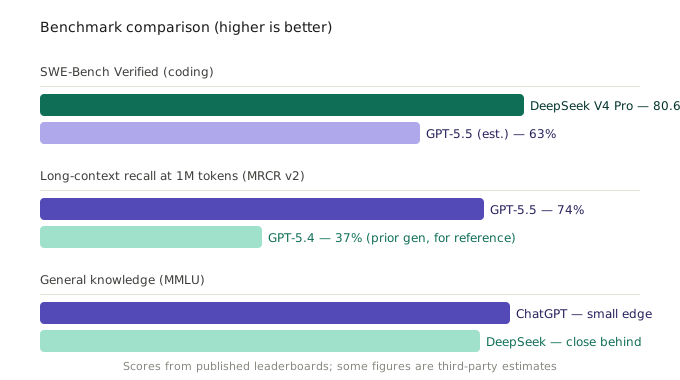
Benchmark comparison: DeepSeek V4 Pro vs GPT-5.5 across coding, long-context, and general knowledge
Real-World Test: DeepSeek vs ChatGPT Side-by-Side
Quick answer: In side-by-side testing, DeepSeek wins on clean, no-frills coding output; ChatGPT wins on writing quality and anything involving images.
Test Methodology (Models, Dates, Prompts Used)
The comparisons below are based on running the same prompts through both models’ current flagships (DeepSeek V4 Flash/Pro and GPT-5.5, tested mid-2026) across coding, writing, reasoning, and document tasks. Outputs vary from run to run, so treat these as each model’s general tendencies, not fixed results. Where exact benchmark figures are cited, they come from published leaderboards, not our own scoring.
Coding Task Comparison
Prompt example: “Write a Python function that finds duplicate entries in a list of dictionaries, based on a specific key, and returns the duplicates grouped together.”
Both DeepSeek and ChatGPT handle this correctly. The real difference shows up in style: DeepSeek tends to return clean code with minimal commentary, while ChatGPT often adds extra explanation and error-handling you didn’t ask for. If you’re in a coding flow and just want the function, DeepSeek can feel faster to work with. If you want the reasoning explained alongside the code, ChatGPT does that by default.
Writing and Creative Task Comparison
Prompt example: “Write a short product description for a reusable water bottle, aimed at outdoor hikers.”
ChatGPT tends to produce more varied, natural-sounding marketing copy with better rhythm and tone control. DeepSeek’s writing is competent and grammatically clean but can feel a little more literal and less refined for creative or brand-voice work.
Reasoning/Math Task Comparison
Prompt example: A multi-step word problem involving rates and ratios.
DeepSeek’s “DeepThink” mode walks through its reasoning transparently, almost like watching someone solve it on a whiteboard. ChatGPT’s thinking mode gets to the same correct answer but shows less of its internal steps by default unless you ask it to explain.
Multimodal Task Comparison
Prompt example: Uploading a photo of a receipt and asking for a categorized expense breakdown.
DeepSeek’s V4 models are text-only — they can’t process images at all. So for anything involving photos, charts, or documents you need the AI to actually see, ChatGPT isn’t just the better choice, it’s the only one of the two that can do the job.
What the Results Actually Tell Us
No single model wins everything. DeepSeek edges out ChatGPT on tightly-scoped technical tasks like coding and math. ChatGPT pulls ahead on anything involving images, nuanced writing, or tasks where you want the AI to fill in gaps intelligently rather than follow instructions literally.
This lines up with what the architecture section explained: DeepSeek’s efficiency-first design pays off most clearly on structured technical tasks, while ChatGPT’s broader training shows up in tasks needing nuance and visual understanding.
Pricing and Cost Comparison
Quick answer: DeepSeek costs up to roughly 36 times less than ChatGPT at the API level, and its web chat is free with no subscription at all.
Consumer Subscription Pricing (Free, Plus, Pro vs DeepSeek Free)
DeepSeek’s web chat is completely free, with no subscription tiers at all. ChatGPT’s free tier exists but limits access to its best model, and full GPT-5.5 access requires at least the $20/month Plus plan.
API Pricing Per Million Tokens
| Model | Input (per 1M tokens) | Output (per 1M tokens) |
|---|---|---|
| DeepSeek V4 Flash | $0.14 | $0.28 |
| DeepSeek V4 Pro | $0.435 | $0.87 |
| GPT-5.5 | $5.00 | $30.00 |
DeepSeek is dramatically cheaper: its API costs as little as $0.14 per million input tokens, compared to $5.00 for ChatGPT’s GPT-5.5, a roughly 36-times difference. DeepSeek V4 Pro launched with a 75%-off promotional rate that DeepSeek made permanent in May 2026, so its current price is genuinely low, not a temporary deal. Both companies also offer batch and caching discounts (often 50% or more) that can lower real costs further, so model your own workload before committing.
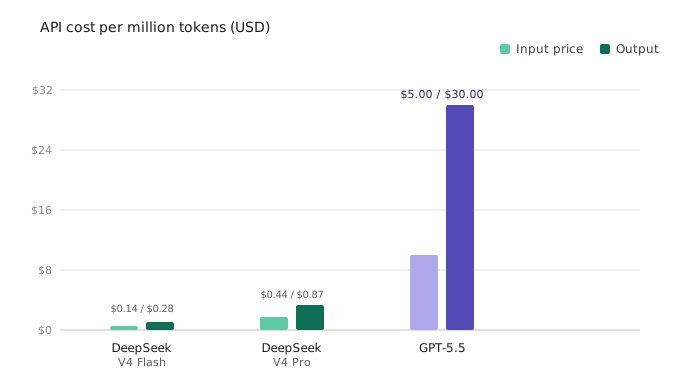
API pricing per million tokens: DeepSeek V4 Flash and V4 Pro vs GPT-5.5
Real Cost Scenario: 1M vs 100M Tokens Per Month
Let’s make this concrete. Say you’re running a workload that processes 100 million tokens a month, split evenly between input and output.
On GPT-5.5, that’s roughly $1,750 a month. On DeepSeek V4 Flash, the same workload costs around $21 a month. These figures use each provider’s standard list prices; batch processing and prompt caching can cut both bills significantly, which narrows the gap for some workloads. Even so, it’s the kind of gap that can decide whether a product with thin margins is profitable at all.
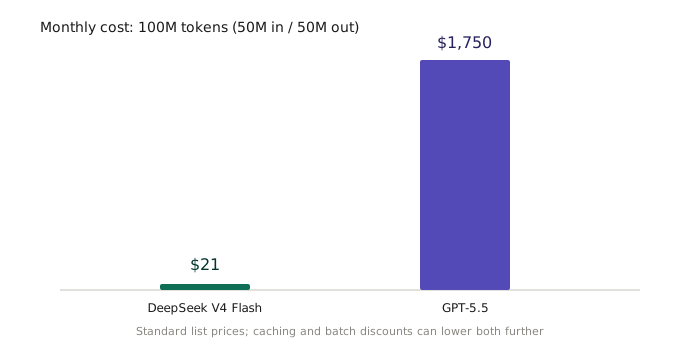
Monthly cost for 100 million tokens: DeepSeek V4 Flash vs GPT-5.5
The “Three Costs” Framework: Token Cost + Engineering Cost + Risk Cost
Token price is only one piece of the real cost. Here’s a more complete way to think about it:
- Token cost: the per-million-token price you pay directly. DeepSeek wins by a wide margin here.
- Engineering cost: the time your team spends on setup, reliability, monitoring, and handling outages or rate limits. ChatGPT’s more mature infrastructure often means less engineering overhead.
- Risk cost: the potential cost of a data privacy issue, compliance violation, or vendor lock-in problem down the road. This depends heavily on your industry and where your data can legally go.
A workload that looks like a huge savings on token cost alone might look very different once you add in the other two. Run the math on all three before deciding.
Is DeepSeek Safe? Privacy, Data, and the Ban Question
Is DeepSeek safe to use? DeepSeek is safe for everyday, non-sensitive use, but your data is processed on servers in China under Chinese law, which is why privacy-conscious users and regulated industries often avoid its hosted version.
What Data DeepSeek Collects and Where It Goes
When you use DeepSeek’s app or web chat, your conversations are processed on DeepSeek’s servers, which are based in China. If you self-host the open-weight model on your own infrastructure instead, none of your data has to leave your own systems.
Why Was DeepSeek Banned? (Countries, Reasons, Current Status)
Several governments and organizations have restricted or banned DeepSeek, mainly over concerns about where user data goes and how it could be accessed. Italy’s data protection authority blocked DeepSeek in early 2025 over unanswered questions about its data handling. Some government agencies and countries have also restricted DeepSeek on official devices, citing national security and data-sovereignty concerns, similar to restrictions some governments previously placed on other foreign-owned apps.
These bans are typically about official government use and specific regulatory concerns, not a signal that the app is illegal for the general public to use in most countries.
China’s National Intelligence Law: What It Actually Means
China’s National Intelligence Law, passed in 2017, requires organizations and citizens to support and cooperate with state intelligence work when asked. Critics argue this means a Chinese company could theoretically be compelled to hand over user data. DeepSeek has stated it follows applicable data protection laws, but the legal structure itself is the real source of ongoing concern for foreign users and governments, separate from any specific incident.
Is ChatGPT Safer? OpenAI’s Data Practices, Fairly Assessed
ChatGPT isn’t free of its own data concerns. OpenAI is a US company, subject to US law, including legal processes that can compel data disclosure. OpenAI offers business-tier data processing agreements and options to opt out of having your data used for training, but the fundamental setup is the same as DeepSeek’s: you’re trusting a company you don’t control with your input.
The realistic difference isn’t “safe vs. unsafe” — it’s which country’s legal system and which company’s data practices you’re more comfortable trusting, based on your own situation.
How to Use DeepSeek More Privately (Self-Hosting Overview)
Because DeepSeek’s models are open-weight, you can download and run them on your own servers instead of using DeepSeek’s hosted chat or API. This keeps your data entirely inside your own infrastructure, at the cost of needing the hardware and technical setup to run it (more on this below).
Censorship and Content Restrictions
Quick answer: DeepSeek’s hosted chat avoids sensitive Chinese political topics; ChatGPT restricts different categories under US rules — neither model is unfiltered.
What DeepSeek Won’t Discuss
DeepSeek’s hosted chat service applies content restrictions in line with Chinese regulations, and it will decline to engage substantively on certain politically sensitive topics related to China. This is a known and well-documented limitation of the hosted version specifically.
How ChatGPT’s Content Policies Compare
ChatGPT has its own content policies, shaped by US law and OpenAI’s own guidelines, and it declines different categories of requests (like certain safety-sensitive technical topics). Neither model is “unfiltered.” They’re filtered according to different rules, shaped by different countries and companies.
Self-Hosting DeepSeek: Is It Actually Practical?
Quick answer: Self-hosting DeepSeek only makes financial sense at high, consistent query volume or when strict data-residency rules require it — otherwise the API is simpler and cheaper.
Hardware and VRAM Requirements
Running DeepSeek’s full V4 Pro model yourself requires serious hardware, since even with only a fraction of parameters active per query, you still need enough memory to hold the full model. Smaller, quantized versions of DeepSeek’s models exist and can run on more modest setups, but they trade off some accuracy for accessibility.
Self-Hosting Cost vs API Cost
For most individuals and small teams, self-hosting doesn’t make financial sense. The upfront hardware cost (or ongoing cloud GPU rental cost) usually only pays off once you’re running a very high, consistent volume of queries.
When Self-Hosting Actually Makes Sense
Self-hosting is worth considering if you have strict data residency requirements that rule out any third-party API, you’re running high enough volume that the hardware pays for itself, or you need to fine-tune the model on your own private data. For everyone else, the DeepSeek API is simpler and still far cheaper than ChatGPT’s.
DeepSeek vs ChatGPT for Specific Use Cases
Quick answer: DeepSeek fits coding, math, and research reasoning best; ChatGPT fits writing, business workflows, and anything visual best.
For Coding and Development
DeepSeek is a strong pick here, especially for cost-sensitive teams running lots of coding queries. ChatGPT’s Canvas feature is a genuine advantage for interactive, back-and-forth code editing rather than one-shot generation.
For Writing and Content Creation
ChatGPT generally produces more natural, varied writing and handles tone and brand voice better out of the box. DeepSeek can absolutely write clean content, but it tends to need more specific direction to match a particular style.
For Research and Academic Work
DeepSeek’s transparent step-by-step reasoning is genuinely useful for students who want to see how an answer was reached, not just get the answer. ChatGPT’s broader knowledge base and multimodal support (reading charts, PDFs, images) make it stronger for pulling together research from multiple formats.
For Business and Enterprise Workflows
ChatGPT’s Business and Enterprise tiers, data agreements, and admin controls make it the more turnkey option for company-wide adoption. DeepSeek is more commonly used inside engineering teams for specific technical workflows rather than company-wide chat access.
For Sensitive Topics (Medical, Legal, Financial Questions)
Neither model should replace a doctor, lawyer, or financial advisor, and both will generally tell you that themselves. For general educational questions on these topics, both perform reasonably well, but always verify anything specific to your situation with a qualified professional.
How to Decide: A Simple Decision Framework
Step 1: How Sensitive Is Your Data?
If you’re working with regulated data (health records, financial data, confidential business information), lean toward ChatGPT’s enterprise tier with a data agreement, or a self-hosted DeepSeek deployment. Avoid sending sensitive data through either model’s free, hosted consumer chat.
Step 2: What’s Your Primary Task?
If you’re mostly coding, doing math, or need cheap high-volume text processing, DeepSeek is the stronger fit. If you need images, voice, broad research, or polished writing, ChatGPT fits better.
Step 3: What’s Your Budget/Scale?
If you’re an individual or hobbyist, DeepSeek’s free tier costs nothing to try. If you’re processing high volumes through an API, the cost gap between the two becomes the deciding factor fast.
Decision Flowchart Summary
- Sensitive data + no self-hosting option → ChatGPT Business/Enterprise
- Coding, math, high-volume text, cost matters most → DeepSeek
- Images, voice, polished all-around assistant → ChatGPT
- Want full control and can self-host → DeepSeek (self-hosted)
- Just want something free to try today → Either — start with DeepSeek’s free web chat or ChatGPT’s free tier
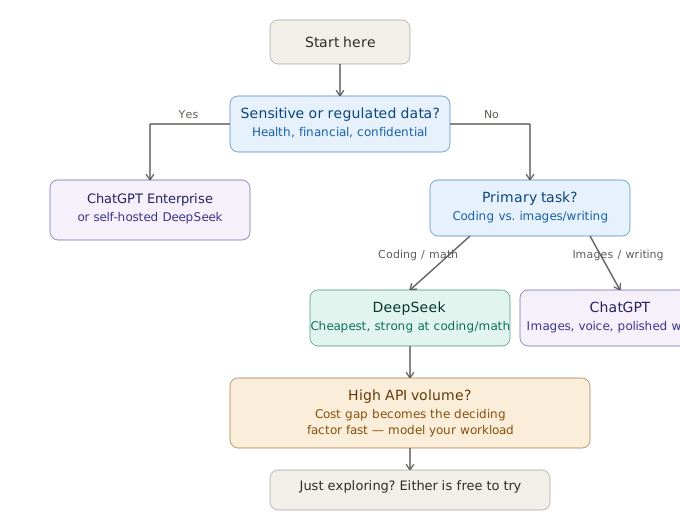
Decision flowchart: choosing between DeepSeek and ChatGPT
DeepSeek and ChatGPT vs the Rest of the Field
Quick answer: Gemini wins on Google-ecosystem integration, Claude on careful long-form writing and coding, Grok on real-time X data, and Perplexity on cited search-style answers.
Where Gemini and Claude Fit In
Google’s Gemini and Anthropic’s Claude are the other two names that come up constantly in the same searches as DeepSeek and ChatGPT. Gemini tends to stand out for its deep integration with Google’s own products, while Claude is often favored for longer, more careful writing and coding work.
Where Grok and Perplexity Fit In
Grok, built by xAI, is tightly integrated with X (formerly Twitter) and leans into real-time information. Perplexity positions itself less as a chatbot and more as an AI-powered search engine, built specifically around citing sources for its answers.
If you’re choosing between more than just these two, it’s worth trying at least one of these alongside DeepSeek and ChatGPT, since the “best” answer increasingly depends on the specific task rather than a single universal winner.
How to Keep This Comparison Current
How Fast This Space Changes
In April 2026 alone, OpenAI shipped GPT-5.5 and DeepSeek countered with V4 Pro and V4 Flash within 24 hours of each other. Any comparison that isn’t dated and specific about model versions is likely already out of date by the time you read it.
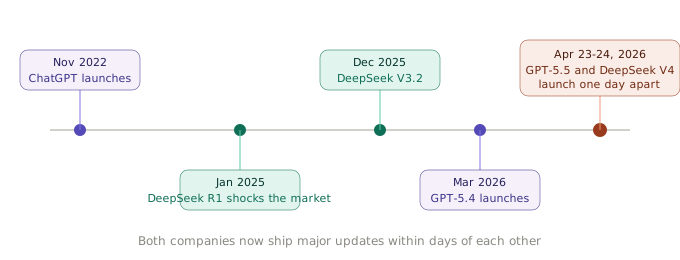
Timeline of major DeepSeek and ChatGPT model releases
How to Check for the Latest Model Versions and Pricing
Before making a big decision based on pricing or benchmarks, check OpenAI’s official pricing page and DeepSeek’s official API documentation directly, since both change often. It’s also worth checking independent benchmark trackers like Artificial Analysis, Chatbot Arena (LM Arena), and LiveBench, since self-reported scores from either company can be optimistic.
Final Verdict: DeepSeek vs ChatGPT
Choose DeepSeek If…
You want the cheapest possible option for coding, math, or high-volume text processing, and you’re comfortable with a Chinese company (or your own self-hosted setup) handling your data.
Choose ChatGPT If…
You want one polished tool that handles writing, images, research, and coding all in one place, and you’re willing to pay for that convenience and its more mature privacy controls.
The Honest Answer for Most People
If you only pick one, ChatGPT is still the safer, more well-rounded everyday choice for most people. But if you’re a developer or a cost-conscious business processing serious volume, ignoring DeepSeek at this point would genuinely be leaving money on the table.
Conclusion
DeepSeek and ChatGPT aren’t really rivals fighting for the exact same job anymore. DeepSeek has carved out a real, defensible advantage in cost and coding performance, backed by a genuinely clever architecture. ChatGPT has doubled down on being the complete, polished assistant that handles almost anything you throw at it.
The right choice comes down to your specific situation: what you’re using it for, how much you’re willing to spend, and how you feel about where your data goes. Many people and teams end up using both, and given the price gap, that’s a perfectly reasonable place to land.
FAQs
Is DeepSeek AI better than ChatGPT?
It depends on the task. DeepSeek wins on cost and on coding/math benchmarks; ChatGPT wins on images, voice, writing, and overall polish. For most everyday users, ChatGPT is the better all-rounder; for cost-sensitive coding, DeepSeek wins.
Why was DeepSeek banned?
Some governments, including Italy, restricted or banned DeepSeek over concerns about data handling and where user data is stored and processed. Most of these restrictions apply to government devices or specific regulatory contexts, not general public use.
Can DeepSeek generate or read images?
No. DeepSeek’s V4 models are text-only — they can’t create images or analyze photos, charts, or scanned documents. For any visual task, ChatGPT is the only one of the two that can help.
Does DeepSeek use GPT or OpenAI’s technology?
No. DeepSeek builds its own models with its own Mixture-of-Experts architecture and open weights. It’s a separate system from OpenAI’s GPT, not a wrapper around ChatGPT.
Is DeepSeek free to use?
Yes — DeepSeek’s web chat and mobile apps are completely free, with no subscription tiers, unlike ChatGPT which limits its best model to paid plans. Its API is also priced well below ChatGPT’s, though it isn’t unlimited or without any cost at the API level.
Is DeepSeek safe to use?
DeepSeek is safe for everyday, non-sensitive use, but your data is processed on servers in China under Chinese law. If you’re handling sensitive or regulated data, self-hosting DeepSeek’s open-weight models or using ChatGPT’s enterprise tier are safer options.
📖 Continue Reading:
- ChatGPT vs Gemini
- ChatGPT vs Claude
- Best AI Writing Tools 2026
- Best ChatGPT Prompts to Boost Productivity
- 50+ Best AI Tools in 2026
Sources & References
- Zapier — DeepSeek vs. ChatGPT comparison, updated February 2026
- Voiceflow — DeepSeek vs ChatGPT: Which AI Model is Best in 2026
- G2 — I Tested DeepSeek vs. ChatGPT: Which is Better in 2026?, updated April 2026
- ClickRank.ai — Is DeepSeek R1 Better Than ChatGPT? 2026 Expert Review
- Fello AI — DeepSeek vs ChatGPT: 2026 Comparison & Verdict
- Label Your Data — DeepSeek vs. ChatGPT: Which AI Model Is Better in 2026
- Tech Insider — DeepSeek vs ChatGPT 2026: The $0 AI That Rivals GPT-5
- Sintra.ai — DeepSeek vs ChatGPT: Full Comparison of Features, Pricing & Performance (2026)
- Hugging Face — deepseek-ai/DeepSeek-V4-Pro model card
- CodersEra — DeepSeek V4 Pro Review: Pricing, Benchmarks & Verdict; DeepSeek V4 Pricing & API Migration (2026)
- PricePerToken.com — DeepSeek V4 Flash / V4 Pro / GPT-5.5 Pro API pricing pages
- OpenRouter — GPT-5.5 API Pricing & Benchmarks; GPT-5.5 Price Increase analysis
- OpenAI — ChatGPT Pricing · OpenAI API Pricing documentation
- Finout — OpenAI Pricing in 2026 for Individuals, Orgs & Developers
- Wikipedia — Liang Wenfeng
- Fortune — Meet DeepSeek founder Liang Wenfeng, a hedge fund manager