⚡ Quick Answer: Who Owns Discord in 2026?
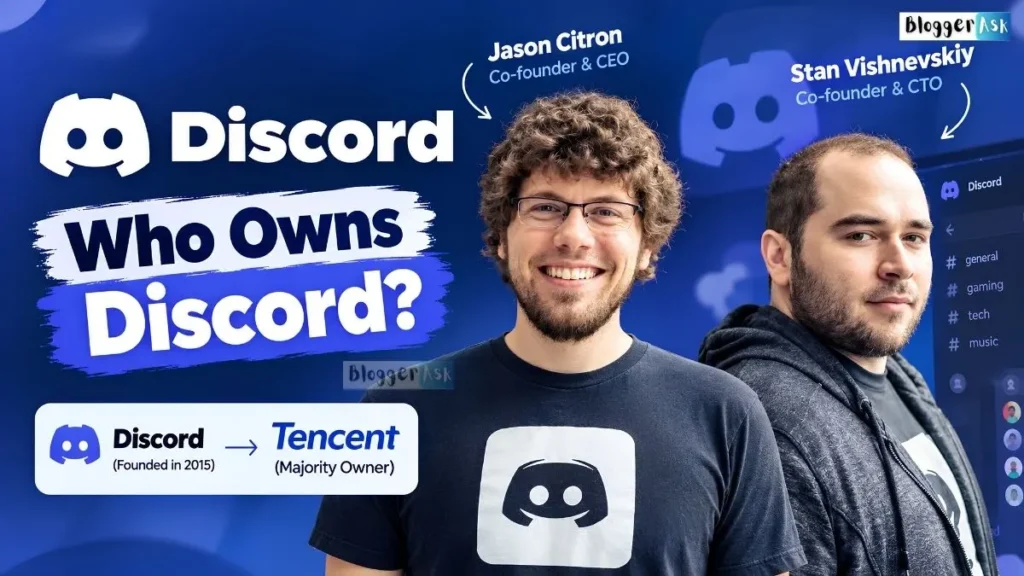
Discord is owned by Discord Inc., a privately held U.S. company — it is not publicly traded, and no single person “owns” it outright. Its current CEO is Humam Sakhnini, who took over on April 28, 2025. The platform was founded by Jason Citron and Stanislav Vishnevskiy in 2015, and its equity is held by the founders, employees, and a mix of venture capital and strategic investors, including Tencent and Sony. As of this writing (September 2026), Discord has confidentially filed for a U.S. IPO but has not gone public, and no listing date has been confirmed.
Key Takeaways
- Discord Inc. is privately held — there is no public stock to buy yet.
- Founders Jason Citron and Stanislav Vishnevskiy started the company in 2015; Citron is no longer CEO but remains on the board.
- Humam Sakhnini has been CEO since April 28, 2025.
- Discord confidentially filed for a U.S. IPO in January 2026 with Goldman Sachs and JPMorgan Chase as lead underwriters; as of August 2026, no listing date or price has been confirmed.
- Microsoft does not own Discord — it made an acquisition offer in 2021 that Discord turned down.
- Tencent and Sony are minority investors, not controlling owners.
If you’ve spent any real time in gaming or hobby communities, you’ve probably noticed Discord servers everywhere — that everyday ubiquity is part of why so many people are curious who’s actually behind the company. Below is a complete, current breakdown.
Who Owns Discord? The Short Answer
Discord Inc. Is the Company Behind Discord
The app you use every day is a product of Discord Inc., a San Francisco-based company. When people ask “who owns Discord,” they’re really asking two separate questions: who runs the company and who holds equity in it. Both matter, and they have different answers.
Discord Is Privately Held
Discord is not publicly traded. There is no stock ticker, and shares aren’t available on a public exchange like the NYSE or Nasdaq. As of September 2026, that remains true — even though Discord has taken real steps toward an eventual IPO, which we cover in detail further down.
Who Actually Owns Discord? (Founders, Employees & Investors)
Because Discord is private, ownership is split among a relatively small group of shareholders rather than the general public:
- Co-founders Jason Citron and Stanislav Vishnevskiy, who retain equity from building the company
- Employees, many of whom hold stock options as part of standard startup compensation
- Venture capital and institutional investors who’ve funded Discord across more than a decade of funding rounds, including Benchmark, Index Ventures, Greylock Partners, and Fidelity Investments
- Strategic investors Tencent and Sony, who hold minority stakes tied to broader gaming-industry partnerships
Discord does not publicly disclose exact ownership percentages — that’s normal for a private company, and it’s one reason so many “ownership breakdown” claims you’ll find online are estimates dressed up as fact. Treat any specific percentage you see (including on other sites) with healthy skepticism unless it’s sourced to an actual filing.
Quick Facts: Discord at a Glance
| Legal name | Discord Inc. |
| Founded | 2015 (San Francisco) |
| Founders | Jason Citron, Stanislav Vishnevskiy |
| Current CEO | Humam Sakhnini (since April 28, 2025) |
| Current CTO | Stanislav Vishnevskiy |
| Ownership status | Privately held; not publicly traded |
| Headquarters | San Francisco, California |
| Monthly active users | 200+ million officially disclosed (April 2025); third-party estimates put it closer to 250 million by mid-2026 |
| 2025 estimated revenue | ~$561 million, reportedly up about 29% year-over-year (third-party estimate; Discord does not publicly disclose financials) |
| IPO status (as of Sept. 2026) | Confidentially filed with the SEC in January 2026; no listing date or price confirmed as of August 2026 |
Who Is the Current CEO of Discord?
Humam Sakhnini — Background and Appointment (April 2025)
Discord’s CEO is Humam Sakhnini, who officially stepped into the role on April 28, 2025. He joined Discord’s Board of Directors at the same time. Before Discord, Sakhnini spent more than 15 years in the gaming industry, most recently as Vice Chairman at Activision Blizzard, where he oversaw a portfolio that included Call of Duty, World of Warcraft, and Candy Crush. Earlier in his career, he served as President of King Digital Entertainment, taking over from that company’s founding CEO and guiding it through its acquisition by Activision Blizzard.
Why Discord Brought In an Outside CEO
Sakhnini’s appointment wasn’t a random hire — it lines up closely with Discord’s next chapter. His background includes years operating inside a large, publicly traded gaming company, giving him direct experience with the financial reporting, investor relations, and scaling challenges that come with life as a public company. That experience is directly relevant given Discord’s confidential IPO filing just nine months later, in January 2026.
What Happened to Jason Citron?
Jason Citron, who co-founded Discord and served as its CEO from the very beginning, didn’t leave the company. He transitioned to a role as Advisor to the CEO and remains on Discord’s Board of Directors. This is a fairly common pattern for founder-led startups approaching an IPO: the founder steps back from day-to-day operations while retaining influence at the board level, and a leader with public-company experience takes over daily management.
Who Founded Discord?
Jason Citron — Co-Founder and Former CEO
Jason Citron co-founded Discord in 2015. Before that, he built and sold OpenFeint, a mobile-gaming social platform, to the Japanese company GREE in 2011 for a reported $104 million. He used that capital to start a game studio, Hammer & Chisel, which released a mobile MOBA called Fates Forever in 2014. The game didn’t take off commercially — but the voice and text chat tools the team built to coordinate during development became the foundation for what would become Discord.
Stanislav Vishnevskiy — Co-Founder and Chief Technology Officer
Stanislav Vishnevskiy co-founded Discord alongside Citron and has served as Chief Technology Officer ever since. Unlike Citron, Vishnevskiy’s role hasn’t changed through the company’s various leadership transitions — he continues to oversee Discord’s technical architecture.
From OpenFeint to Discord: The Founders’ Backstory
The throughline from Citron’s earlier ventures to Discord is instructive: both OpenFeint and Fates Forever were built around solving communication and social problems for gamers. Discord was, in effect, the pivot that finally found product-market fit — the chat tool the team built as an internal necessity turned out to be more valuable than the game it was meant to support.
Discord’s Ownership & Investor Structure
Venture Capital and Institutional Investors
Discord has raised money across roughly ten funding rounds since 2013, growing from an $8.2 million Series A to a $500 million Series I round in September 2021 that valued the company at approximately $15 billion. Here are the investors most consistently named across that history:
| Investor | Type | First Involved | Notable Context |
|---|---|---|---|
| Benchmark | Venture Capital | 2013 (Series A) | Partner Mitch Lasky sits on Discord’s board |
| Tencent | Strategic (gaming/tech) | 2015–2016 | Minority stake across multiple early rounds |
| Index Ventures | Venture Capital | 2017 | Repeat investor across several rounds |
| Greylock Partners | Venture Capital | 2017 | Early- and growth-stage backer |
| Sony | Strategic (gaming/media) | 2020–2021 | Tied to PlayStation-related partnership |
| Greenoaks Capital | Growth Equity | 2018 | Repeat investor across multiple rounds |
| Dragoneer Investment Group | Growth Equity | 2021 | Led the $500M Series I round |
| Fidelity Investments | Institutional/Asset Manager | 2021 | Participated in the Series I round |
| Franklin Templeton | Institutional/Asset Manager | 2021 | Participated in the Series I round |
Strategic Investors: Tencent and Sony
Two names on that list get outsized attention: Tencent and Sony. Both are “strategic” investors rather than purely financial ones — meaning their investment came alongside business relevance to their own operations (Tencent’s global gaming portfolio, Sony’s PlayStation ecosystem), not just a bet on Discord’s valuation. We break down exactly what that does and doesn’t mean in the next section.
What “Privately Held” Actually Means for Discord
Being privately held has practical consequences that matter to anyone trying to understand who’s really “in charge”:
- Discord doesn’t have to publish quarterly earnings or audited financials — the revenue and user figures reported by third-party trackers (like the $561 million 2025 revenue estimate above) are estimates, not company-confirmed numbers
- There’s no stock price to track, and no way for the general public to buy shares directly
- Major decisions run through the Board of Directors and executive leadership rather than public shareholders
That changes, at least partially, if and when the company actually completes an IPO.
Does Tencent Own Discord?
Tencent’s Investment and Stake
Tencent, the Chinese technology and gaming conglomerate, has been a Discord investor since as early as 2015, participating in multiple funding rounds through 2018. This is a real, long-standing financial relationship — but “investor” and “owner” aren’t the same thing.
Does Tencent Have Control or a Board Seat?
Tencent’s investment in Discord is a minority stake, one of many institutional and strategic positions in the company’s cap table alongside Benchmark, Index Ventures, Sony, and others. There is no public evidence that Tencent controls Discord’s operations, product decisions, or content moderation policies. Discord’s publicly named board members — including Mitch Lasky of Benchmark, plus Citron and Sakhnini — reflect a board composition led by Discord’s founders and U.S.-based venture investors, not Tencent.
Is Discord a Chinese Company?
No. Discord Inc. is a U.S. company headquartered in San Francisco, incorporated and operated under U.S. law. Tencent’s minority investment doesn’t change the company’s nationality, legal jurisdiction, or headquarters. This question tends to surface alongside broader public conversation about Chinese investment in U.S. tech companies — a legitimate topic in general, but one that, in Discord’s specific case, doesn’t change who actually runs the company or where it’s based.
Is Discord Owned by Microsoft?
The 2021 Acquisition Talks
In early 2021, Microsoft reportedly held talks to acquire Discord for more than $10 billion — some reports put the figure as high as $12 billion. The talks were real and were widely reported by multiple outlets at the time.
Why the Deal Didn’t Happen
Discord ultimately walked away from the offer. Instead, later that same year, it raised $500 million in a funding round led by Dragoneer Investment Group, which valued the company at roughly $15 billion — higher than what Microsoft had reportedly offered. Discord chose to remain independent, betting it could build more value as a standalone company than as part of Microsoft. That bet is now facing its real test as Discord pursues a public listing on its own.
Bottom line: Microsoft does not own Discord, has never owned Discord, and the two companies have no ownership relationship today.
Founder vs. CEO vs. Owner — Understanding the Difference
A lot of confusion around “who owns Discord” comes from conflating three distinct roles. Here’s the simple version:
- Founder — the person(s) who started the company. This is a permanent historical fact. Jason Citron and Stanislav Vishnevskiy founded Discord in 2015, and that never changes, regardless of who runs the company today.
- CEO — the person currently responsible for running the company day-to-day. This role can and does change; it moved from Citron to Sakhnini in April 2025.
- Owner — anyone holding equity in the company. For a private company like Discord, this is a group: founders, employees, and outside investors, not one individual.
Jason Citron is a founder and a former CEO, but he was never the sole “owner” of Discord in any formal sense — even at the company’s founding, early investors like Benchmark held equity within months of the company’s start.
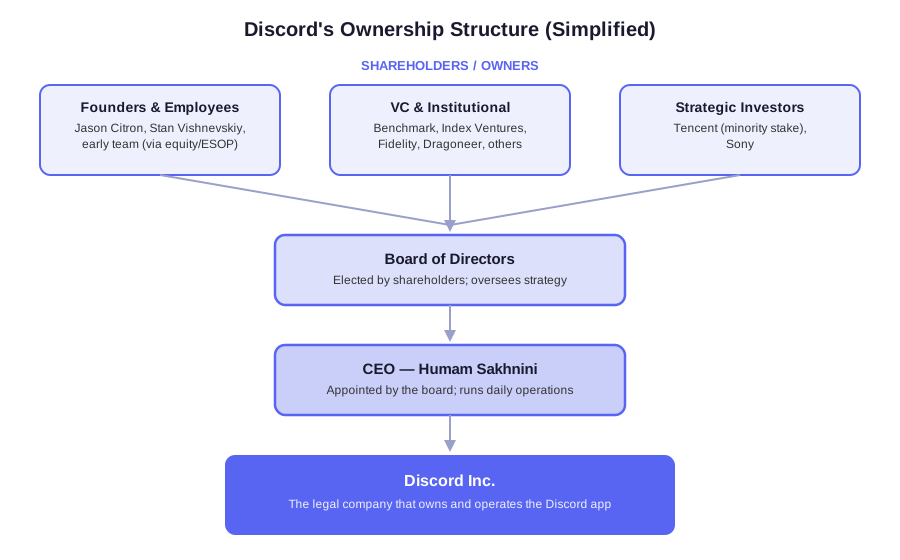
A Simple Structural Model of Discord’s Ownership Layers
The diagram below shows how these layers connect: shareholders elect the board, the board oversees and appoints the CEO, and the CEO runs the operating company.
Is Discord Going Public? IPO Status Explained
What a “Confidential IPO Filing” Actually Means
In January 2026, Bloomberg reported that Discord had confidentially filed paperwork for a U.S. initial public offering. A confidential filing is a legal mechanism (available to eligible companies under the JOBS Act) that lets a company submit draft registration documents to the SEC without immediately making its financials public. It’s a genuine step toward going public — but it is not the same as actually being public, and it doesn’t guarantee the company will follow through.
Underwriters, Timeline, and What’s Still Unconfirmed
Discord is reportedly working with Goldman Sachs and JPMorgan Chase as lead underwriters on a potential listing. Various reports floated a possible listing window as early as the first half of 2026, but as of August 2026, no public S-1 filing, share price range, listing date, or exchange had been confirmed.
What’s confirmed:
- A confidential draft registration was submitted to the SEC on or around January 6, 2026
- Goldman Sachs and JPMorgan Chase are the reported lead underwriters
What remains unconfirmed:
- The final IPO valuation. Private-market secondary trading platforms implied a valuation of roughly $8.5 billion as of mid-2026, well below Discord’s $15 billion private valuation from 2021 — but these secondary-market figures are not official public numbers
- A specific listing date or exchange
- Whether Discord will complete the IPO at all — the company itself has publicly said only that it remains focused on the user experience and building a sustainable business, without confirming its IPO plans
Can You Buy Discord Stock Right Now?
No. Discord has no public ticker symbol as of September 2026. Some private-market platforms allow accredited investors to trade pre-IPO shares informally based on secondary-market demand, but this is not the same as buying stock on a public exchange, and it isn’t accessible to most retail investors. If Discord completes its IPO, its shares would become available through normal brokerage accounts — until then, no legitimate path exists for the general public to buy Discord stock.
Discord’s Timeline: From Startup to Almost-IPO
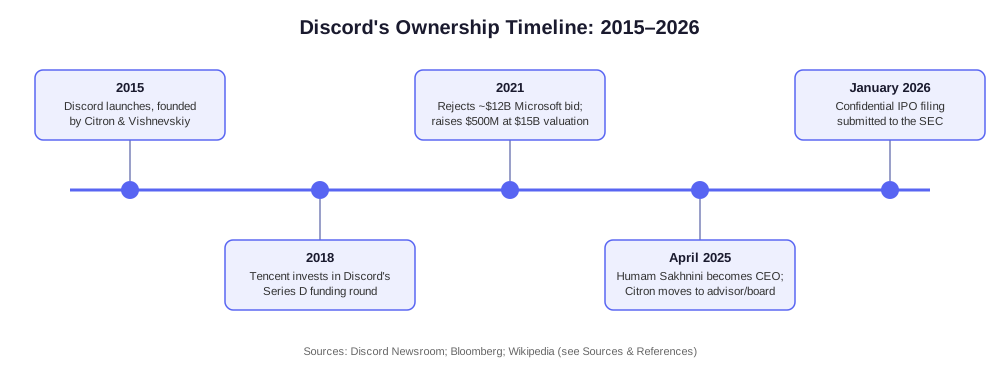
2015–2020: Founding and Early Growth
Discord launched in 2015, growing from a niche gamer chat tool into a broader communications platform used by communities well beyond gaming. Early funding rounds brought in Benchmark, Tencent, Index Ventures, Greylock, and others.
2021: The Rejected Microsoft Acquisition and Dragoneer Round
Discord turned down Microsoft’s multibillion-dollar acquisition interest and instead raised $500 million at a $15 billion valuation, backed by Dragoneer, Fidelity, Franklin Templeton, and other institutional investors.
2025: The CEO Transition
Humam Sakhnini became CEO on April 28, 2025, with Jason Citron moving to an advisor and board role.
2026: The Confidential IPO Filing
Discord confidentially filed for a U.S. IPO in early January 2026, working with Goldman Sachs and JPMorgan Chase. As of this writing, the company remains privately held, with no listing date confirmed as of August 2026.
How Does Discord Make Money?
Discord’s business model is unusual for a consumer platform this large: it has historically avoided the ad-heavy, data-driven approach used by most free social platforms.
| Revenue Stream | What It Is |
|---|---|
| Discord Nitro | Primary subscription tier (~$9.99/month), offering animated avatars, larger file-upload limits, HD video, and cosmetic perks |
| Nitro Basic | A lighter subscription tier (~$2.99/month) with a smaller set of perks |
| Server Boosts | Users pay to unlock perks (better audio quality, more emoji slots, vanity URLs) for specific communities they care about |
| App Directory revenue share | Discord takes a cut when verified third-party bots and apps charge users or servers for premium features |
| Quests | Brand-sponsored, opt-in challenges users can complete for in-app rewards |
| Experimental advertising | Limited, early-stage ad formats being tested — not a feed-based advertising model |
Third-party financial trackers estimate Discord generated approximately $561 million in revenue in 2025, up roughly 29% from the prior year — again, an outside estimate rather than a Discord-confirmed figure, since the company doesn’t publish financials as a private entity.
Discord Nitro and Server Boosts
Nitro and Server Boosts remain the backbone of Discord’s revenue. The Boost mechanic in particular is a clever piece of product design: it lets engaged community members fund improvements to servers they personally care about, rather than just paying for their own account perks.
App Directory Revenue Share and Quests
More recent additions — App Directory revenue share and Quests — reflect Discord diversifying beyond subscriptions as it prepares for public-market scrutiny. Investors evaluating a potential IPO will want to see revenue streams beyond a single subscription product.
Why Discord Doesn’t Rely on Traditional Advertising
Unlike Instagram, Facebook, or Reddit, Discord has not built its business around targeted, feed-based advertising or selling user data. That’s been part of its trust proposition with users for years — though it’s also a genuine open question analysts raise about Discord’s IPO prospects, since ad-free, subscription-first models can face a lower revenue ceiling than ad-driven platforms at scale.
What Discord’s Ownership Structure Means for Users
If you’re a Discord user (or a parent evaluating whether to let your kid use it), here’s the practical takeaway from all of the above:
What’s likely to stay the same:
- Core free features — servers, voice/video/text chat — aren’t going away; Discord’s stated strategy depends on a large, engaged free user base
- Current leadership (Sakhnini as CEO, Vishnevskiy as CTO) is expected to remain in place even if an IPO happens, at least in the near term
- Discord is not, and will not become, Microsoft-owned or Chinese state-owned as a result of anything discussed in this article
What could change if Discord goes public:
- Public companies face quarterly earnings pressure, which has historically pushed similar platforms (Reddit, for example) toward increased monetization, including advertising
- Financial transparency increases — Discord would be required to publicly disclose detailed financials it currently keeps private
- Scrutiny over safety, moderation, and data practices tends to intensify once a company answers to public shareholders and regulators, not just private investors
Discord vs. Other Major Online Platforms
Discord’s private-to-possibly-public trajectory looks a lot like the path other consumer platforms have already walked.
| Company | Founded | Status (Sept. 2026) | Primary Revenue Model |
|---|---|---|---|
| Discord | 2015 | Private; confidential IPO filing submitted Jan. 2026 | Subscriptions (Nitro), Server Boosts, app revenue share |
| 2005 | Public (NYSE: RDDT, since March 2024) | Advertising, data licensing | |
| Roblox | 2004 | Public (NYSE: RBLX, since March 2021) | In-platform currency (Robux) transactions |
Discord vs. Reddit’s Path to Going Public
Reddit is probably the closest comparison point: another long-private, community-driven platform that spent years as an IPO candidate before finally listing in 2024. Reddit’s post-IPO strategy leaned heavily into advertising and data-licensing deals (including with AI companies) to satisfy public-market growth expectations — a pattern worth watching for, since Discord faces similar pressure to diversify revenue if it goes public.
How to Track Discord’s Ownership and IPO Status Going Forward
Because this is a fast-moving story, here’s how to verify anything you read (including in this article) going forward:
- Check Discord’s official newsroom for company-issued announcements on leadership changes or IPO plans.
- Follow reputable financial press — Bloomberg, Reuters, and similar outlets — rather than social media rumors or speculative “insider” posts.
- Watch the SEC’s EDGAR database (sec.gov/edgar) once Discord files publicly — that’s the moment financials genuinely become public record, replacing estimates and leaks.
- Treat prediction-market odds and unconfirmed valuation figures as signals, not facts — they reflect market sentiment, not company-confirmed numbers.
Frequently Asked Questions
Who founded Discord?
Discord was founded in 2015 by Jason Citron and Stanislav Vishnevskiy. Citron previously built and sold OpenFeint before founding the studio that eventually pivoted into Discord.
Who owns Discord?
Discord Inc. is privately held. Ownership is split among its founders, employees, and outside investors — including venture capital firms like Benchmark and Index Ventures, and strategic investors Tencent and Sony. No single entity or individual owns Discord outright.
Is Discord owned by Microsoft?
No. Microsoft held acquisition talks with Discord in 2021 reportedly worth more than $10 billion, but Discord turned down the offer and remains independent.
Can I buy Discord stock right now?
No. Discord has no public ticker as of September 2026. It confidentially filed for an IPO in January 2026, but no listing date or share price has been confirmed as of August 2026.
Did Jason Citron step down as CEO?
Yes. Citron transitioned from CEO to a role as Advisor to the CEO in April 2025, when Humam Sakhnini took over. Citron remains on Discord’s Board of Directors.
Is Discord a Chinese company?
No. Discord Inc. is headquartered in San Francisco and operates under U.S. law. Tencent holds a minority investment stake, but that doesn’t make Discord Chinese-owned or Chinese-controlled.
How much is Discord worth?
Discord’s last confirmed private valuation was approximately $15 billion, set during its September 2021 funding round. Private secondary-market platforms implied a lower figure — around $8.5 billion — in mid-2026, but Discord has no official public valuation since it isn’t publicly traded.
Conclusion
So, who owns Discord? In short: Discord Inc., a privately held company whose equity is spread across its founders, employees, and a mix of venture capital and strategic investors — not Microsoft, not Tencent, and not any single person. Current CEO Humam Sakhnini has run the company since April 28, 2025, while co-founder Jason Citron continues to serve on the board as an advisor.
As of September 2026, Discord remains private, but its confidential IPO filing puts it on a real path toward becoming a publicly traded company for the first time. Given how quickly this story is developing, the details here — especially the IPO timeline and valuation — are worth double-checking against Discord’s official announcements and reputable financial reporting as new information emerges.
📖 Continue Reading:
Disclaimer
This article is for general informational purposes only and does not constitute financial, investment, or legal advice. Discord’s leadership, ownership structure, and IPO plans are subject to change, and unconfirmed figures (such as valuation and revenue estimates) reflect third-party reporting available at the time of writing, not official company disclosures. Readers considering any investment decision related to Discord should consult primary sources — Discord’s official communications and SEC filings once available — and a qualified financial advisor.

Olivia Isabel is a Business & Technology Writer specializing in corporate ownership, company leadership, shareholders, acquisitions, and the business strategies behind major global companies. Her work covers technology, artificial intelligence, social media, finance, e-commerce, automotive, and consumer technology, with a particular focus on explaining who owns, controls, and leads well-known companies.
With a background in Economics and Journalism, Olivia approaches each topic as a research-driven business story. She examines company filings, investor-relations materials, regulatory records, official corporate announcements, and reputable financial sources to distinguish between legal ownership, economic ownership, voting control, and day-to-day management.
Her articles explore the founders behind major companies, current CEOs, significant shareholders, parent companies, subsidiaries, acquisitions, and changes in corporate structure. She has written about companies including Google, Alphabet, Apple, Microsoft, Amazon, Meta, OpenAI, Tesla, SpaceX, YouTube, Instagram, TikTok, WhatsApp, Reddit, Spotify, and other major technology and consumer brands.
Olivia’s goal is to make complicated corporate and financial information clear, accurate, and useful for everyday readers. She is particularly interested in corporate strategy, technology business models, entrepreneurship, emerging AI companies, public markets, and the evolution of globally recognized brands.