
⚡ Quick Answer: Skill-Based Side Hustles?
- A skill-based side hustle means getting paid directly for a skill you already have — writing, organizing numbers, or teaching. It sits between passive income (investing, royalties) and low-skill gig-app work (driving, delivery).
- Freelancing has the highest ceiling but the widest pay range. AI has split the market in two: commodity work is shrinking, specialist work is growing.
- Bookkeeping offers the most predictable, recurring income. You do not need a CPA license to start.
- Tutoring has the fastest realistic start. Demand for human tutors is holding up even as AI study tools spread.
- Want the fastest first paycheck? Tutoring. Want the highest ceiling? Freelancing, if you specialize. Want steady, recurring income? Bookkeeping.
Key takeaway: Across all three, the platform you pick barely moves your pay. A focused niche does. A generalist competes with AI tools and a flooded market. A specialist competes with almost no one.
Quick decision guide
Use this 10-second flow, then check it against the numbers below.
- Need cash this month + like explaining things? → Start tutoring.
- Want money you can count on every month + comfortable with detail? → Start bookkeeping.
- Have a creative or technical skill + want the biggest upside? → Start freelancing, and pick a niche early.
- Not sure? → Pick the one you already lean toward. Momentum beats the “perfect” choice.
Introduction
Got a marketable skill and a few spare hours a week? You don’t need money to start earning. You need the right outlet for the skill you already have.
Skill-based side hustles like freelancing, bookkeeping, and tutoring let you trade what you know for direct income. No inventory. No ad spend. No waiting years for “passive” income that never quite goes passive.
This guide compares all three head-to-head. You’ll see what each pays in 2026, how fast you can land a first client, and how AI is reshaping each one differently. No listicle padding — just the numbers and the decision you’re actually trying to make.
2026 at a glance
| Snapshot | Detail |
|---|---|
| Highest earning ceiling | Freelancing (for specialists) |
| Most predictable income | Bookkeeping ($200–$2,000+ monthly retainers per client) |
| Fastest first paycheck | Tutoring |
| Freelancers who use AI | Earn ~34% more per hour (Upwork, 2026) |
| Freelance writing demand | Fell ~30% for commodity work post-ChatGPT |
| Bookkeeper CPA needed? | No — no license required |
| General tutor pay | ~$18–$19/hr; specialists earn 3–4× that |
What Counts as a Skill-Based Side Hustle (and What Doesn’t)
A skill-based side hustle trades a specific skill for direct payment. It takes more effort to start than gig-app work, but it pays faster than passive income and needs almost no capital. That’s the sweet spot.
A lot of “side hustle” content blurs three very different things. Separate them first.
| Type | What it actually is | Example |
|---|---|---|
| Skill-based | You trade a skill for direct payment | Freelance writing, bookkeeping, tutoring |
| Passive income | Money from an asset that (mostly) runs itself | Dividend investing, royalties, ad revenue |
| Gig-app work | Time for a fixed rate, little skill required | Rideshare driving, food delivery |
Why this distinction matters before you pick one
Expecting bookkeeping or tutoring to become “set it and forget it” income? You’ll be let down. These are service businesses. They pay you for showing up.
What they offer that passive income can’t: a real path to real money in weeks, not years. And unlike gig-app work, your rate climbs as your skill and reputation grow.
These are service-based side hustles — a category that includes most online side hustles and work-from-home side hustles you can start without capital.
Which Skill-Based Side Hustle Fits You?
Most people already lean toward one of these before they see a single number. Start with that instinct, then pressure-test it against the data.
A 30-second self-assessment
- You enjoy one-on-one conversation, you’re patient, and you like explaining things until they click. → Tutoring
- You’re detail-oriented, comfortable with numbers, and fine with repetitive process work. → Bookkeeping
- You can write, design, or code, and you want variety in your projects. → Freelancing
Side-by-side comparison
These are planning ranges built from the sourced data below, not guarantees. Your actual results depend on your niche, your effort, and how fast you specialize.
| Freelancing | Bookkeeping | Tutoring | |
|---|---|---|---|
| Real cash to start | Under $50 (you likely own the gear) | Often under $500 out of pocket to begin | Under $50 (webcam + free tools) |
| Time to first client | Days to a few weeks | 1–3 months typically | Days to a few weeks |
| Typical weekly hours | 5–20, flexible (you set deadlines) | 3–10, mostly month-end | 3–15, evenings/weekends |
| Realistic month 1 income | $50–$500 | $0–$400 (ramp-up) | $100–$800 |
| Realistic month 6 income | $500–$2,500+ | $600–$4,000 (2–5 clients) | $400–$2,000 |
| Income shape | Lumpy, project-to-project | Recurring monthly retainers | Steady weekly sessions |
| Ceiling as a side hustle | High for specialists, low for generalists | Moderate–high, scales with clients | Moderate, scales with specialization |
| AI exposure | Split: high for commodity work, low for specialists | Low–moderate for judgment work; basic data entry already automated | Low; AI is reshaping tutoring, not erasing it |
(A quick note on startup cost: earlier guides often quote “$3,000” for bookkeeping. That figure usually bundles optional business formation and a year of software. Your true cash-to-first-client is far lower — see the bookkeeping section below.)
Which one should you pick? A decision matrix
Match your situation or goal to the strongest fit. When two rows point different ways, weight the goal you care about most.
| If you are / want… | Best fit |
|---|---|
| A student or recent grad | Tutoring |
| A writer, designer, or developer | Freelancing |
| Detail-oriented and numbers-comfortable | Bookkeeping |
| The fastest first paycheck | Tutoring |
| Steady, recurring monthly income | Bookkeeping |
| The highest long-term ceiling | Freelancing (if you specialize) |
| The lowest startup cost | Tutoring or Freelancing |
| The most AI-resistant income | Bookkeeping (judgment work) or a specialist in any of the three |
| The most flexible schedule | Freelancing |
Best practice: Don’t over-optimize this choice. The people who succeed are the ones who start this week, not the ones who spend a month picking the “perfect” hustle. You can always pivot once you have real client experience.
Freelancing as a Skill-Based Side Hustle
Freelancing means selling a creative or technical skill — writing, design, development, virtual assistance — directly to clients, one project at a time. It carries the highest ceiling of the three and the widest pay range. In 2026, that range is driven almost entirely by how specialized you are.
Pros: highest ceiling, huge choice of niches, work from anywhere. Cons: lumpiest income, most exposed to AI price pressure, constant client-hunting.
When freelancing is NOT the right pick: Skip it if you need steady, predictable income right away, or if you dislike selling yourself. Freelancing rewards people who can keep a pipeline full even when they’re busy delivering.
What freelancing actually pays for in 2026
Writing, editing, graphic design, web development, and virtual assistance remain the biggest categories. Writing is the best-documented niche, so it’s the clearest lens on how pay works.
Here’s the pattern: pay tracks specialization, not word count. The gap between a beginner rate and a specialist rate is wider than most people expect.
Realistic rates — and two honest caveats
The strongest current benchmark for freelance writing rates is the Editorial Freelancers Association (EFA) 2026 Rate Chart. It’s built from a survey run November 2025 through mid-January 2026, with over 1,100 respondents — the largest response in the survey’s history, and the first time it opened to non-members. It sets standard professional blog and article writing at $0.25–$0.40 per word.
For comparison, the American Writers & Artists Institute (AWAI) 2026 survey, reported by Mediabistro, put average professional copywriting closer to $0.70 per word. Niche specialists in finance, legal, or technical and medical writing can clear $1.00–$1.25+ per word. But that top tier is rare: across BLS wage data and multiple 2026 writer surveys, only about 2% of freelance writers charge above $1 per word.
Two things to know before you set your rate:
- Underpricing is the norm, not the exception. A large share of writers charge well below market for their own experience level. Don’t default to the bottom of the range just because it feels safe.
- “Expert” rates need a specialization behind them. Clients pay premium per-word rates for defensible expertise in a specific area, not for years of general experience.
Expert tip — headline rate isn’t your real rate. A $0.40/word rate looks like $400 for a 1,000-word article. But if research and edits take you three hours, that’s about $44/hour — not $400. Always think in effective hourly rate.
Here’s why specialization matters more than the headline number: a finance writer who already knows the subject can finish a 1,500-word article in about three hours. A generalist starting from scratch might spend ten hours on the same piece — researching terms, checking facts, second-guessing the framing. Same word count, same client, but the specialist’s effective hourly rate is roughly triple. That gap, not the per-word figure, is where freelance income actually comes from.
How AI actually split the freelance market
AI didn’t shrink freelance writing evenly. It split it into two stories happening at once.
The contraction is real. Researchers at Imperial College London, Harvard Business School, and the German Institute for Economic Research — publishing in Management Science — analyzed roughly 2 million job postings across 61 countries. Within eight months of ChatGPT’s launch, demand for freelance writing fell about 30%, the steepest drop of any category they studied. On Upwork specifically, third-party analysis reported writing project volume down sharply year-over-year, with entry-level listings shrinking as a share of the market.
But the top of the market is booming. Upwork reported that AI-related freelance work crossed $300 million in annualized value by late 2025. And the newest data confirms the split is about judgment, not just AI usage.
Upwork’s Future Workforce Index 2026, published July 14, 2026, found:
- Freelancers doing AI-related work earn 34% more per hour than those who don’t.
- Generative-AI and creative-production contract starts jumped 90% year-over-year — but per-contract earnings fell 13%. (Basic AI execution is scaling fast and losing pricing power.)
- More complex, AI-augmented work saw freelancer earnings rise 45% year-over-year.
Upwork calls the winners “AI Orchestrators” — people who combine domain expertise, human judgment, and AI tools to deliver a business outcome, not just a deliverable.
What this means for you: Write generic content at scale, and you’re in the shrinking half. Write in a defensible niche — or become the person who wields AI better than the client can — and you’re in the half that’s growing.
Where to find your first client
- Marketplaces (Upwork, Fiverr, Freelancer.com) — fastest path to buyers, but the most commoditized and price-competitive.
- Job boards (FlexJobs, industry-specific boards) — usually better rates and less race-to-the-bottom.
- Direct outreach — cold-pitching businesses in a niche you know (a former employer’s industry, say) usually beats marketplace pricing.
When to leave the platforms: Marketplaces are training wheels — great for your first 3–5 clients and reviews, brutal on your rate long-term. Once you have proof and a testimonial or two, shift energy to direct outreach and referrals. That’s where the pay jumps, because you’re no longer competing on price against a global feed of bidders. Many remote and work-from-home side hustles stall because people never make this move.
How to price yourself with no portfolio
- Write 2–3 sample pieces in your target niche before you pitch anyone. Samples replace the portfolio you don’t have yet.
- Anchor your opening rate near the EFA benchmark if you have real subject-matter experience, even without freelance experience.
- Never quote a rate you can’t defend. Know exactly why your rate is your rate before a client pushes back.
What it really costs to start freelancing
Cash out of pocket to your first dollar is tiny:
- Laptop and internet: usually already owned — $0
- A professional email + simple portfolio page: $0–$12/year for a domain
- Grammar/editing tool (optional): $0–$12/month
Realistic first-dollar cost: under $30. The real investment is the unpaid hours you spend on samples and pitches.
Bookkeeping as a Skill-Based Side Hustle
Bookkeeping means keeping a business’s financial records organized — categorizing transactions, reconciling accounts, and producing simple monthly reports. As a side hustle, it delivers the most predictable, recurring income of the three, and it needs no CPA license to begin.
Pros: no license required, recurring monthly income, low AI exposure on the judgment work. Cons: slower ramp to first client, demands comfort with financial detail and accountability.
When bookkeeping is NOT the right pick: Skip it if deadlines and handling other people’s money stress you out, or if you want income this week. Trust and setup take time, so the first client is the slowest of the three to land.
What a bookkeeper does (and how it differs from accounting)
Bookkeeping is the ongoing recording and organizing of financial transactions. Accounting interprets that data, files taxes, and usually requires a CPA license.
You do not need a CPA to work as a bookkeeper. This is one of the most misunderstood facts in the space — and it’s exactly why bookkeeping is so accessible as a side hustle.
Skills, tools, and certifications you need
- Comfort with basic accounting: debits and credits, chart of accounts, reconciliation.
- Software proficiency: QuickBooks Online, Xero, and FreshBooks are the three most widely used.
- Clear, reliable communication. Clients trust you with sensitive data. The bookkeepers who keep clients longest send a short, clear monthly summary — without being asked.
Free certifications that help you win clients: The QuickBooks Online ProAdvisor program and Xero certification are both free. Neither is legally required, but each signals credibility to first clients and lets you list on the software provider’s directory.
What a first month-end close actually looks like
Practical reality helps here. A typical monthly close runs: import the bank and card feeds, categorize each transaction, match and reconcile every account to the statement, flag anything unclear for the client, then send a one-page summary (money in, money out, what stood out). For a simple client, that’s a few focused hours. The skill isn’t speed at first — it’s catching the transaction that doesn’t belong before it becomes a tax-time headache.
Realistic earnings by client count
Retainer pricing is now the dominant model. Across current industry pricing guides, monthly retainers typically run:
- $200–$800 for straightforward clients (low volume, no payroll, single entity).
- $800–$2,000+ for complex clients (higher volume, payroll, multiple accounts).
Hourly rates for one-off or catch-up work generally run $25–$90/hour, depending on experience and location.
For context, the U.S. Bureau of Labor Statistics puts the median pay for an employed bookkeeper at $23.66/hour (about $49,210/year, May 2024 data). Freelance rates usually run higher, because self-employed bookkeepers cover their own taxes and benefits out of that rate.
Here’s how income tends to scale with client count. Treat it as a planning model, not a promise.
| Structure | Client count | Approx. annual income |
|---|---|---|
| Side hustle | 3–5 clients | $12,000–$36,000 |
| Part-time solo | 8–12 clients | $48,000–$84,000 |
| Full-time solo | 15–25 clients | $84,000–$180,000 |
| Small firm with staff | 15+ clients | $200,000–$500,000+ |
Important note on AI and jobs: The BLS projects employment of employed bookkeeping clerks to decline about 6% from 2024 to 2034, largely due to automation. That’s the salaried-clerk role, though. The freelance opportunity looks different: software has automated basic data entry for years, but reconciliation judgment, clean-up work, and client communication still need a human. Clients hire you for the judgment, not the data entry — so lean into the parts software can’t do.
How to land your first client (and keep them)
Business setup — registering a name, opening a separate bank account, setting up software — usually takes 2–4 weeks. From there, most people land their first client within 1–3 months. The fastest movers land client #1 within 30 days by working their existing network first, before cold-pitching strangers.
Retention is where the money actually compounds. Because clients pay monthly, keeping five happy clients for two years beats churning through twenty. The simple habit that drives retention: send that clear monthly summary every month, on time, before they ask.
A real example of where this can go: One bookkeeper featured on the Side Hustle School podcast started out handling books for a handful of Etsy sellers. Nearly every client wanted the same transaction-tracking spreadsheet, so she built one, packaged it, and turned it into a product business. The lesson: the service itself can spin off a second income stream, not just client relationships.
Realistically, replacing a full salary through bookkeeping alone takes 6–12 months of steady client acquisition. There’s a genuine ceiling here — but it isn’t overnight.
What it really costs to start bookkeeping
- Software (QuickBooks Online or Xero): $0 during free trials, then roughly $30–$90/month once you have paying clients who often reimburse it.
- Business bank account: $0 at many banks.
- Business registration (optional at the start): $0–$100+ depending on your state.
- ProAdvisor / Xero certification: $0.
Realistic first-dollar cost: often under $100, with software timed to start once a client is paying.
Tutoring as a Skill-Based Side Hustle
Tutoring means teaching a subject or skill one-on-one, usually online. It offers the fastest realistic start of the three. Average generalist pay is modest, but specialists in high-stakes subjects earn multiples of that.
Pros: fastest start, flexible scheduling, steady weekly income. Cons: generalist pay is modest; real money requires a specific niche; sessions often fall on evenings and weekends.
When tutoring is NOT the right pick: Skip it if evening and weekend availability doesn’t fit your life, or if you want a high income from a broad, general offering. The pay ceiling for “any subject” tutoring is low.
What subjects and skills are in demand
Math, science, test prep (SAT/ACT/AP), and language instruction remain the largest categories. STEM commands a premium, because parents pay more for subjects tied to measurable outcomes like test scores and grades.
The AI tutoring paradox
You’d expect AI study tools to gut demand for human tutors. So far, they haven’t. The online tutoring market was valued at roughly $10.4 billion in 2024 and is projected to reach around $23.7 billion by 2030 — steady double-digit annual growth, in the same window AI tutors went mainstream.
Interest in offering tutoring has surged too. Search interest in tutoring side hustles climbed over 1,000% in the past year, per data from Falcon Digital Marketing. One caveat worth stating plainly: that number measures how many people want to become tutors, so it signals rising competition as much as rising demand. The takeaway isn’t “demand is exploding.” It’s “more people are competing, so being generic won’t cut it.”
Why is human tutoring holding up at all? AI handles drilling and practice problems well. But students and parents increasingly pay for what AI can’t reliably do: patient explanation, accountability, and reading when a student is actually confused versus just quiet. The smartest tutors now use AI to prep custom practice sets, then deliver the human judgment on top.
The pay gap between generalists and specialists
This split shows up clearly in the numbers. Average pay for a general tutor sits around $18–$19/hour, per Payscale and Indeed data. A tutor who narrows into a specific, results-driven niche — say, an SAT Math specialist with a strong personal test score — can charge roughly four times that generalist rate.
So the goal isn’t “become a tutor.” It’s “become a specific, provable kind of tutor.”
Where to find online tutoring jobs (platforms and realistic rates)
| Platform | Best for | Typical rate |
|---|---|---|
| Wyzant | Widest subject range (300+ subjects), full pricing control | You set your rate, roughly $25–$80+/hr |
| Varsity Tutors (Nerdy) | Premium, curated matching; test prep | ~$81–$99/hr |
| Preply | Language tutoring | $3–$40+/hr; ~$10–$15/hr for general instruction |
| Outschool | K–12 group enrichment classes | Varies by class format |
| Tutor.com / Khan Academy (Khanmigo) | Free or low-cost, on-demand help | Free to low-cost; often library- or school-funded |
Online vs local tutoring: which to choose
Both work. They just suit different goals.
| Online tutoring | Local / in-person tutoring | |
|---|---|---|
| Pay | Platform rate, often lower after fees | Usually higher hourly (no platform cut) |
| Reach | Students anywhere | Limited to your area |
| Startup speed | Fastest — list and go | Slower — relies on local referrals |
| Overhead | Platform fees | Travel time and cost |
| Best for | Fast start, flexible schedule, niche subjects | Higher rates, younger students, hands-on subjects |
A practical hybrid: Many tutors start online to build reviews fast, then add higher-paying local clients through word of mouth once they have a track record.
Specialization is the real pricing lever
The pattern across every platform is the same: your ceiling isn’t set by where you list, it’s set by how specific you are. “Math Tutor” is a commodity. “AP Calculus tutor who scored a 5 and has helped 20 students raise their score by two full letter grades” is not. The second version earns specialist rates.
What it really costs to start tutoring
- Webcam and headset: often already owned — $0–$40
- Free video + whiteboard tools (Zoom, Google Meet, free whiteboard apps): $0
- Platform fees: $0 upfront (platforms take a cut of each session instead)
Realistic first-dollar cost: under $50.
How AI Is Reshaping All Three Side Hustles
One pattern runs through all three: AI is compressing pay for generic, commodity work while expanding pay for specialized, judgment-heavy work. It’s not three separate stories. It’s one story playing three times.
Picture a market splitting into two lanes. The bottom lane — anything AI can do alone — is getting crowded and cheaper. The top lane — anything that needs human judgment — is getting more valuable.
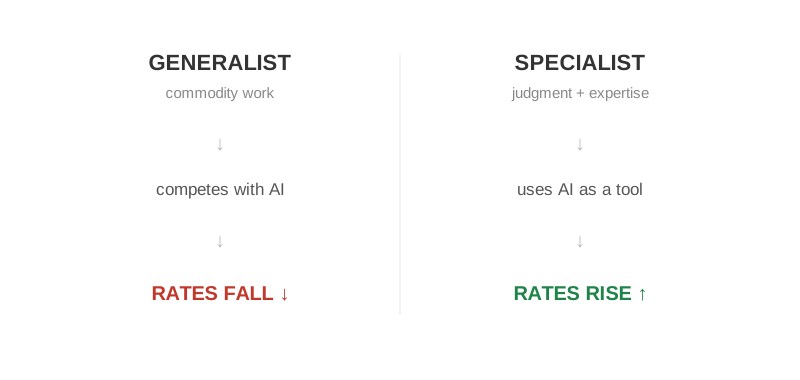
This same split plays out in each vertical:
- Freelancing: Commodity writing volume fell sharply, and basic AI-execution gigs are scaling in volume but losing pricing power (per-contract earnings down 13% year-over-year). Meanwhile, freelancers doing complex, AI-augmented work saw earnings rise 45% year-over-year, and AI-savvy freelancers earn about 34% more per hour overall.
- Bookkeeping: Software automated basic data entry long ago. The reconciliation judgment, clean-up work, and financial interpretation it can’t do reliably is exactly what clients pay a human for.
- Tutoring: AI handles drilling and repetition. Demand holds for tutors who provide what AI structurally can’t — real-time judgment about what a specific student needs right now.
Key takeaway: Whichever hustle you choose, your first real goal isn’t “get a client.” It’s “get specific.” A generalist competes with AI tools and a flooded market. A specialist competes with almost no one.
How to Start This Week: Zero to First Paying Client
- Pick one skill, not three. Trying to freelance, bookkeep, and tutor at once in week one guarantees you do all three badly.
- Build proof before you need it. Two or three writing samples (freelancing), a mock client file (bookkeeping), or one free trial session (tutoring). Do this before you pitch anyone.
- Set an anchor price using the ranges above. If you’re new to client work, start near the lower end of your experience tier — even if you’re experienced in the underlying skill. Remember to think in effective hourly rate, not just headline rate.
- Post on one platform first. Spreading across five platforms in week one slows you down. Depth on one beats a shallow presence on five.
- Send 5–10 outreach messages or applications this week. Consistency matters more than perfect wording.
- Over-deliver for your first client, then ask directly for a review or referral. Your second client should be easier to land than your first.
Pricing scripts for when you have no track record
- Freelancing: “Because I’m building my portfolio in [niche], my rate for this type of project is $[X]. That reflects the research and detail I put into every piece, and it will rise as I take on more clients in this space.”
- Bookkeeping: “For a business your size, I’d start with a monthly retainer of $[X]. That covers reconciliation, categorization, and a monthly summary report. We can revisit it as your transaction volume changes.”
- Tutoring: “My rate is $[X] per session for the first month while we make sure it’s a good fit. After that, we can discuss a package rate if it’s working well for both of us.”
Money, Taxes, and Scaling Past Pocket Change
The rules below are for the United States. Tax treatment differs by country, and thresholds change — always confirm current details with the IRS or a licensed tax pro. (For a deeper walkthrough, see our side hustle taxes guide.)
Self-employment tax basics
Earn income as an independent contractor instead of an employee, and you’re generally responsible for self-employment (SE) tax. That’s 15.3% of 92.35% of your net self-employment income, split as:
- 12.4% for Social Security, up to the annual wage base cap — $184,500 for 2026.
- 2.9% for Medicare, with no cap.
Earn above $200,000 (single) or $250,000 (married filing jointly)? An extra 0.9% Medicare tax applies to the amount over that line.
You’ll report self-employment income on Schedule C (profit or loss) and calculate SE tax on Schedule SE, both filed with your Form 1040.
The two 2026 reporting-threshold changes to know
Following the One Big Beautiful Bill Act (OBBBA), signed into law in July 2025, two reporting thresholds changed:
- Form 1099-NEC (issued by clients who pay you directly for services): the threshold rose from $600 to $2,000, starting with payments made in 2026. It adjusts for inflation from 2027.
- Form 1099-K (issued by payment processors like PayPal, Venmo, and Stripe): the threshold reverted to $20,000 and 200 transactions, undoing the previously planned drop toward $600.
Important note: A higher reporting threshold only changes when a form gets issued. It does not change your duty to report all income on your tax return — even if no 1099 ever arrives. Keep records of every payment, form or no form. (One more habit worth keeping: collect a W-9 from clients, and be ready to hand yours over.)
Quarterly estimated taxes: the part people miss
Expect to owe $1,000 or more in tax for the year? The IRS generally wants quarterly estimated payments, not one lump sum in April. You pay them using Form 1040-ES, in four installments due roughly in April, June, September, and January of the following year.
The simplest system: set aside 25–30% of every payment you receive into a separate savings account, and pay from there each quarter. Miss the quarterly deadlines and you can owe penalties, even if you pay the full amount in April.
When and how to scale from side hustle to small business
There’s no single trigger, but a useful signal is simple: once you’re turning down work, it’s time to formalize. That usually means a simple business structure, a separate bank account, and the 25–30% tax-set-aside habit.
Do you need an LLC? Not to start. Many people begin as a sole proprietor (no formal filing needed) and form an LLC later for liability protection or a cleaner business identity. An LLC doesn’t automatically lower your taxes — talk to a tax pro (a CPA or Enrolled Agent) before assuming it will.
Bookkeeping is the vertical where this scaling path is clearest and best-documented, but the same logic applies once freelancing or tutoring income becomes consistent rather than occasional.
Common Mistakes to Avoid
- Underpricing to “get experience.” Raising a rate later is harder than setting a defensible one now. And most freelancers already underprice relative to their own experience.
- Skipping a written agreement. Even a one-page scope, payment terms, and deadline in writing prevents most client disputes.
- Chasing every platform at once instead of getting genuinely good on one.
- Freelancing: pitching yourself as a “generalist writer” — the exact profile AI competes with hardest.
- Bookkeeping: doing the books but never sending the monthly summary. The summary is what makes clients stay.
- Tutoring: listing yourself for “all subjects, all grades.” Broad offerings sit at the bottom of the pay range.
- Treating any of this as passive income. All three need ongoing effort. None run themselves.
- Ignoring the paperwork. “The reporting threshold is higher now” is not a reason to skip tracking income. You still owe tax on everything you earn.
Frequently Asked Questions
Which skill-based side hustle is best?
There’s no universal winner — it depends on your strengths. Tutoring suits people who like one-on-one teaching and want the fastest start. Bookkeeping suits detail-oriented people who want predictable, recurring income. Freelancing suits people with a specific creative or technical skill who want the highest ceiling, as long as they specialize.
What skill pays $100 an hour?
Specialized freelance work (niche technical, legal, or financial writing; senior design or development), premium tutoring (test-prep and advanced STEM specialists), and experienced bookkeeping for complex clients can all reach or exceed $100/hour. This is specialist-tier pay, though — not the typical beginner outcome in any of the three.
How much can you realistically make bookkeeping on the side?
With 3–5 clients on retainer, roughly $12,000–$36,000 a year is realistic, based on typical monthly retainers of $200–$2,000 per client depending on complexity.
Do you need a certification to be a bookkeeper?
No. Bookkeeping requires no CPA license or formal certification. Software proficiency (QuickBooks, Xero, or FreshBooks) is effectively essential, and the free QuickBooks ProAdvisor or Xero certification helps you win first clients. This differs from accounting, which does require a CPA in most jurisdictions.
How much do online tutors make?
Generalist tutors average roughly $18–$19/hour, per Payscale and Indeed. Specialists — a specific test, subject, or grade level with a strong track record — can charge three to four times that.
Is freelance writing still profitable with AI?
Yes, but unevenly. Commodity writing volume dropped as AI absorbed generic work, and basic AI-execution gigs are losing pricing power. Meanwhile, freelancers doing complex AI-augmented work saw earnings rise 45% year-over-year, and AI-savvy freelancers earn about 34% more per hour (Upwork, 2026). The opportunity shifted rather than disappeared.
How long does it take to get your first client?
Days to a few weeks for freelancing and tutoring on an established marketplace. Typically 1–3 months for bookkeeping, given the extra setup and trust-building.
Can I run one of these while employed full-time?
Usually yes, but check your employment contract first for non-compete or moonlighting clauses, and avoid using your employer’s time or equipment. Many people start a skill-based side hustle precisely because it flexes around a 9-to-5.
Do I need an LLC to start?
No. Most people begin as a sole proprietor with no formal filing. Form an LLC later if you want liability protection or a cleaner business identity. An LLC won’t automatically cut your taxes — confirm with a CPA or Enrolled Agent.
How do I pay taxes on side hustle income?
Report it on Schedule C, calculate self-employment tax on Schedule SE, and make quarterly estimated payments with Form 1040-ES if you’ll owe $1,000+ for the year. Set aside 25–30% of each payment so the bill never surprises you.
The Bottom Line
All three skill-based side hustles can realistically pay you within your first month. Which one fits depends on what you value most: speed (tutoring), predictability (bookkeeping), or ceiling (freelancing, if you specialize).
One mistake undercuts all three: staying generic. Across freelancing, bookkeeping, and tutoring alike, the thing that actually sets your pay in 2026 isn’t the platform you choose. It’s how specific and provable you make your offer.
So pick one. Get specific. Send your first five outreach messages this week.
📖 Continue Reading:
Sources & References
- U.S. Bureau of Labor Statistics — Bookkeeping, Accounting, and Auditing Clerks (Occupational Outlook Handbook)
- U.S. Bureau of Labor Statistics — Writers and Editors and occupational wage data
- Internal Revenue Service — Topic No. 751, Social Security and Medicare Withholding Rates
- Internal Revenue Service — self-employment tax, Schedule C, Schedule SE, and Form 1040-ES guidance
- Editorial Freelancers Association — 2026 Editorial Rate Chart
- American Writers & Artists Institute (AWAI) — 2026 Freelance Rates data, as reported by Mediabistro
- Demirci, Hannane & Zhu — “Who Is AI Replacing? The Impact of Generative AI on Online Freelancing Platforms,” Management Science (Imperial College London, Harvard Business School, German Institute for Economic Research)
- Upwork — Future Workforce Index 2026 (published July 14, 2026)
- Upwork — platform, earnings, and AI-work data
- Ramp Economics Lab — “Payrolls to Prompts” study (February 2026)
- bestwriting.com — Content Writing Rates Statistics 2026
- NerdWallet — Bookkeeping Prices for Small Business (citing BLS data)
- Side Hustle School (podcast, Chris Guillebeau) — Side Hustle School (podcast, Chris Guillebeau)
- Falcon Digital Marketing — tutoring side-hustle search-interest data, as reported by Inc.
- Payscale and Indeed — average tutor hourly wage data (Indeed)
- Grand View Research — online tutoring market size and growth projections
- Avalara — One Big Beautiful Bill Act 1099 reporting threshold changes
- Fidelity — What is Form 1099-K and its reporting threshold?
Disclaimer
This article is for general informational purposes only and is not tax, legal, or financial advice. Tax rules, reporting thresholds, and platform pricing change over time and vary by jurisdiction and individual circumstances. Tax figures above reflect U.S. rules as of July 2026. Confirm current details with the IRS, a licensed tax professional, or the relevant platform before making financial decisions based on this content.

Anjali Kaur is a finance writer specializing in personal finance, international tax, and financial planning for digital nomads, expats, and remote workers. She breaks down dense, high-stakes topics — the Foreign Earned Income Exclusion, totalization agreements, tax residency, and visa-linked tax breaks — into plain-language guides that help readers make confident decisions. Her approach is research-led and source-driven: every figure is dated, and she flags where rules vary or have recently changed. Anjali fact-checks her finance and tax coverage against primary sources such as the IRS, the SSA, and official government tax authorities. Connect with her on Facebook or read more of her work in the Finance section.