
⚡ Quick Answer: AI Side Hustles That Actually Work
Yes, AI side hustles are real. No, the income claims usually aren’t. The typical side hustler earns a few hundred dollars a month, not $10,000. The versions that hold up long-term use AI to speed up a skill you already have. The versions that get people sued promise the AI will do everything for you.
That gap between the two is what this guide is about.
Below you’ll find verified 2026 income figures with their sources and sample sizes, a timeline of the AI money-making schemes regulators have already shut down, the tax math nobody publishes, and a checklist you can run in ten minutes before you pay anyone a cent.
Disclosure: This article sells nothing. No course, no kit, no tool, no affiliate links, no sponsored placements, and no compensation from any platform named here. That matters, because most content on this topic exists to sell you something — and that sales pattern is the exact thing this guide teaches you to spot.
Scope: Income figures and regulatory guidance are U.S.-focused. If you’re reading from outside the U.S., skip to Doing This Outside the United States for what changes.
How we sourced this: Every income figure below is traced to its original survey, dated, and labelled with its sample. Where two sources disagree, we say so instead of picking the friendlier number. Where a figure comes from a company with something to sell, we flag it.
What Is an AI Side Hustle, Really?
An AI side hustle is any paid side work where AI tools handle a meaningful share of the labour, while you supply the judgment, client relationships, quality control, and taste.
That definition sounds boring. It’s also the whole ballgame, because it excludes the thing most people are actually being sold.
Two very different products share the same name. Telling them apart before you spend money is the single most valuable skill on this topic.
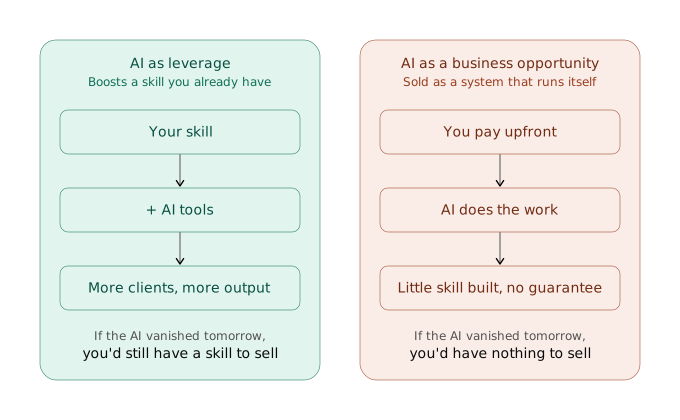
Version 1: AI as Leverage on a Skill You Already Have
This version works. You can already write, design, code, edit video, or run a small business’s back office. AI tools let you do more of that work in the same hours, so you can take on more clients.
Here’s the test that matters. If every AI tool vanished tomorrow, would you still have something to sell?
If yes, you have a real side hustle with AI attached. If no, you have a dependency.
That’s not a philosophical point. It’s a risk assessment. Tools get shut down, repriced, or absorbed into free tiers constantly. Skills don’t.
Version 2: The “AI Business Opportunity” — Why That Phrase Is a Warning Label
This version is where people lose money.
It gets sold as a system, a license, or an “access card” that supposedly runs itself. You pay upfront. The AI allegedly does nearly all the work. Little skill required, little effort required, income arrives shortly.
That framing has a legal definition in the United States, and it isn’t a flattering one. The Federal Trade Commission has been bringing cases against exactly this kind of offer since 2024, under an enforcement push it calls Operation AI Comply, launched in September 2024.
So when you see any of these phrases attached to a price tag, slow down:
- “AI business opportunity”
- “AI-powered system”
- “Done-for-you AI income”
- “Automated AI storefront”
- “AI access card” or “reseller license”
None of these words are illegal. All of them appear repeatedly in the enforcement record below.
What People Actually Earn From AI Side Hustles
Across all side hustles, not just AI ones, the median U.S. side hustler earns about $200 a month, according to Bankrate’s 2025 survey. Averages run much higher — $885 to $1,275 depending on who you ask — because a small group of high earners pulls the mean up. Treat the median as your baseline, not the average.
Most articles skip this section. The honest numbers make a terrible sales pitch.
The Numbers, Side by Side
Here is every figure we could verify, with its source, date, and sample. Read the “who was surveyed” column carefully — it explains most of the disagreement.
| Source | Figure | What it measures | Who was surveyed | Date |
|---|---|---|---|---|
| Bankrate | $200/month median · $885/month average | All side hustles | U.S. adults, general population | 2025 survey |
| Side Hustle Nation | $1,122/month average · $200/month median | All side hustles | Site audience + cited Bankrate median | 2026 update |
| The Penny Hoarder | $1,275/month | Labelled “median” in the article body, “average” in its own summary bullet | 1,000 U.S. adults screened to only include people already earning from an active side hustle (Pollfish) | February 2026 |
| Upwork | +34% hourly premium for freelancers doing AI work | Hourly rates on one marketplace | 2,400 U.S. skilled workers + Upwork platform data | March–April 2026 |
Bankrate’s numbers give the clearest picture of the distribution. Median side hustle income sat at $200 a month in 2025, down from $250 in 2024, while the average slipped slightly from $891 to $885. Twenty-eight percent of side hustlers made between $1 and $50 a month.
Read that last sentence again. More than a quarter of side hustlers earn under fifty dollars a month.
Why These Surveys Disagree (And Which One to Trust)
The Penny Hoarder’s $1,275 figure gets quoted everywhere in 2026. It deserves an asterisk.
The Penny Hoarder surveyed 1,000 U.S. adults in February 2026 using Pollfish, screening respondents to include only people who currently earn income from an active side hustle. That’s a filtered population. Bankrate surveys the general public, then reports what side hustlers within it earn.
Screening for people who are already earning removes everyone who tried and made nothing. Naturally the number goes up.
There’s a second problem. The Penny Hoarder’s own page calls $1,275 a median in one place and an average in another. Those are not interchangeable, and the difference changes the entire meaning. We’ve flagged it rather than quietly picking whichever reading suited the argument.
Practical takeaway: anchor on Bankrate’s $200 median as your realistic expectation. Treat $1,000+ figures as describing people who are already past the hard part.
One more number worth more than any of them. Side Hustle Nation reports that half its survey respondents earned under $100 a month — and 75% of that group spent zero to five hours a week on it.
That reframes the whole “median is only $200” story. A big share of low earners aren’t failing. They’re barely trying, by design.
What You Actually Keep: The Tax Math Nobody Publishes
Gross income isn’t income. Here’s the part that gets left out of every listicle.
Side hustle earnings in the U.S. are self-employment income. That triggers a separate tax on top of your regular income tax.
A worked example. Say you bill $1,000 in a month from freelance work.
| Line | Amount |
|---|---|
| Gross billed | $1,000 |
| Platform fee (varies; ~10% on many marketplaces) | −$100 |
| Tools and software | −$50 |
| Net earnings | $850 |
| Self-employment tax (15.3% on ~92.35% of net) | −$120 |
| Federal income tax at a 12% marginal rate | −$88 |
| Roughly what you keep | ~$642 |
That’s a 36% haircut before state tax. Your actual rate depends on your bracket, state, and deductible expenses — but “gross minus a third” is a far more honest planning number than the gross figure anyone quotes you.
Three rules that apply to almost everyone:
- Self-employment tax kicks in at $400 of net earnings for the year. Not $600, not $20,000. Four hundred dollars.
- Income is taxable whether or not a form arrives. The 1099-K reporting threshold for payment apps and marketplaces has changed several times in recent years, so check the IRS’s current guidance for the 2026 tax year. Either way, the reporting threshold governs paperwork, not liability.
- You may owe quarterly estimated payments if you expect to owe $1,000 or more in tax for the year. Miss them and you can face an underpayment penalty even if you pay in full at filing.
Expert tip: open a separate account and move 30% of every payment into it the day it lands. It is dramatically easier than finding the money in April.
This is general information, not tax advice. Rules vary by state and situation. Verify current figures with the Internal Revenue Service or a qualified tax professional. See our self-employment tax guide for the full breakdown.
Why “$10,000 a Month Using AI” Claims Don’t Hold Up
That phrase drives enormous search volume, so let’s deal with it head-on.
It isn’t impossible. It also isn’t typical, it isn’t a plan, and it sits squarely in the income range regulators have already taken action over.
Sellers of genuine business opportunities in the U.S. must substantiate earnings claims and hand over a disclosure document. Several AI-branded companies got penalised specifically for making claims in this range without either.
The rule of thumb: a precise income number with no substantiation behind it isn’t information. It’s copy.
What the FTC Has Already Shut Down
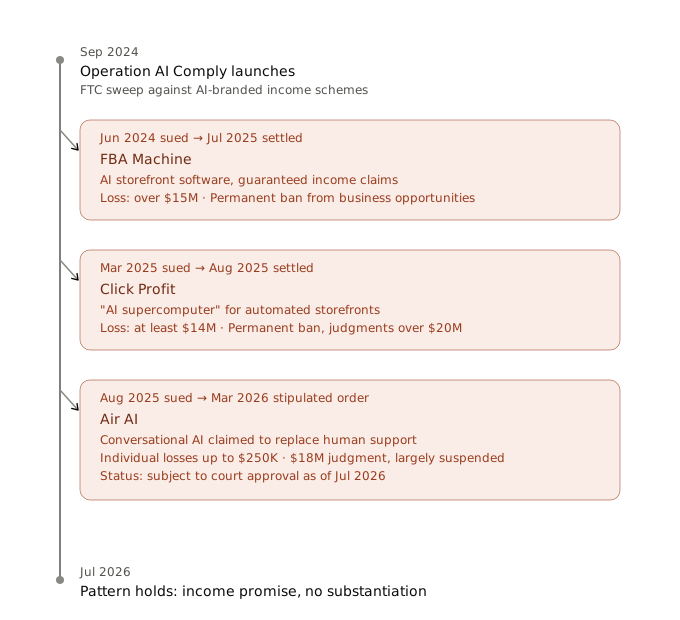
Since 2024 the FTC has brought multiple enforcement actions against companies selling AI-branded money-making schemes. The alleged consumer losses run into tens of millions of dollars, and the pattern across cases is nearly identical: a specific income promise, a claim that AI removes the need for skill, and no evidence behind either.
This section almost never appears in AI side hustle listicles. It’s the most useful thing on this page.
| Case | What was sold | Alleged consumer harm | Outcome | Status |
|---|---|---|---|---|
| FBA Machine (Bratislav Rozenfeld) | AI-powered software to run online storefronts, with guaranteed income | Over $15 million | Permanent ban from selling business opportunities; assets and real estate proceeds turned over for consumer redress | Settled, July 2025 |
| Click Profit (Craig Emslie, Patrick McGeoghean, William Holton, Jason Masri) | An “AI supercomputer” powering automated Amazon, Walmart, and TikTok storefronts | At least $14 million | Permanent industry ban; monetary judgments of $13.6M and $7.3M, partially suspended on claimed inability to pay | Settled, August 2025 |
| Air AI (Caleb Maddix, Ryan O’Donnell, Thomas Lancer) | “Conversational AI” said to replace human customer service, plus coaching, an “Access Card,” and reseller licenses | Individual losses up to $250,000 | Ban on marketing business opportunities; $18M judgment largely suspended, $50,000 paid toward consumer relief | Stipulated order filed March 2026, subject to court approval |
The detail that matters in the Air AI case. The FTC alleged consumers, many of them small business owners, lost as much as $250,000 and were often left in debt after relying on the company’s promises. The proposed order carried an $18 million judgment, largely suspended because of the company’s and operators’ inability to pay, with $50,000 actually paid to the Commission for consumer relief. The complaint alleged violations of both the Telemarketing Sales Rule and the Business Opportunity Rule, and the order remains subject to a court’s approval.
Notice the gap between $18 million and $50,000. That’s the realistic recovery picture even when regulators win.
On Click Profit, the FTC’s proposed orders included monetary judgments of $13.6 million against one group of defendants and $7.3 million against another, though those judgments were partially suspended based on the defendants’ claimed inability to pay, becoming immediately due if they misrepresented their finances.
On FBA Machine, the FTC sued in June 2024 alleging the defendants falsely guaranteed consumers could make money running online storefronts with AI-powered software, defrauding them of over $15 million; in July 2025 the agency announced Rozenfeld would be permanently banned from selling business opportunities and required to turn over financial accounts and real estate proceeds for consumer redress.
The pattern across all three:
- A specific, attractive income figure
- A claim that AI removes the need for skill or effort
- No substantiation for either, and refund promises that went unhonoured
Memorise those three. They do more protective work than any tool review you’ll read.
The Best AI Side Hustles in 2026 (Ranked by What Actually Pays)
Three categories hold up under scrutiny: service-based work using AI to extend a skill you have, platform-based AI training and evaluation work, and — with the widest variance — digital products. Service work has the highest ceiling. Platform work has the fastest path to a first payment. Product work is the least predictable.
These are the AI side hustle ideas with documented income behind them, not the ones with the best marketing.
| Category | Startup cost | Time to first payment | Skill needed | Realistic first-year range | Automation risk |
|---|---|---|---|---|---|
| Service-based<br>Freelancing, automation setup, AI-assisted editing | $0–50/month in tools | 2–6 weeks (you need a client) | An existing marketable skill + AI fluency | Wide; grows with client count | Medium — execution-only work is commoditising fast |
| Platform-based<br>AI model training and evaluation | $0 | Days to weeks after approval | Not required to start; expertise raises pay sharply | Capped by your available hours | Low — the work exists because models need humans |
| Product-based<br>Templates, digital products, prompt packs | $0–200 | Weeks to months (you need an audience) | Design or marketing ability | Often $0–500/month | High — supply is exploding, demand isn’t |
Mobile readers: this table scrolls horizontally. Each category is broken down in full below.
Service-Based: Using AI to Do More of What You Already Do
The clearest data point of 2026 comes from Upwork’s Future Workforce Index, released 14 July 2026. It combines a survey of 2,400 U.S.-based skilled workers conducted in March and April 2026 with Upwork marketplace data.
The headline: freelancers doing AI work on Upwork earn 34% more per hour than those who don’t.
Two caveats before you act on that. Upwork is a marketplace with an obvious interest in freelancing looking attractive. And the finding is a correlation — freelancers who adopt AI early may simply be the more commercially sharp ones to begin with.
The more useful finding is the split underneath the headline. Generative AI and creative production work saw 90% year-over-year growth in contract starts while per-contract earnings fell 13%. Meanwhile, AI-augmented professional services grew 72% year over year with earnings up 22%, and freelancers doing more complex work with AI saw earnings rise 45%.
Translated: churning out AI output is getting cheaper. Applying expertise on top of AI output is getting more valuable.
Upwork calls the second group “AI orchestrators” — people who pair AI fluency with domain expertise, workflow design, and judgment.
Three service offers that fit that description right now:
- AI-assisted video editing and post-production. Raw generative footage from tools like Runway, Sora, or Kling needs shaping into something watchable. Generative AI and creative production was one of the fastest-growing contract categories on Upwork in 2026 — though remember that growth came with falling per-contract rates, so compete on finish quality, not volume.
- Workflow automation for small businesses. Zapier or Make, wired to an AI model, handling lead follow-up, appointment scheduling, or first-line customer replies. Local businesses want this and have no time to build it.
- Custom AI assistant setup. Configuring a business-specific chatbot with a tool like Botpress or a custom GPT, for companies that want the capability without hiring a developer.
When NOT to pick this category: if you have no sellable skill yet, and under five hours a week. You’ll spend months acquiring the skill before AI can amplify anything.
Platform-Based: Getting Paid to Train and Evaluate AI Models
Most beginner content misses this category completely, which is odd, because it has the shortest path from zero to a real payment.
AI companies pay people to evaluate, rank, and correct model outputs. Sometimes they want subject-matter experts. Sometimes they want careful generalists. Active platforms in 2026 include Mercor, Outlier (operated by Scale AI), Invisible Technologies, Handshake AI, Surge AI, and DataAnnotation.
On pay, be careful whose numbers you use. Mercor’s own materials state that AI trainer rates range from $12 to $200+ an hour depending on experience, platform, specialisation, and location. That’s a platform describing its own market, so treat the top of the range as a ceiling for credentialled specialists.
The more grounded figure comes from the same company: Mercor puts the national average freelance AI trainer rate at $31 an hour as of early 2026.
Plan around $31. Be pleasantly surprised by more.
What the sales pages leave out:
- Unpaid assessments. Several platforms require screening tasks before approval. On some, that’s one to three hours of work with acceptance rates in the 10–20% range.
- Time-tracking software. Mercor uses Insightful; Invisible Technologies uses Hubstaff. If that bothers you, consider a dedicated work device.
- Region-tiered pay. The same task can pay very differently depending on where you’re located.
- Task droughts. Work volume tracks client demand and can stop without notice. Experienced workers keep accounts on two or three platforms to smooth the gaps.
- Impersonation scams. No legitimate platform asks you to pay to apply or hands over banking passwords during onboarding. Apply only through official domains.
When NOT to pick this category: if you need guaranteed weekly hours, or you can’t install monitoring software on a machine you use.
This isn’t passive income. It’s gig work — real income, real limits, no mythology attached.
Product-Based: Digital Products and Templates
Selling templates, prompt packs, or AI-assisted design through Gumroad or Etsy is legitimate. It’s also the category with the widest and least predictable outcomes.
Success depends far more on marketing and audience than on the AI tool. Plenty of people make $0 for a year. A few do very well.
There’s a structural headwind worth understanding, and the clearest evidence for it comes from music streaming.
Deezer reported on 21 July 2026 that AI-generated tracks exceeded half of all daily new music uploads for the first time, peaking in June 2026 at a monthly average of 90,000 tracks a day, while fully AI-generated music accounted for only 1–3% of total streams.
Before you read that as pure demand failure, note the mechanism. Deezer automatically excludes all AI-detected tracks from algorithmic recommendations and editorial playlists, which drastically limits their organic reach. Low consumption isn’t just indifferent listeners. It’s platform suppression.
The trajectory is the real story: AI uploads went from roughly 10% of Deezer’s daily deliveries in January 2025, to 39% in January 2026, to 44% in April 2026, to over 50% by June. And Deezer found up to 85% of streams on fully AI-generated tracks were fraudulent in 2025.
Then came the consequence. Deezer announced it will now remove generative-AI tracks used for fraudulent streams, along with AI tracks that haven’t been streamed for six months or more.
The lesson for any product-based hustle: platforms are actively building detection, suppression, and deletion policies for bulk AI content. Flooding a marketplace doesn’t create buyers. It creates enforcement.
When NOT to pick this category: if you have no audience and need income within 90 days.
The Four-Question Test for Any AI Side Hustle
Before committing time to anything — including options not listed here — run it through these four questions.
- Does it depend on going viral or getting lucky? That’s a lottery, not a hustle.
- Does it require relearning an entirely new tool every few months just to stay level? Some churn is normal. Constant reinvention signals a fad.
- Is your income tied to one client, platform, or algorithm that could cut you off overnight? Diversify early, not after the cut-off.
- Has anyone documented earning from this consistently for six-plus months? Or is every piece of “proof” a screenshot of one unusually good week?
Fail two or more, and treat it as high-risk hype regardless of how it’s packaged.
Which Category Should You Pick?
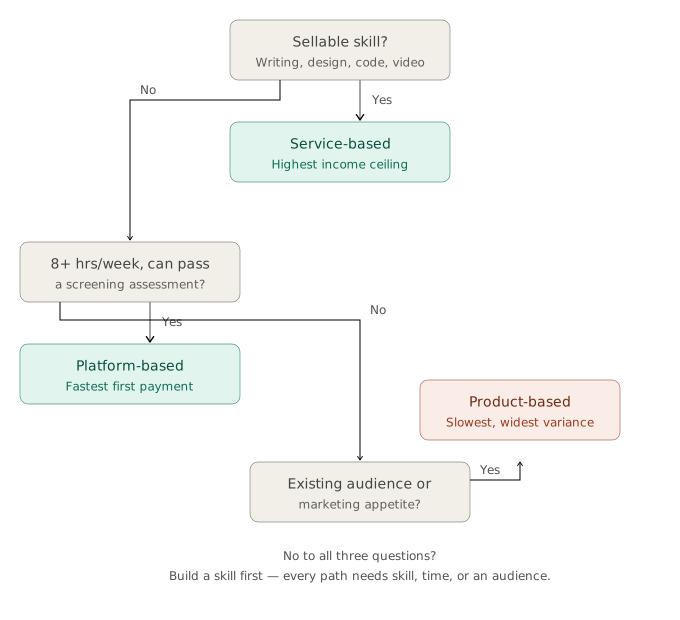
Answer three questions in order.
1. Do you have a skill someone already pays for? (Writing, design, code, video, bookkeeping, admin, subject expertise.) → Yes: start service-based. You’re adding leverage to something sellable today. → No: go to question 2.
2. Can you commit 8+ hours a week and pass a screening assessment? → Yes: start platform-based. It’s the shortest route to a first payment with no client acquisition. → No: go to question 3.
3. Do you have an existing audience or an appetite for marketing? → Yes: product-based can work, slowly. → No: build a skill first. There is no category here that pays well without one of skill, time, or audience.
What Reddit Actually Says About AI Side Hustles
Reddit is the most honest source on this topic and the least reliable one. Threads in r/sidehustle, r/WorkOnline, r/freelance, and r/Upwork surface real failure stories you won’t find in blog posts — but they’re anecdotes, heavily seeded with referral links, and no substitute for survey data.
Search interest in Reddit AI side hustle discussions has climbed sharply, and for a good reason: people trust peers over publishers here. That trust needs guardrails.
Recurring patterns worth knowing about before you go looking:
- AI training platform threads dominate. Discussion of Outlier, Mercor, DataAnnotation, and similar platforms is the highest-volume AI side hustle topic on Reddit, and the most common complaints are consistent with what the platforms themselves disclose: unpaid assessments, sudden task droughts, and regional pay differences.
- Referral links distort everything. Many platform recommendation posts carry referral incentives. A glowing review with a link in the comments is an advertisement.
- Freelancers report the squeeze, not the boom. The lived version of Upwork’s 13% per-contract decline shows up as rate pressure on basic AI-adjacent work — which is exactly what the platform data predicts.
- Course promotion gets removed, then reposted. Most large money subreddits ban guru promotion. It reappears constantly as “just sharing my journey” posts.
How to read Reddit evidence properly:
- Search with
site:reddit.com "platform name" 2026to get recent threads rather than years-old ones. - Check the poster’s account age and history. A three-week-old account posting one success story is marketing.
- Look for people describing problems, not results. Complaints are harder to fake than screenshots.
- Prefer threads with disagreement in the comments. Uniform praise is a signal, and not a good one.
- Never treat a single thread as data. Treat ten threads as a hypothesis.
Legal and Platform Rules to Check Before You Sell AI Work
Before selling anything AI-assisted, confirm three things: whether you can claim copyright, what the platform’s AI policy allows, and what you’ve agreed to tell your client. Getting any of these wrong can cost you the listing, the client, or the ownership.
This section rarely appears anywhere, and it’s where beginners get caught.
Can You Copyright What the AI Made?
In the United States, copyright protection requires human authorship. The U.S. Copyright Office has taken the position that purely AI-generated material — output produced from a prompt without meaningful human creative contribution — is not registrable. Human-authored elements within an AI-assisted work can be protected, but the AI-generated portions generally aren’t.
Practical implication: if your product is essentially raw model output, you may have limited ability to stop anyone from copying and reselling it. The more human structuring, editing, curation, and original design you add, the stronger your position.
Rules differ by country. Check your own jurisdiction rather than assuming U.S. guidance applies.
What Platforms Allow
Marketplace policies have tightened considerably. Before you list anything:
- Etsy requires disclosure of AI involvement in listings and enforces its handmade and originality policies against bulk AI inventory.
- Amazon KDP requires you to disclose AI-generated content on submission and imposes volume limits on uploads.
- Deezer and other streaming platforms now detect, label, suppress, and in Deezer’s case delete AI-generated tracks.
- YouTube requires disclosure of realistic synthetic content and enforces policies against mass-produced, repetitive material.
Policies change. Read the current terms on the day you list, not the summary you read six months ago.
What to Tell Clients
There’s no universal legal duty to disclose AI use in freelance work. There is often a contractual one — and increasingly, an explicit clause.
Best practice: raise it first. Say what you use AI for, what you don’t, and what you personally review. Clients who care will respect it. Clients who find out later will not.
Never feed confidential client material into a tool whose data-retention terms you haven’t read. That’s the fastest way to lose a contract and a reputation in one move.
How to Get Started With an AI Side Hustle (Step by Step)
Three steps: match a category to your skills and available hours, pick one general-purpose AI tool plus at most one specialist tool, then land a first client through your existing network or get approved on a platform. Expect two to six weeks to a first payment for service work, days to weeks for platform work.
Step 1 — Match a Category to Your Skills and Time
Time: 30 minutes. Cost: $0.
Run the decision tree above. Be honest about hours, not aspirational.
If you already have a marketable skill, service-based work is your fastest path — you’re selling something proven, just faster. If you have neither a skill nor much spare time, platform-based work has the lowest barrier, because approval replaces client acquisition.
Step 2 — Pick Your Tools (And Resist Buying More)
Time: 1 hour. Cost: $0–50/month.
One general-purpose model covers most writing, research, and planning: ChatGPT, Claude, or Gemini. Free tiers are enough to start.
Add exactly one specialist tool, and only when a paid task requires it:
- Workflow automation → Zapier or Make
- Video editing → CapCut, or Runway for generative work
- Chatbot setup → Botpress or a custom GPT
Common mistake: buying five subscriptions before landing one client. Tool spending is the most common way beginners turn a $0 startup cost into a $300 loss.
Step 3 — Land Your First Client or Platform Approval
Time: 2–6 weeks (service) or days to weeks (platform). Cost: $0.
For service work: your first client almost certainly comes from your existing network — past colleagues, local businesses, referrals — not cold outreach or a marketplace listing. Marketplaces are brutal for unrated newcomers. Warm contacts already trust you.
Lead with the outcome, not the tool. “I’ll cut your support response time in half” beats “I use AI.”
For platform work: the platform is the client. Complete the application and any assessment carefully and honestly, because quality scores usually determine what work you’re offered afterward. Apply to two or three platforms, not one.
What to Realistically Expect in Months 1–3
Here’s an honest projection, clearly labelled as such.
Survey-backed: the median side hustler across all categories earns around $200 a month. Most people in months one to three sit at or below that.
Estimate, not survey data: for service-based work specifically, reaching $500–$2,500 a month typically requires two to four recurring clients. The arithmetic is simple — three clients on $400 monthly retainers is $1,200 gross, roughly $770 after fees, tools, and tax. That’s not a documented average. It’s the math of the model, and it usually takes longer than three months.
Product-based: slower and less predictable. Assume $0 in this window and treat anything else as upside.
Platform-based: income can start within a week or two of approval. It’s capped by hours available, not by ambition.
How to Spot an AI Side Hustle Scam Before You Pay
Nearly every enforcement case follows the same three-part formula: a specific income number, a claim that AI removes the need for skill, and no substantiation for either. If an offer matches two or more rows in the table below, that’s not a coincidence — it’s a template.
The Three-Part Scam Formula
| What you’ll see advertised | What the evidence shows |
|---|---|
| “Make $10,000 a month with AI” | The median U.S. side hustle income across all categories was $200/month in Bankrate’s 2025 survey. Higher averages are pulled up by a small share of high earners. |
| “Our AI does 100% of the work for you” | The FTC’s Air AI case centred on claims that a conversational AI product would replace human teams and generate large earnings. The company and owners were banned from marketing business opportunities under an $18M judgment, largely suspended. |
| “Guaranteed passive income” | The FTC alleged Click Profit promised guaranteed returns from an AI-powered storefront system. Most consumers earned little or nothing after paying in. |
| “No skills or experience needed” | Upwork’s 2026 data shows the premium sits with expertise. Complex AI-augmented work saw earnings rise 45%, while per-contract earnings for generative AI and creative production fell 13%. |
| “Just post AI content — it sells itself” | Deezer’s 2026 data shows AI content can exceed half of a platform’s uploads while capturing 1–3% of listening, with the platform now deleting unstreamed AI tracks. |
What the Business Opportunity Rule Actually Covers
This part gets misreported constantly, including in articles trying to be helpful. Getting it right protects you twice — from scams, and from wrongly accusing legitimate sellers.
The FTC’s Business Opportunity Rule (16 CFR Part 437) only applies when three elements are all present:
- A solicitation to enter a new business, and
- A required payment from the buyer, and
- A representation that the seller will provide one of three specific kinds of assistance: locations for the buyer’s equipment or displays; outlets, accounts, or customers; or a buy-back of goods or services the buyer produces.
Here’s what that means in practice. A plain online course or coaching program often does not meet element three. The FTC itself has acknowledged that business coaching, work-from-home, investment, and e-commerce schemes may not meet the precise definition of a business opportunity under the letter of the rule.
That gap is exactly why the FTC proposed in January 2025 to expand the Rule to cover money-making opportunities such as business coaching and investment opportunities, renaming it the Business and Money-Making Opportunity Rule. Two commissioners dissented, and as of July 2026 that expansion has not been finalised.
So don’t treat “we’re not covered by that rule” as automatic proof of a scam. It might be true. Use it as a question, not a verdict.
When the Rule does apply, the seller must give you a disclosure document at least seven days before you sign or pay, in the language used to sell to you, plus an earnings claim statement if they’ve made any earnings claims.
When it doesn’t apply, you still have protections:
- Section 5 of the FTC Act prohibits deceptive claims regardless of whether the Business Opportunity Rule covers the seller.
- ROSCA governs negative-option and auto-renewing billing.
- State consumer protection laws and your state attorney general cover deceptive trade practices.
- Card chargeback rights are often your fastest practical remedy.
The 10-Minute Due Diligence Checklist
Run this before paying for any course, kit, license, or “system.”
- Search the exact company name plus “FTC,” “lawsuit,” or “complaint.” Several companies in this exact space are already named in enforcement actions. This takes ninety seconds and catches the most damage.
- Ask which of the three Business Opportunity Rule elements they meet. If they claim coverage, ask for the disclosure document. If they claim exemption, ask them to explain why — a legitimate seller can answer this calmly.
- Ask for written substantiation of any specific income figure. A precise number with no data behind it is copy, not evidence.
- Flag “does it all for you” language. Claims that AI eliminates the need for skill mirror the language in the Air AI and Click Profit cases.
- Get the refund policy in writing. A verbal promise from a salesperson is not a policy. In the Air AI case, refund guarantees were a central allegation.
- Look for dated, independent verification. Reddit threads with disagreement, Better Business Bureau records, reviews from people describing what happened — not testimonials hosted on the seller’s own page.
- Check whether the offer uses countdown timers, “last 3 spots,” or a call before you can see pricing. Urgency engineering before price transparency is a reliable tell.
What to Do If You’ve Already Paid
If you’re reading this after the fact, you still have moves. Act quickly — most of these are time-sensitive.
- Stop any recurring billing immediately. Cancel through the vendor and your card issuer or bank.
- File a chargeback or dispute. Credit card disputes generally have deadlines measured in weeks to months from the charge or the promised delivery date. Don’t wait for the vendor to respond.
- Report it to the FTC at ReportFraud.ftc.gov. Reports feed enforcement decisions, and consumers who report are easier to locate when redress is distributed.
- File with your state attorney general and the Better Business Bureau.
- Preserve everything — sales pages, chat logs, emails, invoices, recorded calls, refund promises. Screenshot before pages disappear.
- Check whether the FTC has an open case or refund program for the company. The FTC distributes redress in some of these matters, though as the Air AI numbers show, recovery is often a fraction of the judgment.
Doing This Outside the United States
Almost every income figure and legal protection above is U.S.-specific. Here’s what changes elsewhere.
Income data. Bankrate, Penny Hoarder, and Side Hustle Nation all survey U.S. respondents. Treat their figures as directionally useful, not locally accurate.
Platform pay. AI training platforms commonly tier rates by region, so advertised U.S. rates may not be what you’re offered. Verify the rate for your location before investing time in an unpaid assessment.
Regulators. The FTC has no jurisdiction over you. Equivalent bodies handle misleading advertising and consumer protection in other markets — the Competition and Markets Authority and Advertising Standards Authority in the UK, the Central Consumer Protection Authority in India, and comparable agencies elsewhere. The due diligence checklist still works; only the complaint address changes.
Tax. Self-employment rules, thresholds, and reporting obligations differ entirely. Check your national tax authority.
Currency and market rates. Service pricing follows client location more than yours. Serving clients in higher-rate markets is usually the single biggest lever on income for freelancers outside the U.S.
What Happens After Month One
Most AI side hustles stall for a distribution reason, not a technical one. People can use the tools. They can’t find clients consistently. The two fixes that work are moving from one-off gigs to retainers, and packaging a custom service into a fixed, repeatable offer.
Why Most People Quit at the Plateau
Month one is exciting. Month three is where it dies.
The pattern is predictable: one or two clients, a couple hundred dollars, and a growing suspicion you were sold a story. Compared to the marketing that got you interested, real early numbers feel like failure.
They aren’t. They’re the median. And the median is the point at which compounding would start, if anyone stayed.
The specific trap is the feast-famine cycle. You take a project, go heads-down for three weeks, deliver, then realise your pipeline is empty and start from zero. Two or three rounds of that, and most people conclude the hustle doesn’t work.
The fix is unglamorous: spend a fixed block every week on client acquisition, even in busy weeks. Two hours on Friday beats a panic in month four.
Turning a Solo Hustle Into a Repeatable System
People who get past the plateau typically do one of two things.
They move to retainers. A $400 monthly retainer beats a $600 one-off, because it removes the acquisition cost from every subsequent month. Three retainers is a stable base. Three one-offs is a treadmill.
They productise. Instead of custom work every time, they sell one fixed offer with a fixed scope and price — “customer service automation setup, $1,200, delivered in ten days.” Fixed scope means you get faster at it, and speed becomes margin.
Both moves map directly to Upwork’s orchestrator finding. The premium isn’t in touching AI. It’s in pairing AI with enough judgment that clients buy an outcome rather than output.
One more thing worth watching: the automation risk column in the ideas table. Execution work is commoditising, per Upwork’s own numbers. If your offer is something a client could reasonably do themselves with a decent prompt by next year, start building the layer above it now.
Key Takeaways
The honest answer to “what’s real and what’s hype” comes down to one distinction. AI genuinely helps people earn more when it’s layered onto a real skill. It genuinely gets used to sell false promises when it’s marketed as a replacement for one.
- AI side hustles are real; most advertised income numbers are not. Bankrate’s 2025 survey puts the median U.S. side hustle income at $200 a month, with 28% of side hustlers earning $1–$50.
- Averages mislead by design. Different surveys report $885 to $1,275, but they measure different populations. The Penny Hoarder’s widely quoted $1,275 comes from a sample screened to include only people already earning.
- Budget for tax from day one. Self-employment tax starts at $400 of net earnings. Plan on keeping roughly two-thirds of what you bill.
- Three categories hold up: service-based freelancing with AI, platform-based model training and evaluation, and selectively chosen digital products. Ceilings and risks differ sharply.
- Judgment is the premium, not access. Upwork’s 2026 data shows complex AI-augmented work earning 45% more year over year, while per-contract earnings for generative AI and creative production fell 13%.
- Regulators have been prosecuting the “automated AI income” model since 2024. FBA Machine, Click Profit, and Air AI all followed the same three-part formula.
- Know what the Business Opportunity Rule actually covers. Three elements, all required. Most courses fall outside it — which doesn’t make them safe, and doesn’t make them scams either.
- If a specific income promise sounds too clean, ask what backs it up. That one question separates multiple FTC enforcement targets from the legitimate options.
Frequently Asked Questions
What are the best AI side hustles in 2026?
Based on 2026 data, three categories hold up. AI-assisted freelancing in a skill you already have offers the highest ceiling. AI model training and evaluation through platforms like Mercor or Outlier offers the fastest, most predictable start, though income is capped by your available hours. Selective digital products offer the widest variance and lowest reliability. Avoid anything marketed as a fully automated “AI business opportunity.”
What are the best AI side hustles for beginners?
Platform-based AI training and evaluation work is usually the best entry point for beginners, because approval replaces client acquisition and startup cost is zero. Expect to plan around roughly $31 an hour as an average rate, with unpaid screening assessments and variable task availability. If you already have a skill — writing, design, admin, video — service-based freelancing pays more and grows faster.
How much can you realistically make from an AI side hustle?
Plan for $0–$300 a month in your first quarter. The median U.S. side hustler across all categories earns about $200 a month, per Bankrate’s 2025 survey. Service-based work reaching $500–$2,500 a month typically requires two to four recurring clients and several months of consistency. Subtract roughly a third for tax, fees, and tools to get your take-home.
How do you make $1,000 a day using AI?
For nearly everyone, that isn’t a realistic starting expectation. Typical side hustle income sits around $200 a month at the median, and even strong AI-related freelance earnings are measured in dollars per hour, not thousands per day. Treat any offer promising this figure as a claim requiring substantiation rather than a plan you can follow.
How can you make $2,000 a month on the side?
It’s achievable, but it sits well above the median. It typically requires an existing marketable skill combined with AI, two to four steady clients, and several months of consistent work — not a single tool or course. AI-enhanced service freelancing in writing, design, automation, or video editing is the category most likely to reach that range, based on 2026 earnings data.
How do you make $10,000 a month using AI?
It’s possible but rare, and it’s also the income range that appears in multiple FTC enforcement cases against companies that couldn’t substantiate the claim. If you see this number attached to a paid product, ask for written substantiation and check whether the seller falls under the Business Opportunity Rule before paying anything.
Do you need coding skills for AI side hustles?
No. Freelancing, no-code automation setup, AI model evaluation, and digital products all work without coding. What matters more is an existing skill — writing, design, admin, subject-matter expertise — or, for platform work, reliability and attention to detail during evaluation tasks. Coding does raise your rate substantially on training platforms.
Is AI training work like Outlier or Mercor legitimate?
Yes, these are real companies paying real money for human evaluation of AI output. The legitimate concerns are practical rather than existential: unpaid screening assessments, mandatory time-tracking software, region-tiered pay, and task availability that can stop without notice. Apply through official domains only, and never pay to apply.
Do you have to pay tax on AI side hustle income?
Yes. In the U.S., self-employment tax applies once net earnings reach $400 for the year, on top of income tax. You may also owe quarterly estimated payments if you expect to owe $1,000 or more. Income is taxable whether or not you receive a 1099 form — reporting thresholds govern paperwork, not liability. Check current IRS guidance for the 2026 tax year.
Can you copyright AI-generated content you sell?
In the United States, purely AI-generated material without meaningful human creative input is not registrable for copyright, per the U.S. Copyright Office. Human-authored elements in an AI-assisted work can be protected. Practically, the more original structuring, editing, and design you add, the stronger your claim. Rules differ by country.
Do you have to tell clients you used AI?
There’s rarely a legal requirement, but there’s often a contractual one, and disclosure clauses are increasingly common in freelance agreements. Best practice is to raise it first: explain what you use AI for, what you don’t, and what you personally review. Never put confidential client material into a tool whose data-retention terms you haven’t read.
Are AI side hustles worth it in 2026?
For people adding AI to an existing skill, yes — Upwork’s 2026 data shows freelancers doing AI work earning 34% more per hour, with complex AI-augmented work up 45% year over year. For people expecting AI to replace the need for a skill, no. That’s the version regulators have been prosecuting since 2024.
Sources and Verification
All figures verified as of 05 September 2026.
Federal Trade Commission (primary sources)
- Air AI and its Owners will be Banned from Marketing Business Opportunities — March 2026
- FTC Sues to Stop Air AI from Using Deceptive Claims — August 2025
- Air AI case page
- FTC Case Against E-Commerce Business Opportunity Scheme Results in Permanent Ban (Click Profit) — August 2025
- Artificial Intelligence enforcement overview, including FBA Machine
- FTC Proposes Rule Changes to Deter Deceptive Earnings Claims — January 2025
- 16 CFR 437 Business Opportunity Rule, Notice of Proposed Rulemaking
- Report fraud: ReportFraud.ftc.gov
Regulation text
Income and labour market data
- Upwork Future Workforce Index 2026 and the accompanying release — July 2026
- Bankrate Side Hustles Survey — 2025
- The Penny Hoarder 2026 Side Hustle Survey — February 2026
- Side Hustle Nation Side Hustle Statistics
Platform and market data
- Deezer: AI Music Tops 50% of Daily Uploads — July 2026
- Deezer: AI-generated tracks reach 44% of new uploads — April 2026
- TechCrunch coverage of Deezer’s July 2026 disclosure
- Mercor: AI Trainer Salary and Hourly Rates — commercial source; Mercor operates one of the platforms discussed
- Mercor: Best AI Model Training Platforms in 2026 — commercial source
Cited as text only (no single canonical URL)
- Internal Revenue Service — self-employment tax, estimated payments, and information reporting thresholds
- U.S. Copyright Office — guidance on human authorship and AI-generated material
Known limitations and what may change
- The Air AI order was filed as a stipulated order subject to court approval in March 2026. Confirm the docket status before relying on it as final.
- Bankrate’s survey median is from 2025. The Penny Hoarder’s survey is from February 2026. They measure different populations and are not directly comparable.
- The Penny Hoarder labels $1,275 as a median in one place and an average in another. We’ve reported the discrepancy rather than resolving it in either direction.
- Upwork’s 34% figure is correlational and comes from a marketplace with a commercial interest in the result.
- AI training platform rates move quarterly and are tiered by region.
- The FTC’s proposed expansion of the Business Opportunity Rule is not final as of July 2026.
- Deezer’s AI upload share has roughly doubled in eighteen months. Any figure here is a snapshot.
This article does not sell, promote, or receive compensation from any course, platform, or tool mentioned. No affiliate links appear anywhere on this page.