⚡ Quick Answer: Who Is the CEO of Google?
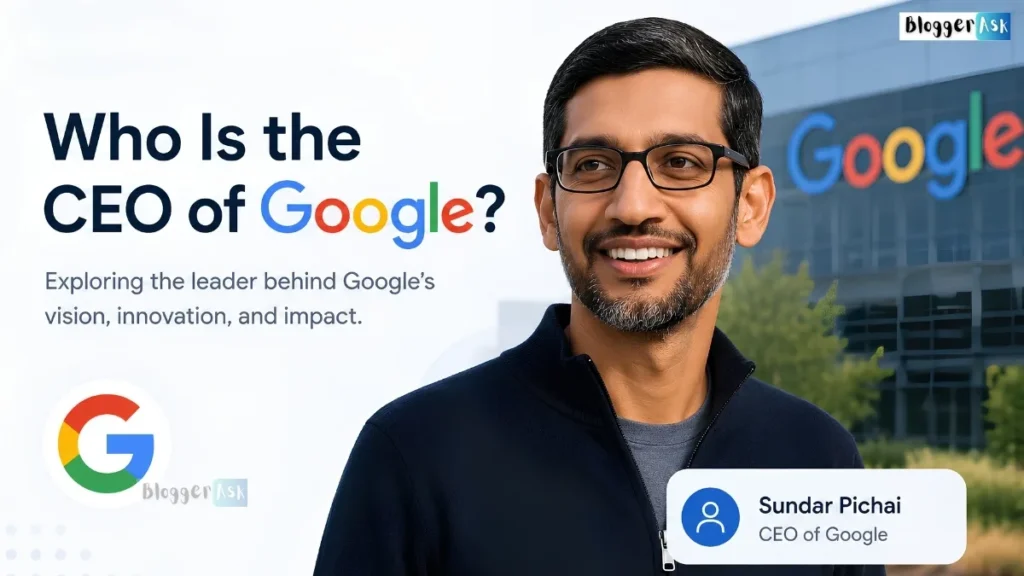
Sundar Pichai is the CEO of Google. He has led Google LLC since August 10, 2015, and became CEO of Alphabet Inc. — Google’s parent company — on December 3, 2019. Born in Chennai, India, Pichai joined Google in 2004 as a product manager and built his reputation launching Chrome before rising to the top job. He is not the owner of Google. His voting power at Alphabet is below 1%.
There is a version of Sundar Pichai’s story that makes it sound inevitable. Brilliant student from Chennai. Stanford scholarship. Wharton MBA. Joined Google. Built Chrome. Became CEO. Grew the company sevenfold.
That version is accurate — and it misses almost everything interesting.
What the clean narrative skips is the 2008 moment when Pichai had to fight internally for a browser that many Google engineers considered a distraction. It skips the 2022 “code red” when ChatGPT launched and the world’s most powerful search company found itself scrambling. It skips the fact that the man running a $4.6 trillion enterprise serves at the discretion of two people who last held executive titles in 2019.
Knowing who is the CEO of Google means understanding all three of those things — not just the biography.
Quick Facts — Google CEO (2026)
| Detail | Information |
|---|---|
| Full Name | Pichai Sundararajan |
| Known As | Sundar Pichai |
| Current Title | CEO of Google LLC and Alphabet Inc. |
| CEO of Google Since | August 10, 2015 |
| CEO of Alphabet Since | December 3, 2019 |
| Born | July 12, 1972 — Madurai, Tamil Nadu, India |
| Education | IIT Kharagpur · Stanford University (MS) · Wharton (MBA) |
| Joined Google | April 2004 |
| Base Salary | $2 million/year (unchanged since 2020) |
| 2026 Compensation Package | Up to $692 million over 3 years (SEC filing, March 7, 2026) |
| Net Worth | ~$1.3 billion (2026 estimates) |
| Voting Power at Alphabet | Below 1% (Alphabet DEF 14A, April 2026) |
Who Is Sundar Pichai? Biography and Early Life
Pichai Sundararajan was born on July 12, 1972, in Madurai, Tamil Nadu, raised in Chennai. His father was an electrical engineer at GEC; his mother a stenographer before raising him and his brother. The family of four lived in a two-room apartment — the two brothers sharing a bed, a telephone arriving when Pichai was twelve.
He has spoken about this often, not as hardship but as context: growing up in a household where technology arrived slowly gave him a direct, personal understanding of what access means. That perspective — that technology’s value is measured by how many people can reach it, not just how powerful it is — runs through every major product decision he has made. Chrome was built to work on low-end hardware. Android was designed to scale globally at low cost. Gemini was developed with efficiency as a core metric alongside capability.
He attended Jawahar Vidyalaya and Vana Vani school in Chennai, then earned a degree in metallurgical and materials engineering from IIT Kharagpur, one of India’s most selective technical universities. A scholarship took him to Stanford University, where he completed a master’s degree in material sciences and engineering. He then earned an MBA from Wharton, graduating with honors, before joining Google in April 2004.
He was 31. He was one of thousands of product managers. Within eleven years he would run the company.
Sundar Pichai Career — How He Became CEO of Google
2004–2008: The Chrome Insight
Pichai joined Google working on the Google Toolbar — a browser plugin embedding Google Search into Internet Explorer. He immediately identified a structural problem: Google’s most important product depended entirely on infrastructure it didn’t own. Microsoft could degrade the Toolbar experience overnight. Safari could change defaults. Mozilla could pivot. Google’s search dominance was a passenger in someone else’s vehicle.
His solution was controversial: build Google’s own browser. Many engineers thought it was a distraction from core search. Internal skepticism was real. Pichai kept building the case.
In September 2008, Chrome launched. Today it holds approximately 65% of global browser market share. But the deeper lesson isn’t the market share number — it’s the strategic logic. Pichai saw that lasting dominance requires owning the platform layer, not just the product sitting on top of it. He applied that same thinking to Android (mobile infrastructure), Google Cloud (enterprise infrastructure), and eventually Gemini (AI infrastructure). Chrome was the first public proof of how he thinks.
2012–2015: Building the Portfolio
Pichai’s responsibilities expanded steadily — Google Drive in 2012, Gmail and Maps in 2013, Android in 2013 (taking over from Andy Rubin). Each handoff was a signal of confidence from the founders. By 2015, he effectively ran Google’s most important products.
On August 10, 2015, when the Alphabet restructuring was announced, Sundar Pichai was named CEO of Google LLC. The appointment surprised almost nobody inside the company.
2019: CEO of Alphabet
In December 2019, Larry Page and Sergey Brin stepped down from their executive roles entirely. Pichai became CEO of both Google LLC and Alphabet Inc. — the first non-founder to hold full operational authority over the entire enterprise. He joined Alphabet’s board of directors simultaneously.
Career Timeline
| Year | Milestone |
|---|---|
| 2004 | Joined Google as Product Manager (Toolbar) |
| 2008 | Led launch of Google Chrome |
| 2013 | Took over Android from Andy Rubin |
| Aug 2015 | Named CEO of Google LLC |
| Dec 2019 | Named CEO of Alphabet Inc. |
| Apr 2023 | Directed merger of Google Brain and DeepMind → Google DeepMind |
| Nov 2025 | Gemini 3 launched — fastest adoption in Google’s history |
| Jan 2026 | Represented Google at Paris AI Action Summit |
| Mar 2026 | New $692M compensation package filed with SEC |
| May 2026 | Headlined Google I/O 2026: declared “agentic Gemini era” |
What Does the CEO of Google Actually Do in 2026?
Pichai’s role has four distinct layers — a combination that makes this one of the most operationally complex executive positions in global business.
Operational leadership of Google LLC: Search, YouTube, Android, Chrome, Gmail, Maps, Google Cloud, Google Ads, and Gemini AI. These products collectively serve billions of users daily and generate approximately $422 billion in annual revenue (Alphabet Form 10-K, FY2025).
Strategic leadership of Alphabet Inc.: Capital allocation across all subsidiaries — Google DeepMind, Waymo, Verily, Wing. Alphabet has committed approximately $185 billion in capital expenditure for 2026, more than double the prior year, driven by AI infrastructure. Pichai is personally accountable for that deployment.
External representation: Congressional testimony, regulatory proceedings, earnings calls, and major events globally. At the Paris AI Action Summit in January 2026, Pichai called AI “a once in a lifetime technology” — and drew directly on his Chennai childhood: “Improving lives through technology is personal for me. I grew up in India.”
AI strategy: Since the 2022 “code red,” Pichai has personally directed Google’s generative AI pivot. He merged Google Brain and DeepMind in 2023, drove the Gemini model family, and at Google I/O 2026 declared: “It’s been an extraordinary year since our last I/O, a period of relentless shipping… We’re now firmly in our agentic Gemini era.”
What he does not control: governance. Below 1% voting power means every decision Pichai makes exists within a framework he didn’t design and can’t modify.
Sundar Pichai’s Biggest Achievements as Google CEO
Chrome and Android: Infrastructure at Planetary Scale
Before ever becoming CEO, Pichai launched two of the most-used pieces of software in history. Chrome holds approximately 65% of global browser market share. Android powers roughly 72% of global mobile devices. Few technology executives have launched two products of comparable global reach — and Pichai did both before he was CEO.
Google Cloud: From Afterthought to Contender
When Pichai became CEO, Google Cloud was a distant third behind AWS and Microsoft Azure. Under his leadership it grew into a genuine competitor, with an annualised run rate approaching $50 billion by 2026. Cloud is now central to Alphabet’s long-term financial story — and it didn’t exist as a serious business when he took over.
The AI Pivot: Gemini and Google DeepMind
When ChatGPT launched in late 2022, Google’s leadership declared an internal “code red.” Pichai’s response was decisive: in April 2023, he merged Google Brain and DeepMind into Google DeepMind, unifying the company’s AI research under a single leadership structure for the first time.
The result: Gemini 2.5 launched in March 2025. Gemini 3 followed in November. At Google I/O 2026, Pichai announced that the Gemini app had crossed 900 million monthly active users — more than double the 400 million reported a year earlier. AI Mode in Google Search separately surpassed one billion monthly active users. In January 2026, when Google and Apple announced a deal for future Siri versions to run on Gemini, Alphabet hit a $4 trillion market cap for the first time.
Fast Company noted in March 2026: “Under Pichai, the company that invented modern AI is finally winning the race to deploy it.”
Revenue Under Pichai’s Leadership
When Pichai became Google CEO in 2015, Alphabet’s annual revenue was approximately $74 billion. By FY2025 it had grown to approximately $422 billion (Alphabet Form 10-K FY2025) — an increase of roughly 470% in a decade. Market capitalization grew from roughly $450 billion to approximately $4.6 trillion over the same period. That’s one of the largest single-decade value creation events in corporate history.
Sundar Pichai Salary and Net Worth (2026)
Base Salary
$2 million per year — unchanged since 2020. No annual cash bonus.
2026 Compensation Package
On March 7, 2026, Alphabet filed a new performance-linked equity package potentially worth up to $692 million over three years — one of the largest CEO compensation structures in global technology.
| Component | Potential Value | Linked To |
|---|---|---|
| Base salary | $6M total (3 years) | Fixed |
| Alphabet stock units | ~$252M | Alphabet total shareholder return |
| Waymo equity | Up to $260M | Waymo value growth (2026–2028) |
| Wing equity | Up to $90M | Wing per-unit value growth |
| Total potential | Up to $692M | All targets met |
The Waymo and Wing components are structurally significant — for the first time, Pichai has direct personal financial interest in businesses that are currently unprofitable. His compensation is now explicitly tied to the long-term bets, not just advertising revenue.
Security costs: Pichai’s personal security expenses, paid by Alphabet, reached $8.3 million in 2024 per Financial Times reporting.
Sundar Pichai Net Worth (2026)
Pichai and his wife Anjali jointly hold approximately 1.67 million Alphabet shares — valued at approximately $498 million at recent share prices, per Storyboard18 reporting citing regulatory filings. His total net worth is estimated at approximately $1.3 billion in 2026 estimates, with Forbes placing it at $1.1 billion in April 2025.
His wealth is substantial. It is also significantly smaller than that of the founding shareholders whose company he runs — a fact that is structurally meaningful, not incidental.
Google CEO vs. Google Owner — The Most Important Distinction
This confusion comes up constantly, and it deserves a direct answer.
CEO means operational authority — running products, employees, strategy, and public representation.
Owner/Controller means governance authority — determining who sits on the board, approving major acquisitions, and setting the strategic direction that the CEO then executes.
Pichai is the CEO. He is not the owner.
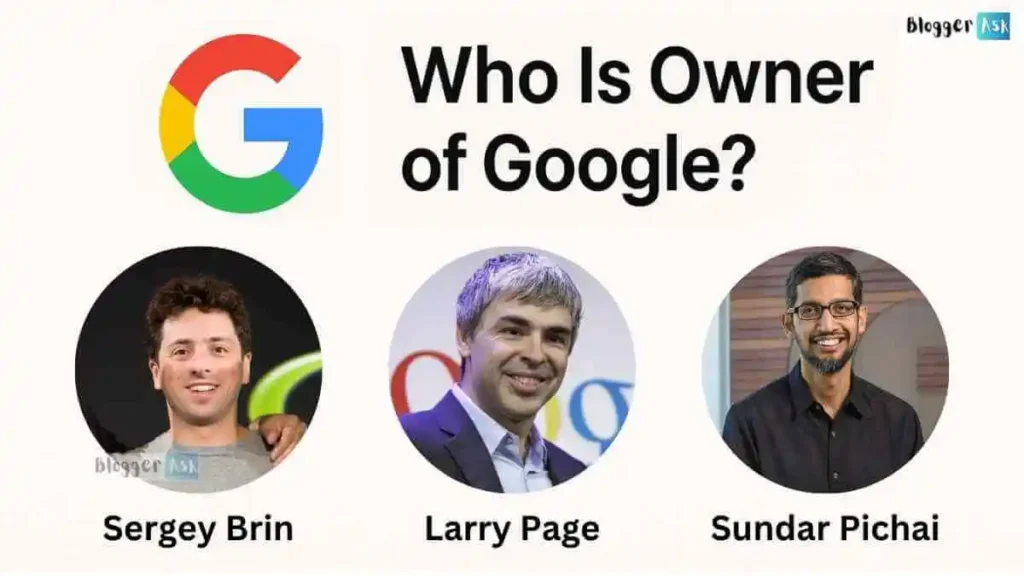
Larry Page and Sergey Brin hold a combined 52.7% of all Alphabet votes through Class B shares carrying 10 votes each. Pichai’s below-1% voting stake means that if the founders ever disagreed strongly enough with his direction, they could replace him — through the board they control — without needing agreement from any other shareholder. Vanguard’s roughly 7% stake and BlackRock’s roughly 6% stake can’t override them either.
This isn’t a weakness of Pichai’s authority — day to day, he has near-complete operational independence. But it is the central governance fact of Google that any complete account of the CEO role must acknowledge honestly.
Google CEO History
| CEO | Period | Key Contribution |
|---|---|---|
| Larry Page | 1998–2001 | Co-founded Google; built original search engine |
| Eric Schmidt | 2001–2011 | Scaled through IPO; built global advertising business |
| Larry Page | 2011–2015 | Drove mobile strategy; architected Alphabet restructuring |
| Sundar Pichai | 2015–Present | Mobile-first to AI-first; ~$422B revenue, ~$4.6T market cap |
Eric Schmidt served for a decade — overseeing the 2004 IPO, acquiring YouTube ($1.65B) and Android ($50M), and expanding Google globally. He was brought in as “adult supervision” for a startup its founders acknowledged needed professional management. Pichai was different: he was elevated because the founders recognized he was already running their most important products. The role changed between those two appointments — and so did the kind of person required to fill it.
Sundar Pichai’s Leadership Style — Three Defining Traits
Consensus before movement. Pichai builds alignment before acting. Chrome, the DeepMind merger, and Google Cloud’s enterprise push all required sustained internal coalition-building before becoming company priorities. Decisions are slower — and more durable.
Technical credibility. His IIT Kharagpur and Stanford background gives him genuine engineering credibility with product teams. He isn’t performing technical understanding — he has it, and Google’s engineers know the difference.
Calibrated urgency. At an internal December 2024 strategy meeting, audio reported by CNBC, Pichai told employees: “I think 2025 will be critical. I think it’s really important we internalize the urgency of this moment, and need to move faster as a company. The stakes are high.” That tone — acknowledged threat, required urgency, no panic — has been consistent throughout every crisis of his tenure.
| “Leadership is about making others better as a result of your presence and making sure that impact lasts in your absence.” — Sundar Pichai |
Challenges Pichai Is Navigating in 2026
DOJ Antitrust Case: In August 2024, a U.S. federal court found Google had illegally maintained a monopoly in general search. Remedies issued in September 2025 banned exclusive default distribution contracts and required data sharing with competitors. Both sides have appealed; DC Circuit arguments are expected in late 2026 or early 2027. Chrome divestiture remains a live possibility at the appellate level.
The AI Race: ChatGPT’s 2022 launch triggered genuine strategic urgency. Pichai’s response — consolidating AI research, accelerating Gemini, integrating AI into every Google product — has produced measurable results. Gemini app users doubled to 900 million by May 2026; AI Mode in Search crossed one billion monthly users. The “code red” is no longer code red.
The $185 billion bet: Alphabet’s 2026 capital expenditure commitment — roughly $185 billion — is among the largest single-year infrastructure investments any public company has ever made. Pichai is accountable for whether that deployment builds the next computing platform or becomes one of the largest strategic bets in technology history to miss its target.
Frequently Asked Questions
Who is the CEO of Google?
Sundar Pichai. CEO of Google LLC since August 10, 2015, and CEO of Alphabet Inc. since December 3, 2019.
Is Sundar Pichai the owner of Google?
No. Pichai is CEO — operational leader — but not the owner. Larry Page and Sergey Brin control Alphabet through a combined 52.7% voting majority via Class B super-voting shares.
When did Sundar Pichai become CEO of Google?
August 10, 2015, when the Alphabet restructuring was announced. He became CEO of Alphabet itself on December 3, 2019.
What is Sundar Pichai’s salary in 2026?
Base salary is $2 million per year, unchanged since 2020. In March 2026, Alphabet filed a new three-year performance package potentially worth up to $692 million, tied to Alphabet stock and the value growth of Waymo and Wing.
What is Sundar Pichai’s net worth in 2026?
Approximately $1.3 billion in 2026 estimates. Forbes placed it at $1.1 billion in April 2025. His wealth is primarily from Alphabet stock accumulated through executive compensation.
Where is Sundar Pichai from?
Born in Madurai, raised in Chennai, Tamil Nadu, India. He moved to the US for graduate school at Stanford in the 1990s.
What did Sundar Pichai build before becoming CEO?
Most significantly, Google Chrome (2008) and led Android from 2013. He also oversaw Google Drive, Gmail, and Maps.
Who was CEO of Google before Sundar Pichai?
Larry Page (2011–2015), Eric Schmidt (2001–2011), and Larry Page again originally (1998–2001).
How much voting power does Pichai have at Alphabet?
Below 1%, per the April 2026 DEF 14A proxy statement. He holds 227,560 Class A shares — minimal governance influence compared to the founders’ combined 52.7%.
What is Pichai’s role in Google’s AI strategy?
He directed the 2023 merger of Google Brain and DeepMind into Google DeepMind, drove the Gemini model family, and at Google I/O 2026 declared Google is “firmly in the agentic Gemini era.” He also uses Gemini personally before CEO meetings.
Is Sundar Pichai a billionaire?
Yes. Net worth estimates for 2026 range from approximately $1.1 billion to $1.3 billion.
What is Sundar Pichai’s educational background?
Metallurgical engineering from IIT Kharagpur; MS in material sciences from Stanford; MBA from Wharton.
Is Sundar Pichai married?
Yes, to Anjali Pichai, whom he met at IIT Kharagpur. They have two children — Kavya and Kiran — and jointly hold approximately 1.67 million Alphabet shares per early 2026 SEC filings.
What was Google’s “code red” moment?
When ChatGPT launched in November 2022, Google leadership recognized generative AI as a serious threat to core search revenue. Pichai’s response — accelerating Gemini, merging AI research divisions — has broadly been considered effective.
What did Pichai announce at Google I/O 2026?
He declared the “agentic Gemini era,” announced Gemini app crossing 900 million monthly users and AI Mode in Search surpassing one billion users, and unveiled Gemini 3.5 Flash along with an 8th-generation TPU chip architecture split into training and inference designs.
The Bottom Line
Sundar Pichai became the CEO of Google by building things hundreds of millions of people used every day — and then earning the trust to run the company that built them.
He arrived as a product manager in 2004 with no particular claim to the top job. He left eleven years later as CEO — not because the role was handed to him, but because the products he built made the case before he had to. Chrome. Android. Google Cloud. Gemini. Four platform layers, each one designed on the same logic: own the infrastructure, not just the application on top of it.
The company he runs in 2026 is not the one he inherited in 2015. Revenue has grown nearly fivefold. Market capitalization has grown sevenfold. And the most consequential product transition in Google’s history — from keyword search to AI-native answers — is playing out in real time, with Gemini at 900 million users and climbing.
What comes next is an open question. The $185 billion capital commitment, the antitrust appeals, the AI race against OpenAI and others — these are genuinely uncertain. But the track record of the person accountable for resolving them suggests the uncertainty is at least in capable hands.
📖 Continue Reading:
Sources
- Alphabet Inc. DEF 14A Proxy Statement (April 2026)
- Alphabet Inc. Form 10-K FY2025
- SEC Form 8-K (March 7, 2026) – Compensation Filing
- Alphabet Q4 2025 Earnings Call
- Google I/O 2026 Keynote Transcript (May 19, 2026)
- Sundar Pichai at Paris AI Action Summit (January 2026)
- Fast Company: Google CEO Sundar Pichai’s Plan to Make Gemini the Only AI That Matters (March 23, 2026)
- Time: How Sundar Pichai Pushed Google to the Front of the AI Race (April 30, 2026)
- Fortune (March 10, 2026)
- Storyboard18: Compensation and Shareholding Analysis (March 8, 2026)
- Financial Times: Security Expenses Report
- StartupHub.ai: Google I/O 2026 Recap (June 1, 2026)

Olivia Isabel is a business and technology researcher and writer with 9 years of experience analysing market trends, corporate strategy, and the impact of emerging technologies on business and marketing practice. She holds an MBA in Strategy and Innovation from London Business School and a Bachelor’s degree in Economics from University College London (UCL) — credentials that ground her research and writing in rigorous analytical frameworks used at the highest levels of global business.
She specialises in corporate ownership, company structure, and how major tech firms are governed and funded — breaking down complex questions like who controls a company versus who profits from it into clear, accurate explainers for readers trying to understand the businesses behind the world’s biggest brands.
Her work on BloggerAsk includes in-depth ownership breakdowns of OpenAI, Tesla, SpaceX, Alphabet, Google, Meta, and more, along with guides to company leadership and the corporate structures of major technology and social media platforms. Each article is built from primary sources — company filings, official statements, and reputable financial press such as Bloomberg, CNBC, Reuters, and the Financial Times — and is updated as ownership and governance details change.
Olivia focuses on accuracy and freshness over hot takes: every ownership figure is dated to when it was confirmed, estimates are clearly labelled, and fast-moving stories (like IPO filings and funding rounds) are revisited as they develop. Her goal is simple — give readers a version of the facts they can actually rely on, and cite where each claim comes from.