⚡ Quick Answer: Side Hustles From Home in 2026
A side hustle from home is any income you earn alongside your main job or studies, without commuting anywhere to do it. Most of them earn modest amounts. In 2025, Bankrate found the typical (median) US side hustler made about $200 a month, while a small number of big earners pulled the average up to roughly $885. A March 2026 LendingTree survey put the average higher, at $1,242 a month. So plan for roughly $200 to $1,250 a month, depending on the hustle, your time, and your skill. The right one fits your actual time, budget, and skills. Use the decision framework below to find yours — and read the scams section before you pay anyone to get “approved” for work.
Scope note: This guide is written for US readers. The pay data draws on US, UK, Canadian, and Australian surveys, but the tax, financial-aid, and platform-age rules are US-specific. If you’re outside the US, use the ideas and the framework, but check your own country’s rules.
Every statistic, tax rule, and legal detail here is sourced from government agencies (IRS, FTC, Federal Student Aid), peer-reviewed academic research, or named news reporting — not recycled marketing claims. Full citations are in the Sources section. Tax and financial-aid rules change; if you’re reading this well after July 2026, confirm the specific figures against current IRS and Federal Student Aid guidance first.
What Counts as a Side Hustle From Home (and What Doesn’t)
Side Hustle vs. Part-Time Job vs. Freelancing
People use these three words interchangeably. They’re not the same, and the difference decides how much control you get.
A part-time job is traditional employment with fewer hours. An employer sets your schedule. You’re usually a W-2 employee. You have little say over how the work gets done.
A side hustle is broader and self-directed. You choose when you work, how much you take on, and often what you charge.
Freelancing is one type of side hustle. You sell a skill straight to clients — writing, design, consulting. It’s the version most likely to grow into a full-time business.
The takeaway: a side hustle almost always means you set the terms. That’s exactly why it fits around a full-time job or a class schedule when a second part-time job can’t.
“From Home” vs. “Online” — Why We Treat Them Differently
Most articles treat “side hustles from home” and “online side hustles” as the same search. They aren’t. Blurring them is why so much content feels generic.
“From home” describes where you work — your kitchen table, your garage, your couch. It says nothing about who your customers are. A from-home hustle can serve your own neighborhood: pet sitting, tutoring a neighbor’s kid, baking for local pickup.
“Online” describes how you deliver the work — digitally, to anyone, anywhere. Freelance writing, virtual assistant work, and selling templates are online and from home at once.
Why it matters: if you live somewhere with strong local demand (a college town, a dense suburb), local options can out-earn online ones because you face less global competition. If you’re isolated or want the widest reach, online-and-from-home wins. This guide covers both and flags which is which.
How Much Do Side Hustles From Home Actually Pay in 2026?
The Real Numbers (and Why Every Survey Reports a Different One)
If you’ve searched around, no two “side hustle statistics” articles agree. That’s not because anyone is lying. They measure different people, in different countries, with different definitions. Here’s an honest side-by-side.
| Source | Who Was Surveyed | Participation | Income Figure |
|---|---|---|---|
| Bankrate (2025) | US adults | 27%, down from 36% in 2024 | Median $200/month; average $885/month |
| LendingTree (March 2026) | 2,049 US adults, ages 18–80 | 33%, down from 38% in 2025 | Average $1,242/month |
| Omnisend (2025) | 4,000+ adults across US, UK, Canada, Australia | 31.1% in the US | 61.7% of Americans earn $500/month or less |
| Melbourne, Deakin & Leeds (academic) | 1,497 Australian side hustlers, ages 18–34 | Side-hustlers only (not a population rate) | Median A$200/week (~US$130/week; roughly US$550–580/month) |
A few honest notes on why these don’t match:
- Bankrate puts 2025 US participation at 27%, a nine-point drop from 36% the year before — the lowest since 2017. Analyst Ted Rossman ties the decline to a stronger job market and cooling inflation easing the pressure to earn extra.
- LendingTree’s higher 33% comes from a survey run a few months later, by a different firm, with a wider age range.
- The Australian academic study is funded by the Australian Research Council, not a finance company, and it excludes standard rideshare and delivery gig work from its definition. That alone explains a big part of the gap, since gig driving is one of the most common US side hustles. Its earnings are in Australian dollars, so we convert them above rather than compare them directly to US figures.
One thing every source agrees on: participation is trending down from its 2022–2024 peak, and the people still doing it skew younger.
Average vs. Median — Why the Gap Matters
This is the single most misleading thing in most side-hustle content, so let’s be blunt: the average and the typical experience are not the same number.
Start with the cleanest US figure. Bankrate’s 2025 median side hustle income was $200 a month (down from $250 in 2024). The median is the middle — half of people earn more, half earn less. It’s what a typical hustler actually takes home.
Now the average. Bankrate’s average was $885 a month; LendingTree’s was $1,242. Averages get dragged upward by a small group of big earners — sometimes a lot a lot. That’s why the average is always higher than the median in every dataset that reports both.
The Australian research team found the same pattern. A typical young side hustler earned about A$200 a week — and their hourly pay usually undercut what the same person could make in retail or hospitality, running at roughly half of their main-job wage.
None of this means side hustles aren’t worth it. It means you should plan around the median, not the headline average. Treat any bigger result as a happy surprise, not the baseline.
Real Example: The Amazon Side Hustle That Went Viral
One well-documented, named example helps calibrate expectations — with its realistic counterweight.
Michael Strahl, a 41-year-old senior construction technician profiled by Business Insider, says he earns about $10,000 a month through Amazon’s Influencer Program, filming product-review videos. He works full-time, supports a family of four, and says the hustle takes under 20 hours a month. It’s a real, named, verifiable result.
Here’s the context that usually gets left out. That same reporting notes the typical creator earns far less. A widely-shared thread on the program’s subreddit puts the common outcome around $300 a month, with individual creators reporting anywhere from under $200 to just over $1,000, and calling it unpredictable.
Strahl is a genuine outlier success — not a template you should expect to copy in month one. Use stories like his to understand what’s possible with consistency, not what’s typical at the start.
Key Takeaways: Real Side Hustle Pay
- US participation sits between 27% (Bankrate) and 33% (LendingTree). The gap is methodology, not disagreement.
- The typical (median) US side hustler earned about $200/month in 2025; averages ($885–$1,242) are pulled up by big earners.
- A realistic monthly range is roughly $200–$1,250, depending on the hustle, your time, and your skill.
- Viral six-figure stories are real but documented outliers — not first-year outcomes.
How to Avoid Side Hustle Scams
This section comes early on purpose. Before you weigh a single idea below, know what a bad one looks like. Search data shows people specifically checking whether a platform is legit before signing up — so let’s answer that first.
Legit Platform vs. Scam: A Side-by-Side Check
| A legitimate platform… | A scam or red flag… |
|---|---|
| Pays you to work | Asks you to pay to start or get “approved” |
| Shows payout terms before you sign up | Hides payout terms until you pay or join |
| Just wants you to do the work | Pushes you to recruit other people |
| Shows realistic, verifiable earnings | Waves screenshots of huge “guaranteed” income |
| Lets you decide on your own time | Uses countdowns and “limited spots” urgency |
| Is findable in a business registry | Has no traceable business registration |
Watch for the New “Task Scam” (Big in 2024–2026)
One scam has exploded recently, and it’s worth knowing by name. The FTC has warned about “task scams” — also called gamified job scams. You get an unsolicited text, WhatsApp, or DM offering easy remote work: “like” videos, rate products, or complete simple “tasks” for commission.
Here’s the trap. Early tasks pay you small amounts to build trust. Then you’re told to deposit your own money to unlock higher-paying tasks or withdraw your “earnings.” That money is gone. If a “job” ever asks you to pay to get paid, walk away.
A Real Case: How the FTC Shut Down an “Amazon Passive Income” Scheme
This isn’t hypothetical. In November 2022, the Federal Trade Commission sued a company called DK Automation and its two owners. The agency said they falsely promised customers passive income “on autopilot” through Amazon and Walmart packages — when almost none actually earned it. The same operation also sold a supposed crypto trading bot with inflated promises, with disclaimers too small and buried to matter.
A court order required refunds. By 2024, the FTC confirmed it had returned $2.8 million to people harmed.
It wasn’t isolated. The FTC has pursued several “Amazon automation” schemes since — including a 2025 case, reported by CNBC, against a company that charged customers tens of thousands of dollars upfront to build an Amazon storefront it claimed would print profits. The pattern repeats: a real platform (Amazon) is used as the credibility hook for a separate, unaffiliated scheme.
How to Vet Any New Platform Before You Sign Up
- Search “[platform name] complaints” and “[platform name] reddit” — not just the platform’s marketing.
- Check for FTC actions or Better Business Bureau complaints against it.
- Read the actual payout terms. If you can’t find them without signing up, that’s a red flag.
- Start with the smallest possible time or money commitment.
- Remember the rule: legitimate platforms pay you to work. You never pay a platform to be allowed to work for it.
Find Your Fit: A Side Hustle Decision Framework
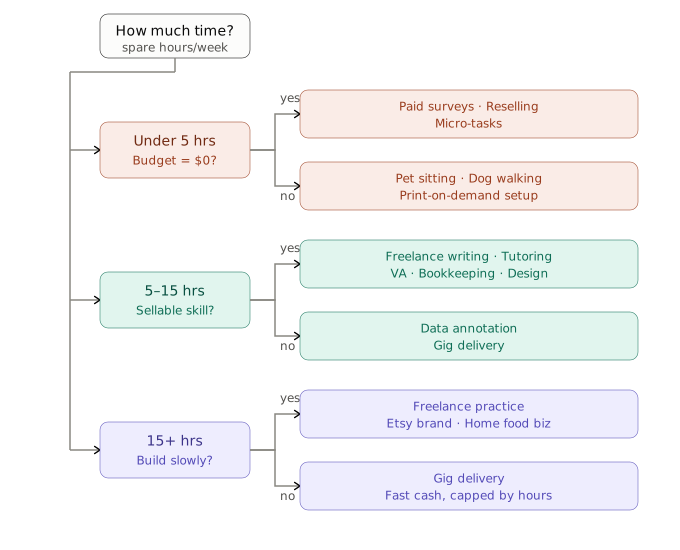
Most “best side hustles” lists hand you 30 ideas and leave you to sort out which fits your life. That’s backwards. Answer three questions first. Then use the matrix and the decision tree to narrow to a category before you look at specific ideas.
1. How Much Time Do You Actually Have?
Be honest about hours left after work, sleep, and existing commitments — not hours you wish you had.
- Under 5 hours/week: low-effort, flexible categories (surveys, selling items, micro-tasks).
- 5–15 hours/week: most freelance and gig options open up.
- 15+ hours/week: you can build real income — a client-based freelance practice or a small product business.
2. How Much Money Can You Put In (Including $0)?
Plenty of legit options need genuinely $0 (surveys, selling your own items, most freelance services once you own a laptop). Others need a little ($20–$200) for supplies or listing fees. Be wary of anything labeled a “side hustle” that demands a big upfront investment. That’s the scam pattern above, not a normal cost.
3. What Skills Do You Already Have?
You don’t need to learn something new to start. Writing, spreadsheet basics, customer-service experience, a second language, organization, or comfort with a specific software tool are all monetizable starting points covered below.
Decision Tree — Follow the Path
Decision Matrix — Time, Cost, and Payoff Speed
| Category | Time Needed | Startup Cost | Time to First Dollar | Income Ceiling |
|---|---|---|---|---|
| Paid surveys & micro-tasks | Very low | $0 | Same day | Low |
| Selling items you own | Low | $0 | Days | Low (one-time) |
| Pet sitting / dog walking | Low–medium | $0–$20 | Days to weeks | Low–medium |
| Data annotation / AI-training | Medium | $0 | 1–2 weeks | Medium |
| Freelance writing | Medium–high | $0 | 2–4 weeks | Medium–high |
| Virtual assistant work | Medium | $0 | 2–4 weeks | Medium |
| Bookkeeping | Medium–high | $0–$100 | 3–6 weeks | Medium–high |
| Tutoring / online teaching | Medium | $0 | 1–3 weeks | Medium |
| Graphic design / web dev | High | $0–$100 | 3–8 weeks | High |
| Print-on-demand / digital products | Medium upfront, low ongoing | $0–$50 | 4–8 weeks | Medium–high |
| Etsy / handmade goods | High | $50–$300 | 4–8 weeks | Medium |
| Home food business | High | $100–$500 | 4–8 weeks | Medium |
| Delivery / gig driving | Flexible | $0 (if you have a car) | Same day | Medium (capped) |
How to use it: rule categories out first. Under 5 hours a week and $0 to spend? Skip Etsy and food businesses for now, and head to the next section.
Key Takeaways: Finding Your Fit
- Answer time, money, and skills honestly before browsing ideas.
- Under 5 hours and $0 → surveys, reselling, or micro-tasks.
- 15+ hours → a real freelance practice or product business becomes realistic.
- Use the matrix and tree to rule categories out. You’ll read the rest faster.
Easy, Low-Cost Side Hustles From Home
These easy side hustles need little time or money to begin. They’re a great way to test the waters before committing to something bigger.
Paid Surveys and Micro-Tasks
Paid surveys and micro-tasks are small digital jobs — data checks, app testing, short transcription. They’re the closest thing to a true $0 side hustle.
The tradeoff is real: pay per task is low, usually $3–$15 an hour in practice, and this category has one of the lowest ceilings in this guide. Treat it as pocket money for downtime, not an income stream. Stick to established platforms like Prolific or UserTesting, and never pay a fee to join — legitimate sites are free.
Selling Things You Already Own
Reselling clothes, electronics, and furniture is genuinely $0 to start, since you already own the items. It won’t produce ongoing income once you run out, but it’s the fastest realistic way to make your first side-hustle dollars this week — on marketplaces like eBay, Facebook Marketplace, or Poshmark — while you plan a longer-term option.
Pet Sitting and Dog Walking
Pet sitting and dog walking is a true from-home (not just online) hustle. It runs on local demand, builds through word of mouth and apps like Rover or Wag, and needs no special gear.
Rates vary by area. Expect roughly $15–$40 per visit or walk, and more for overnight stays, once you have a few regular clients.
Data Annotation and AI-Training Tasks
Data annotation is labeling or rating text, images, and audio to train and evaluate AI models. It’s genuinely new for 2026 and worth taking seriously.
AI companies need huge volumes of human-reviewed data, so they hire remote workers through platforms like DataAnnotation, Outlier, and Scale AI. Most entry-level roles need no coding — attention to detail matters more. Pay tends to beat traditional micro-tasks, often $15–$25 an hour and higher for specialized (coding or STEM) work, though availability swings week to week.
Skill-Based Side Hustles From Home
These take longer to ramp up, but the ceiling is much higher — because you’re selling a skill, not just spare time.
Freelance Writing
Freelance writing covers blog content, marketing copy, technical writing, and ghostwriting. It’s one of the highest-volume entry points relative to how many people search for it.
You don’t need a journalism degree. You need a small portfolio (even 2–3 samples written for a mock client), clear communication, and the discipline to hit deadlines. Start on platforms like Upwork or Contently. Rates range widely — roughly $0.05–$0.15 a word starting out, rising well past $0.50 a word for specialized technical or financial niches.
Virtual Assistant Work
A virtual assistant handles email, scheduling, data entry, and basic customer support for busy businesses. It’s a strong fit if you have office or admin experience, since the skills transfer directly.
Most VA work starts through referrals or platforms like Belay or Upwork, not a single “VA app.” Expect your first client to take longer to land than a gig-driving app. Pay typically runs $15–$35 an hour, and more with specialized skills.
Is Bookkeeping a Good Side Hustle?
Yes — and it’s underrated. Bookkeeping is categorizing expenses, reconciling accounts, and preparing basic reports for small businesses that always need the help.
You can learn the fundamentals through a single certificate course, no accounting degree required, using software like QuickBooks Online or Xero. It has one of the best time-to-income ratios here because the work is recurring and monthly, not one-off. Expect $20–$50 an hour, often billed as a monthly retainer per client.
Tutoring and Online Teaching
Tutoring turns your knowledge of a school subject, test, or language directly into hourly income — locally or through platforms like Wyzant or Preply.
It’s naturally recurring. One family often books you weekly for months, which makes income more predictable than most options here. Rates commonly run $20–$60 an hour, and higher for test prep.
Graphic Design and Web Development
Graphic design and web development carry a higher skill ceiling and a higher pay ceiling. Small businesses constantly need logos, social graphics, simple sites, and landing pages. Neither requires a degree — a strong portfolio matters more than credentials.
Expect a longer runway to your first paid client, since you’ll usually need sample work first. But per-project pay is significant once you’re established — often $30–$100+ an hour.
AI-Assisted Freelancing: What’s New vs. Just Rebranded
“AI side hustles” is one of the fastest-growing searches for 2026. Separate the real from the hype.
Genuinely new: data annotation and AI-model evaluation (above), plus using AI tools to speed up existing freelance work. A skilled writer or designer who’s fast with AI can serve more clients in the same hours — raising their ceiling without changing what they sell.
Mostly rebranded: generic “prompt engineering” pitched as a standalone skill you can sell with no other expertise. In practice, the people earning real money “using AI” almost always had an underlying skill first — writing, design, research, coding — that AI made faster. Be skeptical of anything selling AI as a shortcut that replaces skill entirely.
Selling Products From Home
Print-on-Demand and Digital Products
Print-on-demand lets you design a product — a shirt, a mug, wall art — that’s printed and shipped only after someone orders. You never hold inventory. Services like Printful and Printify handle fulfillment.
Digital products — templates, printables, spreadsheets, guides — go further, with near-zero cost per sale, since the same file sells over and over (often through Etsy or Gumroad).
Both are from-home and online at once. Both need real upfront design and marketing effort before the first sale. Don’t expect instant income the way you’d get with gig driving.
Etsy and Handmade Goods
If you make something physical — jewelry, art, candles, clothing — an Etsy storefront turns a hobby into a sales channel without building your own website.
This category has real startup costs (materials, packaging, listing fees) and a longer runway to profit than most options here. But it’s one of the few home-based hustles with a genuinely high ceiling for people who build a strong, repeat-customer brand.
Home-Based Food Businesses (Cottage Food Laws Explained)
Selling baked goods, jams, or other home-prepared food is regulated at the state level in the US through cottage food laws. These rules specify which foods you can legally make at home and sell directly to consumers — usually excluding items that need refrigeration for safety. Most baked goods qualify; cream-filled pastries or bottled sauces often don’t.
Requirements and annual sales caps vary a lot by state. Some states set caps; others set none, and the list of allowed foods differs everywhere. So check your state’s specific rules before you sell your first item.
Important Note: “Everyone on TikTok does it” is not a substitute for confirming your state’s cottage food rules. Start with your state department of agriculture or health, and the Institute for Justice’s cottage food resources, both listed in Sources.
Gig and Delivery Platforms: Are They Actually Worth It?
This category gets recommended constantly. The honest answer: it depends heavily on your market and vehicle costs — and the headline hourly rate is rarely the real one.
Is DoorDash a Good Side Hustle?
DoorDash is one of the most accessible gig platforms: flexible scheduling, no interview, and a same-day path to your first payout.
It’s a good fit if you want maximum flexibility and don’t mind variable earnings. It’s a weaker fit if you’re chasing dollars per hour, since a real chunk of your gross goes to gas, vehicle wear, and unpaid waiting between orders.
Is Uber or Uber Eats a Good Side Hustle?
Similar tradeoffs to DoorDash, with one key difference. Rideshare driving (Uber, Lyft) and food delivery (Uber Eats) have different age and vehicle rules. Rideshare usually needs a higher minimum age and longer driving history than delivery-only work. If you’re choosing between them, delivery is the easier entry point.
Is Instacart Worth It as a Side Hustle?
Instacart shopping — picking and delivering groceries — tends to pay a bit more predictably than restaurant delivery, since batches and tips are usually larger. But it demands more active time per order, because you’re shopping, not just driving.
Try it if nearby stores consistently show good batch availability. Skip it in low-volume areas.
The Real Hourly Rate After Gas, Wear, and Time
Before you commit real hours, run the actual math. Take your shift payout. Subtract fuel and a per-mile estimate for wear. A good reference is the 2026 IRS standard mileage rate of $0.725 per mile, which is designed to approximate the real cost of operating a vehicle. Then divide by total hours — including unpaid waiting time.
Worked example:
- Gross payout for the shift: $120
- Hours worked (including waiting): 6
- Miles driven: 90
- Vehicle cost: 90 × $0.725 = $65.25
- Net: $120 − $65.25 = $54.75
- Real hourly rate: $54.75 ÷ 6 = about $9.13/hour
Many drivers are surprised their real rate is far below the headline number the app shows.
Side Hustles for College Students
Side hustles for college students come with two constraints most other readers don’t have: a fixed, unpredictable class schedule, and a financial aid package that can shift with how much you earn.
Campus-Based Options
Tutoring other students, teaching or research assistant roles, campus tour guiding, and resident advisor positions all work around a class schedule by design — the institution already accounts for student availability.
They also tend to look better on a resume in your field than an unrelated gig job. Factor that in alongside the pay.
Remote and Dorm-Friendly Options
Freelance writing, virtual assistant work, tutoring platforms, and online surveys need only a laptop and internet. That makes them a natural fit for dorm life, where you may lack a car or storage for physical products.
They also travel with you between school and home over breaks — unlike a local pet-sitting client base you’d rebuild every time you move.
How Side Income Can Affect Financial Aid
This gets underexplained everywhere, and it matters. If you’re a dependent student filing the FAFSA, your own income is shielded by a Student Income Protection Allowance. For the 2026–27 award year, that allowance is $11,770 (per the Federal Register and Federal Student Aid).
Earn at or below that from work — including a side hustle — and it has no effect on your federal aid calculation. Earn above it, and the formula counts 50 cents of every additional dollar toward your expected contribution, which can reduce your aid.
Expert Tip: A modest side hustle is very unlikely to touch your aid. A genuinely lucrative one (a thriving Etsy shop, a busy freelance practice) could — once you cross $11,770. Also note the FAFSA uses prior-prior-year income, so this year’s earnings usually affect a later year’s aid. If you’re near the line and aid is a big part of how you pay for school, run the numbers or ask your financial aid office before assuming more income is always better.
Side Hustles for Teens
Side hustles for teens face a different set of constraints: legal age minimums that vary by platform, and the reality that a parent or guardian is usually involved somewhere.
What Teens Can Legally Do (Age Minimums by Platform)
Most major gig and delivery apps are adults-only. Know the actual numbers rather than assuming they’re the same:
- DoorDash: at least 18 in most states, 19 in several (including Texas, Florida, and Arizona), and 21 in a few (California recently moved to 21).
- Uber Eats: at least 19 for delivery drivers; some markets allow 18-year-olds to deliver by bicycle.
- Rideshare (Uber, Lyft): typically 21 or older, with driving-history requirements.
- Amazon Flex: 21 or older.
In short: almost nothing in delivery driving is open to anyone under 18.
What’s realistic for younger teens: babysitting and pet sitting (local trust and word of mouth), yard work and odd jobs, reselling items, and select survey or micro-task platforms that accept participants as young as 14. Older teens (16–17) can usually add traditional part-time retail or food service, plus tutoring younger students, selling digital art, or running a small online shop — though payment processors and marketplaces may require an adult’s name on the account.
(Age rules change. Confirm current requirements on each platform’s official requirements page before applying — DoorDash, Uber, and Amazon Flex all publish them.)
What Parental Involvement Actually Looks Like
For most legitimate paid platforms — payment processors, marketplaces, freelance sites — anyone under 18 legally can’t hold an account in their own name. A parent or guardian typically needs to set up and be named on the account, and often handle payouts.
This isn’t a loophole to route around. It’s a normal, expected part of how a minor legally earns through a digital platform. Frame it to a parent as a practical requirement, not a hurdle, and loop them in from the start.
Realistic Earnings for Teens
Expect lower, less consistent income than an adult doing the same work — both because fewer options are legally open, and because teens are building a track record from zero.
Local services (babysitting, pet sitting, yard work) tend to be the most reliable early income, precisely because they don’t depend on a platform’s age policy — just on a parent’s help making the first neighborhood connections.
Taxes, LLCs, and the Legal Basics
This section covers general US federal rules as of July 2026. It isn’t personal tax advice — for your specific situation, check IRS guidance or a licensed tax professional.
Do You Owe Taxes on Side Hustle Income?
Yes — no matter how small the amount, and whether or not anyone sends you a form. The IRS requires self-employment tax once your net earnings reach $400 or more in a year, and that rule exists independently of any 1099.
This is one of the most confused areas in side-hustle content, so here are the current 2026 rules.
For years, people repeated a claim that any $600+ through PayPal or Venmo would trigger a 1099-K. That’s outdated. The One Big Beautiful Bill Act (signed July 4, 2025) reinstated the older, higher threshold. Payment apps and marketplaces now issue a federal 1099-K only once you exceed $20,000 in payments and 200 transactions in a year (confirmed by the IRS 1099-K FAQ, Fact Sheet 2025-08).
Separately, the 1099-NEC threshold (for clients who pay you directly, not through an app) rises from $600 to $2,000 starting with 2026 payments.
Important Note: A handful of states set their own, lower 1099-K thresholds — historically including Massachusetts, Vermont, Maryland, Virginia, Illinois, and others. State rules are shifting after the federal change, so if you’re near the line, verify your specific state’s current threshold.
None of this changes whether income is taxable. It only changes when someone else must send you paperwork. You owe tax on every dollar of profit, form or no form.
Self-employment tax is 15.3% of your net earnings (technically 92.35% of your profit) — split into 12.4% for Social Security and 2.9% for Medicare — on top of ordinary income tax. (The 12.4% Social Security portion applies only up to the annual wage base, which most new hustlers won’t hit.)
If you expect to owe $1,000 or more for the year after withholding, the IRS expects quarterly estimated payments (Form 1040-ES), not one lump sum at filing. That’s a common surprise for first-timers.
Key Takeaways: Side Hustle Taxes
- You owe self-employment tax once net earnings hit $400 — with or without a 1099.
- The federal 1099-K threshold is $20,000 and 200 transactions, not $600 — but check your state.
- Self-employment tax is 15.3% of net earnings; pay quarterly if you’ll owe $1,000+.
- An LLC is usually unnecessary for a new, modest side hustle.
Should You Start an LLC?
For most people just starting, no — not yet. An LLC adds cost (state filing fees, sometimes annual fees) and paperwork without changing how much tax you owe in most basic cases, since a single-member LLC is taxed like a sole proprietor by default.
The main reasons to form one are liability protection — separating personal assets from business risk — once you have real revenue or clients, or a specific need like a partner or investor requiring it. If you’re earning a modest amount from freelancing, reselling, or gig work, operating as a sole proprietor and tracking income and expenses is normal and enough.
Simple Record-Keeping That Prevents a Tax-Time Mess
Keep it simple but consistent:
- Use a dedicated spreadsheet or a free expense-tracking app. One line per payment and per expense. Update it weekly, not from memory in April.
- Separate a bank account, or at least a savings “bucket,” for taxes.
- Set aside roughly a quarter of your profit as you earn it — that lines up reasonably with the combined self-employment and income tax you’ll likely owe.
- Save receipts for anything you’ll deduct — mileage, supplies, a portion of home internet used for the business. Deductions lower the profit your tax is calculated on.
How to Actually Start This Week
A Step-by-Step First-Week Plan
- Use the framework above to pick one category — not three — based on your real time, money, and skills.
- Pick one specific idea and one specific platform to try it.
- Set a small, concrete first goal (your first $50, first client, first sale) instead of “see how it goes.”
- Spend your first session on setup only — a profile, a listing, a pitch. Don’t try to earn on day one.
- Tell one person what you’re doing, so you have accountability.
The 30-Day Test-Drive Method
Commit to 30 days before you judge a hustle. Don’t quit after one slow week.
Track two numbers only: total hours and total money earned. At day 30, divide one by the other for a real hourly rate. Compare it honestly against the decision matrix.
If it’s badly underperforming with no reason to expect improvement (more reviews, more visibility, a growing client list), that’s a clean, unemotional signal to try a different category — instead of pushing on out of sunk-cost stubbornness.
Stacking Two Hustles Without Burning Out
Once one hustle runs smoothly, the highest-leverage move is pairing a fast-cash option with a slow-build one. For example: a few hours of gig delivery for reliable cash, alongside a freelance writing practice or Etsy shop that takes longer but climbs higher.
Avoid stacking two options that fight for the same hours and mental energy — two client-based freelance practices at once, say. That’s a common way people burn out and quit both instead of succeeding at either.
Which Side Hustle Should You Actually Start?
If you’ve read this far, you already have what you need.
The best side hustles from home aren’t the ones with the loudest income claims. They’re the ones that fit the hours, money, and skills you actually have — and that you’ll give a real 30-day trial instead of abandoning after a slow week.
So go back to the framework. Be honest about your real hours, budget, and skills. Pick exactly one category to test for 30 days. Skip the too-good-to-be-true option and start with the boring, verifiable one that matches your constraints.
The single biggest predictor of success isn’t which idea you pick. It’s whether you give one option an honest 30-day trial — instead of sampling five for a day each and deciding side hustles “don’t work.”
Whether you’re an employee wanting breathing room against rising costs, a student working around class and financial aid, or a teen earning your first taxable income, the same process holds: get honest about your constraints, pick one category, watch for the scam patterns, and track your real hourly rate before you keep going or pivot.
Side hustles rarely make anyone rich overnight. But done deliberately — with expectations set by the real data here, not social media hype — they’re a genuinely useful, low-risk way to build extra income on your own terms.
Frequently Asked Questions
How can I make $2,000 a month with a side hustle?
For most people, $2,000 a month takes a skill-based hustle charging a real rate — or several stacked streams. Concretely: about 25 hours a week of tutoring at ~$20/hour, or roughly 13–14 freelance articles a month at ~$150 each, or a mix. It’s a goal to build toward over months, not a first-few-weeks result. Treat any content claiming otherwise with the skepticism from the scams section.
Can I really make $100 a day online?
It depends on the category. A skilled freelancer at a solid rate can hit $100 in a focused few hours. Someone relying on surveys or basic micro-tasks alone (often $3–$15/hour) is unlikely to reach it in a day. Gig drivers can hit it during peak hours in a busy area — after gas and vehicle costs. So yes for some categories, no as a baseline across all of them.
What is the best paid side hustle?
There’s no single answer — it depends on your skills and time. Among skill-based options, specialized freelance work (web development, technical writing, design) tends to have the highest per-hour ceiling, but it takes the longest to ramp up. The framework above beats chasing whichever option has the highest headline number.
What are the easiest side hustles to start today, with no money?
Three truly $0 starting points: selling items you already own, joining a reputable paid survey platform (like Prolific), and offering pet sitting or dog walking to your neighborhood (via Rover or word of mouth).
Do I have to pay taxes on a small side hustle?
Yes. The IRS requires self-employment tax once net earnings reach $400 in a year, whether or not you get a 1099. No paperwork doesn’t mean no tax. See the tax section for the current 2026 reporting thresholds.
Is it better to run one side hustle or several at once?
For most people, one well-chosen hustle run consistently beats several run half-heartedly. Once one runs smoothly, pairing a fast-cash option with a slow-build one is a smart next step — but stacking two that compete for the same hours and energy is a fast route to burning out on both.
How much money do I actually need to start a side hustle from home?
Many legit options need genuinely $0 — reselling your own items, freelance services once you own a laptop, most surveys and micro-tasks. Others (a home food business, an Etsy shop with inventory) need a modest amount for supplies or permits. Anything demanding a large upfront “investment” is the scam pattern from earlier, not a normal cost of entry.
📖 Continue Reading:
Sources & References
- Bankrate — Side Hustle Survey (2025)
- LendingTree 2026 Side Hustle Survey, via LiveNOW from FOX
- Omnisend — Side Hustles Report (2025)
- The University of Melbourne — “Are side hustles really a way to escape the rat race…”
- The Conversation — same research team’s analysis
- Deakin University — “Youth hustle culture not all it’s cracked up to be”
- Business Insider — original reporting on Michael Strahl’s Amazon Influencer earnings (via Yahoo Finance)
- Federal Trade Commission — DK Automation complaint (2022)
- Federal Trade Commission — $2.8M in DK Automation refunds (2024)
- CNBC — FTC action against an Amazon “passive income” scheme (2025)
- Federal Trade Commission — consumer alerts on “task scams” / gamified job scams (search “task scams”)
- Internal Revenue Service — Self-Employment Tax (Social Security and Medicare)
- Internal Revenue Service — Estimated Taxes / Form 1040-ES
- Internal Revenue Service — 1099-K FAQ under the One Big Beautiful Bill (Fact Sheet 2025-08)
- Internal Revenue Service — Self-Employed Individuals Tax Center
- Federal Register — Federal Need Analysis Methodology for the 2026-27 Award Year (Student Income Protection Allowance $11,770)
- Federal Student Aid — 2026-27 SAI and Pell Grant Eligibility (FSA Handbook)
- DoorDash — official Dasher (driver) requirements page
- Uber — official delivery and rideshare driver requirements pages
- Amazon Flex — official driver requirements
- Institute for Justice — cottage food law resources, plus your state department of agriculture or health.

Anjali Kaur is a finance writer specializing in personal finance, international tax, and financial planning for digital nomads, expats, and remote workers. She breaks down dense, high-stakes topics — the Foreign Earned Income Exclusion, totalization agreements, tax residency, and visa-linked tax breaks — into plain-language guides that help readers make confident decisions. Her approach is research-led and source-driven: every figure is dated, and she flags where rules vary or have recently changed. Anjali fact-checks her finance and tax coverage against primary sources such as the IRS, the SSA, and official government tax authorities. Connect with her on Facebook or read more of her work in the Finance section.