⚡ Quick Answer: Who Owns Mazda Right Now?
Mazda isn’t owned by anyone in the usual sense. Mazda Motor Corporation is an independent, publicly traded Japanese company (Tokyo Stock Exchange: 7261). Ford held a stake from 1979 until fully exiting in 2015. Toyota now holds a minority stake of about 5.1% through a 2017 alliance — a partnership, not a controlling interest.
(Figures below reflect Mazda’s most recently published shareholder disclosure and public statements, current as of 2026 — ownership stakes shift slightly with each fiscal-year filing.)
That’s the headline. The rest of this article covers why the confusion exists, exactly how much Ford and Toyota each held and when, and what a 5% stake actually gets a company like Toyota (spoiler: a shared factory, not a say in Mazda’s decisions).
Why People Think Ford or Toyota Owns Mazda
The confusion isn’t random. Mazda has had two genuinely significant corporate relationships in its history, and both left visible fingerprints that outlasted the actual ownership.
Ownership vs. Partnership — The Distinction Most Articles Skip
These three words get used almost interchangeably online, but they mean very different things:
- Ownership means holding enough shares to control decisions — typically over 50%, though practical control can sometimes happen with less if no other shareholder is close.
- A stake just means holding some shares. It can be 1% or 40%. The number is what determines whether it matters.
- A partnership or alliance means two companies agree to work together — sharing a factory, technology, or engineering — with no ownership implied at all.
Toyota and Mazda have both a stake (small) and a partnership (substantial). Ford, historically, had a stake that got close to but never reached outright control.
Where the Confusion Actually Comes From
Two things specifically drive people to search this question:
- The Alabama plant. Mazda and Toyota jointly built and operate a vehicle assembly plant in Huntsville, Alabama, through a joint venture called Mazda Toyota Manufacturing, U.S.A. Seeing “Toyota” and “Mazda” on the same factory gets misread as an acquisition.
- Old habits from the Ford era. For over three decades, Mazda genuinely was closely tied to Ford — shared platforms, Ford executives running the company at points, co-branded models. That history is real, but it ended in 2015, and a lot of content online still writes about it as if it’s current.
Mazda’s Ownership Structure, Explained
Is Mazda a Publicly Traded Company?
Yes. Mazda has traded on the Tokyo Stock Exchange under the ticker 7261 for decades. Its shares are held by a mix of institutional custodians, corporate partners, and the general public — there is no single controlling shareholder.
Who Are Mazda’s Actual Shareholders?
Based on Mazda’s most recently published shareholder disclosure, as reflected in Mazda’s company profile on Wikipedia, the largest holders are:
| Shareholder | Stake | Type |
|---|---|---|
| The Master Trust Bank of Japan | 15.4% | Custodian (nominee holder) |
| Custody Bank of Japan, Ltd. | 5.9% | Custodian (nominee holder) |
| Toyota Motor Corporation | 5.1% | Strategic alliance partner |
| All other shareholders (public float, funds, other corporate holders) | ~73.6% | Dispersed |
These percentages shift slightly with every fiscal-year disclosure as shares are bought back, reissued, or reallocated, so treat the exact decimal as a snapshot rather than a fixed number.
Custodian Banks vs. Beneficial Owners
The two largest names on that list — Master Trust Bank of Japan and Custody Bank of Japan — are not strategic owners in any real sense. They’re nominee custodians: institutions that hold shares in trust on behalf of underlying pension funds, asset managers, and other institutional investors, as is standard practice for Japanese public companies. They don’t vote those shares to pursue their own agenda or push for control. Toyota’s 5.1%, by contrast, is a genuine strategic holding — smaller in percentage, but actually meaningful in intent.
The Ford Era — How Much of Mazda Did Ford Actually Own?
1979: Ford’s Initial Investment
Ford first invested in Mazda in 1979, acquiring a stake of roughly 25%. This came at a time when Mazda needed capital and Ford wanted a foothold in small-car engineering it didn’t have in-house.
The 1990s Peak — 33.4%, Not a Majority
Ford steadily increased its position, reaching 33.4% by 1996 — its all-time high, and the number most often (and incorrectly) associated with “Ford owning Mazda.” Nikkei Asia confirms this was the peak of what it describes as a capital partnership lasting well over three decades. Even at its highest point, though, Ford never held a majority. It placed its own executives in Mazda’s top roles through 2003 and exercised real influence, but the ownership threshold for outright control was never crossed.
2008–2015: The Divestment and Full Exit
Ford’s exit was gradual, driven by its own financial crisis, not by any breakdown with Mazda:
| Year | Ford’s Stake | What Happened |
|---|---|---|
| 1979 | ~25% | Initial investment |
| 1996 | 33.4% | All-time peak |
| Nov. 2008 | ~13% | Ford sells a large block for roughly $540 million amid its own financial crisis |
| ~2010 | ~3.5% | Stake reduced further |
| 2015 | 2.1% → 0% | Ford sells its remaining shares, fully exiting |
By late 2015, Nikkei Asia reported that Ford had sold off its last remaining 2.1% stake, closing out a capital relationship that had run for well over three decades.
Why Did Ford Sell Mazda?
Ford wasn’t offloading a failing asset — it was raising cash. The 2008 global financial crisis hit Ford’s balance sheet hard, and selling non-core equity stakes (it did the same with other holdings around this period) was a straightforward way to shore up liquidity. The relationship didn’t end over a dispute; it ended because Ford needed the money more than it needed the stake.
The Toyota Alliance — Does Toyota Own Mazda?
The 2015 Partnership vs. the 2017 Capital Alliance — Getting the Dates Right
This is where a lot of existing coverage gets sloppy, so it’s worth being precise. Toyota and Mazda actually signed two separate agreements, and conflating them is the source of most date errors you’ll see elsewhere:
- May 13, 2015: Toyota and Mazda signed a long-term business partnership agreement. No shares changed hands. This was collaboration only — engineering, technology, that kind of thing.
- August 4, 2017: The two companies upgraded that partnership into an actual business and capital alliance, as confirmed in Mazda’s own press release. This is the agreement that actually created equity ownership — Toyota acquired newly issued Mazda shares through a third-party allotment, and Mazda simultaneously acquired an equivalent value of Toyota treasury shares.
So: partnership since 2015, actual shareholding since 2017. If you’ve seen an article claim Toyota “bought into” Mazda in 2015, it’s describing the wrong agreement.
How Much of Mazda Does Toyota Actually Own?
As of the most recent published disclosure, Toyota holds approximately 5.1% of Mazda’s outstanding shares. Toyota’s own release on the 2017 alliance describes the capital tie-up as one that “preserves independence and equality for both companies” — language chosen deliberately to signal this wasn’t an acquisition.
The Mazda Toyota Manufacturing U.S.A. Plant in Alabama
The clearest, most visible product of the alliance is a joint-venture assembly plant in Huntsville, Alabama, which builds the Mazda CX-50 and the Toyota Corolla Cross on the same production line. It’s a real, substantial piece of shared infrastructure — but it’s owned and operated by a jointly held venture entity, not evidence that either company owns the other. It’s the clearest concrete example of what a 5% stake plus an alliance actually buys: shared factory capacity and engineering collaboration, not corporate control.
What the Alliance Gives Toyota — and What It Doesn’t
Toyota’s stake and alliance agreement grant:
- A seat at the table on jointly agreed projects (EV development, connected-car technology, safety tech, the Alabama plant)
- Some alignment of long-term strategic interests
They do not grant:
- Board control or the ability to appoint Mazda’s leadership
- Veto power over Mazda’s independent product or business decisions
- Any legal claim to Mazda as a subsidiary
Ownership vs. Partnership: A Simple Framework
Rather than just repeating percentages, it helps to see where Mazda’s stakeholders actually land on the control spectrum — because “5%” and “33%” both sound like meaningful numbers until you compare them to what full ownership actually requires.
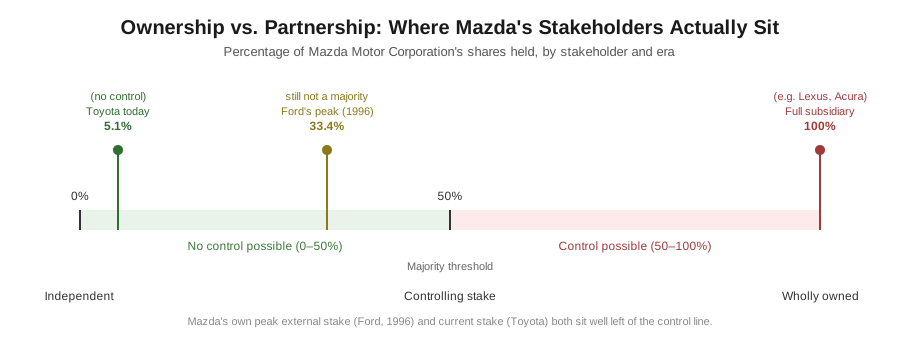
Figure: Ford’s 1996 peak (33.4%) and Toyota’s current stake (5.1%) both sit well below the 50% majority threshold — nowhere close to a fully owned subsidiary like Lexus (Toyota, 100%) or Acura (Honda, 100%).
| Tier | What It Means | Real Example |
|---|---|---|
| Full subsidiary | One company owns essentially all the shares and fully controls the other | Lexus (Toyota), Acura (Honda) |
| Controlling stake | A shareholder holds enough (typically 50%+) to direct major decisions | Not applicable to Mazda at any point — Ford never crossed this line |
| Minority strategic stake | A meaningful but non-controlling holding, usually paired with a business alliance | Toyota’s current 5.1% stake in Mazda |
| Fully independent | No outside company holds a strategic stake at all | The vast majority of Mazda’s shares, held by public and institutional investors |
Mazda has never actually occupied the “controlling stake” or “full subsidiary” tiers with any outside company — not even during Ford’s 33.4% peak. It has moved between “fully independent” and “minority strategic stake,” which is exactly where it sits today.
A Brief History of Mazda’s Independence
1920: Toyo Cork Kogyo and Jujiro Matsuda
Mazda traces back to 1920, founded in Hiroshima by Jujiro Matsuda as Toyo Cork Kogyo — originally a cork-manufacturing operation before it pivoted to machinery and, eventually, automobiles. The company has operated as an independent entity for the vast majority of its 100-plus-year history, with the 1979–2015 Ford relationship standing out as the one real exception.
Mazda Today — Leadership and Headquarters
Mazda remains headquartered in Fuchū, Hiroshima Prefecture, Japan. Masahiro Moro was named President and CEO in March 2023, and he continues to hold that role according to Mazda’s most recently published executive roster, alongside Kiyotaka Shobuda as Chairman of the Board. For readers in the U.S. specifically, Tom Donnelly serves as President and CEO of Mazda North American Operations, overseeing U.S. sales and operations separately from the parent company’s Japan-based leadership. None of these leaders are appointed by, or answerable to, Toyota or Ford — a detail that itself confirms Mazda’s operational independence.
That independence shows up in the numbers, too: Mazda produced over 1.2 million vehicles and reported roughly ¥3.8 trillion in revenue in its most recent full fiscal year on record, per Mazda’s company profile on Wikipedia — the scale of a fully self-sustaining automaker, not a dependent subsidiary running on someone else’s balance sheet.
Key Facts Recap
- Mazda is an independent, publicly traded company (TYO: 7261) — no single company owns it.
- Ford held a stake from 1979 to 2015, peaking at 33.4% in 1996, and fully exited by the end of 2015.
- Ford’s exit was driven by its own 2008 financial crisis, not a dispute with Mazda.
- Toyota and Mazda signed a partnership agreement in 2015 — no equity involved — then upgraded it to an actual capital alliance in 2017.
- Toyota currently holds about 5.1% of Mazda’s shares — a minority stake, not control.
- The Alabama assembly plant is a joint venture, not proof of ownership.
- Mazda’s leadership (CEO Masahiro Moro, Chairman Kiyotaka Shobuda) answers to Mazda’s own board, not to Toyota or Ford.
Conclusion
If you came here to settle an argument: Mazda owns itself. Ford’s ownership ended a decade ago, Toyota’s current stake is a strategic sliver rather than control, and every visible sign of collaboration — shared factories, joint tech development — is a partnership, not a takeover. The short version of who owns Mazda hasn’t changed much in the last several years and isn’t likely to anytime soon: it’s an independent Japanese automaker with a notable but limited Toyota relationship, and a Ford chapter that’s firmly closed.
Frequently Asked Questions
Is Mazda Japanese, American, or Chinese-owned?
Mazda is a Japanese company, headquartered in Hiroshima, with no controlling foreign or domestic owner. It is not American-owned (despite the Ford history) or Chinese-owned.
Will Toyota eventually fully acquire Mazda?
There’s no public indication of this. The 2017 alliance was explicitly structured to preserve both companies’ independence, and nothing in Toyota’s or Mazda’s public statements since suggests that’s changing.
Does Mazda still use Ford engines or technology?
No. Engineering and platform-sharing with Ford ended along with the ownership relationship. Mazda’s current engine lineup (the SkyActiv family) is developed in-house.
Is investing in Mazda the same as investing in Toyota?
No. They’re separate publicly traded companies with separate stock listings. Toyota’s minority stake doesn’t merge their financials or share performance.
Are Mazda and Nissan the same company?
No — that’s a separate and unrelated point of confusion. Mazda and Nissan are independent competitors with no ownership relationship to each other.
📖 Continue Reading:
Disclaimer
This article is for general informational purposes. Ownership percentages are based on the most recently available public disclosures at the time of writing and are subject to change with each fiscal-year filing. This is not financial or investment advice — anyone making an investment decision involving Mazda or Toyota shares should consult current regulatory filings and a licensed financial advisor.

Alex Miller is an automotive writer and industry researcher specializing in the companies, brands, and corporate groups that shape the global automotive market. His coverage focuses on automotive ownership, parent companies, mergers and acquisitions, brand histories, executive leadership, and the business decisions behind major vehicle manufacturers.
Alex’s work spans mainstream, luxury, performance, and emerging automotive brands. He researches how automakers are structured, which companies control individual brands, how ownership has changed over time, and what those relationships mean for consumers and the wider industry. His coverage includes brands such as Jaguar, Ferrari, BMW, Volvo, Mazda, Lamborghini, Lexus, Acura, Audi, Genesis, Infiniti, Porsche, and Volkswagen.
For ownership and corporate-structure stories, Alex prioritizes primary and authoritative sources, including company filings, investor-relations publications, official corporate announcements, regulatory records, and established automotive and financial publications. This approach helps separate a brand’s public identity from its actual corporate ownership and control.
Alex combines detailed industry research with straightforward explanations designed for both automotive enthusiasts and general readers. Beyond ownership stories, his interests include automotive history, luxury and performance vehicles, electric-vehicle development, mobility companies, motorsports, and the evolving relationship between global automakers and their parent groups.