⚡ Quick Answer: Side Hustle Scams
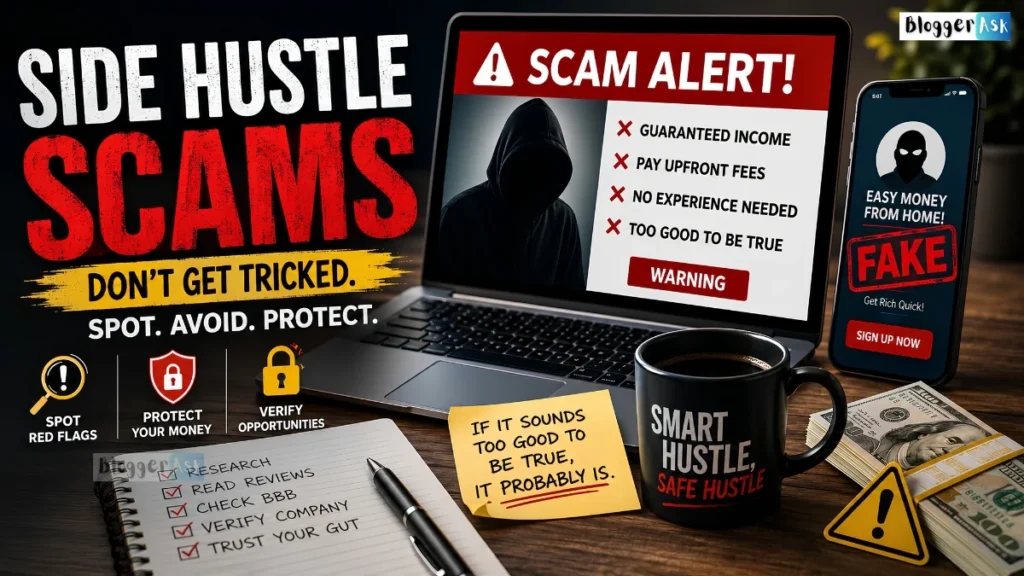
A side hustle scam is any “opportunity” built to take your money or your personal data instead of paying you for real work. Three rules catch almost all of them: legitimate side hustles never ask you to pay upfront, never promise big money for almost no effort, and never rush your decision.
- Reported fraud hit a record in 2025. U.S. consumers reported losing about $15.9 billion, roughly 27% more than 2024 and nearly 430% above 2020.
- Job and side hustle fraud is one of the fastest-growing slices of it, driven by gamified “task scams” and AI-built fake recruiters.
- The defense hasn’t changed. Never pay to get paid. Never decide fast. Always verify through a channel the other side doesn’t control.
Introduction
Side hustles are more popular than ever in 2026. So is the fraud built around them.
The scale is no longer small. The FTC reported that about $16 billion was lost to fraud in 2025 — the highest figure on record and roughly a 25% jump over 2024. Consumers filed 3 million fraud reports that year, up from 2.6 million in 2024. Losses have climbed nearly 430% since 2020.
Money-making offers sit right in the middle of that growth. FTC data show reported losses to job and employment scams rising from $90 million in 2020 to $501 million in 2024. The trend kept climbing through 2025.
This guide covers the red flags, the platform-specific versions, the newer AI tactics, five real enforcement cases with names and dollar figures, a verification sequence you can run in fifteen minutes, and exactly what to do if you’ve already been hit.
What Is a Side Hustle Scam?
A side hustle scam is a fraudulent income offer that reverses the normal direction of money. Instead of paying you for work, it extracts money, credentials, or personal data from you — usually through an upfront fee, a fake check, a “deposit to unlock earnings,” or malware disguised as onboarding software. It typically arrives unsolicited, promises unusually high pay for minimal effort, and pressures you to decide before you can verify anything.
Side Hustle Scam vs. Job Scam vs. Business Opportunity Scam vs. Task Scam
These four terms get used interchangeably. They aren’t the same thing, and the difference matters when you report.
| Term | What it means | Typical ask | Where to report |
|---|---|---|---|
| Job scam | Fake employment offer from a fake or impersonated employer | Your SSN, bank details, or a fee for “equipment” | FTC + IC3 |
| Task scam | Gamified app paying you for simple repetitive tasks, then demanding deposits to withdraw | Crypto deposits to “unlock” a balance | FTC + IC3 (crypto) |
| Business opportunity scam | Sale of a supposedly turnkey income system (storefronts, trucking, coaching) | $2,000–$75,000+ upfront | FTC (Business Opportunity Rule applies) |
| MLM-style income scam | Recruitment-driven “education” or trading program | Monthly subscription + recruitment pressure | FTC + your state AG |
“Side hustle scam” is the umbrella term. All four fall under it.
Are Side Hustles Actually Scams?
Most side hustles are not scams. Freelancing, delivery work, tutoring, reselling, pet sitting, and dozens of other income streams are real. Millions of people do them without incident.
The category isn’t the problem. The problem is that “side hustle” has become a magnet for fraud that piggybacks on genuine demand for flexible income.
How Common Are Side Hustle Scams in 2026?
The numbers have moved fast, and they moved again in 2025.
| Metric | Figure | Source |
|---|---|---|
| Total U.S. fraud losses, 2025 | ~$15.9 billion (record) | FTC |
| Fraud reports, 2025 | 3 million (up from 2.6M) | FTC |
| Job/employment scam losses, 2020 → 2024 | $90M → $501M | FTC |
| Job-opportunity scam losses, Q4 2025 alone | $150.4M across 25,002 reports | FTC Consumer Sentinel |
| Median job scam loss, Q4 2025 | ~$2,000 | FTC Consumer Sentinel |
| BBB employment scam reports, 2025 | 23,234 — roughly double 2024 | BBB |
| Median BBB employment scam loss, 2025 | ~$2,300 | BBB |
In the fourth quarter of 2025 alone, job-opportunity scams accounted for $150.4 million in reported losses across 25,002 reports, with a median loss of $2,000 per victim.
The Better Business Bureau’s 2026 employment scam study tells the same story from a different dataset. BBB Scam Tracker job scam reports doubled year over year in 2025 to 23,234, and median losses climbed to about $2,300 — far above historical norms, because task scams are engineered to extract escalating payments over weeks rather than a single application fee.
Task scams deserve special attention. They barely existed five years ago. FTC data showed task scam reports going from zero in 2020, to about 5,000 in 2023, to roughly 20,000 in just the first half of 2024 — accounting for nearly 40% of all job scam reports that year. Overall job scam losses topped $220 million in those first six months, and cryptocurrency losses tied to job scams hit $41 million, nearly double the total for all of 2023.
BBB’s researchers note that reported cases are almost certainly a severe undercount — one study using FTC data found that fewer than 5% of mass-market fraud victims report it to the BBB or a government agency at all.
Social media is where most of this now starts. FTC data show that in 2025, nearly 30% of people who reported losing money said the scam began on social media, with reported losses reaching $2.1 billion — an eightfold increase since 2020, and more than any other contact method.
Why Scammers Target Side Hustle Seekers Specifically
Side hustle seekers make an unusually efficient target. They’re actively looking for extra income. Many are under financial pressure. And they’re open to unconventional work arrangements by definition.
That combination lowers normal skepticism. A promise of fast, flexible money lands differently when fast, flexible money is exactly what you’re searching for.
Scammers exploit this by copying the language of legitimate flexibility and independence — the same pitch honest platforms use — while stripping out every step that would slow a decision down. No interview. No contract. No verifiable counterparty.
Even experienced job seekers are struggling to tell the difference. In a Gartner survey of job candidates conducted in early 2025, only half said they trusted that the jobs they were applying for were legitimate.
The Core Red Flags of a Side Hustle Scam
These signals show up across nearly every side hustle scam, on every platform. Treat one as a reason to slow down. Treat two or more as a reason to walk.
- Upfront payments or “starter kit” fees. Employers and clients pay you. You never pay them to start working, to train, to get equipment, or for “access.”
- Unrealistic pay for minimal work. “$500 a day, no experience needed” is designed to override skepticism, not to describe a job.
- High-pressure or urgency tactics. “Spots are filling fast” exists to stop you from checking anything.
- Unsolicited contact out of the blue. If you didn’t apply and a “recruiter” messaged you first, that’s a starting red flag — not a lucky break.
- Requests to move to WhatsApp, Telegram, or Signal. Real companies don’t need to leave verifiable platforms to discuss a job.
- No verifiable company information. No real website, no way to confirm the business exists, or a personal Gmail address as the only contact.
- Requests for personal or financial info too soon. Your Social Security number, bank login, or ID photos should never be requested before a signed, verified offer.
- Overpayment or “send some money back” schemes. You’re sent a check larger than expected and told to wire back the difference. The check is fake. It bounces after your real money is gone.
- A “deposit to unlock your earnings.” This is the signature move of a task scam. Your balance on screen is a number in a database. It was never money.
- Software you’re told to install before day one. See Malware Disguised as an “Onboarding Kit” below.
Expert tip: The single most reliable test is directional. Ask yourself: in this arrangement, which way is money flowing first? If it flows away from you, stop.
How Side Hustle Scams Show Up by Platform
The same tactics look different depending on where you meet them. Recognizing the local dialect makes the pattern easier to catch in real time.
TikTok, Instagram, and YouTube
These scams ride viral momentum. A video promises guaranteed daily income using AI tools, dropshipping, or a “secret” money-making app. Viewers get funneled toward a paid course or a “done for you” storefront service.
This isn’t a theoretical pattern — it’s the exact business model the FTC has repeatedly sued. Growth Cave, one of the largest cases in recent memory, reached consumers through YouTube ads and email marketing to sell an online program called Knowledge Business Accelerator.
A recurring tell: the same operators reappear under new account and business names once one gets flagged. That’s not speculation. It’s documented in the enforcement record. IM Mastery Academy operated as iMarketsLive, IM Academy, and finally IYOVIA. The scheme behind FBA Machine ran first as Passive Scaling, then rebranded after consumers sought refunds and filed lawsuits. Ascend Ecom operated under at least eight different names since 2021.
Facebook Groups and Marketplace
Facebook-native versions usually wear investment clothing rather than job clothing. The common shape: an invitation into a private group, often pushed onward to WhatsApp, promising large fast returns from crypto or forex, backed by screenshots of supposed earnings.
Those screenshots cost nothing to fabricate. And the platform is now the primary origin point for fraud losses generally — social media produced $2.1 billion in reported losses in 2025, the costliest contact method scammers use.
LinkedIn, Email, and Text Recruiter Scams
This is the channel most connected to the AI tactics below. A message arrives from someone posing as a recruiter or hiring manager, sometimes referencing a real company. The “interview” moves faster and asks for more upfront than any real hiring process would.
WhatsApp and Telegram
Almost no legitimate U.S. employer runs hiring through these apps. The FTC’s own guidance on task scams is blunt about it: ignore generic, unexpected texts or WhatsApp messages about jobs, because real employers won’t contact you that way.
If someone moves the conversation there before you’ve verified who they are, the conversation is over.
The New Wave: AI-Powered Side Hustle Scams in 2026
This is where the landscape has shifted most since older “red flag” advice was written. Generative AI made the production side of fraud dramatically cheaper. The underlying schemes are the same. The packaging is far more convincing.
Federal data now tracks this directly. In its 2025 Internet Crime Report, the FBI’s IC3 recorded AI-related crime for the first time as its own category: 22,364 complaints and $893,346,472 in reported losses.
Deepfake Interviews and Fake Recruiters
Scammers build AI-generated LinkedIn profiles with photorealistic headshots, fabricated work histories, and plausible connection graphs. Some go further, running video “interviews” with real-time face-swap and voice-cloning tools to impersonate an actual executive at a real company.
The FBI now names this pattern explicitly. IC3’s 2025 report flags employment scams — roughly $13 million in AI-linked losses — in which fraudsters use voice and face deepfakes during video interviews.
The capability is scaling fast across every industry that authenticates people remotely. Security firm Pindrop’s 2025 Voice Intelligence & Security Report found deepfake fraud attempts across the contact centers it monitors rose more than 1,300% in 2024 — from roughly one per month to about seven per day — based on analysis of over 1.2 billion calls. That’s a broad industry signal, not a side-hustle-specific one. But it shows how cheap real-time voice impersonation has become.
The risk runs both directions, and it’s worth understanding why that matters to you. A 2025 Gartner survey of 3,000 job candidates found 6% admitted to some form of interview fraud themselves, and Gartner predicts that by 2028 roughly one in four job candidate profiles worldwide could be fake. That statistic describes employers being deceived by fake applicants, not job seekers being deceived by fake recruiters.
The consequence for you is indirect but real: as employers harden their hiring processes against fake candidates, the verification burden increasingly runs in both directions. Expect more identity checks. Also expect scammers to mimic those checks as a pretext for collecting your ID documents.
There’s a national security dimension too. The U.S. Department of Justice has reported that facilitators in the United States and Ukraine helped North Korean actors secure remote IT roles at U.S. companies using false or stolen identities — a scheme that touched more than 136 U.S. companies, generated over $2.2 million for the regime, and compromised the identities of at least 18 Americans. If your identity documents end up in a fake-hiring pipeline, this is one of the places they can go.
Malware Disguised as an “Onboarding Kit”
This is the most dangerous variant, and it’s growing.
After a fake offer is “accepted,” the employer sends a file: onboarding software, a VPN client, a required security tool, a skills-assessment app, or a code repository you’re asked to run locally. Installing it can deliver malware that hands over remote access to banking logins, saved passwords, crypto wallets, and personal files.
That turns a job scam into a full account-takeover event. The same infrastructure appears in the North Korean fake-recruiter campaigns described above, where malicious “assessment” files are a documented delivery method.
Three hard rules:
- Never install software sent by an employer before you have a signed offer through a verified corporate domain.
- Never run code or open a repository as part of an “assessment” on a machine that holds your financial logins.
- If you already installed something, treat it as a compromise. Skip to What to Do If You’ve Already Been Scammed and change passwords from a different device.
AI-Generated Company Profiles, Reviews, and Testimonials
It’s no longer just individual scammers using AI. Entire fraudulent companies now market themselves with AI-generated credibility.
This is documented, not hypothetical. The FTC has run a coordinated enforcement sweep — Operation AI Comply — against exactly this pattern. Its targets have included FBA Machine, which promised income from AI-powered storefronts; Ascend Ecom, which claimed AI tools would generate thousands in monthly passive income; Ecommerce Empire Builders, which promised up to $10,000 a month from AI-powered stores; and Rytr, an AI writing tool the FTC alleged could generate false testimonials and reviews.
The pattern is consistent: use “AI-powered” as a credibility hook, then back it with fabricated testimonials and false claims of partnership with major unrelated brands.
Task Scams and Organized Scam Operations
Task scams are the highest-volume side hustle fraud in 2026, and they’re rarely run by lone individuals.
The mechanics are consistent: a text or WhatsApp message about vague online work; tasks framed as “app optimization” or “product boosting”; small real payouts early to build confidence; then a pivot asking you to put your own money in to complete the next set of tasks. Cryptocurrency is the payment method of choice, and once the money is sent it’s gone.
One detail the FTC highlights and most guides miss: being paid to rate or “like” things online is itself illegal, and no honest company will offer it. That alone disqualifies the entire category.
Real Side Hustle Scam Cases: FTC and FBI Enforcement (2024–2026)
Generic warnings only go so far. Below are five real, named enforcement actions with named defendants, dollar figures, and dates. Each one is a working template of how these schemes actually operate.
Case 1: Growth Cave — $50 Million in Coaching and Credit Repair
Promised: Business coaching and credit-repair “opportunities” with large income potential, sold mainly through YouTube ads.
Alleged: The FTC’s complaint alleged the Growth Cave operation took approximately $50 million from consumers using false promises of huge income. Its co-CEOs posted videos of lavish lifestyles as proof of earning potential — lifestyles the complaint said were funded by the consumers who lost money. The primary scheme, Knowledge Business Accelerator, pitched consumers on generating $20,000 to $50,000 in passive income by marketing a “digital education program.”
Outcome: Co-CEOs Lucas Lee-Tyson and Osmany Batte, operations manager Jordan Marksberry, and related entities were permanently banned from marketing and selling business opportunities and credit repair programs. Lee-Tyson must sell a multimillion-dollar house and liquidate investment and bank accounts; Batte must liquidate assets including a Rolls-Royce and a Ferrari; relief defendant Friendly Solar must transfer $43,000. The orders carry a judgment of $48,597,538, partially suspended based on inability to pay — Marksberry’s portion suspended upon payment of $35,000. Final stipulated orders were entered January 27, 2026.
Case 2: RivX — “Trucking Automation” for $75,000
Promised: Pay roughly $75,000 or more, and RivX would buy a semi-truck in your name and operate it for you — securing loads, drivers, and logistics — for passive income.
Alleged: The FTC and the State of Florida alleged that RivX, owner Antonio Rivodo, and executive Noah Wooten took in millions from consumers while failing to deliver anything close to the promised profits. Regulators said very few consumers received trucks, and none recouped their investment.
Charges: The FTC Act, the FTC’s Business Opportunity Rule, the Consumer Review Fairness Act, and Florida’s Deceptive and Unfair Trade Practices Act.
Outcome: A federal court in Florida granted default judgments against 10 defendants, permanently shutting down the operation and banning the defaulting defendants from any business or investment opportunity. The order entered an $8.39 million judgment against them. The precise figure was $8,390,025.99, entered January 15, 2026 in the U.S. District Court for the Southern District of Florida, with an additional $1,790,465.54 judgment against Propihub LLC and $42,153.65 against RivX Investments LLC. Diamond Cargo LLC settled separately for $15,000 and agreed to assist with selling trucks tied to the case. The resolution came through the FTC Chairman’s Joint Labor Task Force, established in February 2025.
Case 3: Click Profit — “AI-Powered” Storefronts With Fake Nike and Disney Ties
Promised: Large sums in “passive income” through a proprietary AI-powered system selling goods on Amazon, Walmart, and TikTok. Click Profit also claimed affiliation with major companies like Nike and Disney.
Alleged: Consumers were charged a management fee of at least $45,000, plus thousands more purportedly for inventory. The FTC alleged the operators made false and unsubstantiated earnings claims, falsely claimed advanced AI and exclusive brand partnerships with well-known suppliers, and threatened and intimidated consumers while using illegal contract clauses to suppress truthful negative reviews. The complaint said the scheme cost consumers at least $14 million.
Outcome: A federal court halted the scheme and installed a receiver, then granted a preliminary injunction. Under settlements announced in August 2025, the operators were permanently banned from the industry, with a $13.6 million judgment against Emslie, McGeoghean, Holton and their entities and a $7.3 million judgment against Masri and his entities. Both judgments were partially suspended based on inability to pay — and become immediately payable in full if the defendants lied about their finances.
Case 4: Ecommerce Empire Builders — The “AI-Powered Ecommerce Empire”
Promised: Training programs costing nearly $2,000, plus “done for you” online storefronts costing as much as $35,000, with promised profits of $10,000 every month.
Alleged: The FTC charged that those profits never materialized and in many cases left consumers with significant losses, and that owner Peter Prusinowski used consumers’ money to enrich himself. Marketing urged consumers to “skip the guesswork” and start a million-dollar business by harnessing the power of artificial intelligence.
Outcome: A settlement entered in May 2025 permanently banned Prusinowski (also known as Peter Pru) and the company from selling business opportunities of any kind, barred unsubstantiated earnings claims, prohibited contract terms blocking consumer reviews, and required surrender of rental properties, luxury watches, and receiver-held account balances for consumer refunds. The order contains a monetary judgment of $9,786,124, partially suspended based on inability to pay.
Case 5: IM Mastery Academy / IYOVIA — A $1.2 Billion Trading-Education MLM
This is the largest case in the group, and it moved significantly in 2026.
Promised: Forex, crypto, binary options, and stock trading education, paired with recruitment-based earnings through a multi-level marketing structure. The scheme targeted young adults, including Black and Latino consumers, with claims that instructors would teach them to make significant trading income.
Alleged: The FTC and Nevada Attorney General alleged in a May 2025 complaint that the scheme — operating most recently as IYOVIA, and previously as IM Mastery Academy, iMarketsLive, and IM Academy — used false or baseless earnings claims to sell financial training and recruit people into its MLM. It generated more than $1.2 billion since 2018, marketed through social media posts flaunting luxury lifestyles supposedly funded by trading profits and commissions.
Outcome — updated May 2026:
- August 7, 2025: three defendants — Global Dynasty Network LLC, Jason Brown, and Matthew Rosa — agreed to settle.
- August 2025: a U.S. District Court judge in Nevada issued a preliminary injunction against the three companies executing the scheme and the two individuals leading it.
- September 2025: proposed settlements with Alex Morton and Brandon Boyd.
- November 2025: the FTC and Nevada obtained a modified preliminary injunction imposing a receivership and asset freeze on the Terrys and their companies.
- May 2026: a proposed order resolving allegations against the five main defendants — including co-owners Chris and Isis Terry — imposed a $795.8 million judgment. It also requires surrender of assets valued at nearly $90 million, including 19 automobiles, eight luxury homes, and a yacht, bringing total judgments in the case to over $914 million.
- Nevada’s Attorney General reported that more than 5,000 Nevadans were affected, losing up to $9 million in that state alone.
More Cases in the Same Pattern
These five aren’t outliers. They’re a sample from a sustained enforcement sweep.
| Scheme | The pitch | Alleged consumer harm | Status |
|---|---|---|---|
| Ascend Ecom (William Basta, Kenneth Leung) | “Cutting edge” AI tools for Amazon/Walmart/Etsy/TikTok storefronts | At least $25 million | FTC lawsuit; operated under 8+ names since 2021 |
| FBA Machine / Passive Scaling (Bratislav Rozenfeld) | Guaranteed income from AI-priced storefronts | More than $15.9 million | Permanent business-opportunity ban; judgment over $15.7 million, partially suspended |
| Air AI | AI-driven business growth and earnings claims | Not publicly quantified | Settlement banning it from marketing business opportunities |
| Career Step, LLC | Online career training with job-placement claims, marketed to servicemembers and spouses | FTC alleged false placement and employer-partnership claims | Refunds distributed to affected consumers |
What These Numbers Actually Mean (Read This Before You Get Hopeful)
Here’s the part almost nobody explains, and it changes how you should read every headline above.
A judgment is not a refund. In nearly every one of these cases, the court entered a large monetary judgment and then suspended most of it because the defendants don’t have the money.
- Growth Cave: $48,597,538 judgment, partially suspended.
- Click Profit: $13.6M and $7.3M judgments, both partially suspended.
- Ecommerce Empire Builders: $9,786,124 judgment, partially suspended.
- FBA Machine: judgment over $15.7 million, partially suspended for claimed inability to pay.
- IM Mastery: $795.8 million in judgments, against roughly $90 million in actual surrendered assets — and TINA.org notes only a fraction of the total will ever be paid.
What consumers actually recover comes from liquidated assets: houses, cars, watches, frozen accounts. That’s real money, and it does get distributed. But it is a fraction of the headline number, and distribution often takes a year or more after a settlement.
Two separate ways to count the damage, kept separate on purpose:
- Alleged consumer losses: Growth Cave ~$50M · Click Profit at least $14M · Ascend Ecom at least $25M · FBA Machine ~$15.9M · IM Mastery/IYOVIA more than $1.2 billion in revenue generated
- Judgments entered: Growth Cave $48.6M · Click Profit $20.9M combined · Ecommerce Empire Builders $9.79M · RivX $8.39M · IM Mastery $795.8M (case total over $914M)
Adding those two columns together would produce a meaningless number. They measure different things.
The pattern across all five cases is identical: a large upfront payment, income framed as “passive,” and marketing that leaned on fabricated brand affiliations or AI branding to look more credible than the underlying business ever was.
The Consumer Protection Rules Scammers Break
Knowing which rules exist gives you leverage. Each of these creates a specific, checkable obligation.
| Rule | What it requires | How you use it |
|---|---|---|
| Business Opportunity Rule (16 C.F.R. Part 437) | Sellers of business opportunities must give buyers a one-page disclosure document at least seven days before any money changes hands or anything is signed | Ask for it in writing. Refusal or inability to produce it is disqualifying |
| Consumer Review Fairness Act (15 U.S.C. § 45b) | Bans contract clauses that stop customers from posting honest reviews | If a contract gags you from reviewing them, that’s a legal violation and a scam signal |
| Rule on Consumer Reviews and Testimonials (16 C.F.R. Part 465) | Bans fake reviews and fabricated testimonials, including AI-generated ones | Testimonial-heavy sales pages with no verifiable people are a flag |
| Rule on Impersonation of Government and Businesses (16 C.F.R. Part 461) | Bans impersonating real businesses or agencies | Covers fake recruiters claiming to represent real companies |
Click Profit was charged under the FTC Act, the Business Opportunity Rule, the Consumer Review Fairness Act, and the impersonation rule. RivX was charged under the FTC Act, the Business Opportunity Rule, the Consumer Review Fairness Act, and Florida’s state consumer protection law. These aren’t obscure technicalities. They’re the exact provisions these schemes trip over.
How to Verify Any Side Hustle Before You Commit
“Do your research” isn’t a plan. It’s an instruction with no steps. Here’s a sequence you can actually run in under fifteen minutes.
The 5-Step Verification Sequence
Step 1 — Search the company name plus “scam,” “complaint,” or “review.” Also check the BBB Scam Tracker and the FTC’s public complaint data. Search the FTC’s Cases and Proceedings library directly — if the company has been sued, it’s there, free, in plain language.
Step 2 — Go around the recruiter, not through them. If it’s a real company, find the role on the company’s own careers page and apply through that path. Do not click a link a recruiter sent you. If the role doesn’t exist on the official site, the role doesn’t exist.
Step 3 — Demand the Business Opportunity Rule disclosure. If the offer involves paying money to start an income-producing venture, ask in writing for the one-page disclosure document. Federal law requires it at least seven days before you pay or sign. Can’t produce it? Walk. This step alone would have stopped Growth Cave, RivX, Click Profit, Ecommerce Empire Builders, and FBA Machine.
Step 4 — Verify the person, not just the company. This is where most people stop too early. Do all five:
- Check how long the LinkedIn profile has existed and whether it has an aged history of posts, comments, and mutual connections — not just a follower count.
- Reverse image search the profile photo. AI headshots and stolen photos both surface this way.
- Confirm the email domain matches the company’s real domain exactly.
@company-careers.netis not@company.com. Neither is@company.co. - Look up the company in your state’s business registry, or the registry of the state it claims to operate from.
- Call the company’s publicly listed main number — found independently, not from the recruiter — and ask if the person works there.
Step 5 — Talk to someone you trust before you pay or sign anything. A second, less emotionally invested opinion is one of the most effective scam interrupters that exists. Scammers depend on you deciding alone and fast.
How to Check a Specific Company by Name
If you’re researching one particular offer, run this checklist:
| Check | Where | What you’re looking for |
|---|---|---|
| Federal enforcement | FTC Cases and Proceedings library | Any complaint, TRO, or order naming the company or its owners |
| State enforcement | Your state AG’s consumer protection page | State-level actions, which often come first |
| Business registration | Secretary of State business search | Whether the entity legally exists and when it was formed |
| Securities/trading claims | FINRA BrokerCheck, SEC investor tools | Required for anyone selling trading advice or investment returns |
| MLM income reality | The company’s own income disclosure statement | Median earnings — usually near zero |
| Independent watchdogs | BBB Scam Tracker, TINA.org | Documented complaint patterns |
| Domain age | Any WHOIS lookup | A “10-year-old company” with a 3-month-old domain is lying |
Important note: A company being recently formed isn’t proof of fraud. Combined with big income promises and an upfront fee, it’s close to conclusive.
Red Flag Scorecard — How Many Signals Is Too Many?
Not every red flag carries equal weight. Use this model.
Hard signals — any single one is disqualifying on its own, regardless of how legitimate everything else looks:
- Any request for payment before you’re paid
- Any request for your SSN or bank login before a signed offer
- Any request to download unfamiliar software as “onboarding”
- Any request to deposit money to “unlock” earnings
- Any check you’re asked to deposit and partly wire back
- Any inability or refusal to produce the Business Opportunity Rule disclosure
Soft signals — these matter in combination, not alone:
- Unsolicited contact
- Urgency or deadline pressure
- A push to move to WhatsApp, Telegram, or Signal
- Vague job description with no specific deliverables
- Testimonials you can’t independently verify
- Generic or free-domain email address
- Interview conducted entirely by text
Scoring rule: Two or more soft signals together should stop you until you’ve completed the five-step sequence. One hard signal ends it immediately.
Unsolicited contact by itself isn’t proof of anything — plenty of real recruiters cold-outreach. But unsolicited contact plus urgency plus a platform switch is a strong combined signal, even though no single piece is disqualifying alone.
Legitimate Side Hustles That Get Mistaken for Scams
Being cautious doesn’t mean assuming everything is fraud. Real opportunities exist. Knowing what they look like is as useful as knowing the red flags.
What a Real Side Hustle Offer Looks Like
Legitimate side hustles share consistent traits:
- The company pays you. Money flows toward you first, always.
- You can find independent information about the business beyond its own marketing.
- The scope of work is specific and explainable in plain language.
- Payment terms are written down — rate, schedule, method.
- Nobody is rushing you to decide in the next ten minutes.
- Onboarding happens on the company’s own systems, not through files sent over chat.
Legit vs. Scam Version — Side by Side
| Side hustle type | Legitimate version | Scam version |
|---|---|---|
| Mystery shopping | A provider pays you after you complete and submit an evaluation. No upfront cost. Established firms are typically affiliated with the Mystery Shopping Providers Association | You’re “hired” instantly, sent a check to deposit, and told to wire part of it back to buy items or cover a fee |
| Product testing / reviewing | You apply through an established platform, receive products or payment for genuine feedback, pay no fee | You’re asked to pay a “registration” or “membership” fee before you can start receiving products |
| Reshipping / package forwarding | Rare as a legitimate consumer side hustle. When real, it’s a documented logistics role with a verifiable employer, a contract, and payroll | You receive packages at home and reship them elsewhere — often unknowingly moving stolen goods. This can expose you to criminal liability |
| Data annotation / AI training | Established platforms with published rates, a real onboarding portal, and tax paperwork | “AI training app” that requires a crypto deposit to access higher-paying tasks |
| Social media engagement work | Genuine social media management or content roles with a defined scope and a real client | Being paid to like, rate, or review products. This is illegal and always a task scam |
| Online tutoring | Platform vets your credentials, you’re paid per session, no fee to join | You pay for “certification” first, then the work never materializes |
| Freelance writing / design | Client or platform pays on delivery or milestone. Escrow is normal | “Client” overpays, then asks for a refund of the difference before their check clears |
Real Platforms Worth Knowing
None of these are endorsements, and none guarantee income. But they’re real, established businesses with verifiable corporate identities — useful as a baseline for comparison:
- Freelance marketplaces: Upwork, Fiverr
- Delivery and gig work: DoorDash, Uber Eats, Instacart
- Pet and household services: Rover, TaskRabbit
- User research and testing: UserTesting and similar established research panels
The test isn’t the brand name. It’s whether you can independently confirm the company exists, find its terms, and see money flowing toward you.
A Note on Taxes
Side hustle income is taxable income. Legitimate platforms will issue tax documents — typically a 1099-NEC or 1099-K — and will ask for a W-9. Reporting thresholds for 1099-K have changed repeatedly in recent years, so check current IRS guidance rather than relying on a number you read somewhere.
A useful side effect: a company that never asks for tax paperwork and never issues any is telling you something. Real employers and platforms handle this. Scams don’t.
What to Do If You’ve Already Been Scammed
If you’re reading this because something already happened, this section matters more than everything above it. Work through it now.
One thing first: this is not a judgment on your intelligence. These operations are professionally run, well-funded, and specifically engineered to bypass careful thinking. The FTC’s own data show consumers losing over $1 million each in some cases. Move fast, and skip the self-blame.
First 24–48 Hours
- Stop all further payment and contact immediately. Do not send more money to “release,” “unlock,” or “recover” what you’ve already lost. That’s the single most common follow-up scam.
- Screenshot everything now — messages, payment confirmations, profiles, invoices, websites, and apps — before pages and accounts get taken down. Include URLs and timestamps.
- Contact your bank or card issuer right away. Report the transaction and ask specifically about disputing or reversing it. Speed is the deciding factor.
- If you sent a wire transfer, call your bank and ask them to initiate a recall immediately, then file with IC3 (see below). Hours matter here, not days.
- Change reused passwords and turn on two-factor authentication on financial and email accounts. If you installed any software they sent, do this from a different, clean device.
- Freeze your credit with all three bureaus — Equifax, Experian, and TransUnion. Freezes are free by law and you can lift them anytime. Do this if you shared your SSN or ID documents.
- Start a recovery plan at IdentityTheft.gov if identity documents were exposed. It generates a personalized checklist and pre-filled letters.
Where to Report It — By Payment Method
Different payments have different recovery paths. Use this table.
| How you paid | Report to | Time sensitivity | Realistic odds |
|---|---|---|---|
| Credit card | Card issuer, then FTC | Dispute within 60 days of the statement (Fair Credit Billing Act) | Good |
| Debit card | Bank fraud department, then FTC | Report unauthorized transfers within 60 days of statement (Regulation E) | Moderate |
| Bank wire | Your bank immediately, then IC3 | Hours. Recall requests decay fast | Low, but real if reported same day |
| ACH / bank transfer | Bank, then FTC + IC3 | Days | Low to moderate |
| Zelle, Cash App, Venmo, PayPal (friends & family) | The app’s fraud team, then your bank, then FTC | Immediate | Low — payments you authorized yourself have limited protection |
| Cryptocurrency | IC3, plus the exchange you sent from | Immediate | Very low, but exchanges can sometimes freeze funds |
| Gift cards | The gift card issuer, then FTC | Immediate — call the issuer’s fraud line | Very low |
Important legal nuance: Regulation E protects you against unauthorized electronic transfers. If you were tricked into sending the money yourself, that’s an “authorized push payment,” and consumer protections are much weaker. This is exactly why speed and your bank’s discretionary goodwill matter so much.
The Reporting Channels
- FTC — ReportFraud.ftc.gov. Feeds the Consumer Sentinel Network, a database federal, state, and local law enforcement across the country can access for free to spot patterns and build cases. This is how the cases above got built.
- FBI’s Internet Crime Complaint Center — ic3.gov. The right channel for internet-enabled fraud, including task scams and anything involving crypto.
- IC3’s Recovery Asset Team. This is the most underused tool in consumer fraud recovery. IC3 operates a Recovery Asset Team that works with financial institutions through the Financial Fraud Kill Chain to freeze fraudulent transfers — in one documented case, the team traced a fraudulent recipient account and connected two separate incidents. File with IC3 fast and include full wire details, recipient bank, and account numbers. Reports filed within roughly 72 hours have the best chance.
- BBB Scam Tracker. A public complaint database that warns others. Not a law enforcement body, but its data drives the research cited throughout this guide.
- Your state Attorney General. State AGs frequently act alongside the FTC — Florida did in RivX, Nevada did in IM Mastery.
- U.S. Postal Inspection Service. For anything involving physical mail, checks, or packages.
Reporting Outside the U.S.
The enforcement cases above are U.S. actions, but the scams are global. Report to your national body:
- United Kingdom: Action Fraud (National Fraud & Cyber Crime Reporting Centre)
- Australia: Scamwatch, operated by the National Anti-Scam Centre
- Canada: Canadian Anti-Fraud Centre
- European Union: Your national consumer protection authority, or the European Consumer Centres Network for cross-border cases
- India: National Cyber Crime Reporting Portal
- Everywhere: Your bank first, always, regardless of country
If You Received Packages or Deposited a Check
This needs its own warning, because people don’t realize they’re exposed.
Reshipping work can make you a “money mule.” If you received packages bought with stolen cards and forwarded them, or deposited a fraudulent check and wired the difference, you may have unknowingly participated in a criminal scheme. People in this position have faced account closures, civil liability for the full check amount, and in some cases criminal charges.
What to do:
- Stop immediately. Don’t ship anything else. Don’t send any more money.
- Keep every package, label, tracking number, and message.
- Contact your bank proactively and explain what happened before they discover it.
- Report to the U.S. Postal Inspection Service and to IC3.
- If you deposited a check and wired money, expect your bank to reclaim the full amount. Talk to them now, not after the overdraft.
Coming forward voluntarily matters. The Department of Justice’s money mule enforcement work distinguishes between knowing participants and people who were deceived — but that distinction is much easier to establish when you report it yourself.
Watch Out for Recovery Scams
Once you’ve been scammed, you’re on a list. Expect a second wave.
The FBI reports that recovery scams are on the rise, with fictitious law firms or government officials targeting fraud victims and claiming they can recover lost funds — in one scheme, fraudsters impersonated IC3 employees themselves.
No legitimate government agency will ever charge you a fee to recover your money. The FTC never demands payment or account information to issue a refund. If someone contacts you offering to get your money back for a fee, an “unlocking payment,” or a “tax,” it’s the same criminals or their associates.
Can You Actually Get Your Money Back?
Honestly: it depends heavily on how you paid, and the odds are worse than most people hope.
Wire transfers, cryptocurrency, and gift cards are extremely difficult to reverse once sent. Card payments and some bank transfers have a real, if not guaranteed, chance if reported quickly.
Recovery sometimes comes later, through enforcement rather than your own dispute. FTC law enforcement actions returned $337.3 million to consumers in 2024. Across the five years through 2024, the agency returned about $2 billion to consumers while sending less than $42 million to the U.S. Treasury. That included refunds to consumers harmed by Career Step, an online career-training company the FTC alleged used false job-placement and employer-partnership claims to target servicemembers and their spouses.
For current refund programs and check-cashing deadlines, go to the FTC’s refunds page directly at ftc.gov/enforcement/refunds.
Set realistic expectations on timing. Refunds flow only after a case is final and the defendants have actually paid. Growth Cave’s orders were entered in January 2026; distributions to affected consumers follow a separate administrative process that typically takes many months. Filing your report is what makes you eligible when that day comes.
That’s the real argument for reporting. Even when it doesn’t get your money back, it’s how the next case gets built.
Frequently Asked Questions
What are the most common side hustle scams right now?
The four dominant patterns in 2026 are task scams (gamified apps that ask you to deposit crypto to “unlock” fake earnings), business opportunity schemes selling passive-income e-commerce or trucking setups, MLM-style trading education programs, and AI-driven fake recruiter or deepfake interview scams tied to remote job offers. Task scams are the fastest-growing of the four — BBB reports of employment scams doubled in 2025.
How can I tell if a side hustle is legitimate?
Legitimate side hustles pay you rather than charging you, let you verify the company independently, describe the work in specific terms, and don’t pressure you to decide immediately. Run the five-step verification sequence: search the company plus “scam,” apply through the official careers page instead of a recruiter link, demand the Business Opportunity Rule disclosure, verify the recruiter as a person, and get a second opinion before paying anything.
Is it a scam if I have to pay upfront for a side hustle?
Almost always, yes — with narrow exceptions. Legitimate costs exist (a professional license, your own equipment you choose and own, a background check for certain regulated roles). But paying the “employer” itself for training, access, inventory, or a starter kit is the defining feature of a business opportunity scam. If money flows to them before it flows to you, treat it as disqualifying until proven otherwise in writing.
Are there apps that help detect side hustle scams?
There’s no single reliable “scam detector” app worth trusting blindly, and some marketed as such are low quality or scams themselves. Use free public tools directly instead: the BBB Scam Tracker, the FTC’s Cases and Proceedings library, your Secretary of State’s business registry, FINRA BrokerCheck for anything involving trading, and a reverse image search on any recruiter’s profile photo.
Where do I report a side hustle scam?
Report to the FTC at ReportFraud.ftc.gov, and to the FBI’s Internet Crime Complaint Center at ic3.gov if it involved the internet or cryptocurrency. Report directly to your bank or card issuer the same day. Add your state Attorney General and the BBB Scam Tracker. Outside the U.S., use your national fraud reporting body.
How do I protect my personal data when trying a new side hustle?
Never share your Social Security number, bank login, or ID photos before you have a signed, verified offer through an official corporate channel. Never install software an “employer” sends before day one. Use a separate email address for job applications. And monitor your credit — freezes with Equifax, Experian, and TransUnion are free and reversible.
Can I get in legal trouble from a side hustle scam?
Yes, in two specific situations. Reshipping packages can make you a money mule moving stolen goods. Depositing a fake check and wiring back the difference can leave you liable for the full amount and, in some cases, exposed to criminal investigation. If either has happened, stop immediately, preserve everything, and report it yourself — voluntary reporting matters.
How long does it take to get money back from an FTC case?
Longer than most people expect. Refunds flow only after a case is final and defendants have surrendered assets, which often takes a year or more after a settlement is announced. And because most judgments in these cases are partially suspended for inability to pay, the amount available is typically a fraction of the headline figure. Check ftc.gov/enforcement/refunds for active programs.
Are AI-powered side hustles automatically scams?
No — but “AI-powered” is now the single most common credibility hook in this fraud category. The FTC has run a dedicated enforcement sweep, Operation AI Comply, against schemes marketing AI-driven passive income. Its targets included FBA Machine, Ascend Ecom, and Ecommerce Empire Builders, all of which promised income from AI-powered online storefronts that never materialized. Treat the AI label as a reason for more scrutiny, not less.
Key Takeaways
Side hustle scams succeed by mimicking the exact language of legitimate flexible income, then removing every step that would let you verify who you’re dealing with.
The core defense hasn’t changed, even as tactics got more sophisticated:
- Never pay to get paid. Money flows toward you first, always.
- Never rush a decision. Urgency is a tactic, not a circumstance.
- Always verify through a channel they don’t control. Official careers page, publicly listed phone number, state business registry.
- Demand the disclosure. If it’s a business opportunity, federal law entitles you to a one-page disclosure seven days before you pay.
The scale is real and growing. Reported fraud losses hit about $15.9 billion in 2025, a record, up nearly 430% since 2020. The FBI’s IC3 logged 1,008,597 complaints in 2025 — the first time past a million — with losses near $21 billion, a 26% jump.
The named cases prove the pattern. Growth Cave, RivX, Click Profit, Ecommerce Empire Builders, and IM Mastery Academy each relied on the same handful of red flags in this guide. IM Mastery alone accumulated over $914 million in judgments. Every one of them was catchable with the checklist above.
And be realistic about recovery. Judgments get suspended. Distributions take time. What you recover comes from liquidated assets, not headline numbers. That’s the strongest possible argument for catching it before you pay.
If something you’re looking at right now matches more than one red flag, that’s your answer. And if you’ve already lost money or shared personal information, do the reporting steps today — not after you’ve decided whether it’s “worth it.” Reporting is how the next person’s case gets built.
How We Researched This Guide
Every statistic and case detail in this article traces back to a primary document — not to a secondary summary or another article.
- Loss and reporting data comes from the FTC’s Consumer Sentinel Network releases and the FBI’s IC3 annual reports. Where a figure is quarterly or partial-year, we say so rather than presenting it as an annual total.
- Enforcement case details — defendant names, dollar amounts, dates, and charges — come from FTC press releases, court orders, and case timelines published in the FTC’s Cases and Proceedings library. We distinguish between what the FTC alleged and what a court actually ordered.
- Judgments vs. recovery. We report suspended judgments as suspended. A headline judgment figure is not the amount consumers get back, and we’ve flagged that difference throughout.
- Industry research (Pindrop, Gartner) is labelled with its survey period and scope. Where a statistic measures something adjacent to side hustle fraud rather than side hustle fraud itself, we say that explicitly.
- Update cadence. Enforcement cases move. We re-check every case cited here against its FTC case page on a quarterly basis and update the “Last updated” date at the top when figures change.
📖 Continue Reading:
Sources & References
Federal Trade Commission — Data
- FTC Data Show People Reported Losing $3.5 Billion to Imposter Scams in 2025 (June 2026)
- New FTC Data Show People Have Lost Billions to Social Media Scams (April 2026)
- Consumer Sentinel Network Data Book 2024
- FTC Explore Data — Data and Visualizations (quarterly Consumer Sentinel figures)
- Paying to Get Paid: Gamified Job Scams Drive Record Losses (Data Spotlight, December 2024)
- Task Scams Create the Illusion of Making Money (Consumer Alert)
- FTC Annual Report on Refunds to Consumers, 2024 (PDF)
- FTC Sends More Than $15.5 Million in Refunds to Consumers Affected by Career Step
- FTC Announces Crackdown on Deceptive AI Claims and Schemes (Operation AI Comply)
FTC — Enforcement Cases
- FTC Secures Settlement Banning Growth Cave Defendants (January 2026)
- FTC Takes Action to Stop Sprawling Growth Cave Business Opportunity and Credit Repair Scam (March 2025)
- Federal Court Permanently Shuts Down Deceptive Trucking Business Opportunity — RivX (January 2026)
- RivX Final Default Judgment and Order (PDF)
- FTC Case Against E-Commerce Business Opportunity Scheme Results in Permanent Ban — Click Profit (August 2025)
- FTC Acts to Stop ‘Click Profit’ Online Business Opportunity (March 2025)
- FTC Action Ends Ecommerce Empire Builders Online Business Opportunity Scam (May 2025)
- Lead Defendants in the IM Mastery Academy MLM Scheme to Turn Over Tens of Millions in Assets (May 2026)
- FTC — IM Mastery, Cases and Proceedings (full case timeline)
Federal Bureau of Investigation
- Cryptocurrency and AI Scams Bilk Americans of Billions (2025 Internet Crime Report announcement, April 2026)
- FBI IC3 — 2025 Internet Crime Report (PDF)
State Enforcement, Watchdog, and Industry Research
- Nevada Attorney General — IM Mastery Scam Defendants to Turn Over Nearly $90 Million in Assets (May 2026)
- Better Business Bureau — Employment Scams: 2026 Update
- TINA.org — IYOVIA / IM Mastery Academy / iMarketsLive Investigation
- Pindrop — 2025 Voice Intelligence & Security Report
- Gartner — Candidate Fraud and AI in Hiring Survey (July 31, 2025)
Regulations Referenced
Business Opportunity Rule, 16 C.F.R. Part 437 · Consumer Review Fairness Act, 15 U.S.C. § 45b · Rule on the Use of Consumer Reviews and Testimonials, 16 C.F.R. Part 465 · Rule on Impersonation of Government and Businesses, 16 C.F.R. Part 461 · Electronic Fund Transfer Act / Regulation E · Fair Credit Billing Act
Disclaimer
This article is for general informational purposes only. It is not legal advice, financial advice, or tax advice, and it does not create any professional relationship between you and the publisher.
Fraud recovery outcomes depend heavily on your bank, your payment method, your timing, and your jurisdiction. If you have lost money, been asked to repay a bank, or received packages or checks connected to a scheme, speak to a qualified attorney or your financial institution about your specific situation.
Enforcement case details reflect the public record as of the “Last updated” date above. Cases can be appealed, modified, or resolved further after publication. Allegations described here are allegations by the FTC or state authorities; where defendants settled, they generally did so without admitting liability.
Company and platform names appear as factual examples only. Naming a platform is not an endorsement, and naming a defendant is a description of public enforcement records — not an independent finding by this publication.

Anjali Kaur is a finance writer specializing in personal finance, international tax, and financial planning for digital nomads, expats, and remote workers. She breaks down dense, high-stakes topics — the Foreign Earned Income Exclusion, totalization agreements, tax residency, and visa-linked tax breaks — into plain-language guides that help readers make confident decisions. Her approach is research-led and source-driven: every figure is dated, and she flags where rules vary or have recently changed. Anjali fact-checks her finance and tax coverage against primary sources such as the IRS, the SSA, and official government tax authorities. Connect with her on Facebook or read more of her work in the Finance section.