
Introduction
Many people still type questions like “who owns Google now?”, “who is the real owner of Google?”, or “is Google owned by one person or a company?”
It sounds like a simple query. But in 2026, the true answer is layered. Google is part of a huge public company, its founders still control most of the votes, and a different person runs it day to day.
This guide breaks all of that down in simple language, with clear examples and tables.
By the end, you’ll clearly understand who the owner of Google is in 2026 and how the ownership structure actually works.
Quick Answer: Who Owns Google in 2026?
The legal owner of Google in 2026 is Alphabet Inc., while voting control remains with the founders.
The owner of Google in 2026 is Alphabet Inc.
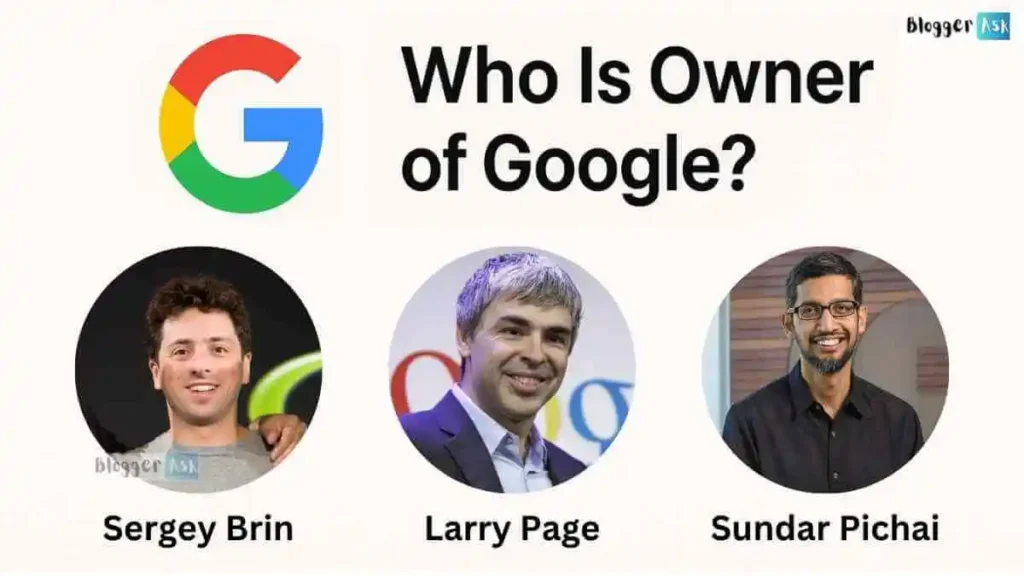
The controlling owners are Larry Page and Sergey Brin.
The CEO running Google is Sundar Pichai.
- Legal owner of Google: Alphabet Inc., a publicly traded holding company formed in 2015 as a restructuring of Google.
- Controlling shareholders: Google’s co‑founders Larry Page and Sergey Brin, through special Class B “super‑voting” shares that give them majority voting power.
- Operational leader: Sundar Pichai, CEO of both Google and Alphabet, and a member of Alphabet’s board.
What “Ownership” of Google Really Means
To understand who owns Google, it helps to separate three different ideas:
Understanding these differences is essential when identifying the true owner of Google.
| Term | What It Really Means |
| Legal ownership | Which company officially owns Google |
| Economic ownership | Who owns the shares and gets the financial benefits |
| Voting control | Who has the real decision‑making power |
Key point:
- Google is not a standalone public company.
Since 2015, it has been a subsidiary of Alphabet Inc. - That means: Alphabet is the legal owner of Google.
- But Alphabet itself is listed on the stock market, so millions of investors own pieces of Alphabet, directly or via funds.
However, not all shares are equal. Some shares carry far more votes than others. That is where Google’s founders come back into the story.
Who Originally Founded and Owned Google?
Google was officially founded in 1998 by Larry Page and Sergey Brin, then PhD students at Stanford University in California.
- They started with a research project called Backrub in 1996.
- The key innovation was PageRank, an algorithm that ranked web pages by analyzing links.
- Their original mission was:
“To organize the world’s information and make it universally accessible and useful.”
So if someone asks:
- “Who was the owner of Google originally?”
- “Who owns Google originally?”
The answer is very clear: Larry Page and Sergey Brin were the original owners and founders.
Early History of Google (1996–2004)
Here is a simplified early timeline based on historical sources:
| Year | Event |
| 1996 | Backrub search engine project begins |
| 1997 | google.com domain registered |
| 1998 | Google Inc. officially founded |
| 2000 | Google becomes a leading search engine |
| 2004 | Google goes public via IPO |
In the early years:
- The founders and early investors owned almost all of Google.
- Google grew quickly because its search quality was better than competitors.
- This brought in users, advertisers, and investors, setting the stage for a historic IPO.
When Did Google Become a Public Company?
Google went public via an Initial Public Offering (IPO) on August 19, 2004.
- IPO price: 85 USD per share
- Market cap at IPO: about 23 billion USD
- It used an unusual Dutch auction method instead of the standard Wall Street IPO book‑building.
Before 2004:
- Google was privately owned by founders, employees, and early investors.
After 2004:
- Anyone could buy Google stock and become a partial owner.
But the founders had a plan:
Even after going public, they wanted to keep long‑term control. To do this, they created a dual‑class share structure.
Alphabet Inc.: Google’s Parent Company Explained
In 2015, Google’s leadership announced a major reorganization. They created a new holding company called Alphabet Inc. and made Google a subsidiary.
- On October 2, 2015, Alphabet officially became the parent of Google and several other Google businesses.
- Google became Alphabet’s largest subsidiary and the main holder of its internet products and services.
This restructuring permanently changed who the legal owner of Google is at the corporate level.
Why did they create Alphabet?
- To separate core Google products (Search, Ads, YouTube, Android, Maps, etc.) from
more experimental projects like self‑driving cars, life sciences, and other “moonshots”. - To make the business “cleaner and more accountable” and improve transparency for investors.
Think of it like this:
| Company | Role |
| Alphabet Inc. | Parent holding company, listed on stock markets |
| Google LLC | Alphabet subsidiary focused on internet services |
So when someone asks in 2026:
- “Is Google owned by Alphabet?”
- “Who owns the company Google?”
The direct legal answer is: Google is owned by Alphabet Inc.
Alphabet’s Share Classes: Class A, Class B, and Class C
Alphabet uses a three‑class share structure. This is the core of its control system.
Basic Share Classes
| Share Class | Ticker | Voting Rights | Typical Owners |
| Class A | GOOGL | 1 vote per share | Public investors |
| Class B | None | 10 votes per share | Founders & a few insiders |
| Class C | GOOG | 0 votes (no voting) | Public investors & employees |
Key points:
- Class A (GOOGL): Publicly traded shares with normal voting rights.
- Class B: Not publicly traded. Held by founders and some insiders. Each share carries 10× the voting power of a Class A share.
- Class C (GOOG): Publicly traded shares without voting rights.
This system allows Alphabet to:
- Raise money from the public,
- While keeping voting control concentrated with the founders and top insiders.
Are Larry Page and Sergey Brin Still Owners in 2026?
Yes. But their role is now more about control than daily management.
Important facts:
- Larry Page and Sergey Brin still hold large stakes in Alphabet, mainly via Class B super‑voting shares.
- Together, they control around a majority of all voting power (slightly over 51% in recent analyses).
- They stepped down from executive roles in 2019, but they did not give up their voting control.
According to Alphabet’s latest SEC filings (Form 10-K and proxy statements), the founders continue to hold majority voting power through their Class B super-voting shares.
That means:
- They no longer run day‑to‑day operations.
- But they can still strongly influence major strategic and governance decisions, because they control most of the votes.
So, if someone asks in 2026:
- “Are Larry Page and Sergey Brin still owners of Google?”
The accurate explanation is:
They are controlling shareholders of Alphabet, the company that owns Google, thanks to their Class B super‑voting shares.
Economic Ownership vs Voting Control (Simple Example)
Google’s shareholding structure can be confusing because economic stake and voting power are not the same thing.
- Economic ownership = who enjoys the financial benefits (dividends, share price rise).
- Voting control = who can actually decide what the company does.
Real‑world data shows this clearly:
- In one detailed analysis based on SEC filings, Vanguard held about 7.0% of Alphabet, and BlackRock about 6.2%.
- Larry Page owned around 6.1% of Alphabet shares, and Sergey Brin about 5.7%.
- But thanks to Class B shares, Page had about 26.3% of the total voting power and Brin about 24.9%.
In other words:
- Large asset managers own more shares in percentage terms.
- But the founders control far more votes.
A simple illustration:
- Person A: 5% of shares, 1 vote per share → 5% of votes
- Person B: 3% of shares, 10 votes per share → 30% of votes
Even though Person B owns fewer shares, they control more of the company.
That is exactly how Page and Brin remain the real controlling owners of Google’s parent company in 2026.
Google Owner vs Google CEO – What’s the Difference?
Many people mix up “owner” and “CEO”, but they are very different roles.
| Role | What They Do |
| Owner / Controlling shareholder | Holds shares, especially voting shares. Influences or controls major company decisions. |
| CEO (Chief Executive Officer) | Runs day‑to‑day operations, manages employees, executes strategy. |
In Google’s case:
- Sundar Pichai is the CEO of both Google and Alphabet and sits on Alphabet’s board.
- He oversees:
- Search,
- YouTube,
- Android,
- Google Cloud,
- AI products, and more.
But:
- Pichai does not personally own a controlling stake in Alphabet.
- He receives shares and stock options like other top executives, but voting control lies primarily with Page and Brin.
So, if someone asks:
“Does Sundar Pichai own Google?”
The correct 2026 answer is:
- He owns shares and is the CEO, but he is not the controlling owner.
- Control remains with the founders through their Class B voting shares.
Who Controls Google Now (in 2026)?
Control at Google and Alphabet comes from two main sources:
- Voting power (shareholder control)
- Executive authority (management control)
In 2026:
- Larry Page and Sergey Brin
- Hold majority voting power via Class B super‑voting shares.
- Can influence or block major strategic and governance decisions.
- Sundar Pichai
- Is CEO of Google (since 2015) and Alphabet (since 2019).
- Leads daily operations, products, AI strategy, hiring, investments, and so on.
So a practical way to say it is:
- Founders: Control the steering wheel at the shareholder level.
- CEO: Drives the car every day.
Major Shareholders of Alphabet Inc.
Alphabet is publicly traded. This means that, beyond the founders, there are three broad groups of owners:
- Founders and insiders
- Larry Page, Sergey Brin, and a small group of insiders hold Class B shares with 10 votes each.
- Together, the founders hold over half of all voting power.
- Institutional investors
- The Vanguard Group
- BlackRock
- State Street
- Large investment firms, such as:
- These firms may own large economic stakes, but mostly in Class A and Class C shares with normal or zero voting rights.
- Public shareholders
- Individual investors who buy shares on the stock market (GOOGL or GOOG).
- They become partial economic owners, but have limited influence on control.
This dual-class share structure is central to understanding Google stock ownership and Alphabet voting rights, even though most of the economic value is held by public markets and institutions.
Who Owned Google Before Alphabet?
Before Alphabet existed:
- From 1998 to 2004, Google operated as Google Inc., a private company owned by its founders, employees, and early investors.
- In 2004, Google went public via its IPO and became a publicly traded company called Google Inc.
- From 2004 to 2015, public investors, founders, and institutions shared ownership, but founders kept control through their dual‑class share system.
In 2015, Google created Alphabet Inc. as a new parent company and turned Google into a subsidiary.
So if someone asks:
“Who was the owner of Google before Alphabet?”
You can say:
- The company was Google Inc., controlled mainly by Larry Page and Sergey Brin and other shareholders after its 2004 IPO.
- Alphabet only became the parent company after the 2015 restructuring.
Can One Person Own Google?
Realistically, no single individual can become the full owner of Google under the current share structure.
To “own Google” in a full sense, a single person would need to:
- Buy a controlling stake in Alphabet (over 50% of votes, not just shares).
- Overcome the founders’ Class B super‑voting structure, which currently gives Page and Brin over half of all votes.
- Spend hundreds of billions of dollars, because Alphabet’s market value runs into multiple trillions of dollars in recent years.
On top of that:
- Any such takeover would face regulatory, legal, and shareholder resistance.
- The dual‑class structure is specifically designed to prevent this kind of hostile control shift.
So in theory, someone could try to buy enough shares.
In reality, one person owning Google outright is practically impossible.
Is Google Privately Owned, Publicly Traded, or Government Owned?
In 2026:
- Google is not privately owned.
- Google is not owned by any government.
- Google is owned by Alphabet Inc., which is publicly traded on the Nasdaq under the tickers GOOGL and GOOG.
This means:
- Anyone can buy Alphabet stock and become a partial owner.
- However, ordinary investors do not gain majority control, because of the special share structure.
So, the correct description is:
Google is a subsidiary of Alphabet Inc., a publicly traded technology holding company.
Interesting Facts About Google’s Ownership Structure
Founders built control into the IPO on purpose
When Google went public in 2004, Larry Page and Sergey Brin openly said they wanted to preserve long‑term control and would not manage the company to please short‑term Wall Street expectations. The dual‑class structure is a direct result of that philosophy.
Alphabet increased transparency and focus
By moving “other bets” like life sciences, self‑driving cars, and venture capital into separate subsidiaries, Alphabet made core Google’s financial performance more transparent.
Voting power, not just shares, defines “real ownership”
In many companies, one share equals one vote. In Alphabet, founders have super‑votes, so a smaller economic stake still means controlling power.
Sundar Pichai is the face of Google, not the owner
Pichai is the public face and the operational leader of Google and Alphabet, frequently speaking at major events and earnings calls, especially about AI and cloud. But from a strict ownership perspective, Page and Brin remain the ultimate power center.
Final Ownership Summary Table (2026)
Here is a simple breakdown of the owner of Google in 2026:
| Role / Category | Name / Entity | Main Responsibility / Power |
| Legal Owner of Google | Alphabet Inc. | Holds full corporate ownership of Google LLC |
| Founders / Controllers | Larry Page & Sergey Brin | Hold majority voting control via Class B super‑shares |
| CEO | Sundar Pichai | Runs day‑to‑day operations of Google and Alphabet |
| Institutional Investors | Vanguard, BlackRock, etc. | Large economic stakes, limited voting power |
| Public Shareholders | Individual investors | Partial economic ownership through GOOGL / GOOG shares |
Conclusion: Who Really Owns Google in 2026?
The owner of Google in 2026 is not a single individual but a structured public company with concentrated voting control. Legally, it belongs to Alphabet Inc., a publicly traded parent company created in 2015. The economic stake in Alphabet is shared among its founders, big institutional investors, and millions of public shareholders. However, real voting control is still concentrated with Larry Page and Sergey Brin through their powerful Class B super-voting shares, while Sundar Pichai runs the day-to-day business as CEO of both Google and Alphabet. This structure lets the company raise money from the public, preserve founder influence, and keep driving long-term innovation in AI, cloud, and other technologies.
FAQs
Who owns Google in 2026?
Google is owned by Alphabet Inc., a publicly traded holding company. Founders Larry Page and Sergey Brin retain majority voting control through Class B super-voting shares.
Who is the real owner of Google today?
Alphabet Inc. legally owns Google, but Larry Page and Sergey Brin hold true control via super-voting shares that give them over 50% of voting power.
Does Sundar Pichai own Google?
No, Sundar Pichai does not own Google. He serves as CEO of Google and Alphabet, managing operations, while founders control voting decisions.
Is Google owned by one person in 2026?
No, Google is not owned by one person. It’s a subsidiary of publicly traded Alphabet Inc., with ownership split among founders, institutions, and public investors.
Who controls Google now?
Founders Larry Page and Sergey Brin control Google through Alphabet’s voting shares, while CEO Sundar Pichai handles day-to-day strategy and operations.
How much of Google do Larry Page and Sergey Brin own?
They own a minority of total shares but control majority voting power (over 51%) thanks to Class B shares with 10 votes each.
What company owns Google?
Alphabet Inc., created in 2015, fully owns Google as its main subsidiary focused on search, YouTube, Android, and cloud services.
Is Google publicly traded or privately owned?
Google itself is privately held by Alphabet Inc., which is publicly traded on Nasdaq under GOOGL (Class A) and GOOG (Class C) tickers.
When did Google become publicly owned?
Google went public via IPO on August 19, 2004, but restructured under Alphabet in 2015, preserving founder control through special shares.
Can someone buy and own Google completely?
No, buying Google outright is nearly impossible due to Alphabet’s trillion-dollar value and founders’ super-voting shares that block takeovers.

For the past decade, I’ve been researching personal finance, investing, and online income models. I break down complex money matters into simple strategies so readers can build wealth, avoid common mistakes, and make confident financial choices.


Wonderful article! I’ve been following this blog regularly, and it never disappoints. The insights shared here are incredibly helpful, especially the final section—it really stood out to me 🙂 I’ve been looking for this kind of detailed information for quite some time, and I’m glad I finally found it here. Thanks for putting in the effort to share such valuable content, and wishing you continued success!
Great post. I was checking continuously this blog and I’m impressed! Extremely useful info particularly the ultimate section 🙂 I maintain such information much. I was seeking this particular information for a very long time. Thank you and best of luck.
I was actually searching for this information out of curiosity and found your blog. The article explained everything clearly without making it complicated. I didn’t know about Alphabet Inc. before reading this, so that part was really helpful. Thanks for putting the details together in such a simple way. Nice and informative post!
Thank you for your kind feedback! We’re glad you found the article clear and informative.