The first time I made kombucha at home, I nearly poured it down the sink.
The SCOBY looked wrong. The smell was sharp. And I had no idea whether what was happening inside that jar was fermentation or catastrophe. That batch turned out perfectly — and cost me less than fifty cents to make.
Four years and hundreds of batches later, I can tell you that kombucha is one of the most forgiving fermentation projects a beginner can try. Once you understand what the SCOBY needs and what to watch for, the process almost runs itself.
This guide gives you everything: the homemade kombucha recipe, the brewing steps, the safety knowledge, and every mistake worth avoiding.
What Is Kombucha?
Kombucha is a fermented tea drink made by adding a SCOBY — Symbiotic Culture of Bacteria and Yeast — to sweetened tea and letting it ferment for 7–14 days. The SCOBY consumes most of the sugar and produces a lightly tart, slightly fizzy drink with organic acids, B vitamins, and live cultures.
Think of a SCOBY like a sourdough starter. It’s a living culture you feed and reuse batch after batch. The flavor it produces ranges from gently tart (day 7–8) to pleasantly dry and vinegary (day 12–14), depending entirely on how long you let it ferment.
Kombucha Health Benefits — What the 2024–2025 Research Says
Kombucha isn’t a cure for anything. But the science has moved forward noticeably since 2023 — and the picture is more nuanced than most wellness content suggests.
Here’s where things actually stand as of 2025:
Gut microbiota: A 2024 controlled clinical trial published in Scientific Reports (University of California San Diego) found that four weeks of daily kombucha increased the abundance of Weizmannia coagulans — a beneficial probiotic species — and several short-chain fatty acid-producing bacteria. Notably, overall microbiota diversity showed a modest decrease, which researchers attributed to the small sample size and short duration. No significant changes were seen in blood markers or inflammation. Encouraging, but not definitive. A separate 2025 human trial in The Journal of Nutrition found black tea kombucha positively influenced gut bacteria over 8 weeks, with more pronounced effects in participants with obesity.
Blood sugar: A 2023 pilot RCT in Frontiers in Nutrition found kombucha reduced post-meal glucose responses in adults with type 2 diabetes. Small sample — but the finding has since been supported by a University of Sydney crossover trial showing kombucha lowered the glycemic index of a high-GI meal from 86 to 68.
Antioxidants: Since kombucha is brewed from black or green tea, it retains a meaningful portion of the tea’s polyphenols — 145 phenolic compounds were identified in one 2025 study, primarily flavonoids. These survive partially into the finished drink regardless of fermentation length.
The honest summary from a Healthline medically reviewed overview: kombucha shows real biological activity, but most human trials are still small and short. Drink it as part of a broader gut-healthy diet — if you want other fermented options to pair with it, see our guide to gut-healthy fermented drink recipes.
Note: Kombucha is a food, not a treatment. If you have gut disorders, diabetes, liver disease, or are pregnant, talk to your doctor before drinking it regularly. I’m a home brewer and wellness writer — not a clinician.
Equipment & Ingredients (1-Gallon Batch)
Equipment Checklist
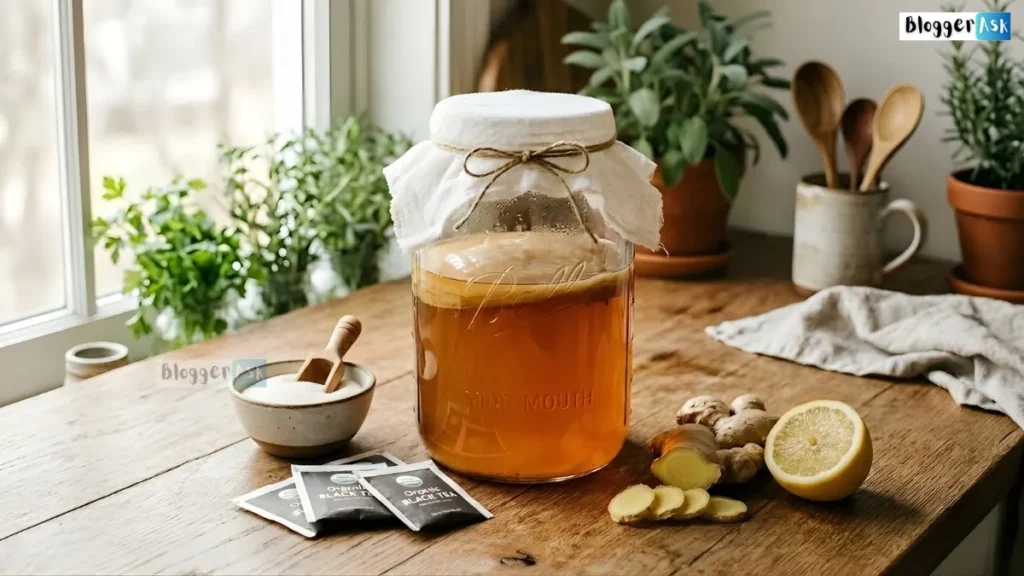
- 1-gallon wide-mouth glass jar (Mason jar works great)
- Large pot for boiling and cooling tea
- Breathable cloth cover — cheesecloth or a coffee filter
- Rubber band to secure the cover
- Wooden or silicone spoon (no metal near the SCOBY)
- Swing-top glass bottles for second fermentation
- Fine-mesh strainer and funnel for bottling
- pH strips (optional — target 2.5–3.5 after fermentation)
Ingredients
| Ingredient | Amount | Notes |
| Filtered water | 1 gallon | Chlorinated tap water can slow fermentation |
| Black tea bags | 4–6 bags | Plain only — no herbal or flavored for batch 1 |
| Plain white sugar | 1 cup | Don’t swap for honey or artificial sweeteners yet |
| SCOBY | 1 disc | See sourcing options below |
| Starter liquid | 1–2 cups | Raw, unflavored kombucha — previous batch or store-bought |
💡 Pro Tip Rinse all equipment twice after washing — even faint soap residue can disrupt fermentation. Avoid anything reactive: no uncoated metal, no ceramic crocks with unknown glazes. Glass, silicone, and wood only.
On sugar: The SCOBY consumes most of it during fermentation — residual sweetness in the finished drink is far lower than what you started with. If you’re managing your overall diet, pairing kombucha with a high-protein balanced meal plan keeps one serving in healthy perspective.
How to Get a SCOBY
You have three options:
- Buy a kit online or at a health food store — includes the SCOBY and starter liquid. Easiest for beginners. Expect to pay $10–20.
- Get one from a friend — every batch grows a new SCOBY layer. Most experienced brewers have extras. Check r/kombucha or local fermentation groups — often free.
- Grow your own from store-bought kombucha — combine raw, unflavored, live-culture kombucha with cooled sweet tea in a glass jar. Cover with cloth and leave at 70°F+. A disc forms in 1–4 weeks.
⚠️ Important Only use plain, raw, unflavored kombucha to grow a SCOBY. Pasteurized kombucha contains no live cultures. Flavored versions often include additives that prevent disc formation.
How to Make Kombucha at Home — Step-by-Step
Step 1 – Brew and Cool Sweet Tea
Boil 4 cups of filtered water. Steep 4–6 black tea bags for 10–15 minutes. Remove the bags — don’t squeeze them. Stir in 1 cup of sugar until dissolved. Add cool water to reach 1 gallon total.
Non-negotiable: the tea must cool below 80°F before the SCOBY touches it. Hot tea kills the culture. I brew mine in the evening and let it sit overnight.
Step 2 – Add Starter Liquid First
Pour 1–2 cups of starter liquid into your clean jar before anything else. This drops the pH immediately, protecting the batch from contamination before fermentation begins. Skipping this step is the number one reason new batches go wrong — I learned that on my second batch.
Step 3 – Add SCOBY, Then Cooled Tea
With clean, unscented hands, lower the SCOBY into the jar. Pour in the cooled sweet tea. Leave 1–2 inches of headspace. The SCOBY may float, sink, or tilt — all normal. A new disc will form on the surface regardless.
Step 4 – Cover and Ferment
Secure the cloth cover with a rubber band. Never use a solid lid — the SCOBY needs airflow and CO₂ needs to escape. Write the start date on a label. Place somewhere consistently warm (70–78°F), away from sunlight. Leave it completely undisturbed.
Step 5 – Taste and Bottle
Starting day 7, taste daily with a clean straw slipped under the SCOBY disc.
- Very sweet? Ferment 2–3 more days.
- Pleasantly tart with light fizz? Ready to bottle.
- Strongly sour, vinegary? Over-fermented for drinking — save as starter liquid for your next batch.
Remove the SCOBY, reserve 1–2 cups of finished kombucha as your next starter, and bottle the rest.
🍵 Taste by Day (at 72–74°F) Day 7: Sweet, mild tang · Day 9–10: Balanced, tart, some fizz · Day 12–14: Dry, vinegary · Past 14: Too sharp to drink — ideal starter liquid.
Second Fermentation — How to Carbonate Your Kombucha
First fermentation makes kombucha. Second fermentation (F2) makes it bubbly. It’s optional — but worth it.
- Fill swing-top bottles, leaving 1 inch of headspace.
- Add per 16 oz: 1 tsp sugar, 1–2 tbsp fruit juice, or a few slices of fresh ginger.
- Seal and leave at room temperature (70–75°F) for 2–4 days.
- Burp daily — crack the seal briefly to release pressure, then reseal.
- Once carbonation is right, refrigerate for at least 12 hours before opening.
My go-to: 3–4 thin ginger slices + a squeeze of lemon. It’s been in every batch for two years.
Kombucha Fermentation Time — What to Expect
Quick answer: First fermentation takes 7–14 days. Most batches hit their sweet spot between days 8–11. Temperature drives timing more than anything else — warmer kitchens brew faster.
| Days | Stage | Flavor |
| 1–3 | Culture activating | Very sweet, tea-forward |
| 4–6 | Acidity building | Light tang emerging |
| 7–10 | Peak drinking window | Balanced and tart |
| 11–14 | Acidity deepening | Dry, vinegary notes |
| 14+ | Over-fermented | Sharp — use as starter |
Safety Tips — And How to Know If Kombucha Has Gone Bad
A properly brewed batch, per research aligned with FDA Food Code guidelines, should reach a pH of 4.2 or below within the first seven days — at which point most harmful organisms can’t survive the acidity. Starter liquid is what gets you there fast.
Signs of a Healthy Batch
- Sharp, vinegary smell with a faint sweetness
- Smooth, cream-to-beige disc forming on the surface
- Brown, stringy bits floating in the liquid (yeast strands — normal)
- Small bubbles along the jar walls
When to Discard — Immediately
⚠️ Throw Out If You See or Smell: Fuzzy green, black, pink, or orange growth on the SCOBY · A rotten or cheese-like smell (not just sharp-sour — rotten) · SCOBY appearing to dissolve · Mold on the cloth or jar rim.
If you see mold: discard everything — SCOBY, liquid, all of it. Contaminated batches cannot be saved.
Quick rule: Fuzzy = mold. Smooth (whatever the color) = almost certainly fine. When in doubt, throw it out.
Common Kombucha Brewing Mistakes
“The SCOBY doesn’t need your help. It needs a warm shelf and your patience. Every time I’ve interfered, I’ve made the batch worse.”
| Mistake | Fix |
| Adding SCOBY to warm tea ⭐ | Cool completely — brew the night before |
| Skipping starter liquid ⭐ | Always use 1–2 cups. Non-negotiable. |
| Using a solid lid in first fermentation | Breathable cloth only |
| Flavored or herbal tea for batch 1 | Plain black tea first, always |
| Cold fermentation spot | Find anywhere consistently above 70°F |
| Moving or shaking the jar | Pick a spot and leave it untouched |
| Tasting before day 7 | Wait. It will still taste like sweet tea. |
How to Store Kombucha
Finished kombucha: Refrigerate in sealed glass bottles. Best within 2–4 weeks; drinkable for up to 3 months. The flavor continues to develop (read: get sharper) in cold storage.
SCOBY between batches: Store in a glass jar with 1–2 cups of starter liquid, covered with cloth at room temperature. Feed with a splash of fresh sweet tea every 4–6 weeks if not actively brewing. Refrigerate if you’re pausing for a month or more — bring back to room temperature 24–48 hours before your next batch.
Starter liquid: Always keep 1–2 cups in reserve. Treat it like sourdough starter. Losing it means starting over from store-bought. Don’t let it run out.
FAQs
How long does it take to make kombucha at home?
First fermentation: 7–14 days. Second fermentation (optional): 2–4 more days. Most batches are ready to drink in 10–18 days total, with day 9–11 being the sweet spot at average room temperature.
What temperature should kombucha ferment at?
70–78°F (21–26°C) is ideal. Below 65°F, fermentation slows dramatically or stalls. Above 85°F, it can stress the culture and produce off-flavors. Consistent temperature matters more than hitting an exact number.
How do I know when kombucha is done fermenting?
Taste it from day 7. It’s ready when it’s pleasantly tart with mild residual sweetness and a light natural fizz — enjoyable to sip, not sharp enough to make you wince. If it still tastes like sweet tea, ferment 2–3 more days.
How do I know if kombucha has gone bad?
Fuzzy colored mold on the SCOBY or a rotten, cheese-like smell means discard the entire batch. A healthy batch smells sharp and vinegary. When in any doubt, throw it out — no single batch is worth the risk.
Is homemade kombucha safe during pregnancy?
Most healthcare providers advise caution or avoidance due to the small alcohol content, unpasteurized nature, and caffeine from the tea. Speak with your OB before drinking it during pregnancy.
Can I make kombucha without sugar?
No — the SCOBY’s food source is sugar. Without it, fermentation doesn’t happen. Most sugar is consumed during fermentation, so the finished drink contains far less than what you added.
What’s the difference between first and second fermentation?
First fermentation (F1) turns sweet tea into kombucha in an open, breathable jar over 7–14 days. Second fermentation (F2) builds carbonation by sealing the bottled kombucha with a small sugar addition for 2–4 days. F1 makes the drink; F2 makes the fizz.
Ready to Brew Your First Batch?
Kombucha is one of the most rewarding fermentation projects a beginner can take on — and one of the cheapest. A single SCOBY, properly maintained, will last years. The learning curve is real but short: most people nail the process by batch three.
Start this weekend. Order a SCOBY, grab black tea and cane sugar, and follow the steps above. The worst that happens is one poured batch. The far more likely outcome is a drink you’ll want to make on repeat.
Already comfortable with kombucha? Our guide to gut-healthy fermented drink recipes covers kefir, jun tea, tepache, and more — all beginner-friendly, all worth trying after your first successful kombucha batch.
Batch one is where it starts. The rest takes care of itself.
Sources & References
All health-related claims reference peer-reviewed research or medically reviewed sources. Preliminary or animal-model findings are noted as such in the text above.
- Ecklu-Mensah G et al. (2024). Modulating the human gut microbiome and health markers through kombucha consumption: a controlled clinical study. Scientific Reports.
- Costa MA et al. (2025). Regular Consumption of Black Tea Kombucha Modulates the Gut Microbiota in Individuals with and without Obesity. Journal of Nutrition.
- Mendelson C et al. (2023). Kombucha tea as an anti-hyperglycemic agent: randomized controlled pilot study. Frontiers in Nutrition.
- Esatbeyoglu T et al. (2023). Additional advances related to the health benefits of kombucha. Critical Reviews in Food Science and Nutrition.
- Gunnars K. (2023). 7 Evidence-Based Health Benefits of Kombucha Tea. Healthline (medically reviewed).
- Cleveland Clinic. (2023). Kombucha: What Is It and 7 Benefits. Reviewed by Smith & Zumpano, RD.

With a strong interest in fitness and preventive wellness, I focus on sustainable habits rather than quick solutions. I write evidence-based content on nutrition, exercise, and mental well-being to support long-term healthy living.