It is not a matter of going about the trends aimlessly when starting a business in 2026. It is about knowing to where the world is headed and creating something that is realistically needed. There is rapid movement in technology, increased expectations of customers and competition is all around. Meanwhile, the accessibility of entrepreneurship has never been so great due to the tools, platforms, and access to a global reach.
This is the guide that is simple enough to understand without being hyped. No matter what size online business you have in mind or a scalable startup, this article takes you through all you have to know about Starting a New Business in 2026.
Introduction: Is it the right time to start a business in 2026?
The present business environment is both a business opportunity and uncertainty. Remote working is standard, AI is cutting costs and customers are not afraid of making purchases online. Simultaneously, the decisions made carelessly are dangerous due to inflation, competition, and rapidly changing trends.
Opportunity vs Risk Reality
Opportunities
- Reduced start up expenses on cloud tools and automation.
- Reach to the world customers at the initial stage.
- Increased need of digital solutions, AI-based ones, and sustainable solutions.
Risks
- Crowded markets
- Shorter attention spans
- Early stage cash flow pressure.
Statistical Systems on Startup Success and Failure (2025–2026)
| Metric | Data |
| Startups that fail | ~90% overall |
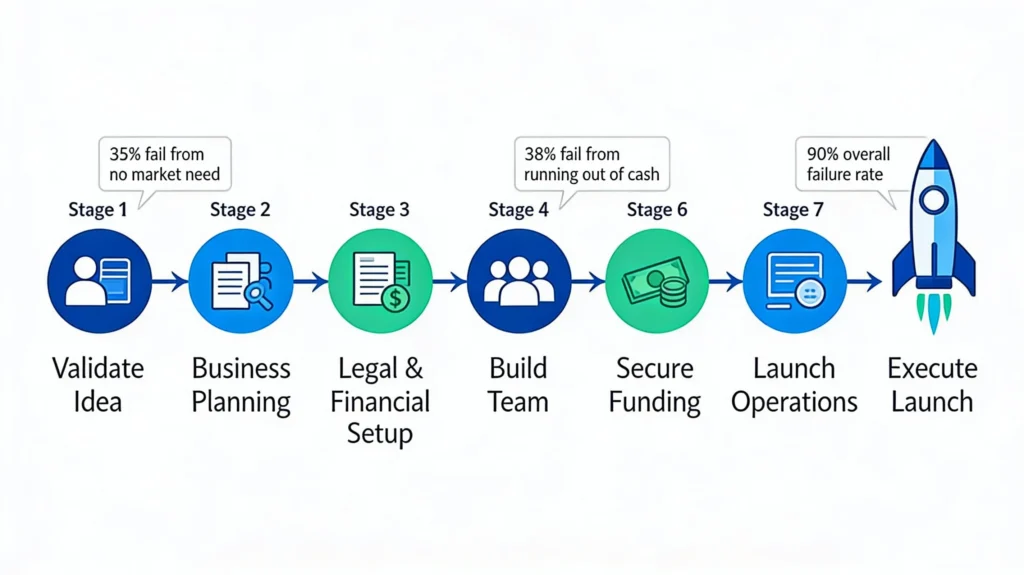
| Fail due to no market need | ~35% |
| Fail due to cash flow issues | ~38% |
| Fail due to team problems | ~23% |
| Small businesses expecting growth in 2026 | ~74% |
The message is clear. The market is not the problem. Poor preparation is.
The Secret of Success to Most New Businesses
The majority of the businesses failed because of weak foundations despite their good intentions.
No Market Need
Most founders create what they prefer, and not what customers want. Unless individuals are actively seeking out or even paying to get a solution, the business does not perform well.
How to avoid it
- Discuss with actual users their building.
- Validate demand with small tests
- One definite problem rather than many indistinct ones.
Cash Flow Problems
On paper profit is not cash in the bank. Companies close down merely because they end up without funds.
How to avoid it
- Track monthly burn rate
- Keep at least 6 months runway
- Distinct business and personal finances.
Team and Leadership Issues
Roles, ego clashes and poor communication can be death killers.
How to avoid it
- Early definition of responsibilities.
- Hire slowly
- Decisions and processes on documents.
The way Planning Minimizes Risk of Failure
An agency plan makes one clear. Planned businesses are statistically likely to survive since they make less emotional decisions.
Reasons why a New Business should be launched in 2026
Startup 2026 has good reasons in spite of risk.
AI-Driven Opportunities
Big companies are no longer monopolized on AI. Small businesses use it for:
- Customer support
- Content creation
- Data analysis
- Process automation
Example: An individual inventor of an AI-based resume screening application.
Eco-Friendly and Sustainable Demand
Customers like environmentally conscious brands. The growth of sustainable packaging, ethical sourcing and green services is rapidly increasing.
Digital Business Growth Remote
Service enterprises, SaaS, coaching, and online products do not need physical offices.
Low-Cost Online Business Models
- Freelancing
- Print on demand
- Digital courses
- Affiliate websites
Future-Proof Industries to Watch
| Industry | Reason |
| AI services | High demand, scalable |
| Health & wellness | Long-term need |
| Online education | Reskilling economy |
| Sustainability | Regulation + consumer push |
| Cybersecurity | Rising digital risks |
Step 1 – Validating Your Business Idea Before You Invest
Establishing a Real Market Problem
An excellent idea is one that resolves an uncomfortable issue. Ask:
- Who has this problem?
- How often does it occur?
- What do they do now?
It is a positive indicator when people already spend money on solving the problem.
Primary Market Research Methods
- One-to-one interviews
- Surveys
- Direct observation
- Pre-orders or waitlists
Secondary Market Research Resources
- Google Trends
- Industry reports
- Competitor websites
- Forums, Reddit, Quora
Competitor Analysis Model
Study:
- Pricing
- Positioning
- Strengths and gaps
- Customer reviews
MVP and Idea Testing Techniques
Build the simplest version:
- Landing page
- Demo service
- Prototype
Sell before scaling.
Step 2 – Writing a Strong Business Plan
The importance of a Business Plan in 2026.
A business plan is your guideline to decision. It helps you:
- Stay focused
- Manage money
- Attract investors
- Measure progress
Important Parts of a Modern Business Plan
Executive Summary Clear snapshot of your business
Market Analysis Customers, demand, competitors
Product or Service What you sell and why it’s better
Business Model How you make money
Marketing Strategy How customers find you
Operations Plan How the business runs daily
Financial Projections Revenue, expenses, cash flow
Business Plan Mistakes to Avoid
- Unrealistic revenue forecasts
- Ignoring competition
- No clear customer definition
Step 3 – Legal Setup and Business Registration of the Business
Selecting the Best Business Structure
| Structure | Best For |
| Sole Proprietorship | Solo, low-risk |
| LLP / LLC | Most startups |
| Private Limited / Corporation | Funding-focused |
Business Registration Process
- Choose name
- Register entity
- Open business bank account
Licenses, Permits, and Compliance
Depends on industry. Always check local requirements.
Tax Registration and Basics
- Income tax
- GST / Sales tax
- Payroll tax (if applicable)
Step 4 – Financial Planning and Cash Flow Management
Startup Costs Breakdown
- Tools & software
- Marketing
- Legal fees
- Operations
Effective Cash Flow Management
Track:
- Inflows
- Outflows
- Monthly runway
Budgeting and Control of Expenses
Spend on:
- Revenue-driving activities
- Customer acquisition
Avoid unnecessary tools early.
Financial Tools for New Businesses
- Accounting software
- Expense trackers
- Cash flow dashboards
Step 5 – Funding Options for New Businesses 2026
Bootstrapping
Full control, slower growth.
Bank Loans and SBA Loans
Reduced cost at the expense of repayment.
Angel Investors and Venture Capital
Rapid growth, equity dilution.
Crowdfunding Platforms
Market validation + funding.
Government Grants and Programs
Competitive but not dilutive
Selecting the appropriate Funding Strategy
Correspond with match funding to business goals.
Step 6 – Developing the appropriate Team and Leadership
Recruiting in Early-Stage Startups
Recruit problem solvers, not job seekers.
Co-Founder Roles and Responsibilities.
The ownership is clear and thus does not create conflict.
Remote Teams and Freelancers
Inexpensive and necessitate communication systems.
Developing good company culture
Credibility, transparency, and responsibility are important starting with the first step.
Step 7 – Pre-Launch Preparation and Operations
MVP Development
Focus on core value only.
Branding and Positioning
Elegant message surpasses classy design.
Website and Online Presence
Fast, simple, mobile-friendly.
Before Launch Marketing
- Email list
- Social presence
- Analytics
Step 8 – How to Start Your New Business Successfully
Launch Timeline (Pre & Post Launch)
- Pre-launch testing
- Soft launch
- Feedback loop
Key Metrics to Track After Launch
- CAC
- Retention
- Revenue
- Burn rate
Common Launch Mistakes
- Scaling too fast
- Ignoring feedback
Early Growth Strategies
- Partnerships
- Content marketing
- Referrals
Pivot or Persist? How to Make the Right Decision
Signs You Should Pivot
- Low retention
- No willingness to pay
Signs You Should Continue
- Repeat users
- Growing demand
Information-Based Decision Model
Make decisions based on numbers and not feelings.
Key Trends Shaping New Businesses in 2026
- AI integration
- Sustainability
- Personalization
- Cybersecurity
- Workforce flexibility
Common Challenges New Businesses Face
| Challenge | Solution |
| Cash flow stress | Budget discipline |
| Customer acquisition | Focused niche |
| Competition | Clear positioning |
| Founder burnout | Systems & rest |
Final Thoughts: Building a Profitable and Sustainable Business
It is not a matter of luck or hype to start a New Business in 2026. It is execution, discipline and learning how to do it. Concentrate on how to address real problems, cash management and change of market with a variation.
FAQs About Starting a New Business in 2026
How do I start a new business from scratch in 2026?
To start a new business in 2026, begin with your identification of a real customer problem and the demand should be confirmed by doing some simple research in 2026. Select a low-risk business model, open up a business online, and manage costs, build a simple MVP. Expand slowly but surely by enhancing after actual customer reviews.
What is the easiest business to start in 2026?
The simplest business to establish in 2026 is service-based and online business. Low investment and minimum setup are required in freelancing, consulting, digital marketing, content creation, and services powered by AI. It can be implemented in a short time with existing skills, demand can be tested rapidly and it can be expanded without excessive operational expenses.
How much money should I save before starting a business in 2026?
Try to save at least six months of personal expenses before starting. For most online businesses in 2026, that usually means $3,000 to $7,000. This safety net gives you breathing room, helps you make better decisions, and protects you from shutting down too early due to cash stress.
Can one person start a successful business in 2026?
Yes, many successful businesses in 2026 are built by solo founders. With AI tools, automation, and freelancers, one person can manage marketing, sales, and operations efficiently. Starting solo also allows faster decision-making, lower costs, and easier idea testing in the early stages.
Which business will grow fastest in 2026?
Fast-growing businesses in 2026 include AI-based services, sustainability-focused brands, digital education, health tech, and remote solutions. These industries are driven by changing consumer behavior and global demand. Entrepreneurs who target a clear niche within these sectors often see faster growth.
Do new businesses still fail a lot in 2026?
Yes, many new businesses still fail in 2026, mainly due to lack of market demand, poor cash management, or weak execution. The good news is that founders who validate ideas early, track finances closely, and adapt quickly have a much higher chance of success.
How long does it take for a new business to become profitable?
Most new businesses take around 6 to 18 months to reach profitability. Online and service-based businesses may generate income faster, while product-based businesses often take longer. Profit depends on pricing, demand, cost control, and how quickly you refine your offer.
Is it better to start an online or offline business in 2026?
Online businesses are usually easier and more affordable to start in 2026. They offer lower overhead, faster testing, and access to a global audience. Offline businesses can still work well, but they require more capital, location planning, and consistent local demand.
What skills are most important for new business owners in 2026?
The most important skills for new business owners in 2026 include problem-solving, basic financial management, marketing, communication, and adaptability. You don’t need to master everything, but knowing how to use AI tools and respond to customer feedback makes a big difference.
What should I do in the first 30 days of starting a business?
During the first 30 days, concentrate on the validation of your business idea, knowledge of your target customer, legal foundations, and simple online presence. Get your offer testable and learn quickly. At this point, progress is greater than perfection.

For the past decade, I’ve been researching personal finance, investing, and online income models. I break down complex money matters into simple strategies so readers can build wealth, avoid common mistakes, and make confident financial choices.