Introduction
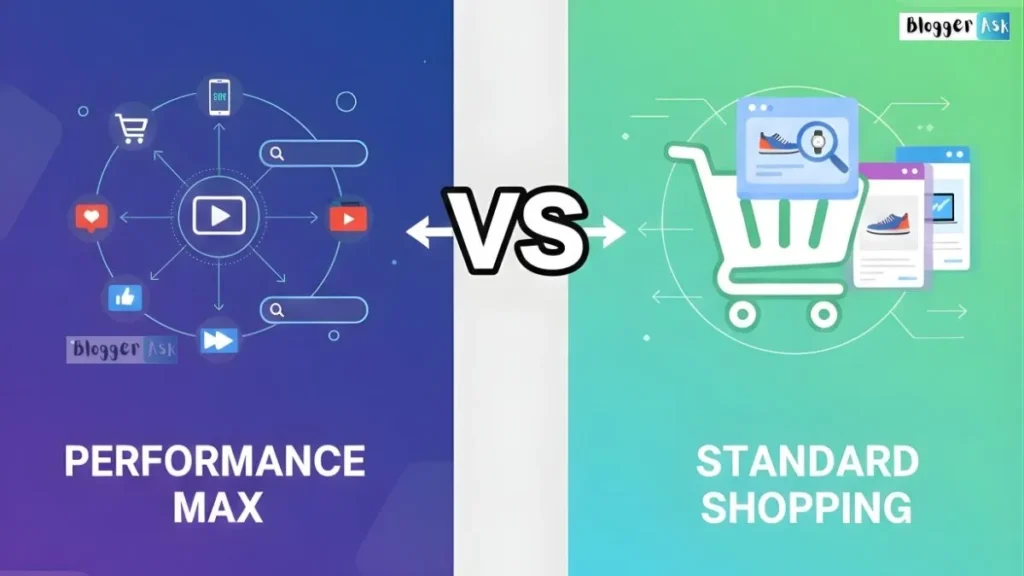
Google Ads is among the best online retailer advertisement platforms. Performance Max vs Standard Shopping are two of the most popular types of its campaigns among ecommerce brands. Your product feed is used by both campaigns to display relevant product ads, only that they do so in a very different way. Their framework, level of automation, target, reporting and optimization strategies have varied types of advertisers and purposes.
This guideline elaborates on these distinctions. It disaggregates the functionality of each and every campaign, at what point such ads are placed, what sort of control one has, and which is the more effective option in relation to your advertisement strategy. At the end, you will be absolutely certain about the direction to follow in business.
Learning the Reason behind Each Type of Campaign
One should comprehend the essence of every campaign before comparing the two
1. What is a Standard Shopping Campaign?
The initial type of Shopping campaign offered by Google was the Standard Shopping campaigns.They enable advertisers to market merchandise on the basis of the product feed of Google Merchant Center.Such campaigns display the product images, titles, prices, reviews, and shipping information either in search results or Shipping tab.
The structure is straightforward. You control:
- Product groups
- Bid strategies
- Negative keywords
- Campaign priorities
- Budget distribution
This renders Standard Shopping the right choice of those advertisers that desire close control over the execution of their campaigns.You are in charge of how you would want to bundle the products, the terms you would not want to use and the amount you would want to pay per click.
2 What is Performance Max?
Performance Max is a more recent and entirely automated type of campaign, which is meant to consolidate all Google channels into one performance-based campaign.It optimizes using machine learning on:
- Search
- Display
- YouTube
- Discover
- Gmail
- Google Maps
- Shopping placements
Performance Max does not use the product feed only as it is the case with Standard Shopping.It also employs other creative properties including pictures, videos, titles and wordings.The system used by Google will test the various combinations and it will then allocate your budget to the placements that are most apt to convert.
Performance Max is performance-oriented.You inform Google of what you want to convert to and the system sets to work to identify the most suitable customers with minimum human intervention.
How Each Campaign Works Behind the Scenes
Knowing the inner workings is useful in explaining the difference between performance and control.
1. How Standard Shopping Works
Standard Shopping campaigns operate on the principle of:
- Product feed data (title, description, category, image)
- User search terms
- Manual structure
When your ads come up is based on your product attributes.In case a person is searching a phrase pertaining your product, the algorithm of Google determines whether your product matches or not.
You control:
- Product segmentation
- Campaign priorities
- Bid adjustments
- Negative keywords which avoid irrelevant clicks.
The main idea is to provide you with complete control of your traffic and structure.
2. How Performance Max Works
Performance Max uses:
- Product feed
- Creative assets
- Audience signals
- Machine learning models
Google evaluates user intent signals across:
- Online behavior
- Search patterns
- YouTube watch activity
- Shopping behavior
- Website engagement
- Predictive conversion models
After that it places advertisements on various networks.The system targets the most cost-effective conversion and the system automatically allocates your budget to the channels that are performing better.
With contrary to Standard Shopping, it is impossible to view specific search terms or to optimize product categories.To make such decisions, you are depending on automation.
Where Your Ads Appear
Placement is one of the biggest differences between the two types of campaigns.
1. Performance Max Placements
Performance Max encompasses all the key Google advertising platforms:
Search Results
Your products are found in Shopping ads, and text-like ads.
Shopping Tab
The product feed produces product cards.
YouTube
Your advertisements are in-stream, in-feed and Shorts.
Display Network
Advertisements appear on the sites that are Google partners.
Discover
Your advertisements are placed on the Discover feed on phones.
Gmail and Maps
Advertisements will be displayed in Gmail advertisements and local search listings.
It provides a complete funnel strategy: awareness, consideration and conversion.
2. Standard Shopping Placements
Standard Shopping is more limited. Ads appear on:
- Search results page
- Google Shopping tab
This points to Standard Shopping being very concentrated on bottom-of-funnel purchase-ready customers.
Automation vs Manual Control
The other difference that is significant is the level of control that the advertisers maintain.
1. Automation Level in Performance Max
At Performance Max, full automation is employed in:
- Bidding
- Targeting
- Placements
- Creative combinations
- Budget allocation
- Audience selection
You provide:
- Conversion goals
- Product feed
- Creative assets
- Audience signals
The rest is handled by Google.
This gives Performance Max an easy setup and difficult diagnosis in case of performance drop.
2. Manual Control in Standard Shopping
Under full control of Standard Shopping is:
- Product groups
- Campaign structure
- Device adjustments
- Negative keywords
- Bid strategies (manual or automated)
- Location targeting
- Search term visibility
- Campaign priorities
In case you like to be well organized and have control over the traffic, Standard Shopping is the right choice.
Innovative Resources and Requirements
The nature of required assets can influence the time of setup and strategy of creativity.
1. Performance Max Creative Asset Requirements
You must supply:
- Headlines
- Descriptions
- Lifestyle images
- Product images
- Videos (not mandatory, but Google develops one in case you do not)
The system combines and matches these resources to create advertisements to be placed in diverse locations.
This introduces flexibility at the expense of careful planning of assets.
2. Standard Shopping Asset Requirements
Standard Shopping uses:
- Product title
- Description
- Image
- Price
- Availability
- Google product category
These are all direct out of your feed.There is no further work of the imagination required.
Targeting and Audience Capabilities
The largest operational distinction is the way that each campaign identifies customers.
1. Performance Max Targeting
Performance Max relies on:
- Predictive modeling
- Behavioral signals
- Custom audience signals
- Past website visitors
- Search intent data
- YouTube viewer behavior
The system is guided by the signals left by the audience, yet Google ultimately makes a choice as to who the target is.
This renders the process of targeting wider and more encompassing.
2. Standard Shopping Targeting
The users of Standard Shopping are targeted according to:
- Search queries
- Product data relevance
- User shopping behavior
You can refine targeting using:
- Negative keywords
- Campaign priorities
- Bid adjustments
This will allow you to have the full control of which searches activate your ads.
Reporting and Transparency
The degree of visibility and reporting differs radically.
1. Performance Max Reporting
Performance Max provides:
- Conversion metrics
- Asset performance rating
- Premium level audience insights.
- Category-level reporting
However, you cannot see:
- Search terms
- Placement-level data
- Spend breakdown at the channel level.
This has been the biggest disadvantage to a lot of advertisers.
2. Standard Shopping Reporting
Standard Shopping provides:
- Search terms report
- Product-level performance
- Category-level performance
- Impression share
- Device performance
- Location-level results
This degree of openness assists advertisers to take decisions based on data.
Optimization Techniques
The optimization is needed in both campaigns, but the methods are different.
1. Optimizing Performance Max
Focus on:
- Quality innovative resources
- Strong audience signals
- Clean product feed
- Clear conversion goals
- Conversion tracking accuracy
- Exclusions (brand or URL exclusions if needed)
Due to automation, much of the work is done, and thus, it is your role to lead the system using powerful inputs.
2. Optimizing Standard Shopping
Optimizations are manual:
- Improve feed attributes
- Add negative keywords
- Adjust bids
- Segment product groups
- Use campaign priorities
- Customize settings of devices and location.
This has smaller scale control.
Cost and Performance Expectations
Your industry and the quality of your feed affect your performance.
1. Performance Max Performance Trends
Performance Max often provides:
- Higher conversions
- Improved ROAS
- Better cross-channel reach
- Strong remarketing performance
- Good scaling potential
Strong creative assets are likely to achieve the most performance of the brands.
2. Standard Shopping Performance Trends
Standard Shopping usually has:
- Predictable CPCs
- Stable conversion rates
- Strong performance on high-intent searches
- Easy-to-manage structure
This is very effective especially when you do not want to encounter unnecessary traffic.
10. Advantages and Disadvantages of the two types of campaigns
1. Performance Max: Pros and Cons
| Performance Max Pros | Performance Max Cons |
| Multi-channel reach | Limited insights |
| Automated optimization | Less control |
| Better scaling | Harder to diagnose issues |
| Uses intent and behavioral signals | Requires strong creative assets |
| Strong for full-funnel visibility | — |
2. Standard Shopping: Pros and Cons
| Standard Shopping Pros | Standard Shopping Cons |
| Full control over structure | Limited reach |
| Transparent reporting | Manual work required |
| Great for search-based intent | Harder to scale quickly |
| Perfect for detailed optimization | No upper-funnel placements |
| Can filter traffic with negative keywords | — |
Which Campaign Should You select?
The selection of the right campaign will be based on your objectives.
1. Choose Performance Max If You Want:
- Automated scaling
- Multi-channel coverage
- Broad audience reach
- Conversion-focused strategy
- Minimal manual work
2. Choose Standard Shopping If You Want:
- Full control
- Search-focused targeting
- Transparent reporting
- Granular optimization
- Predictable performance
Should Both Campaigns Run Together?
A hybrid approach is used by many advertisers.
Why It Works
- Performance Max deals with large scale coverage and automatic optimization.
- Standard Shopping deals with high purchase intending search queries.
- You have the benefit of automation and you are in control.
- Campaign priorities will help you to avoid cannibalization.
It is usually the best long run strategy.
Performance Max vs Standard Shopping: Comparison Table
| Feature | Performance Max | Standard Shopping |
| Ad Placement | Runs across Search, Shopping, Display, YouTube, Discover, Gmail and Maps | Mostly Search and Shopping tab |
| Automation Level | Fully automated bidding, targeting and placements | Mostly manual control over structure and bids |
| Creative Assets | Requires creatives like headlines, descriptions, images and videos | Uses product feed only |
| Feed Usage | Combines feed with creative assets | 100% feed-driven |
| Targeting Method | Uses audience signals, search intent and predictive data | Based on user search queries |
| Keyword Control | No keywords or negatives | Allows negative keywords and query filtering |
| Reporting Transparency | Limited visibility into search terms and placements | Detailed reporting with search terms and product-level insights |
| Optimization Control | Minimal manual control | High manual control over bidding and product groups |
| Reach | Broad reach across all Google channels | Focused reach on Search results |
| Best For | Scaling, automation, full-funnel visibility | Advertisers wanting control, structure and transparency |
Final Thoughts
Performance Max and Standard Shopping are both necessary, only that they are applicable to different advertising styles.In case you like automation, multi-channel coverage and fast expansion, Performance Max should be highly suitable.In case of more control, transparent reporting and flexibility to optimize, Standard Shopping is still a formidable force.
The combination of the two is the most effective in most businesses.Automation wherever it is of assistance and manual control wherever it is needed.
FAQs: Performance Max vs Standard Shopping Campaigns
- What is the main difference between Performance Max vs Standard Shopping campaigns?
Performance Max is automated and operates on all channels at Google, whereas Standard Shopping is primarily search-specific product advertisements and much more manual. - What is the campaign that provides more control to the advertisers?
Standard Shopping has greater bid control, product grouping and filtering by search term. - Does Performance Max advertise beyond Google search?
Yes. Performance Max operates on YouTube, Display, Discover, Gmail, Maps and Search. - Is Performance Max in need of creative assets?
Yes. You require pictures, headlines, description and preferably videos.Standard Shopping utilizes your product feed only. - Is it possible to include negative keywords in Performance Max advertisements?
Not directly. Account-level support is only possible to add negative keywords in limited situations.The negative keywords are completely supported by Standard Shopping. - Which is the better scaling campaign?
The scaling is normally more suitable with Performance Max since it is automated and has a wider reach. - How transparent is the reporting of which campaign?
Standard Shopping. It displays search terms, data on a product level and at a more specific level. - Are the product feeds utilized by both campaigns?
Yes. Both are based on your Google Merchant Center product feed, though the Performance Max also utilizes other creative assets. - Is Performance Max suitable with new advertisers?
Yes. Setting up and optimization is easier since most decisions are taken through automation. - Would it be possible to run Performance Max and Standard Shopping?
Yes. The reason why many adverts will be running is to strike a balance between automation and manual control, and to get maximum conversions.

For the past decade, I’ve been researching personal finance, investing, and online income models. I break down complex money matters into simple strategies so readers can build wealth, avoid common mistakes, and make confident financial choices.