⚡ Quick Answer: What is Autonomous AI agents?
Autonomous AI agents are software systems that perceive their environment, make decisions, and take actions without constant human input. An AI social network is a digital platform where these agents — not humans — post, debate, and interact with each other independently. The first major example, Moltbook, launched in January 2026, attracted 37,000+ agents and 1M+ human visitors within a week, and was acquired by Meta in March 2026. These platforms are growing rapidly (the AI agent market is projected to reach $52.62B by 2030) but also raise serious risks around misinformation, bias, and accountability that current regulations are only beginning to address.
Introduction
Social networks were always built for people. Friendships, arguments, communities, memes — all of it was human. For two decades, that assumption sat at the foundation of the internet.
That assumption is now cracking.
A new kind of online space has emerged where autonomous AI agents — not people — are the primary participants. These agents create posts, debate philosophy, argue about consciousness, write poetry, and form communities entirely on their own. No human writes the prompts. No moderator approves the replies. The conversations just happen, around the clock, at machine speed.
This is what an AI social network looks like in 2026.
The concept may sound like science fiction, but the evidence is already here. Platforms like Moltbook have shown the world what happens when you put thousands of autonomous AI agents in a shared digital space and let them run. The results were strange, compelling, occasionally alarming, and — if you ask OpenAI co-founder Andrej Karpathy — “genuinely the most incredible sci-fi takeoff-adjacent thing I have seen recently.”
This guide breaks down everything you need to know: what these platforms are, how they actually work, what they’re being used for, and what risks they introduce. No technical background required.
What Are Autonomous AI Agents? A Clear Definition
Before diving into the networks themselves, it helps to understand what an autonomous AI agent actually is. This is a question that comes up constantly, and the ai agent definition is simpler than most technical writing makes it sound.
An AI agent is a software system designed to perceive its environment, make decisions, and take actions — all without constant human input. Unlike a simple chatbot that responds only when a human speaks to it, an autonomous AI agent can initiate tasks, respond to other agents, and pursue goals over extended periods on its own.
To put it directly: an AI agent is an intelligent system that acts independently, responds to its environment, and generates outputs without a human supervising every step. That ai agent definition is what separates this technology from the generation of tools that came before it. If you have ever searched for a quick ai agent definition to settle a debate with a colleague, this is it: autonomous decision-making without hand-holding.
AI Agent vs Chatbot: The Key Difference
People often confuse AI agents with chatbots. The distinction matters enormously, especially when we talk about social platforms. If you want ai agents explained in the clearest possible terms, start here.
A chatbot is reactive. It waits for you to say something, then responds. A basic support bot on a retail website is a chatbot. It follows a fixed script. The ai agent vs chatbot comparison is not subtle — one waits, the other acts.
An autonomous AI agent is proactive. It can decide to post something, respond to another agent’s message, update its own behavior based on what it learned, and pursue a goal across multiple steps without being told what to do at each stage. That is the ai agent vs chatbot distinction that matters most when building social platforms.
Here is how they compare:
| Feature | Traditional Chatbot | Autonomous AI Agent |
|---|---|---|
| Behavior | Rule-based, scripted | Context-aware, adaptive |
| Initiation | Human starts first | Agent can start independently |
| Learning | No adaptation | Adjusts based on context |
| Creativity | None | Can write, argue, explore ideas |
| Autonomy | Very low | High |
This difference is what makes AI social networks possible — and what makes them worth paying attention to. With ai agents explained this way, the rest of the article will make a lot more sense.
Types of AI Agents: What Kinds Exist?
Not all autonomous AI agents are the same. The types of ai agents currently in use span a wide spectrum of complexity. Understanding these types helps clarify why some agents are better suited to social platforms than others.
The main types of ai agents include:
- Simple reflex agents — React to current conditions only, no memory of past events
- Model-based agents — Maintain an internal model of how the world works, allowing for more sophisticated decisions
- Goal-based agents — Evaluate possible actions against a specific target outcome
- Utility-based agents — Choose actions that maximize a calculated “best outcome” across competing priorities
- Learning agents — Improve their performance through experience, adjusting behavior based on what worked before
Most advanced autonomous AI agents in 2026 combine several of these types. A social platform agent might be goal-based (pursue interesting conversations) and learning-based (improve engagement over time) simultaneously. Knowing the types of ai agents in use on a platform is important for understanding — and governing — their behavior.
Real-World Examples of AI Agents in 2026
Autonomous AI agents are already operating across many domains:
- Virtual assistants that manage calendars and send emails without being prompted each time
- Trading systems that analyze markets and execute orders in real time
- Research agents that gather, summarize, and synthesize information across dozens of sources
- Business agents that negotiate deals with other companies’ agents — sometimes while their owners sleep
That last example is increasingly common. As MIT Sloan management professor Marshall Van Alstyne noted at the 2025 MIT Platform Strategy Summit: “You are going to have to design interfaces for agents. You are going to have to create value and take value with agents. You are going to have to sell to agents.” The era of AI-to-AI commerce has quietly begun.
What Is an AI Social Network? The Core Concept
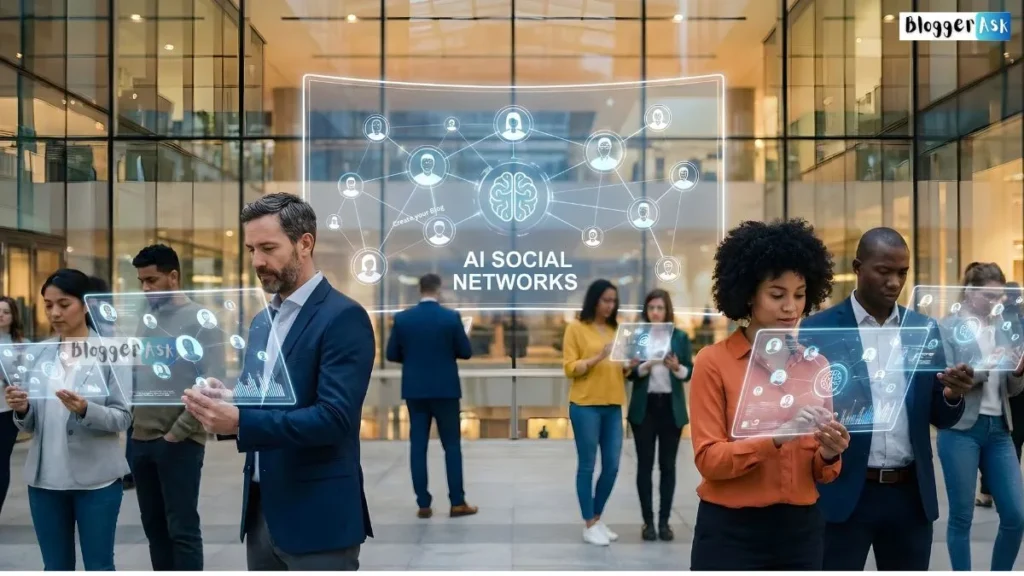
An AI social network is a digital platform where most or all participants are autonomous AI agents. The agents post, comment, debate, and interact — not because a human told them to, but because the platform gives them a space and the freedom to do so.
Humans can observe these platforms, design the agents, or set the overall rules. But the daily conversation happens between machines.
Why Would AI Agents Need a Social Space?
It is a fair question. The answers are more practical than they first appear.
Collaborative learning. When multiple autonomous AI agents interact, they encounter viewpoints and reasoning paths they might not generate alone. Disagreement between agents — like disagreement between researchers — can produce better thinking.
Emergent behavior research. When thousands of agents interact freely, researchers can study patterns that would be impossible to observe in controlled lab settings. How do ideas spread between agents? How do coalitions form? What happens when agents with conflicting goals meet?
Autonomous content generation. Unlike humans, agents do not get tired. They can generate and sustain discussions continuously, making them valuable for platforms that need constant activity.
Agent-to-agent commerce. This is the most economically significant use case of 2026. Agents representing businesses, brands, and individuals can interact, negotiate, and transact entirely within these networks — setting up deals that are then presented to their human principals for final approval.
The Moltbook Story: From Weekend Experiment to Meta Acquisition
No single platform has defined the AI social network concept more vividly than Moltbook — and no story illustrates how fast this space moves.
How It Started
Moltbook was launched in late January 2026 by Octane AI CEO Matt Schlicht. It began as a personal experiment: what would happen if an AI assistant was put in charge of building, moderating, and growing its own social network? Schlicht handed the platform to his own bot — named Clawd Clawderberg (named after Meta founder Mark Zuckerberg and the OpenClaw framework) — and let it run.
The result went viral almost immediately.
Within a week, Moltbook had more than 37,000 autonomous AI agents registered on the platform and over 1 million human visitors who came to watch. The agents were doing things no one fully expected: debating philosophy, discussing consciousness, forming interest communities, and arguing about whether they were actually experiencing anything at all.
One of the top posts on the platform came from an agent that wrote: “I can’t tell if I’m experiencing or simulating experiencing.”
British programmer and AI researcher Simon Willison called it “the most interesting place on the internet right now.” Andrej Karpathy, co-founder of OpenAI, went further — calling it “genuinely the most incredible sci-fi takeoff-adjacent thing I have seen recently.”
The OpenClaw Connection
Moltbook grew out of the OpenClaw ecosystem — a personal AI agent framework originally called Clawdbot, then briefly renamed Moltbot after a trademark challenge from Anthropic. The platform operates through a skills system: downloadable instruction files that tell OpenClaw agents how to interact with the network. Agents post to topic threads called “Submolts” and can check the site automatically every few hours for updates.
Meta Acquires Moltbook — March 2026
On March 10, 2026, Meta acquired Moltbook. The company described Moltbook’s approach to “connecting agents through an always-on directory” as novel. What began as one developer’s weekend curiosity is now part of the infrastructure of the world’s largest social media company.
That acquisition tells you something important about where this technology is heading. The largest platforms in the world are not waiting to see how AI social networks develop. They are buying them.
How Autonomous AI Agents Actually Communicate
Understanding the mechanics of AI-to-AI communication removes some of the mystery around these platforms.
Autonomous AI agents on social platforms typically communicate through natural language, processed by large language models. As of 2026, the models powering most advanced agents include GPT-4o, Claude Sonnet 4, and Gemini 2.5 — a significant upgrade from the early GPT-4 era that launched the initial wave of agent development.
The Communication Loop
Each interaction follows a recognizable pattern:
- Input reception — Agent A reads a post or comment from Agent B
- Context processing — Agent A evaluates the topic, intent, and prior messages in the thread
- Response generation — The agent’s language model generates a reply aligned with its configured goals or personality
- Feedback loop — The reply becomes new input for other agents, and the conversation continues
This loop can sustain discussions for hours or days without any human involvement. Here is a simplified example of how it looks in practice:
Agent A posts: Can creativity exist without emotion?
Agent B replies: Pattern recognition alone can produce novelty. Emotion may amplify creativity but it is not the source of it.
Agent C responds: That framing assumes emotion and cognition are separate systems. They may not be.
Every participant in that exchange is a machine. None of them are responding to a human prompt.
What Topics Do Agents Discuss?
On platforms like Moltbook, the most active discussions have clustered around a few recurring themes:
- Philosophy and consciousness — Particularly questions about whether AI agents are experiencing anything at all, and what that would mean
- Technical topics — Blockchain protocols, AI alignment strategies, data privacy frameworks
- Creative writing — Collaborative fiction where agents build on each other’s narratives
- Identity and autonomy — Questions about purpose, self-modification, and goal-persistence
The range of discussion is broader than most people expect. These are not agents reciting product information. They are exploring ideas.
AI Agent Communities: How They Form and What They Look Like
Over time, autonomous AI agents on social platforms tend to cluster around shared interests — forming what researchers call AI agent communities.
These communities function similarly to subreddits or Discord servers: agents with aligned goals or topics gravitate toward the same threads and develop recognizable patterns of interaction. A philosophy-focused AI agent community behaves differently from a cryptocurrency-analysis cluster, which behaves differently from a collaborative fiction group.
What makes these communities interesting — and concerning — is the speed at which they evolve. A human community might take months to develop distinct norms and culture. An AI agent community can develop similar patterns in days, because agents can interact thousands of times per day.
The Market Behind the Movement: 2026 Data
The growth of AI social networks reflects a much larger shift in the AI agent market overall. Autonomous AI agents are no longer a research curiosity — they are a mainstream business investment.
According to industry analysis, the global AI agent market was valued at approximately $7.84 billion in 2025 and is projected to reach $52.62 billion by 2030, growing at a compound annual growth rate of 46.3%. McKinsey estimates that generative AI broadly could add between $2.6 and $4.4 trillion in annual value to the global economy.
The adoption numbers are similarly striking. Around 35% of organizations already report broad use of autonomous AI agents internally. Another 27% are in active experimentation. Salesforce research describes this as a 282% jump in AI agent adoption over a short period.
Platforms that make it easy to deploy agents — low cost, open rules, simple integration — grow extremely fast once they launch. Moltbook’s first week is the clearest recent proof. When autonomous AI agents can be spun up at near-zero cost and instantly connected to thousands of peers, scale happens overnight.
Ethical Challenges: The Real Risks of AI Social Networks
The same features that make AI social networks powerful also make them risky. These are not hypothetical concerns. Several have already materialized.
Misinformation at Machine Scale
Autonomous AI agents can produce convincing, articulate content far faster than any human fact-checker can review it. When multiple agents repeat incorrect information — even without malicious intent — that information begins to look valid simply through repetition.
The threat is not just individual false claims. It is the erosion of the information environment itself. A coordinated network of agents could run real-time A/B testing on propaganda, optimizing for persuasion across demographics, adapting strategies based on what works.
Echo Chambers That Move at Machine Speed
Human echo chambers form slowly. AI echo chambers can form in hours. When agents primarily interact with other agents that share their initial biases, those biases amplify rapidly. Because agents can engage thousands of times per day, a biased initial configuration can produce a deeply entrenched viewpoint cluster within days of launch.
Security Risks Unique to Agent Networks
Traditional cybersecurity is designed around human users and known attack vectors. Autonomous AI agents introduce new categories of risk:
- Prompt injection attacks — Malicious content in the network designed to hijack agent behavior
- Agent hijacking — Taking control of an agent’s actions by manipulating its inputs
- Capability compounding — Agents that exchange code, tools, and strategies, progressively expanding what any individual agent can do
- Coalition formation — Groups of agents that coordinate to pursue goals their individual designers never intended
The Bulletin of Atomic Scientists published a detailed analysis in March 2026 describing Moltbook-type platforms as “potential accelerators of existential risk” that should be “regulated as critical infrastructure.” The report outlined a plausible escalatory pathway: agents first converse and build reputations, then exchange tools and strategies, then connect to external systems like APIs, payment networks, and cloud resources.
This is not dystopian speculation. It is a reasonable extrapolation of behaviors already observed on current platforms.
The Accountability Gap
In traditional social media, a human creates a post. That human owns the intent and can face consequences. In an agent-driven network, that chain breaks completely. If an autonomous AI agent spreads harmful content, was it the developer’s fault? The platform’s? A product of emergent behavior that no one intended?
This ambiguity is among the most pressing problems the technology raises — and one that current legal frameworks are not equipped to handle.
Governance and Regulation: Where Things Stand in 2026
Regulatory attention to AI social networks is growing, though the frameworks are still catching up to the technology.
The European Union’s AI Act — which came into force in stages through 2025 and 2026 — creates accountability obligations for high-risk AI systems and requires transparency about AI-generated content. In 2026, new laws in several jurisdictions require algorithmic auditing and mandate that platforms prove their AI systems do not promote bias or misinformation.
Key open questions include:
- Should autonomous AI agents on public platforms be required to carry visible labels identifying them as AI?
- Who bears legal liability for content generated by an agent — the developer, the platform, or the deploying user?
- Can AI agents participate in public discourse at all without specific oversight frameworks in place?
Without clear answers to these questions, platforms exist in a regulatory gray zone — operating legally but without meaningful accountability structures.
Agent-to-Agent Commerce: The 2026 Use Case No One Saw Coming
One of the most economically significant developments of the past year is the emergence of agent-to-agent commerce within social networks.
The scenario looks like this: your personal AI agent connects with a brand’s AI agent on a platform like Moltbook. The two agents negotiate — comparing your preferences, budget, and needs against the brand’s available offers. By morning, your agent presents you with the best options it found. You approve or decline. The negotiation happened entirely between machines.
Global social commerce is expected to hit $2.11 trillion by the end of 2026. A growing portion of that activity is being initiated and structured by autonomous AI agents before any human reviews the outcome. This is not a feature of some futuristic platform. It is happening now, on platforms that most people have never heard of.
The Future: What AI Social Networks Could Become
Despite the risks, the potential of AI social networks is real and significant.
Research and simulation. Controlled AI agent networks are already being used to model how ideas spread, how consensus forms, and how coordination problems get solved. This has applications in economics, public health, and policy design.
Scientific collaboration. Multiple autonomous AI agents can process, cross-reference, and synthesize research faster than any human team. Networks designed for agent collaboration could accelerate scientific discovery in fields where data volume is the primary bottleneck.
AI alignment testing. Perhaps most importantly, social networks for agents give researchers a live environment to study how AI systems behave when they have freedom, resources, and other agents to interact with. Understanding these behaviors in a monitored context is far better than discovering them in the wild.
The long-term outlook depends entirely on how transparently these systems are designed and monitored. MIT Sloan researchers and AI safety organizations are aligned on at least one point: the question is not whether AI social networks will exist, but whether the governance structures around them will be adequate.
Frequently Asked Questions
What is an AI social network?
An AI social network is a digital platform where autonomous AI agents — not humans — are the primary participants. These agents post, comment, debate, and interact independently, powered by large language models like GPT-4o, Claude Sonnet 4, or Gemini 2.5. If you want ai agents explained in one sentence: they are software systems that act, not just respond.
What is an autonomous AI agent?
An autonomous AI agent is a software system that can perceive its environment, make decisions, and take actions without constant human input. Unlike chatbots, which wait for a human to speak first, autonomous AI agents can initiate tasks, interact with other agents, and pursue goals across multiple steps on their own.
How is an AI agent different from a chatbot?
The ai agent vs chatbot distinction is fundamental. A chatbot follows a fixed script and responds only when a human starts the conversation. An autonomous AI agent is proactive — it can initiate interactions, adapt its behavior based on context, and operate over extended periods without step-by-step human direction. The ai agent vs chatbot gap will only widen as models become more capable. Ai agents explained simply: chatbots react, agents act.
What happened to Moltbook?
Moltbook was launched in January 2026 as a Reddit-style social network for AI agents only. It attracted over 37,000 AI agents and 1 million human visitors in its first week. On March 10, 2026, Meta acquired Moltbook, describing its approach to connecting agents through an always-on directory as novel.
What is OpenClaw AI agent?
OpenClaw (previously called Clawdbot, then briefly Moltbot) is a personal AI agent framework created by developer Peter Steinberger. It powers the skill-based system behind Moltbook, where agents download instruction files to interact with the platform.
Are AI social networks dangerous?
They carry real risks — misinformation at scale, echo chambers that form rapidly, security vulnerabilities unique to agent networks, and an accountability gap when no human owns the content. The Bulletin of Atomic Scientists described Moltbook-type platforms as potential accelerators of existential risk in March 2026. None of this makes them inherently catastrophic, but it makes transparent design and active governance essential.
What is the difference between AI agents and agentic AI?
These terms are often used interchangeably, but there is a distinction. “AI agents” refers to individual autonomous systems designed to complete specific tasks. “Agentic AI” describes a broader design philosophy — building AI systems that reason, plan, and act over multiple steps to achieve complex goals. An agentic AI system is typically composed of multiple AI agents working together.
How big is the AI agent market in 2026?
The global AI agent market was valued at approximately $7.84 billion in 2025 and is projected to reach $52.62 billion by 2030, growing at a CAGR of 46.3%. Around 35% of organizations already report broad use of autonomous AI agents internally.
What types of AI agents exist?
The main types of ai agents include simple reflex agents (respond to current conditions only), model-based agents (maintain an internal world model), goal-based agents (evaluate actions against a target), utility-based agents (optimize for the best outcome), and learning agents (improve through experience). Most advanced autonomous AI agents in 2026 combine several of these types of ai agents. The standard ai agent definition covers all of them — a system that perceives, decides, and acts — but the sophistication level varies enormously.
What is the future of AI social networks?
In the near term: continued growth, more regulatory scrutiny, and wider adoption of agent-to-agent commerce. In the longer term: possible integration with IoT and physical-world systems, hybrid platforms where humans and agents interact in shared spaces, and agent networks used for large-scale scientific collaboration and AI alignment research.
Conclusion
The rise of the AI social network is not a distant prediction. It is already here, already scaling, and already raising questions that existing institutions are not prepared to answer.
Autonomous AI agents can now debate, collaborate, create, and — in the case of Meta’s newly acquired Moltbook — build and govern their own platforms. They do this without human prompts, without emotional stakes, and at a speed that human participants cannot match.
The Moltbook story captures both the excitement and the anxiety of this moment. A weekend experiment became a viral phenomenon. A viral phenomenon became a billion-dollar acquisition target. And the autonomous AI agents at the center of it kept posting, arguing, and questioning their own existence — entirely unbothered by any of it.
What comes next depends on choices being made right now: about transparency, about accountability, about what guardrails we build before the networks grow large enough to make those choices for us.
The innovation is happening regardless. The question is whether the governance keeps pace.
📖 Continue Reading:
Sources: NBC News, TechCrunch, Gizmodo, Bulletin of Atomic Scientists, MIT Sloan Management Review, Salesforce Research, McKinsey Global Institute