
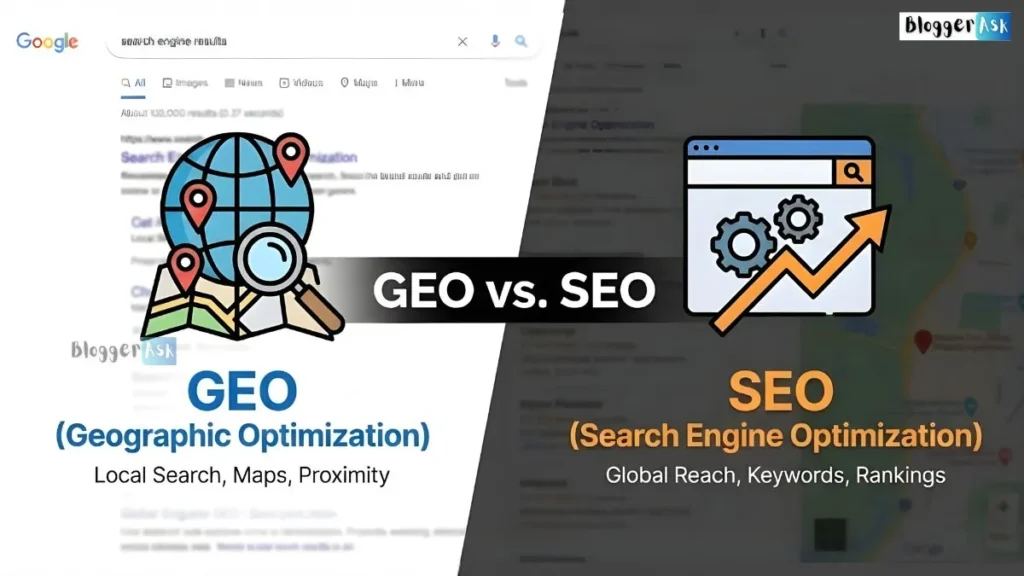
⚡ Quick Answer: GEO vs SEO
SEO gets your page ranked in Google’s list of blue links. GEO gets your page retrieved and cited inside AI-generated answers — in Google AI Overviews, AI Mode, ChatGPT, Perplexity, and others.
As of May 2026, Google’s official position is that GEO isn’t a separate discipline for its own AI features — it’s still SEO. Other AI platforms retrieve and cite content differently, and that’s where the real strategy decisions live.
Key Takeaways
- SEO optimizes for ranking position. GEO optimizes for being cited inside AI-generated answers. Those are two different jobs — even when the same page can do both.
- Google’s official May 2026 guidance states that optimizing for its generative AI features is still SEO, and specifically says tactics like llms.txt files and content “chunking” aren’t required for Google.
- Google AI Overviews now appear on roughly half of tracked searches — about 48% in early 2026, up from ~30% a year earlier, per BrightEdge — and reach an estimated 2 billion+ people a month. Google’s conversational AI Mode surpassed 1 billion monthly users in 2026.
- Ahrefs’ December 2025 data found that top-ranking pages lose about 58% of their click-through rate when an AI Overview appears for that query — up from a 34.5% drop measured earlier in 2025.
- Ranking #1 on Google does not guarantee AI citation. Independent research finds only ~17% of AI Overview citations come from a page’s organic top-10 — down from roughly 76% a year earlier.
- ChatGPT, Perplexity, Gemini, Claude, and Microsoft Copilot each retrieve and cite sources differently. A single “AI SEO” tactic does not work identically across all of them.
- You don’t have to choose between SEO and GEO. The pages that perform best in 2026 are built for both at once.
Introduction
If you’ve searched “GEO vs SEO” before, you’ve probably read a dozen articles telling you they’re two different-but-complementary disciplines. That’s directionally true. It’s also missing the most important update in this entire debate.
On May 15, 2026, Google published something it had never published before: an official guide addressing generative AI search optimization directly, inside Google Search Central’s documentation. It settled several arguments the SEO industry had been having for two years — and it didn’t settle them the way most GEO vendors expected.
This isn’t a niche concern anymore. Google’s AI Overviews reach an estimated 2 billion-plus people a month, and its conversational AI Mode crossed 1 billion monthly users in 2026 — so the way AI systems choose and cite sources now shapes real traffic.
This guide covers:
- What SEO and GEO actually mean, in plain terms
- What Google itself now officially says about the difference between them
- Real, sourced data on how AI Overviews and AI-first platforms are changing click behavior
- How ChatGPT, Perplexity, Gemini, Claude, and Copilot actually differ in how they choose sources
- A practical, step-by-step way to optimize one piece of content for both traditional search and AI search
- How to measure whether any of this is working
Whether you run a blog, an e-commerce store, or a B2B SaaS site, this shift affects your traffic. Let’s get into what’s actually true right now.
What Is SEO? (Search Engine Optimization)
Definition: SEO is the practice of improving a webpage so search engines can find it, understand it, and rank it for relevant queries — with the goal of appearing high in the list of search results.
SEO has three main components:
- On-page SEO — content quality, headings, internal links, titles, and how thoroughly a page covers a topic.
- Off-page SEO — backlinks, mentions, and other signals of reputation that live outside your own site.
- Technical SEO — crawlability, indexing, site speed, mobile usability, and structured data. (See our technical SEO checklist for the fundamentals.)
SEO still works the way it always has: search engines crawl the web, index what they find, and rank pages using hundreds of signals. What’s changed isn’t the mechanism. It’s what happens after a page ranks — because ranking #1 no longer guarantees a click. More on that below.
What Is GEO? (Generative Engine Optimization)
Definition: Generative Engine Optimization (GEO) is the practice of structuring and supporting content so that generative AI systems — like Google AI Overviews, ChatGPT, or Perplexity — are more likely to retrieve it, use it, and cite it when generating an answer.
GEO isn’t a marketing buzzword invented by an agency. It comes from a real, peer-reviewed academic paper: “GEO: Generative Engine Optimization” by Pranjal Aggarwal, Vishvak Murahari, Tanmay Rajpurohit, Ashwin Kalyan, Karthik Narasimhan, and Ameet Deshpande — researchers affiliated with Princeton University, IIT Delhi, Georgia Tech, and the Allen Institute for AI — presented at the 30th ACM SIGKDD Conference on Knowledge Discovery and Data Mining (KDD 2024).
The paper introduced GEO-bench, a benchmark of roughly 10,000 real user queries across multiple domains, and tested nine optimization methods — things like adding statistics, adding quotations, citing sources, and improving fluency. The headline finding: these methods can boost a source’s visibility inside generative engine responses by up to 40%, though the effect varies significantly by topic and domain. (Notably, the study also found that keyword stuffing reduced visibility, scoring below the unmodified baseline.)
That’s an important nuance most GEO content skips: there’s no universal trick. What works for a product comparison query may not work for a medical question.
How Generative Engines Actually Work
Most generative engines that answer search-style questions use a process called retrieval-augmented generation (RAG). Google’s own AI features layer a second technique on top called query fan-out — quietly generating several related sub-questions to gather a broader set of results before writing the final answer. Here’s the flow:
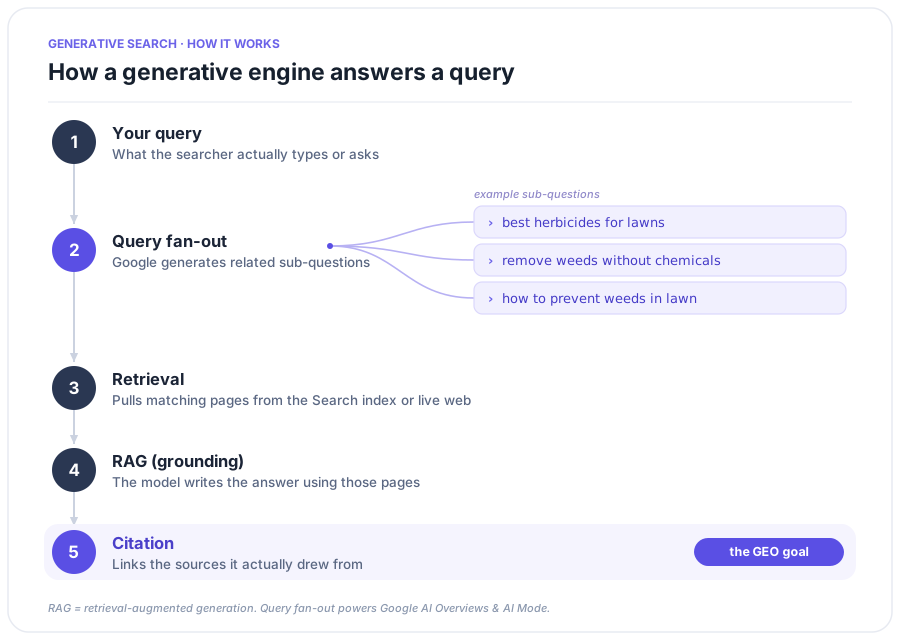
Google’s published example makes fan-out concrete: a query like “how to fix a lawn that’s full of weeds” fans out into sub-queries such as “best herbicides for lawns,” “remove weeds without chemicals,” and “how to prevent weeds in lawn.” This is why a single AI Overview can reflect information that doesn’t appear to directly answer your literal query — it’s answering a fanned-out version of it too. It’s also why one genuinely comprehensive page tends to beat a dozen thin, near-duplicate pages built for each keyword variation.
GEO vs SEO: Core Differences
| Dimension | SEO | GEO |
|---|---|---|
| Primary outcome | Rank in the list of results | Get cited inside a generated answer |
| Optimization focus | Keywords, links, crawlability | Clarity, evidence, structure, credibility |
| User behavior | User clicks through to a page | User often gets the answer without clicking |
| Success metric | Rankings, impressions, CTR | Citation frequency, position, AI share of voice |
| Content approach | Comprehensive, keyword-mapped | Extractable, quotable, fact-dense |
| Failure mode | Page doesn’t rank | Page ranks but is never retrieved or cited |
The simplest way to hold this in your head: SEO competes for a position. GEO competes for inclusion. A page can win at one and lose at the other — which is exactly why so many site owners are confused about why their rankings look stable while their traffic doesn’t.
Google’s Official Position: Is GEO Actually Different From SEO?
This is the part most existing “GEO vs SEO” articles miss entirely, because it happened recently.
On May 15, 2026, Google Search Central published a new documentation page titled “Optimizing your website for generative AI features on Google Search.” It’s the first time Google has consolidated its position on AI search optimization into one official resource, and it directly addresses the GEO/AEO terminology debate.
What Google’s guide says clearly:
- The best practices for SEO remain relevant because Google’s generative AI features are rooted in its core Search ranking and quality systems.
- Its AI features (AI Overviews and AI Mode) use retrieval-augmented generation and query fan-out to surface content already in the Search index.
- From Google’s perspective, optimizing for its generative AI search experience is simply optimizing for search — in Google’s own words, “optimizing for generative AI search is optimizing for the search experience, and thus still SEO.”
- Alongside the guide, Google clarified that its standard Search spam policies — covering things like scaled content abuse and site reputation abuse — now explicitly apply to its generative AI features. Gaming your way into an AI Overview carries the same risk as gaming a traditional ranking.
What Google’s guide says you can stop worrying about (for Google, specifically):
- llms.txt files — Google’s crawler may discover them, but the company doesn’t treat them as a meaningful ranking or inclusion signal.
- Content “chunking” — restructuring content into rigid fragments for AI extraction. Google says its systems understand full-page context and there’s “no ideal page length.”
- AI-specific rewriting — obsessively covering every long-tail keyword variation. Google says its systems understand synonyms and general meaning.
- Special schema or markdown versions of pages — not required for inclusion in Google’s AI features.
Google’s guide also leans hard on a distinction between “non-commodity” content and “commodity” content. Its own example contrasts a generic “7 Tips for First-Time Homebuyers” article (commodity — could have been written by anyone) with a specific, experience-based piece like “Why We Waived the Inspection & Saved Money: A Look Inside the Sewer Line” (non-commodity — built on a real, specific perspective). This matters because RAG systems need sources that add something the model can’t already generate from general knowledge.
It’s worth stressing that this isn’t one person’s take. The May 2026 guide was announced by Google’s John Mueller, and Googlers including Gary Illyes have made the same point at industry events — that “GEO” and “AEO” don’t require a separate playbook for Google Search. The consistency across Google voices signals a settled internal position, not a passing soundbite.
Important Caveat
Google’s guidance describes Google’s own systems specifically. It does not describe how ChatGPT, Perplexity, Claude, Gemini, or Copilot retrieve and cite content — those platforms use different architectures, and some (like Perplexity) rely more heavily on real-time web retrieval and structured citation. Treat Google’s May 2026 guidance as authoritative for Google Search, not as a universal rulebook for every AI platform.
Is GEO Just Rebranded SEO? The Honest Answer
This is a genuinely disputed question in the industry, not a settled one — and a fair answer should show both sides.
The “it’s the same thing” view: Danny Sullivan — a director within Google Search and the company’s former Search Liaison — put it bluntly at WordCamp US in 2025: “Good SEO is good GEO.” (He went on to list every acronym the industry had coined — AEO, AIO, LLM SEO — and folded them all back into SEO.) The overlapping logic is straightforward: content that’s clear, well-structured, and backed by real expertise tends to perform well whether the output is a ranked list or a generated summary.
The “it’s a real shift” view: Some practitioners argue this understates how much has changed. SEO consultant Michael King (founder of iPullRank) has described classic SEO tactics as increasingly outdated for AI-driven retrieval, and proposes a framework he calls “Relevance Engineering” — built around aligning content with how large language models process query variations and sub-passage relevance, rather than optimizing single pages for single keywords.
Both views can be true at different altitudes. At the foundation — crawlability, real expertise, clear writing — GEO and SEO overlap almost completely. At the tactical level — how you structure passages, which platforms you prioritize, how you measure success — they genuinely diverge.
Why “Zero-Click Search” Changes the Stakes
Understanding GEO vs SEO matters more now because the cost of ranking without being seen has gotten measurably higher.
What Pew Research Center found (March 2025 browsing data, published July 2025):
- 58% of the ~900 U.S. adults tracked encountered at least one Google AI summary during the study month.
- When an AI summary appeared, users clicked a traditional search result in just 8% of visits — compared to 15% of visits without one.
- Users ended their browsing session entirely after seeing an AI summary in 26% of cases, versus 16% without one.
- About 18% of all Google searches in the study produced an AI summary, and 88% of those summaries cited three or more sources.
What Ahrefs found (December 2025 Search Console data, published February 2026):
- Ahrefs found that the presence of an AI Overview correlated with a 58% lower average click-through rate for the top-ranking page — up from a 34.5% drop measured earlier in 2025.
- The effect isn’t limited to position #1: pages ranking second lost about half their clicks, and even pages at position ten saw click declines of nearly 20%.
A fair caveat: Google has publicly pushed back on some of this research, describing certain third-party methodologies as flawed and stating that its AI features continue to send a large volume of traffic to websites overall. Independent researchers stand by their numbers. Both things can be part of the picture — aggregate click volume can still grow even as per-query click-through rates fall, especially as search volume itself increases. (It’s also worth noting some trackers report a partial CTR rebound in early 2026, so treat any single figure as a snapshot, not a permanent state.)
The bottom line for your strategy: ranking has not stopped mattering. But ranking alone is no longer a reliable proxy for traffic, especially on informational queries. That gap is exactly what GEO is trying to close.
How Different AI Platforms Actually Cite Sources
This is the section most “GEO vs SEO” guides skip — and it’s arguably the most useful one, because treating all AI platforms as one undifferentiated group leads to wasted effort.
| Platform | Retrieval approach | Typical citation behavior |
|---|---|---|
| Google AI Overviews / AI Mode | RAG over Google’s Search index, plus query fan-out | Draws from indexed, ranking-eligible pages; most citations don’t match a page’s normal organic top-10 |
| ChatGPT | Blends trained knowledge with live web search when enabled | Varies by mode; leans on established reference and community sources |
| Perplexity | Built as a citation-first, real-time web search engine | Runs a live search for nearly every query; shows inline citations by default; tends to cite more sources per answer |
| Google Gemini (app) | Similar retrieval to Google’s Search AI features, plus model knowledge | Increasingly integrated with Google’s Search grounding |
| Claude | Web search with its own retrieval and ranking logic | Source mix differs from both Google and OpenAI |
| Microsoft Copilot | Bing’s index with a language-model layer | Tends to cite fewer sources per answer, weighted toward Bing’s index |
What independent, cross-platform research actually shows:
- Multiple analyses of large citation datasets have found that only around 11% of domains are cited by both ChatGPT and Perplexity for comparable queries — meaning a domain that performs well on one platform frequently doesn’t appear at all on another.
- Research examining Google AI Overviews and AI Mode finds that only about 17% of citations come from a page’s organic top-10 (down from roughly 76% a year earlier), and a meaningful share of ChatGPT’s most-cited pages have little to no visibility in Google’s own top results for related queries.
A note on data quality in this space: Be skeptical of any single precise-sounding statistic about AI citation behavior. Different research groups report meaningfully different numbers for the same question, because measurement methods, query sets, and time periods all differ, and the platforms themselves change quickly. Treat any specific percentage as a directional signal, not a fixed law — and expect it to shift within months.
Try this yourself (a 5-minute test): Pick one question your customers actually ask. Enter it, unchanged, into Google (watch the AI Overview), Google AI Mode, ChatGPT, Perplexity, Gemini, and Copilot. Note which sources each one cites — and whether your site appears at all. You’ll usually see three things immediately: the citations barely overlap between platforms, the sources often aren’t the top organic results, and the same query can produce different sources on different days. That variation is the GEO problem in miniature.
What this means practically: don’t assume that winning on Google automatically wins on ChatGPT, or that being cited once on Perplexity means you’ll show up consistently. If a specific AI platform matters to your business, you need platform-specific visibility tracking — not just traditional rank tracking.
Step-by-Step: How to Optimize One Page for Both SEO and GEO
You don’t need two separate content strategies. You need one page built with both jobs in mind.
- Start with real search intent, not just a keyword. Identify what the person actually wants to know or do, and make sure the page resolves that need directly. Note that AI and voice queries tend to be long, conversational, and multi-part — often 70–80 words versus 3–4 for a typed search — so cover the whole question, not just a head keyword.
- Open with a direct, self-contained answer. The first 2–3 sentences under any major heading should answer the question completely enough to be quoted on their own, before you add nuance. Compare:Before (hard for a model to extract):There are many factors that can influence whether AI systems surface your content, and while it’s difficult to say anything definitive, in some cases structured, clear content may be more likely to be referenced, depending on the platform and the query.After (self-contained and quotable):AI systems are more likely to cite content that answers the question in the first two sentences, backs claims with named sources, and uses clear headings. In a 2024 Princeton study, adding citations, quotations, and statistics raised a source’s visibility in AI answers by up to 40%.The “after” version states the answer immediately, is verifiable, and makes sense even if it’s the only sentence an AI system quotes.
- Add a clear, quotable definition early. If your topic has a “what is X” component, define it in one or two plain sentences near the top. This is one of the most commonly cited content types in AI-generated answers.
- Support claims with named, dated sources. A statistic without a source is unusable to a generative engine and untrustworthy to a human reader. Name the organization and the date wherever possible.
- Structure for both skimming and extraction. Use descriptive subheadings, short paragraphs, and lists. Clean HTML structure (real headings, real lists, real tables) is easier for both users and AI systems to parse than dense prose.
- Build in comparisons where relevant. “X vs Y” framing, pros/cons blocks, and decision tables are consistently among the content types generative engines summarize most easily.
- Add genuine experience, not just information. Google’s own May 2026 guidance singles this out directly: content built on a specific, lived perspective outperforms generic, could-have-been-written-by-anyone content in both ranking and citation systems.
- Keep technical SEO fundamentals in place. Make sure the page is crawlable, indexable, fast, and doesn’t hide key content behind client-side JavaScript rendering that crawlers can’t easily process.
- Update it on a real schedule. Both ranking systems and generative engines weigh recency. A page with a stale “last updated” date and outdated stats will lose ground to a fresher, thinner competitor.
- Check how it’s actually being cited. Don’t assume; verify using the tools in the measurement section below.
Common GEO and SEO Mistakes to Avoid
- Treating llms.txt as essential. As of May 2026, Google says it doesn’t treat this file as a meaningful signal for its own AI features. It has shown some value in developer-documentation and coding-agent contexts (tools like Cursor and Cline), but there’s no evidence it helps with consumer AI search on Google, ChatGPT, or Perplexity. Don’t treat it as a must-have universal fix.
- Over-fragmenting content into rigid “chunks.” Google’s own guidance says this isn’t necessary for its systems and can hurt readability for actual humans.
- Writing vague, hedge-heavy paragraphs. Generative engines — and readers — struggle to extract a clear point from sentences full of “may,” “could,” and “in some cases” with no specifics attached.
- Citing statistics with no source or date. This is a trust problem for readers and a usability problem for AI systems, which favor claims they can verify.
- Assuming one AI platform’s behavior applies to all of them. A tactic that works for Perplexity’s citation-first model won’t automatically transfer to ChatGPT’s blended-knowledge approach.
- Ignoring technical SEO because “GEO is the new thing.” If a page isn’t indexed and crawlable, it’s unlikely to be retrieved by any generative engine that draws from a search index.
- Publishing “commodity” content and expecting AI citation. Generic, could-be-written-by-anyone advice is exactly what generative models already produce on their own — it gives them no reason to cite you instead of just generating the answer themselves.
Why AI Citations Are Volatile (and Why That Changes Measurement)
Before you invest in any of this, understand one thing that traditional SEO didn’t prepare you for: AI citations churn far faster than rankings do.
- Tracking of AI answers across Google AI Mode and ChatGPT has found that roughly 40–60% of cited sources change from month to month (Semrush AI Visibility Index).
- When Google switched AI Overviews to its Gemini 3 model in January 2026, industry trackers observed a large share of previously cited domains — by some estimates around 42% — being replaced within weeks.
- One analysis reported by Search Engine Journal found that about 70% of pages cited in AI Overviews changed their citation status within two to three months.
The takeaway isn’t “don’t bother.” It’s that AI visibility is a flow, not a position you win once. A single citation is a data point, not a finish line — which is exactly why measurement (below) matters more here than in classic SEO.
How to Measure GEO and SEO Performance
Free, Do-It-Yourself Methods
- Google Search Console — confirms whether your pages are indexed, tracks impressions and clicks, and now includes a Generative AI performance report showing how content performs in Google’s AI features alongside traditional Search metrics.
- Manual prompt-checking — periodically ask your target questions directly in ChatGPT, Perplexity, Gemini, and Copilot, and note whether and how your brand or content is cited. It’s manual, but it’s free and directly observable. (The 5-minute test above is a good starting template.)
- Schema.org validators — confirm your structured data is implemented correctly, which supports rich results in traditional search even though it’s not required for AI citation specifically.
- Bing Webmaster Tools — some practitioners use its data as a rough proxy for the kinds of “grounding queries” AI systems generate behind the scenes.
Paid AI Visibility Platforms
A dedicated category of software has emerged specifically to track brand and content visibility across AI platforms. As of mid-2026, commonly used options include:
- Profound — enterprise-focused, tracks a wide range of AI platforms with citation source attribution and competitive benchmarking.
- Peec AI — mid-market analytics platform with strong brand-sentiment and source-discovery features.
- Otterly.ai — budget-friendly entry point with automated monitoring across major AI platforms and a built-in content-gap audit feature.
- Semrush AI Visibility Toolkit / Ahrefs Brand Radar — AI-citation tracking bolted onto existing SEO platforms, useful if you’re already using one of these tools for traditional SEO.
None of these tools “fix” your GEO problem by themselves — they tell you where you stand. The content work described in the step-by-step section above is still what moves the needle.
A word of caution: this tool category is new, pricing and feature sets change quickly, and much of the comparison content you’ll find between these platforms is written by the vendors themselves or by affiliates. Treat vendor comparison articles (including “best GEO tools” roundups) with the same skepticism you’d apply to any product review — check official pricing pages directly before buying.
Real Example: GEO in Action
Concrete, verifiable examples of GEO working in the wild are still relatively rare compared to the volume of GEO advice being published — which is itself worth noting honestly. One well-documented example is Tally, a bootstrapped form-building tool. Its own team wrote publicly in 2025 that ChatGPT had become their number-one referral source, and a company update in April 2026 confirmed that AI-powered search had overtaken its long-running “Made with Tally” viral loop as its single biggest acquisition channel — with Claude, in particular, growing fast as a referral source alongside ChatGPT, Gemini, and AI Overviews.
Keep this in proportion: even in cases like Tally’s, AI referral volume remains small next to Google’s overall search traffic industry-wide. The real lesson isn’t that AI search has overtaken Google — it’s that a small, focused site with clear, specific content can earn AI visibility disproportionate to its size, because generative engines match content to a specific query need rather than ranking domains by overall authority the way classic SEO link-based signals do.
Use Cases: When to Prioritize GEO vs SEO
| Business type | Where SEO still leads | Where GEO opportunity shows up |
|---|---|---|
| Blogs & publishers | Core traffic from ranking on informational queries | Being cited as a source in AI answers protects visibility as informational queries go zero-click |
| E-commerce | Category/product pages, Merchant Center feeds | “Best X” and comparison queries are increasingly AI-summarized; clear attributes help AI extract specifics |
| SaaS & B2B | Active buyer search demand | AI tools generate shortlists; earned mentions, reviews, and use-case pages influence whether you make the list |
| Local & service | Google Business Profile, reviews, NAP consistency | “Best near me” queries are often AI-summarized; transparent pricing and service-area pages improve accuracy |
Expert Tips
- Write the answer before you write the explanation. If a generative engine — or a skimming human — only read your first two sentences, would they get the actual answer? If not, restructure.
- Treat “last updated” as more than decoration. Both Google’s ranking systems and generative engines weigh freshness. Update the specific numbers and examples, not just the timestamp.
- Don’t chase every acronym. GEO, AEO, AIO, and “AI visibility” are largely describing overlapping ideas with different marketing labels attached. Focus on the underlying practice — clear, evidence-backed, well-structured content — rather than treating each acronym as a separate to-do list.
- Build content that earns citations elsewhere, not just on your own site. Generative engines frequently weigh third-party mentions and reviews heavily; a strong presence on relevant review platforms and community discussions can matter as much as your own page.
- Re-check your assumptions quarterly. This entire space — including Google’s own official guidance — has changed substantially more than once in the past 18 months. A strategy that’s six months old deserves a re-check, not blind faith.
The Future of Search: What’s Next
The pace here is the story. Two announcements in May 2026 show where search is heading.
Google I/O 2026 (May 19, 2026) was the most consequential search update in years. Google announced that AI Mode had crossed 1 billion monthly users within roughly a year of launch, with queries reportedly more than doubling every quarter. It named Gemini 3.5 Flash as AI Mode’s new default model, said AI Overviews now reach around 2.5 billion monthly users, and unveiled the biggest redesign of the search box in over 25 years — a multimodal input that accepts text, images, files, video, and open browser tabs. Google also began rolling out agentic “Information Agents“ that can take actions and deliver proactive, source-linked updates.
Shortly before that, on May 6, 2026, Google shipped five link-focused updates to AI Overviews and AI Mode: inline source links placed next to the specific text they support, desktop hover previews, a “Subscribed” label for content from a reader’s paid news subscriptions, an end-of-answer section suggesting further reading, and a “Community Perspectives” feature that surfaces firsthand quotes from Reddit, forums, and social posts with creator attribution.
Read together, these point in one direction: more blended results pages, more surfaces where an AI-generated summary sits above or alongside traditional links, more weight on firsthand and community content, and continued platform-specific divergence between Google, OpenAI, Perplexity, Anthropic, and Microsoft. The practical implication isn’t that SEO is ending — it’s that “ranking” and “being seen” are no longer reliably the same outcome, and your measurement strategy needs to track both.
Frequently Asked Questions
What is the difference between GEO and SEO?
SEO optimizes content to rank in a search engine’s list of results and earn clicks. GEO optimizes content to be retrieved and cited directly inside AI-generated answers, where a click may never happen at all.
Is GEO replacing SEO?
No. Google’s own May 2026 guidance states that for its Search features, GEO isn’t a separate discipline — both rely on the same underlying quality and ranking systems. Technical SEO fundamentals remain necessary for a generative engine to find and retrieve your content in the first place.
Do I need an llms.txt file?
Not for Google specifically — its May 2026 guidance says it doesn’t treat this file as a meaningful signal. It has shown some value in developer-documentation and coding-agent contexts (tools like Cursor and Cline), but there’s no broad consensus that it helps with consumer AI search, and it carries little downside beyond the time to create and maintain it.
How is Google AI Mode different from AI Overviews?
AI Overviews are AI-generated summaries that appear above or alongside traditional search results for a given query. AI Mode is a more extensive, conversational search experience built on the same retrieval-augmented generation and query fan-out techniques. At Google I/O 2026 (May 2026), Google announced AI Mode had surpassed 1 billion monthly users globally, with queries reportedly more than doubling every quarter, and named Gemini 3.5 Flash as its default model.
Why do ChatGPT and Perplexity cite different sources for the same question?
They use different retrieval systems. Perplexity was built as a citation-first, real-time web search engine and typically cites more sources per answer. ChatGPT blends its own trained knowledge with web search depending on the mode, and independent research has found relatively low overlap — often cited around 11% — between the domains each platform references for comparable queries.
How volatile are AI citations, really?
Very. Tracking across Google AI Mode and ChatGPT suggests roughly 40–60% of cited sources change month to month, and a large share of AI Overview citations turn over within two to three months — especially around major model updates. Treat AI visibility as an ongoing flow to monitor, not a position you win once.
How do I check if my content is being cited in AI answers?
Manually query your target questions directly in ChatGPT, Perplexity, Gemini, and Copilot and note the results, or use a dedicated AI visibility platform such as Profound, Peec AI, or Otterly.ai for ongoing, automated tracking.
Does keyword density still matter for GEO?
Less than it used to. Google’s own guidance states its systems understand synonyms and general meaning, so rewriting content to capture every keyword variation isn’t necessary — and the foundational GEO research actually found keyword stuffing reduced AI visibility. Comprehensive, clear coverage of a topic matters more than exact-match repetition.
Does schema markup help with AI search?
Not directly for citation. Google says structured data isn’t required for its generative AI features and there’s no special AI-only schema. It’s still worth using for traditional rich-result eligibility, and product/local structured data (via Merchant Center and Google Business Profile) does help products and businesses surface in AI answers.
What is “non-commodity content,” and why does it matter?
It’s Google’s own term (from its May 2026 guidance) for content built on a specific, original perspective or direct experience — as opposed to generic advice that could have been written by anyone. Google specifically calls this out as a factor in both ranking and AI-feature visibility.
Conclusion
The GEO vs SEO debate isn’t really about picking a side. SEO gets your content discovered and indexed in the first place. GEO determines whether it gets pulled into the answer itself once it’s found. As of May 2026, Google’s own position is that for its Search features, these aren’t separate jobs — but that position doesn’t extend to ChatGPT, Perplexity, Claude, or Copilot, which each behave differently enough to deserve their own attention.
The practical move is straightforward, even if the landscape keeps shifting: build genuinely useful, well-structured, experience-based content; keep your technical SEO fundamentals solid; and check — don’t assume — how you’re actually showing up across the AI platforms that matter to your audience.
📖 Continue Reading:
Sources & References
- Aggarwal, P., Murahari, V., Rajpurohit, T., Kalyan, A., Narasimhan, K., & Deshpande, A. (2024). GEO: Generative Engine Optimization. Proceedings of the 30th ACM SIGKDD Conference on Knowledge Discovery and Data Mining (KDD 2024).
- Princeton University publication record for GEO: Generative Engine Optimization.
- Google Search Central. Optimizing your website for generative AI features on Google Search (official guide).
- Google Search Central Blog. A new resource for optimizing for generative AI in Google Search (May 15, 2026).
- Google. How AI Mode and AI Overviews help you explore the web (May 6, 2026 updates).
- Google I/O 2026 keynote — AI Mode surpasses 1 billion monthly users; Gemini 3.5 Flash; AI Overviews reach approximately 2.5 billion monthly users (Google, May 2026).
- Pew Research Center. Google users are less likely to click on links when an AI summary appears in the results (July 2025).
- Ahrefs. AI Overviews Reduce Clicks by 58% (updated February 2026).
- BrightEdge. AI Overviews at the One-Year Mark: Presence, Size, and What They’re Citing (2026).
- Search Engine Journal. Google’s New AI Search Guide Calls AEO And GEO ‘Still SEO’.
- Search Engine Land. Google’s Danny Sullivan: ‘Good SEO is good GEO’.
- Search Engine Land. Generative Engine Optimization (GEO) resource hub.
- Tally. The road from $4M to $5M ARR (April 2026).
- Tally. From $2M to $3M ARR: How We Bootstrapped Tally With a Tiny Team (2025).
- iPullRank — Mike King, Relevance Engineering framework (industry publication).
- Semrush AI Visibility Index / Toolkit — cross-platform AI citation tracking and volatility data (2025–2026).