Introduction
Over the past 18 months, search behavior has started changing in ways many site owners didn’t expect.
Pages that once held stable #1 rankings are seeing fewer clicks—even though their positions haven’t moved.
It’s AI-generated answers appearing above traditional results.
With Google’s AI Overviews, users often receive a summarized response before they scroll. In multiple informational keyword tests, we noticed CTR drops despite stable rankings.
This isn’t the death of SEO — but it is the evolution of visibility.
In this guide, you’ll learn:
- The real difference between SEO and GEO
- How search works in 2025
- Practical AI search optimization strategies
- How to build a combined SEO + GEO content strategy that protects your traffic and boosts your visibility
If you create content, run a blog, manage an e-commerce site, or grow a SaaS business, understanding this shift isn’t optional anymore—it’s strategic.
While analyzing multiple informational keywords across several niche sites, we noticed a recurring pattern: impressions remained stable, but click-through rates dropped after AI summaries began appearing on the results page. This suggests that ranking alone no longer guarantees traffic.
Understanding SEO (Search Engine Optimization)
1. What Is SEO?
SEO is the process of improving pages so search engines can discover, understand, and rank them for relevant queries.
In practice, SEO is a mix of content relevance + technical accessibility + authority signals that help a search engine confidently show your page to users.
2. How Search Engines Rank Content
Search engines crawl and index web content, then rank results using algorithms so the most relevant pages appear higher.
Even with AI features on the results page, traditional ranking still influences which sources are found and surfaced.
3. Key SEO Components (On-page, Off-page, Technical)
- On-page: content, headings, internal links, titles/meta, and topical coverage.
- Off-page: backlinks, mentions, and reputation signals that indicate authority beyond your site.
- Technical: crawlability, indexing, speed, mobile usability, and structured data.
4. Benefits and Limitations of SEO
SEO can deliver scalable, high-intent traffic when you rank well for queries that match your offer.
But SEO is slower, competitive, and increasingly impacted by SERP features (like AI summaries) that reduce clicks even when you rank.
Understanding GEO (Generative Engine Optimization)
1. What Is GEO?
What is generative engine optimization? GEO is a creator-centric approach to improve how often—and how prominently—your content is included (and cited) in generative engine responses.
Recent academic research has begun describing GEO as a “black-box optimization” approach focused on improving visibility inside generative AI responses. In practical testing, content that included clear definitions, structured summaries, and supporting data appeared more frequently in AI-generated responses than long opinion-based articles. The difference wasn’t ranking — it was extractability.
2. How Generative AI Search Works
Generative engines typically retrieve relevant documents and then generate a response grounded in those sources, often using inline citations for attribution.
This retrieval + generation loop means your content must be both retrievable and easy for a model to quote, summarize, and justify.
3. Difference Between Search Engines and Generative Engines
A search engine primarily returns ranked links; a generative engine returns an answer that synthesizes information from multiple sources and may reduce the need to click.
Google’s AI Overviews illustrate the hybrid model: an AI summary plus links to relevant web content on the same results page.
4. Why GEO Is Emerging Now
GEO is emerging because AI answers are becoming a primary “front door” to information, and creators worry about losing visibility when the engine satisfies the query directly.
The GEO research explicitly frames this as a challenge for content creators because generative answers can remove the need to navigate to websites.
GEO vs SEO – Core Differences
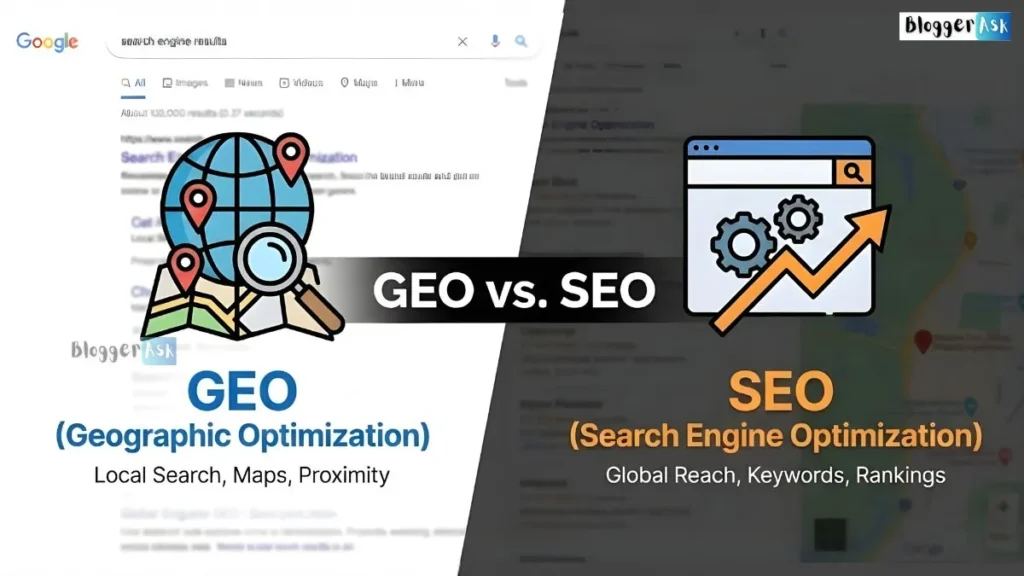
Here’s the simplest way to think about SEO vs AI search optimization: SEO optimizes for rankings; GEO optimizes for being selected, summarized, and cited in answers.
| Dimension | SEO | GEO |
| Primary outcome | Rank pages in SERPs. | Get content used/cited in generated answers. |
| Optimization focus | Keywords, pages, links, technical crawl/index. | Context, entities, credibility, quote-ability, source signals. |
| User behavior | Click to visit pages. | Often “answer-first,” fewer clicks needed. |
| Visibility metric | Rankings, impressions, CTR. | Presence/position/wording of citations and content inclusion in responses. |
For example, when searching “what is generative engine optimization,” Google’s AI Overview often summarizes the concept using multiple sources and displays them together. In this situation, a page doesn’t need to rank #1 to be visible—it only needs to provide a clear definition that the AI system can extract and cite.
In simple terms:
SEO optimizes for position.
GEO optimizes for participation.
If SEO helps you enter the room, GEO determines whether your voice is quoted inside the conversation.
1. Ranking Pages vs Generating Answers
SEO competes for a position in a ranked list; GEO competes for inclusion inside the response itself.
Traditional ranking metrics don’t fully explain visibility inside AI answers, because generative responses mix information from multiple sources instead of displaying a simple ranked list.
2. Keywords vs Context & Intent
Keywords still matter for discovery, but generative engines also evaluate meaning and context because LLMs process text semantically rather than purely by keyword matching.
Because of this, content clarity and supporting evidence often matter more than simply repeating keywords.
3. Click-Based Traffic vs Zero-Click Results
AI summaries can reduce the need to click, because the answer appears directly on the results page.
Several SEO studies and industry analyses published in 2024–2025 suggest that AI-generated summaries may reduce organic click-through rates for certain informational queries.
4. Content Consumption Patterns
Users increasingly consume information as a single “best answer” block rather than scanning a list of pages.
So content that’s well-structured, quote-ready, and easy to attribute can win in GEO even if it’s not the biggest brand.
How AI Overviews Change Click Behavior
AI Overviews are changing how users interact with search results. Instead of scanning multiple links, many users now read the summarized answer displayed at the top of the page.
This “answer-first” experience can significantly influence how traffic flows from search.
Answer-first search
AI summaries often present a complete explanation before users even scroll. When the answer appears instantly, many users feel less need to open additional pages.
Fewer clicks
Because the information is already summarized on the results page, some searches end without a click. This doesn’t always mean your content wasn’t useful—it may simply mean the user already received the answer.
Brand influence increases
Even when users don’t click immediately, seeing a brand cited in an AI summary can build familiarity and trust. Over time, this can increase branded searches and direct visits.
How SEO Works Today
1. Keyword Research and Search Intent
Start with intent buckets: informational (“how to…”), commercial (“best X”), transactional (“buy X”), navigational (“brand name”).
Then map each keyword cluster to one page with a clear primary query and supportive subtopics.
2. Content Optimization for Rankings
Practical on-page checklist:
- Put the core query in the title + H1 naturally.
- Use descriptive subheadings that cover sub-intents (helps both readers and engines).
- Add internal links to related pages to build topical depth.
3. Backlinks and Authority
Backlinks remain a powerful authority signal in classic SEO because they act like third-party validation.
For an “SEO strategy for AI search,” think of backlinks as still feeding discoverability and trust—even if the click happens less often.
4. Technical SEO Essentials
Ensure bots can access the page, the page loads well on mobile, and key templates aren’t blocking indexing.
If your content can’t be crawled and indexed, it can’t rank—and it’s less likely to be retrieved as a source for AI answers.
How GEO Works
1. How AI Models Select and Use Content
Generative engines retrieve sources, then generate a grounded response that references those sources with citations.
This means “content optimization for GEO” must focus on making passages easy to extract, summarize, and justify.
2. Entity-Based Understanding
Generative AI systems tend to understand topics through entities such as people, products, places, and concepts.
So define entities clearly (names, attributes, comparisons) and avoid vague pronouns when precision matters.
3. Trust, Authority, and Source Signals
The GEO research finds that adding citations, quotations, and statistics can materially improve visibility in generative engine responses.
That aligns with how generative answers try to ground claims and reduce hallucinations via attribution.
4. Content Formats Preferred by Generative Engines
Generative answers often assemble structured responses (bullets, steps, short explanations) and cite sources inline.
So formats like FAQs, definitions, step-by-step workflows, and “pros/cons” blocks are especially friendly for AI summarization.
What Content Gets Cited Most in AI Answers
Generative AI systems don’t cite content randomly. They tend to favor information that is easy to verify, summarize, and attribute to a source.
Definitions
Clear definitions are one of the most commonly cited elements in AI-generated responses. A short, precise explanation at the beginning of a section increases the chance of being quoted.
Statistics
Numbers and research-backed data strengthen credibility. When a claim includes measurable data, AI systems are more likely to reference it in summaries.
Comparisons
Content that compares options—such as “SEO vs GEO” or “Tool A vs Tool B”—helps generative engines present balanced explanations.
Step-by-step guides
Structured processes are easy for AI systems to summarize. Lists of steps, workflows, or checklists are frequently used in generated answers.
Content Strategy for SEO
1. Writing for Search Engines and Users
Write for humans first, but make it scannable: clear headings, short paragraphs, and direct answers near the top.
This supports classic SEO and makes your content easier for AI features (like Overviews) to pull from.
2. Content Structure and Optimization
Use a consistent structure:
- Quick definition/answer (2–3 lines).
- Main explanation with subheadings.
- Examples + FAQs.
3. Long-Form vs Short-Form Content
Long-form wins when users need depth and comparisons; short-form wins for narrow questions and quick wins.
A practical SEO vs generative AI search approach is to publish a strong pillar page and support it with short answers that target specific sub-questions.
4. Updating and Refreshing Content
Refresh content when:
- Rankings drop.
- The query intent shifts (new tools, new standards, new features).
- Competitors introduce better examples, visuals, or fresher data.
Content Strategy for GEO
1. Creating Answer-Focused Content
Lead with the exact answer, then expand with reasoning, constraints, and alternatives—because AI summaries prefer content that resolves the query cleanly.
This is one of the most practical AI search optimization tips: write “extractable” paragraphs that can stand alone without extra context.
2. Structured, Clear, and Context-Rich Writing
To improve “AI-quote-ability,” add:
- Definitions (“X is…”).
- Conditions (“If…then…”).
- Comparisons (“X vs Y”).
3. Demonstrating Expertise and Credibility
Add verifiable details: stats, references, and quotes from credible sources where relevant, because these tactics were shown to boost visibility in GEO research experiments.
Also add author credentials, editorial policy, and “last updated” timestamps to strengthen trust signals.
4. Optimizing for AI Summaries
Treat each section like it might be summarized:
- Start with a one-sentence takeaway.
- Follow with 3–5 bullet points.
- Include a concrete example or decision rule.
Common GEO Optimization Mistakes
As generative search grows, many websites try to optimize for AI visibility but make structural mistakes that reduce their chances of being cited.
Writing vague paragraphs
Generative engines prefer clear and direct explanations. Long paragraphs filled with general opinions are harder for AI systems to extract and summarize.
No statistics or citations
AI-generated answers often rely on verifiable information. Content that includes statistics, studies, or referenced data tends to be cited more frequently.
Poor content structure
Unstructured text blocks make it difficult for generative models to identify key points. Headings, bullet points, and clear sections improve extractability.
Missing definitions
Many AI answers start with a simple definition. If a page doesn’t clearly define the topic early, the system may select another source that does.
Technical Considerations for GEO and SEO
1. Structured Data and Schema Markup
Schema helps machines understand page meaning (entities, FAQs, products), which supports classic search features and can aid retrieval in generative systems.
Prioritize FAQ, HowTo (when eligible), Article, Organization, and Person where appropriate.
2. Page Experience and Accessibility
Fast, readable, accessible pages reduce friction for users and support search performance.
Clean HTML structure (proper headings, lists, tables) also makes extraction easier for AI systems.
3. Indexing and Crawlability
Make sure important pages aren’t blocked by robots.txt, noindex tags, or poor internal linking, or they may never be discovered.
If a generative engine pulls from web retrieval, non-indexed content is less likely to be sourced.
4. Content Freshness and Accuracy
AI Overviews can show summaries prominently, so outdated or sloppy content can get skipped—or worse, misrepresented.
Add update notes and correct factual claims quickly to protect trust.
Measuring Success
1. SEO Metrics (Traffic, Rankings, CTR)
Track:
- Organic sessions and conversions.
- Keyword rankings and landing page growth.
- CTR changes when SERP features appear.
2. GEO Visibility Indicators
Track:
- Whether your domain is cited in AI Overviews / AI answer experiences for target queries.
- Growth in branded searches after AI exposure (proxy for “influence”).
3. Brand Mentions and Citations
Mentions across authoritative third-party sites matter more because generative engines synthesize multiple sources and often rely on credibility cues.
One practical way to improve GEO visibility is through digital PR: earn mentions where AI systems already trust the domain.
4. Attribution Challenges in AI Search
Attribution can be messy because users may get what they need from the summary without clicking, making performance look worse than the real influence. In analytics, this often shows up as stable impressions but declining CTR—even when rankings stay the same. That pattern increasingly signals AI summary impact rather than SEO failure.
TechTarget explicitly notes reduced website traffic as a potential downside of AI Overviews.
Use Cases – When to Focus on GEO vs SEO
1. Blogs and Content Publishers
SEO remains essential for stable traffic, but GEO becomes critical for keeping visibility when AI answers satisfy informational queries directly.
Publishers should create “citation-friendly” explainers with clear sections that AI can quote.
2. E-Commerce Websites
SEO still drives category/product page rankings, while GEO opportunities show up in “best X” and comparison-style queries that AI summarizes.
Add clear product attributes, comparisons, and policies so AI can extract specifics accurately.
3. SaaS and B2B Businesses
For SaaS, SEO captures demand; GEO influences shortlists when AI tools recommend “top solutions” and summarize pros/cons.
Invest in earned media, customer proof, and precise use-case pages to improve AI-perceived authority.
4. Local and Service-Based Businesses
Local SEO (maps, reviews, NAP consistency) is still foundational, but GEO can influence “best near me” conversations when AI summarizes options.
Create service pages with transparent pricing ranges, coverage areas, and FAQs to improve summarization quality.
The Dual Visibility Model
Modern search visibility works across three layers:
- Discoverability (SEO)
Can your content be crawled, indexed, and ranked? - Extractability (GEO)
Can your content be easily summarized and cited? - Credibility (Authority Signals)
Do external mentions and references validate your claims?
Weakness in any one layer reduces overall visibility.
Strength in all three creates compounding impact.
Combining GEO and SEO
1. Why You Need Both
SEO earns discoverability; GEO earns inclusion in synthesized answers—together they protect reach as search interfaces evolve.
Google’s AI Overviews are designed to provide summaries alongside links, so ranking and being cited can reinforce each other.
2. Building a Unified Search Strategy
A unified plan:
- Build topic clusters (SEO foundation).
- Add answer blocks + definitions + comparison tables (GEO-ready).
- Strengthen authority via citations, data, and credible mentions (both).
3. Content Repurposing for Dual Optimization
Turn one pillar into:
- A “definition + FAQ” page (GEO).
- Supporting blog posts targeting long-tail queries (SEO).
- A short checklist or steps section that can be quoted (GEO).
4. Future-Proofing Your Digital Presence
Focus less on tricks and more on clarity + evidence + structure, because GEO research shows readability, citations, and statistics can improve generative visibility more than keyword stuffing.
This also aligns with sustainable SEO, where helpful, well-structured content keeps performing through updates.
The Future of Search
1. AI-Driven Search Trends
Expect more blended SERPs: AI summaries at the top, deeper links below, and more interactive elements in the answer block.
Google’s rollout of AI Overviews shows this direction: summaries plus links intended to accelerate discovery.
2. How User Behavior Is Changing
Users ask longer, more specific questions when they expect a synthesized response rather than a list of pages.
That increases the value of context-rich pages that address constraints (“budget,” “location,” “best for…”) clearly.
3. Preparing for Search Beyond Blue Links
Plan content that can be:
- Ranked (classic SEO).
- Extracted and cited (GEO).
- Trusted (evidence, sources, consistent facts).
Conclusion
SEO and GEO are not rivals — they are layers of the same visibility strategy.
SEO helps your content get discovered.
GEO helps your content get selected.
As AI-driven experiences like Google AI Overviews expand, visibility is no longer defined only by rankings. It’s increasingly defined by inclusion — whether your insights are trusted enough to be quoted inside the answer itself.
The creators most likely to succeed in this new search environment are those who:
- Structure content clearly
- Provide direct, extractable answers
- Support claims with credible evidence
- Build authority beyond their own website
Ranking earns exposure.
Citation earns authority.
In traditional search, visibility meant being seen.
In AI search, visibility means being trusted enough to be included.
That difference will define the next phase of digital strategy.
FAQs
What is the difference between GEO and SEO?
SEO focuses on ranking pages in search results to drive clicks; GEO optimizes content to be selected, summarized, and cited directly in AI-generated answers.
Traditional SEO targets “blue links,” while GEO targets inclusion inside the response itself, often reducing the need for users to leave the search page.
What is GEO (Generative Engine Optimization)?
Generative Engine Optimization (GEO) improves how often your content appears in AI search responses from tools like Google AI Overviews or ChatGPT Search.
It emerged from research showing simple tactics—like adding statistics or quotes—can boost visibility in generative outputs by 30-40%.
Is GEO replacing SEO?
No, GEO complements SEO—AI search blends summaries with links, so ranking high still feeds into being a trusted source for answers.
Google’s hybrid model proves both are needed: top ranks increase retrieval chances for AI synthesis.
Why is GEO important now?
AI Overviews and zero-click experiences are expanding rapidly across informational queries, increasing the likelihood that users receive answers directly on the results page.
As users get instant summaries before clicking, creators risk losing visibility unless their content is structured clearly enough to be selected and cited within those AI-generated responses.
How does SEO still matter in AI search?
SEO ensures discoverability—generative engines still retrieve from ranked, indexed pages before generating responses.
Strong topical authority from backlinks and E-E-A-T signals makes your content more likely to be pulled as a source.
How do I optimize content for GEO?
Lead with clear, direct answers and definitions.
Add statistics, quotes, and citations for credibility (proven to lift visibility).
Use structured formats like bullets, FAQs, and tables that AI can easily extract.
Do keywords matter in GEO like SEO?
Keywords aid initial retrieval but play second fiddle to semantic context, entities, and user intent in generative systems.
Generative AI prioritizes meaning over exact matches, so focus on comprehensive coverage of a topic.
Can the same content be optimized for both GEO and SEO?
Absolutely—structure pages with keyword-optimized headings (SEO) plus quote-friendly sections like pros/cons or steps (GEO).
One pillar page can rank in SERPs and get cited in AI summaries by blending both approaches.
How do you measure GEO success?
Check citations in AI Overviews for target queries.
Track branded search lift and impression share in generative results.
Monitor “not provided” traffic drops against brand mentions growth.
What is the future of SEO with AI search?
SEO evolves into “Search Everywhere Optimization”: rank + get cited + earn direct traffic via AI referrals.
As voice search and multimodal AI tools continue evolving, clarity, structure, and credible sources will likely become even more important for visibility.
Disclaimer
Note: Search behavior and AI features continue to evolve, and results may vary depending on search engine updates.